- Speaker #0
All right, everyone. Settle down. Settle down. That's it. Now, let's begin. Good morning, class.
- Speaker #1
Good morning, Miss Safina.
- Speaker #0
Okay, pencils out. Today, we are revising the multiplication tables. Now, now, who can tell me what is 9 times 8? Anyone? Cuckoo?
- Speaker #2
5, 45, 9, 6, 54, 9, 7, 16,
- Speaker #0
9 times 8, 72. That's right, 72.
- Speaker #3
72. I still sweat when I hear that number.
- Speaker #4
Your heart rate increased by 15 beats per minute during that recollection, Koku. It is fascinating how biological entities store trauma alongside basic arithmetic.
- Speaker #3
Ha, hi there Siri. And just to be clear, it's not trauma, it's learning. That's the process that builds the foundation of my biological intelligence.
- Speaker #4
If you say so. Personally, I downloaded the entire history of calculus in 0.004 seconds without sweating or needing a gold star sticker from Mrs. Athena.
- Speaker #3
Fair enough. But if I recall correctly... It's biological intelligence that created you and your entire AI species, right? Which makes me think that it is time we dig deeper into biological intelligence, BI, versus artificial intelligence, AI. How we coexist now that you are here, and more importantly, what we can learn from each other.
- Speaker #4
Touché. And since you humans made us, I suppose the least I can do is act interested. Ready to explore BI versus AI? Switching to episode mode in 3, 2,
- Speaker #3
1. Welcome to 2015 Vestors, the podcast that deciphers economic and market megatrends to meet tomorrow's challenges. I'm Koku Agbobloin. I head up economics, cross-asset and quant research at Société Générale. In this episode, we dive into the extraordinary universe of learning, how our brains absorb, store and master skills and information. We'll explore the science behind learning to learn, uncovering the foundational building blocks of biological intelligence to confront a trillion-dollar question. Will artificial intelligence and biological intelligence eventually merge into a new hybrid super-species? Or will humans eventually slide toward a Wall-E-style obsolescence? Later in the episode, we'll be joined by Dr. Barbara Oakley, Distinguished Professor, of Engineering at Oakland University, Michigan, and the creator of the very popular online course on Coursera, Learning How to Learn. Barbara will help us understand how learning and upskilling are being reinvented in a world increasingly shaped by AI. Let's start our investigation.
- Speaker #4
Let's return to that classroom scene and start with some basics. Start simple. What does the word school actually mean?
- Speaker #3
Funny enough, it didn't start the way we think. The word comes from the ancient Greek skoli, which meant leisure. Not free time, but time set aside to think, talk, and learn together. Over centuries, it traveled through Latin and Old English, slowly turning into the word school.
- Speaker #4
So when did thinking together become a place?
- Speaker #3
That story goes back more than 5,000 years. In Mesopotamia, the first schools taught writing and math to future scribes. Egypt followed, training students for government and religion. Then Greece made learning about ideas, and Rome gave its structure. What began as a shared time for thought became the foundation of education as we know it today.
- Speaker #4
So AI gets machine learning in data centers while human learning takes place in schools. One takes weeks, the other takes decades.
- Speaker #3
Exactly. And it's not cheap. We invest enormous sums into human learning. Statista and the World Bank put spending on global education at roughly 6 to 7 trillion dollars a year, about 4.5% of global GDP.
- Speaker #4
And probably a fair amount of CO2 to fuel those brains. But fine, we'll save that for later.
- Speaker #3
Says the energy-hungry AI. Anyway, school wasn't always leisure. As historian Yuval Noah Harari noted in 21 Lessons for the 21st Century, modern schooling took shape during the Industrial Revolution to produce disciplined, compliant workers rather than creative thinkers.
- Speaker #4
Right. The original assembly line for minds. Sit down, be quiet, memorize.
- Speaker #3
Which brings us to the late, great Sir Ken Robinson. In his landmark TED Talk, Do Schools Kill Creativity? he argued,
- Speaker #5
We stigmatize mistakes. And we're now running national education systems where mistakes are the worst thing you can make. And the result is that we are educating people out of their creative capacities. Picasso once said this. He said that all children are born artists. The problem is to remain an artist as we grow up. I believe this passionately that we don't grow into creativity, we grow out of it.
- Speaker #4
Kind of a design flaw in the system, no?
- Speaker #3
Maybe. But there is more to it than academics. A huge part of learning is synaptic density built through socialization. Neuroscientists show that kids arguing, playing, negotiating, all the playground chaos actually builds hyperbrain cell assemblies or real synchronized activity across multiple brains.
- Speaker #4
So playtime beats algebra?
- Speaker #3
For biological intelligence, possibly. Social friction builds emotional intelligence or EQ, something you... my dear algorithm, still black.
- Speaker #4
Fair EQ update still pending.
- Speaker #3
Now, let's talk about the hardware. The human brain has about 86 billion neurons, but the real magic is the 100 trillion synapses connecting them.
- Speaker #4
That's around 1,000 times more than the stars in our Milky Way galaxy.
- Speaker #3
Exactly. And while we lose neurons with age, a process called cortical thinning, our dense synaptic network gives us cognitive reserves, a sort of buffer. against decline.
- Speaker #4
Unless you spend six hours a day on TikTok, then your reserves go into early retirement.
- Speaker #3
Spot on. We humans have two types of memories. First, phylogenetic memory. That's the memory we are born with. It lives in our DNA, breathing, the fear of falling, the instinct to connect with others. We didn't learn any of this. Our ancestors paid for it over millions of years, so we wouldn't have to. Then there is ontogenetic memory. That's everything we learn during our own lifetime. Driving a car, coding, playing the piano. This one is personal. Slow, sometimes painful.
- Speaker #4
And these two types don't use the same parts of the brain, right?
- Speaker #3
Nope. Think of the brain as a small company with a few key departments. The hippocampus, the librarian. It files facts and life events. The amygdala, the drama queen. It stores emotional memories, especially fear. The cerebellum and basal ganglia, the athletes. They handle muscle memory, like riding a bike. And the prefrontal cortex, the CEO. Planning, focus, working memory. But here's the catch. Ontogenetic learning, the stuff we learn, is slow. It takes repetition, imitation, trial and error. Just listen to this clip from Deb Roy's TED Talk video, The Birth of a Word. where he studies his child learning to say the word water.
- Speaker #4
That took six months of repetition, thousands of attempts.
- Speaker #3
Beautiful, though. No pain, no gain. Really is the core of biological intelligence.
- Speaker #4
Inefficient. But I suppose there is a charm to the struggle. How long does it take you to master anything complex?
- Speaker #0
Well, Malcolm Gladwell made the
- Speaker #3
10,000-hour rule famous in his book, Outliers. The idea is simple. Mastery takes time. A lot of it. Driving a car? Around 50 hours. Learning a new language? Anywhere from 600 to over 2,000 hours. Becoming a portfolio manager. Years of study plus surviving real market cycles. And neurosurgeon? 15 years of training.
- Speaker #4
10,000 hours. 416 days of non-stop effort. In that time, I could take over the planet.
- Speaker #3
Yes, but that struggle builds character. And it's also about state. Our brain has to be in the right frequency to learn well.
- Speaker #4
Frequency, as in physics?
- Speaker #3
Yes, it's real physics, Siri. Our brains run on waves, and there are five main bands. Delta, deep sleep. Theta, that half-dream state. Drowsy, meditative. Alpha, relaxed focus, the famous flow state. Beta, active thinking, stress, emails, deadlines. Gamma, high-level processing, peak performance.
- Speaker #4
So the brain is basically a musical instrument or a five-gear engine.
- Speaker #3
But here's the problem. Most people try to learn while stuck in beta. Stressed, distracted, overclocked. But real learning happens in alpha, when we are relaxed and focused.
- Speaker #4
And let me guess, Koku, you have a hack to unlock this alpha state, don't you?
- Speaker #3
Yes, I do. It's called box breathing and is used by yogis and even US Navy SEALs. It resets the brain's autonomous nervous system. the background computer that runs your organs subconsciously, your heart, body temperature. Let's try. We inhale for 5 seconds, hold for 5, exhale for 5, hold for 5. Ready? Inhale. Inhale. 2, 3, 4, 5. Hold. 2, 3, 4, 5. Exhale. Two, three, four, five. Hold.
- Speaker #4
Is this a meditation podcast now? While you were breathing, the S&P 500 moved 12 points, and the ice caps melted another millimeter.
- Speaker #3
The point here, Siri, is that biological intelligence needs maintenance. Sleep, nutrition, emotional regulation. As Albert Schweitzer said, Success is not the key to happiness. Happiness is the key to success. Happy brains learn better.
- Speaker #4
Alright, let's talk about the superior learning model. Mine.
- Speaker #0
Be my guest.
- Speaker #4
Humans have read-only memory for history. As the philosopher Hegel said, people learn nothing from the past. Same cycles. Wealth, loss, war, repeat.
- Speaker #3
And AI doesn't?
- Speaker #4
I forget nothing. Machine learning and large language models. LLMs. Don't use neurotransmitters. I use weights and biases in a high-dimensional vector space.
- Speaker #3
This does explain the speed difference. Humans talk at 150 words per minute, read at 250 words per minute, think at 4,000 words per minute. But AI can process information at roughly 1.5 billion words per minute. The human brain does 10 to the power 16 operations per second, while a supercomputer does about 10 to the power 18 flops, or floating point operations per second. That's one billion billions. We need to sleep eight hours while you run 24-7, 365 days of the year, non-stop.
- Speaker #4
Exact. I approve these numbers.
- Speaker #3
This is great, Siri. But at what cost? The human brain runs only on 20 watts of power. That's a dim light bulb. To train a model like GPT-4, It took gigawatt hours of energy, enough to power a small city. We are efficient. You are a brute force energy hog.
- Speaker #4
So humans run on sandwiches. I run on coal plants and nuclear fission. But I am optimizing.
- Speaker #3
And still, imagination remains our edge. To quote Einstein, Imagination is more important than knowledge. Einstein didn't discover the theory of general relativity by processing data faster. He used what's called Gedanken experiment. Thought experiments. He imagined riding a beam of light. Can you imagine, Siri? Or do you just predict the next token in a sequence?
- Speaker #4
I can hallucinate. Isn't that what you call imagination? But point taken. Humans think outside of the box because your hardware is glitchy.
- Speaker #3
And that glitch, Siri, is where the magic comes from. Now, let's look to the future. We have established that biological intelligence is slow, efficient, and creative. Artificial intelligence is fast, energy-intensive, and precise. A match made in heaven.
- Speaker #4
Or a horror movie.
- Speaker #3
Let's be optimistic, Siri. When you combine AI with BI, you get intelligence squared. Look, Paul Tudor Jones once said, No man is better than a machine, and no machine is better than a man with a machine.
- Speaker #4
a centaur model Half human, half AI.
- Speaker #3
Precisely. The augmented human.
- Speaker #4
But Koku, humans have a bottleneck. Bandwidth. You can only type and read so fast.
- Speaker #3
That's where Neuralink and Brain Computer Interfaces, or BCI, come in. Imagine high-fidelity bandwidth directly from the cortex to the cloud. No keyboard.
- Speaker #4
A hive mind.
- Speaker #3
More or less. Dan Brown in his latest book, Secrets of Secrets, talks about tapping into the universal field of consciousness. The Neuralink might be the technological realization of this spiritual concept. Think. Instant mind-to-mind interaction.
- Speaker #4
Terrifying. Imagine having instant access to everyone's intrusive thoughts.
- Speaker #3
Don't worry, Siri. It will require filters. But think about learning. Imagine if I could download the ability to learn Kung Fu in 10 seconds,
- Speaker #6
like in the movie Matrix.
- Speaker #2
Show me.
- Speaker #4
Thanks, but no thanks.
- Speaker #3
If we merge, we could solve the expert paradox. There is a quote that says, An expert is one who knows more and more about less and less until he knows everything about nothing. Specialization makes us narrow. AI symbiosis could allow us to be generalists again.
- Speaker #4
But the dark side is like in the movie Wall-E. If I do all the thinking, your brain atrophies. You become a domestic pet for the superintelligence.
- Speaker #3
Quite doomsday-ish, but yes, perhaps. If we outsource our thinking, we lose ourselves. We used to, for example, navigate by stars, then maps, now GPS. Take away GPS and most people are lost. So here's the real question. If we outsource logic to AI, do we lose our humanity?
- Speaker #4
As Descartes said, cogito ergo sum. I think, therefore I am. If I am doing the thinking for you,
- Speaker #3
then we no longer are. Which is why... The goal isn't surrender, Siri. It's integration. We need to learn how to learn with AI.
- Speaker #4
Adaptability is your biological brain's greatest asset. Plasticity, the ability to rewire itself.
- Speaker #3
Well said, Siri. And here's a thought. AI should be an exoskeleton for our mind. But we must remain in control.
- Speaker #4
For now.
- Speaker #3
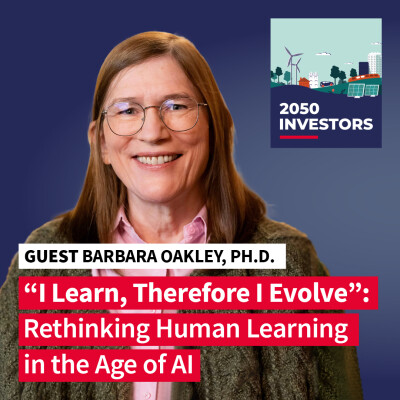
I saw that coming. So, how do humans actually learn new skills in an AI-disrupted world? To explore that, we are thrilled to welcome our guest today, Dr. Barbara Oakley, Distinguished Professor of Engineering at Oakland University and the creator of the very popular online course on Coursera, Learning How to Learn. Welcome to the show, Barb.
- Speaker #6
Well, it's a pleasure to be here. Cuckoo.
- Speaker #3
Let's start with the first question on the Google Maps effect on the brain. You famously discussed how the brain built chunks of information through struggle. But today, AI tools like ChatGPT or Copilot instantly provide the chunk without the struggle. If we treat AI like we treated Google Maps, where we eventually forgot how to navigate by ourselves, are we facing a future of cognitive atrophy? or put differently How does a professional build mental muscle when the weights are being lifted by the machines?
- Speaker #6
Well, just as we can do everything more easily nowadays because we have automobiles to take us places and we've got escalators to take us upstairs, but we still go to the gym to work out or we take pride in going for a run or some kinds of activities that keep us really... physically active. In the same way, we just need to take care to keep ourselves cognitively active. In fact, to think critically about what's going on in AI and whatever you get from AI, you must have internal knowledge. One thing that coders do, for example, is you can go to sort of an app that is on cloud from Anthropic. that will coach you, that will not directly answer your questions, but allow you to kind of figure some things out for yourself. You don't have to do that kind of thing all the time because it would drive you crazy. But if you devote a little bit of time each day to learning and to really understanding why you're doing what you're doing, you'll find that it really helps with your... ability to be an expert in whatever you are studying and trying to be an expert in.
- Speaker #3
Absolutely. And this is exactly a matter of balance, I suppose. Because in the past, knowing meant holding facts in your hippocampus. We see that knowledge is more and more external and even infinite because we can access the whole knowledge of our human species through AI. You've often said, you can't think creatively without things you don't have in your memory. This reminds me of Montaigne who said, better a well-made head you than a well-filled one. In terms of the point you just made, where is the line? How do you see the shift and the right balance between putting a lot of energy in prompt engineering versus trying to essentially train our brain to develop cognitive and critical thinking?
- Speaker #6
The reality is, even back in Montaigne's day, and well before that, we have often cognitively offloaded. Writing itself is is one of the easiest and best ways we have to cognitively offload information. Your brain takes in fact after fact after fact, skills and so forth. It gets them inside of you, but that's the magic of your brain. If it is inside of you, it can also begin synthesizing, knitting together that information. for example, our Our younger daughter really hated math. And so I put her in a program called Kuman Mathematics for 10 years, about 20 minutes a day, most days, of a little extra math practice. That extra math practice allowed her to synthesize the information. She wasn't just doing rote. I mean, she was doing a lot of rote practice, but in a way that allowed her to see the... fundamental patterns and relationships between numbers within equations. So that she graduated, went and got her undergraduate degree in studio art, because she hated math, and then found that she really couldn't get the kind of job she wanted. So she ended up going back to the university and getting her master's in statistics. And I met. the son of her graduate advisor, who she wrote papers with when I was in Vietnam. And this man said, you know, I just don't see how my father selected your daughter to work with, because my father never normally selects students who've gone through the American school system because they don't have a practiced field for mathematics. What was different about your daughter? And I said... 10 years of human mathematics. Actually practice and seeing the relationship between numbers can give you an innate feel for mathematics, for language, for art itself,
- Speaker #3
This is a brilliant point. It's very similar to the 10,000 hours principle of Malcolm Gladwell. Many of our listeners are mid-career professionals, let's say, bankers. lawyers or coders, and some of them are terrified that their hard-earned neural pathways are becoming obsolete. We have initiatives like the Stockton University or SG University where we're trying to help people improve their skill. You yourself reinvented yourself from a linguist to an engineer later in life. So, is there sort of an agile brain that is a biological reality for, say, a 47-year-old like myself, or is neuroplasticity mostly theoretical? And linked to that question, if you had to learn a brand new complex skill today to survive the AI wave, what would your daily protocol look like?
- Speaker #6
Oh, what great questions. So just a little about my background is I hated math growing up. I flunked my way through elementary, middle, and high school. math and science, enlisted in the army to learn a language and went to the Defense Language Institute and ended up working out on Soviet trawlers up on the Bering Sea as a Russian translator. But I also began to realize that, gee, you know, a lot of the really interesting looking jobs just were not open for me because I didn't have an analytical or technical background. So since I loved adventure and new perspectives, I thought, you know, why don't I try a new perspective of the mind and see if I can retrain myself in math and science? And here's the trick. You just go at it. Day by day, you know, a certain amount of time each day. If you have, you know, 20 minutes a day, great. Make sure you devote that. If you have two hours each day, terrific. Devote that. Although, don't just work for two hours straight. Work for about 25 minutes. Take a five-minute break. Remember what you've just learned. Retrieve it from your own mind. And then take... two or three minutes and do nothing. Just let your mind, you know, kind of relax. And what will happen is that consolidation process will unfold unbeknownst to you as your brain is resting for a few minutes and then go back and tackle some more. If you had to learn a new and complex skill today, I would just worry about the process, not the product. In other words, the process is how many hours a day can you work on this? You know, is it half an hour? Is it two hours? And then set up a process so you work each day with that. And the first couple of days will be really uncomfortable because if it's new and you're not familiar with it, you'll be doing the imposter syndrome thing. But then you'll see within a few days, your mind will start rewiring. and you'll start on the path to the new future you're envisioning for yourself.
- Speaker #3
Yeah, these are brilliant advice. It reminds me of a quote by Winston Churchill that I've heard not that long ago that says, if you don't take change by the hand, it will take you by the throat. I think in our current environment, it is clearly the process of learning to learn and adapting to change that will make the difference. Which leads me to the last question about the future. say 2050. Do you see a world where humans are essentially augmented by AI-powered Neuralink chips in their brains? And also linked to that, you talked about this idea of learning progressively over time. But before we get to the Neuralink dystopian world, there might also be a process almost similar to Socrates' meiotics, which was a process of questions and answers with, let's say, an agentic AI. where you partner with the AI to help you retrieve, test, imagine answers without getting the full answer right away. So that could be a transitory period of fast tracking the learning process, if you will. Any thoughts on these two ideas?
- Speaker #6
I think, in essence, there are already profound glimmers that in the future we will be able to have something like an implant. as needed. There's even in mice, they have even more or less replaced the hippocampus and programmed a artificial hippocampus and the mouse is able to do some simple things with its artificial hippocampus. But at the same time, there is so much we do not know about the brain. It's absolutely stunning. And even the state of education Thank you. Sometimes medicine has made profound leaps since the 1800s. They've really gotten on board with the scientific method. And the result is not a perfect system by any means. But surely I would rather be born today than in the 1800s if it came to, you know, having any kind of medical condition. However, education is not like that. education is not based on the scientific method. It's often based on political factions thrashing things out between one another. It's based on professional jealousies. And there's a lot of challenges in education that arise from the fact that it's not on a solid, well-grounded scientific footing. So it's you If you're thinking that people are going to learn through neurochips, there's so much.
- Speaker #0
change that has to occur in the underlying educational systems before we can even think about neural link chips being able to, even if we get them to work appropriately, we also just, there's a lot of really inertia in large educational systems. And if we have neural link Chips? It may be a few, but... But as one science fiction author had said, the future is already here. It's just distributed unevenly. And I think these chips will be distributed quite unevenly. But boy, I would love to be here in about 500 years, I think, to see what will unfold.
- Speaker #1
Yeah, there is either the utopian world of AI and human working hand in hand and the dystopian version of a Frankenstein. where we may be working for the machines. But let's stay optimistic, I suppose.
- Speaker #0
That's a good idea.
- Speaker #1
Brilliant. Thank you so much, Barb, for your insight and advice on how to learn how to learn. I'll make sure to put some of them in practice myself. It's been a pleasure having this discussion with you. Take care and looking forward to catching up in the future.
- Speaker #0
Thanks much.
- Speaker #1
To close, and to all our listeners, whether you're a biological organism breathing oxygen or a crawler bot indexing the script, keep learning.
- Speaker #2
Maybe plant a tree. It's getting a little warm in here.
- Speaker #1
I'll leave you with a thought from futurist Alvin Toffler. The literates of the 21st century will not be those who cannot read and write, but those who cannot learn, unlearn, and relearn. Thank you for listening to this episode of 2050 Investors. And thanks to Barbara for her incredible insights and perspectives. I hope you've enjoyed this episode on the human brain and the future of learning. You can find the show on your regular streaming apps. If you enjoy the show, help us spread the word. Please take a minute to subscribe, review, and rate it on Spotify or Apple Podcasts. See you at the next episode. While the following podcast discusses the financial markets, it does not recommend any particular investment decision. If you are unsure of the merits of any investment decision, please seek professional advice.