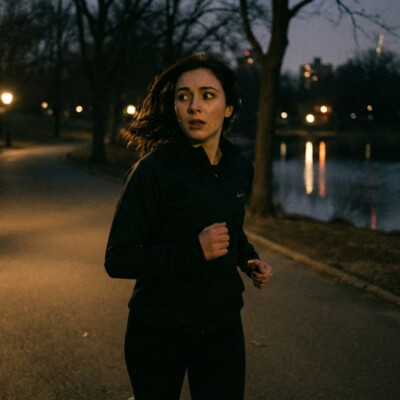
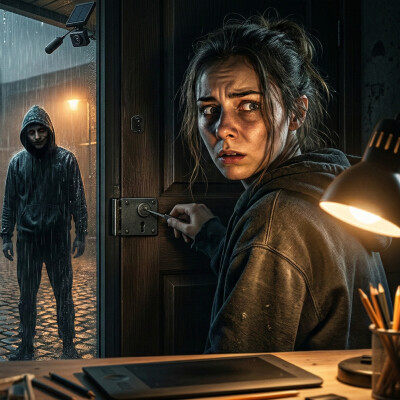
Speaker #0There is a specific kind of silence found only in urban parks after 11pm. It's an artificial stillness, a small bubble of nature surrounded by the distant hum of the city. For me, it was my escape, and back then I had the somewhat foolish habit of running at night. I worked in a kitchen, finishing my shifts high on tension, my ears ringing with the clatter of orders and dishwashers. I needed that nocturnal chill to come back down to earth. The Central Park was my playground. It's vast, beautiful, and at night it becomes a labyrinth of paths bathed in semi-darkness. That night, there was a light fog, a mist clinging to the ground that made the halos of the street lamps look blurry, almost dreamlike. I had my earbuds in, but I never turned the music up loud. An old runner's habit. You always need to hear the ground beneath your feet and what's happening around you. I was in the zone, that moment where you no longer feel fatigue, where you feel like you could run until dawn. It was at the third kilometre, near the large lawn bordering the lake, that I noticed the first anomaly. At the corner of a grove, there's a small outdoor fitness area. As I passed it, I saw a silhouette. A man, standing still next to a pull-up bar. He wasn't exercising. He was just standing there. arms hanging by his sides facing the lake. What struck me was his outfit. He wasn't wearing athletic gear. It was dark loose trousers and a city jacket that looked too big for him. I thought to myself, just another poor guy sleeping off a beer or waiting for a date that's never coming. I kept going without slowing down, giving him nothing more than a sideways glance, but as I passed him, he turned his head. Not with a jerk, but with the slow deliberation of a predator tracking prey. His eyes locked onto mine for a fraction of a second under the harsh light of a street lamp. He had no expression. It was a blank face, like wax beneath a hood. I covered another two hundred metres when I heard a new sound. Until then, the only rhythm I heard was my own. Suddenly an echo appeared. A second set of footsteps. Slightly heavier. Slightly more irregular. I didn't look back immediately. I told myself it was another jogger. It's a big park, after all. I moved to the right side of the path to let him pass. But the echo moved too. The footsteps stayed exactly the same distance behind me. About twenty metres. I picked up the pace. Not much, just enough to go from ten to twelve kilometres per hour. Normally, a runner wanting to overtake would have maintained their speed, or accelerated more. But here, the echo followed. The footsteps behind me sped up in perfect synchronisation with mine. That's when I felt that prickle on the back of my neck. I snapped my music off. The silence of the park hit me in the face. Broken only by our two breaths. Mine, controlled and athletic, and his, a raspy, forced breathing, as if every inhalation cost him an immense effort. I decided to test the situation. I abruptly slowed to a fast walk. The man behind me did the same instantly. I sprinted like mad for ten metres. then stopped dead, spinning around. The path behind me was deserted. The mist drifted between the trees. There was no one. Just the buzzing of the street lamps. My heart hammered against my ribs. I stood still, hands on my hips, scanning the darkness between the massive trunks of the plane trees, but nothing moved. I started running again, but this time I headed for the nearest exit, the one leading to the boulevard. I was no longer trying to finish my loop, I just wanted the sound of cars and the light of shop signs. The path I was on made a wide curve around a cluster of rhododendrons. To reach the exit, I had to either follow that curve or cut through a small, unlit, narrow alley. I chose the alley. I wanted to save time. I had hardly entered the darkness of the alley when I heard the sound of snapping branches to my left. Someone wasn't running on the path anymore. Someone was cutting through the brush. The man was no longer trying to hide. He was running at full speed through the dead leaves, a chaotic, wild gait. I threw a look over my shoulder and I saw him. He wasn't twenty metres away anymore. He was ten metres away, emerging from the shadow of a tree. He ran with his body leaning forward, arms flailing erratically, as if he were fighting his own balance. And he wasn't wearing his jacket anymore. He was in a white shirt, a shirt that glowed strangely under the moon. I went into a full sprint, the real kind, the one you save for the last hundred metres of a race. My lungs burned, my legs begged me to stop. I could see the park gates at the end of the alley. They were close, too close for him to catch me. But as I approached the exit, I realised with absolute horror that he wasn't trying to catch me from behind. By cutting through the grove, he had gotten ahead of me. He stepped out of the black right in the middle of the exit, barring my way. I skidded to a halt three metres from him, nearly slipping on the gravel. He was there, blocking the path to freedom. Up close, he was even more terrifying. His white shirt wasn't white. It was covered in dark, damp stains, and in his right hand, he wasn't holding a gun. He held something small and silver, an old-fashioned straight razor. He stared at me with insane intensity. His eyes seemed too large for his face. You run well, he whispered. His voice was wheezing, as if his vocal cords had been crushed. But you make too much noise when you breathe. I don't like noise. I didn't think. I didn't try to negotiate. Behind me, the park was a trap. In front of me, he was the obstacle. I grabbed a large stone bordering the path. I didn't scream. I charged. When you have no choice left, fear turns into a kind of cold fury. I fented to the right and threw the stone with all my might at his face. He raised his hands to protect himself, and I took the opportunity to ram him with all my weight, shoulder first, right in the solar plexus. We tumbled to the ground. I felt the cold steel of the razor graze my cheek, a clean cut that began to burn instantly. But adrenaline is a powerful anaesthetic. I struck, again and again, with my knees, my elbows, anything that could hurt. The man let out a strangled cry, and I managed to break free. I didn't look back to see if he was getting up. I vaulted through the gate, crossed the boulevard without looking for cars, and didn't stop until I reached a local police station a kilometre away. The police returned to the scene 20 minutes later. They found no one. The man had vanished into the park's mist. They took my statement and treated the gash on my cheek. They seemed sceptical, perhaps thinking it was a fight between homeless people that had escalated, until they analysed the surveillance footage from the park entrance. The officer called me a few days later. His voice was different. We viewed the footage, he said. We clearly see your panicked exit. But that's not what's bothering us. What then? I asked. We spotted the man on the cameras. He had been following you since you entered the park, perfectly matching your stride. And there's something else, the officer added. In his other hand, the one you couldn't see, he was holding a camera. We found the memory card he must have dropped during your struggle. There are hundreds of photos of you, not just from that night, but from every one of your night runs for the last three months, since that day. I don't run anymore, and when I walk through the city, even in broad daylight, I can't help but count my steps. One, two, three, four, and I listen with a dull terror, to see if a second set of footsteps hasn't, by chance, synced up with mine. Thank you for listening, and for staying until the very end. If you enjoyed this nightmare, subscribe now to support the channel. And remember, you're never truly alone in the dark.