- Speaker #0
Every journey, every trip generates a multitude of informational flows. With data becoming increasingly abundant, it has become a real asset for businesses and regions. It is no longer just a question of producing data, but of organising its reuse at a time when 80% of industrial data is not shared. Unaix is a trusted ecosystem where these leaders can collaborate while respecting European sovereignty and the principles of governance. Convinced that together we will be more flexible and resilient, we orchestrate these exchanges with respect for the participants and in complete transparency. Tourism, mobility, logistics. We bring these strengths together to develop more efficient solutions and innovative new services. You are listening to Ecosystem. the voice of those who collaborate and shape the future of data and AI. 22 billion. That's the number of connected objects that power today's digital solutions. And this is particularly true in our infrastructure. Thanks to the Internet of Things, our train stations and airports are no longer just places of transit, but are becoming smart environments capable of monitoring and even anticipating thanks to AI and digital twins. The IoT no longer just captures information, but thanks to analytical capabilities and edge technologies, is becoming a decision-making tool that integrates numerous parameters. In critical infrastructures such as train stations, airports or even terminals, being able to understand operational flows and the consequences of changes by anticipating or reacting can be vital. This challenge can highlight LiDAR technology, an invisible laser that scans space in 3D to create total spatial intelligence without ever compromising your privacy. Our guest today is the head of Outsight, a French company ranked among the biggest world leaders in digital twins by Gartner. To date, this team has carried out the largest LiDAR mission worldwide at Dallas Airport. This large scale project with an investment of 17 US million dollars aims to streamline the journey. of its 73 million annual passengers. But this motivation is also to be environmentally conscious. These powerful calculations fit into a tiny chip similar to the one in your smartphone. By processing information directly on site using the edge principle, operators avoid sending terabytes of data to intense energy data centers. This saves CO2 consumption.
- Speaker #1
Fasten your seat belts and step behind the scenes. As today, we're going to explore the backstage of your journeys, where data streamlines the travel experience for millions of passengers every day.
- Speaker #0
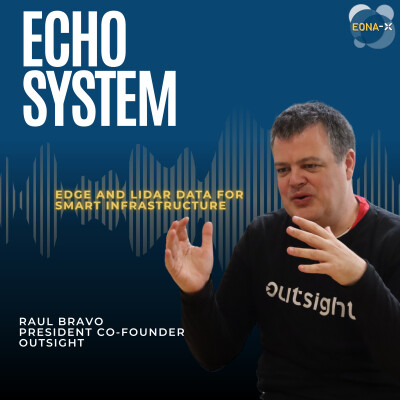
For this first episode, we are delighted to welcome the president and co-founder of Outsight, Raoul Bravo.
- Speaker #1
Raoul, your career has been closely linked to the development of 3D perception technologies that underpin today's special AI, including LIDAR. After confronting robotics to give robots an autonomous... a vehicle's ability to see, you found outside. All this hard work has paid off as Gartner now ranks your Hamburg the world leaders in digital twins. Congratulations!
- Speaker #2
Thank you.
- Speaker #1
How do you explain that the future of mobility is not only determined by the vehicle itself, but also by the infrastructure's ability to become a brain capable of understanding and predicting movement?
- Speaker #2
Well... Something that may be surprising is that regardless of a mobile robot or an autonomous car or anything which I would say moves, or the infrastructure being a static asset, a big building, a big surface, the problem you need to solve, or one of the problems you need to solve, it's the same, which is understanding the physical world. understanding what's happening in reality because either the mobile robot is moving in the real world so he needs to understand either the infrastructure operator transportation hubs or many others we're going to see that needs to understand what's happening in the infrastructure which is also the real world so that's a common point and if you need to understand the physical world, that means 3D, because the world is in 3D. So using a 2D solution like cameras or whatever to understand a 3D reality, it may work. It works in some limited use cases, situations. But it's not the real solution. The real solution to understand a 3D world, it's a 3D thinking, 3D brain and 3D sensors.
- Speaker #1
We often forget that the travel experience begins on the pavement, but the famous cap side, you show that special AI powered by LIDAR data is uniquely suited for managing this complex transition, zones where pedestrians... priority vehicles on private air vehicle mix and rare video often files due to reflections or distance. But all those outsides, especially I, levering continuous 3D perception from help to reconcile urban mobility management and airport operations, ensuring seamless experience from the movement passengers arrive.
- Speaker #2
So if you look at what I just said before, on the micro, I would say, situation, which is a mobile robot or a specific place, the same problem you have at a bigger scale. Bigger scale can be a whole airport, a whole city, or a whole neighborhood, or any kind of infrastructure. If you want to optimize traffic, movement, interactions, or you want to ensure safety, or you want to increase the experience of people, because at the end of the day, it's all about people, because those are the moving things, either walking, running, or in a vehicle. But in both cases, in any case, you still need to have the right LiDAR data. So LiDAR, it is the sensor we leverage, which is, for those that don't know it, is not working in the same approach such a camera. It is using lasers, laser lights, laser beams to reflect back on objects and understand the precise distance. And that millions of times per second in very wide field of view, what we call. And the result is a digitalization of the physical world. That's just the beginning. That's the first step. If you don't have that, if you don't have 3D data, of course, you cannot work on that. But that's perhaps 3-5% of the problem. The rest, the big problem, is what is called spatial AI, or 3D AI, if you want. It's all the software techniques that are going to, based on 3D data, create information. Information means something which is useful. Useful means actionable, means things humans can leverage to, as I said before, better operations or any other benefit.
- Speaker #1
Recently, Raoul, Dallas Airport, one of the world's top five airports in terms of passenger traffic, chose your technology for what is valued as the world's largest LIDAR development, a project worth over 17 million dollars. That is? Ah, yeah.
- Speaker #2
That's the first phase. The project should be much, much bigger. But yes, the first phase, which is public information, it is that the decision of the customer was to allocate a first step, a first phase, which is important here to understand is because we have been talking about LIDAR data, but it's perhaps not so clear what... what are we doing with that yeah so what are we what we are doing with this 3d data is answering a simple question i would say which is for every single individual either walking or in a vehicle doesn't matter every single individual we want to know we want to allow the customer to know how it is moving how it's interacting with each other how it is he's interacting with the assets, the equipment of the infrastructure, in that case, airport infrastructure, and that in real time, at scale. At scale means that today, our customers, mainly airport customers, but also train stations, also hospitals, also museums, also tourism sites, etc. We are dealing with some 280 million people per year. So it's massive scale. So scale means three things. It means lots of people or vehicles. It means large spaces. So an airport is pretty big, I would say. That's also scale. And the third point of scale. is density. Because all these million people, it happens that they're very close to each other. And you look at the airport terminal in summer or in holidays, you're going to see that the density of people, it's very high. And that is a big problem, a big technical challenge because you want to follow each individual as a unique trace, I would say, unique track, because that's what is going to allow to generate insights. Because if you are following every single person, then you can derive KPIs, actionable insights, such as what is the waiting time at a certain place, what is the dwell time between the time I arrive to the airport, the time I'm getting out, etc. How many people are in a certain place? You create an alert because there is a sudden density which is not normal. That may be a signal. for a security threat or any other situation. So the key point here is as soon as you know what everyone is doing all the time, everywhere that generates a wealth of rich levels of data, billions of terabytes, not billions of terabytes, billions of objects, but dozens of terabytes of data in real time that creates unlocks. new reality, new understanding of the reality that was just not available before.
- Speaker #1
In Europe, pressure is mounting with the implementation of the EAS.
- Speaker #0
In Europe, the entry-exit system was creating new constraints for airports, meaning that new processes were implemented, and that generates different or adapting to different flows of passengers. For example, new kiosks are installed for people to check and validate their documents, etc. This was new, this has been new. Of course, Airpods have been working on that for many years to prepare to that. But at the end of the day, at showtime, you need to be able to manage these flows of people. And what happens is that the same process that were very well defined before are becoming more what we call unstructured, meaning that queues of people waiting are not perfectly aligned, are not respecting exactly how you want them to do that. And that... It means that if you want to manage these flows, you need to have the right insights. And the legacy technology based on cameras, stereo vision, etc., was simply not able to manage this new complexity, this new dynamics. So that's why European airport has a strong interest on what we are providing, because it's helping them to solve a new problem in a modern way, I would say.
- Speaker #1
Your analysis shows that conventional vision technologies such as stereo vision, which face structural limitations compared to special AI systems built on precise 3D sensing, particularly with the widespread installation of biometric kiosks. How does the flexibility of outside special AI enable an airport to remain compliant with ESS? I recommend while preventing border control from becoming a bottleneck in the passenger experience.
- Speaker #0
Put it simply, if you are a passenger, you're almost never happy to wait. There may be some people that like to wait, but in general, no one likes to wait. And it also happens that if you don't wait and you were expecting to wait, sometimes you spend also more money in the duty-free, etc., etc., which is good also for revenue. what we call non-aeronautical revenue for airports. But the main point is that no one likes to wait. So if you, as an operator of the infrastructure, you are not providing the processes, the insights that allow you to avoid or to prevent or minimize at least these wait times, then you're not making a good job. And people are going to let you know some way or another. So that's the main point. So how you optimize, how you solve, these bottlenecks, how you minimize queues, waiting time, etc. First thing is you need to understand when and where these things are happening. If you don't have a way to measure, you cannot improve. You're blind. It's what is called physical flow obscurity. You know that there are problems. People on the field, they understand there are problems, but it is very hard to grasp the real situation because you don't have a way to measure that. So getting back to the technologies, etc. Again, this is a 3D problem because it's a physical world problem. And then you need 3D sensors. Does it mean that cameras are useless, are not good for that? No. It's just a way of using the right tool for the right problem. If you have a 3D problem, you need a 3D solution. If you have a 2D problem, image problem, you need an image. solution. Cameras are the best sensor by far for many problems, such as classifying situations. For example, is this a dog or a cat? Don't use a lighter for that. Cameras are the perfect sensor for that because you don't mind if it is farther away or close by the cat or the dog. You want to know to classify. So it's not a discussion or a debate on when technology is better. than other is what technology is the right one for the right problem so that's why 3d problems require 3d sensors and that's what we are doing we are using lidar today but we are not a lidar company we're especially a company you understood that we're not building manufacturing the hardware there are dozens of lidar manufacturers thanks to the self-driving car for example in robotics also what we are doing is the 95% of the problem. that needs to be solved, which is a software special AI. That means that as soon as other 3D sensing technologies mature, which may be the case for imaging radar or other technologies, we don't care. We are leveraging native 3D data and not necessarily LiDAR. But it happens that today LiDAR is the only 3D technology. It is just today, but it can change. But getting back to another subject that you mentioned, is that it could happen at some moment that if you wanted to follow the movement of every single person all the time, in order to optimize process, wait times, passenger experience, etc., you need to look at what happens. The contradiction may be that if you need to look to what extent this could be a threat for private data, personal data. What you don't want, really, is to have images of every single passenger moving in your airport easily and using that as your raw data. If you are doing that, there is always a possibility that this non-private data can be used for other reasons, not voluntary, but can be also security issues, etc. So ideally, sometimes you cannot prevent that, but ideally you don't capture any image. And it happens, it is not something that we designed, it is by definition that LiDAR lasers are not capturing any image. Which means that even if we want it, even if the customer wants it, we can't and they can't really understand who is this person. So we don't have and it's not possible, technically possible, to know who is this person. But it's not the objective. The objective is not to know that you personally are waiting a certain time. The objective is to understand how all passengers are waiting or how they are moving, how are they. evolving in the airport. So LIDAR data is anonymous. It is not anonymized, which is a misunderstanding sometimes. We take anonymized means that it was not anonymous. You did something to make this anonymous, but the risk is always there. Anonymous, natively anonymous means that at any moment there is a personal information that is being captured.
- Speaker #1
And our part does not end at the terminal doors, managing taxis, buses, and drop-off points in an operating operational challenge. The leader market is booming with dozens of manufacturers like Ezei, Auster, Robesense, etc. And you have chosen to be the hardware agnostic, meaning that you're Shift Special AI software works with any major industrial LiDAR sensor, treating hardware as a configurable input rather than a constraint. For an infrastructure manager, this guarantees sovereignty and independence. From a long-term perspective, how does its hardware independence enable your customers to upgrade? their infrastructure without having to reinstall everything every time the sensors are updated.
- Speaker #0
Well, there are several things that the benefit of hardware freedom or hardware agnosticity is hardware freedom. So the benefits of hardware freedom are manifold. You mentioned some of them. You master as a customer what hardware? you really want to use and that may change over time. So for example, the right hardware today, it may not be the right one in 2, 3, 4, 10 years or the right manufacturer. There are some lighter companies that have just become bankrupt. So you cannot even buy the hardware anymore, etc. So if you chose them 3 years ago, now you have a problem. If you were also linked to their software. If you are free from hardware, then you can adapt to the situation because you don't care so much about the hardware. So one aspect is this supply chain, I would say, freedom. But another one, which is less known because it's a little bit technical, is that when you buy a camera from one manufacturer or the other, the principle is the same. It is a camera, it's a camera. It's the same principle, it works always the same way, etc. When you buy a LiDAR, it's a very different situation because there... There are many different types of LiDAR. And to make it easy to understand, the LiDAR you're going to use to monitor 500 meters fence of an airport for security issues is not at all the same that you're going to use in the security checking, ceiling mounted, etc. Not at all. Not in price, not in performance, not in manufacturers because it happens that the manufacturer which is good at long-range LiDAR, it is not good at cheap, short-range LiDAR because it's different techniques, different approaches. So compared to cameras, the LiDAR is much more diverse. So if you are not free from choosing your hardware, it is not only a matter of supply chain, it's also a matter of optimizing the installation. You may be paying twice. three times the cost that you may have used instead of using the right hardware, because there is no manufacturer that can deliver all the range of all different types of LiDAR. So players like us that are agnostic and provide this freedom are essential, because otherwise the customer is trapped in a situation, is locked in a situation that is very likely not going to be the ideal one over time.
- Speaker #1
The issue of sustainability is central to Ionaix's projects. One technical point struck me in your publications. Your software is capable of processing massive volumes of 3D data on simple ARM processors, HII, without requiring energy and intensive GPU servers in the cloud. Doesn't the true sustainability of the smart city lie precisely in this ability to process intelligence at the source, the edge, in order to minimize the digital carbon footprint of the infrastructure.
- Speaker #0
A very important point. As you're seeing, what we're proposing is not so much a software, it's a real complete platform that has solved many of the problems that you need to deploy at scale as we are doing. and one of the pronouns is how. You process millions of 3D points in real time. In real time means milliseconds. So you need to get the insights. You need to get the output almost as soon as you get the input. That's real time. So making this at scale in real time, it is not realistic to do only on the cloud. It is not realistic to send... all the data from the sensors on the cloud, then process that and get it back, et cetera. The right approach, we think, is to mix, to have a hybrid approach where you are processing on the edge most of the making the heavy lifting of the processing and then sending to the cloud or to the servers of the customer or wherever the right insights data that is much less volumetric, I would say, just to give you a figure. one lighter process streaming data it's more or less equivalent to more than 100 people looking at a netflix movie at the same time you know so it's lots of data lots of data so if you are not able to do that efficiently then you have a problem you have a problem of cost you have a problem of scalability and you have a problem of energy consumption sustainability and when you look at for example computer vision. And you say there is no hardware because we can reuse the data stream from the cameras that some of them are already there. What we're not looking at is the GPU, which is hardware that is needed to process that. And this hardware, it's expensive, it's hard to find rare, and it's extremely energy hungry, I would say. So us being able to do in the edge. Only with CPU in real time, it's a big, big difference for our customers because that, at the end of the day, translates into much more efficient systems, more affordable, and also contributes to their sustainability objective because we are spending or using, on average, between 70% to 80% less energy compared to GPUs. So that's an advantage also for customers.
- Speaker #1
In your version of Special Intelligence, you describe a trajectory of technological Maturity, that leads from simple ray to data to autonomous action. You also define your four stages of evolution for intelligent systems. First, the reporter, which describes what exists. Second, the insiders, which analyzes it. And the predictor, which anticipates. And the prescriptor. This last stage, that of pre-extraction, seems... to be the natural meeting point with energetic AI. If we consider your functional digital twins defined as digital twins in motion, where our classic digital twins models the static structure of our technical state of a building, the digital twin of motion captures and analyses in real time the dynamics, trajectories and interactions of people. and vehicle flows within an infrastructure as a high-definity sensor layer. How do you envision the technical collaboration between this real-time 3D perception and engines capable of autonomously prescribing and orchestrating actions within the infrastructure?
- Speaker #0
Yeah, let's say that... Let's say that you as a user, as an infrastructure operator, you want to answer the question of what's going to happen in this process next week. What do you need to do that? First, you need, and you cannot achieve that otherwise, to be able to answer what is happening now. If you're not really able to describe to... digitize to understand the current situation or another way to say that if you're not able to gather the right data, your predictions are not going to be really useful. You cannot predict if you don't have the right data or you may think that you are predicting but it is not going to be very useful because very quickly you're going to see that it doesn't work. Why? Because you need a baseline of data that you can trust. that you can really measure. So if I'm saying you that there are 57 people in the queue, you need to be sure that there are 57 people. Because if in reality there are 40 or 80, your predictions based on that are just going to be false. So that's the first step. So that's why before talking about prediction, prescription of what needs to be done, you need to be able to really report what is happening now or what happened. which is more or less the same thing, similar. So that's the first point. And that already creates huge benefits. So I know, Argentina, it's something we're all working, delivering. But the intermediary steps of getting to this level of autonomy or prescription or prediction, the intermediary levels are already... extremely valuable. Another way to say that is that if you are blind, you are already happy to start seeing the light before even predicting what is going to happen.
- Speaker #1
The roles of the reporter and the insider are well understood, but the predictor stage is undoubtedly the one of fascinated reporters of the most. In the airport sector, anticipating a bottleneck 20 minutes before it occurs is the professional holy grail. And thanks to the history of your digital twins of movement, are you now able to transform real-time data into a prediction tool capable of alerting agents even before congestion forms?
- Speaker #0
is that agentic AI may leverage, may demultiply, I would say, the capabilities. that a very knowledgeable human or operator may do. It's just really demultiplying these capacities. And if you go to an airport, almost any experienced employee of an airport understands and knows that if there is a huge affluence in a checking process, 20 minutes after that, you're going to have the same problem in security. And the operators and the people working on the field, they know these kinds, I would say, almost intuitively. So the key thing here is how you do that scale, how you do that automatically. How do you detect at least what a very skilled operator may detect? And then what can you uncover that even the more skilled operator wouldn't detect? Why? Because even the most skilled operator, human operator, has a limited view of the situation. It is not God. Yeah. It only has a... understanding of what's happening around either in space and in time yeah so he didn't know what is going what happened when he was not in shift or exactly and he doesn't know what's happening in a place that he doesn't have a line of sight and so the capacity the capability of the system to understand everything all the time in real time over the whole airport or the zones that of course gives an advantage and that we really have validated it. that uncovers insights that were just not possible before.
- Speaker #1
Sure. The tourism and transport sector often faces user-reliance towards surveillance. You place great emphasis on the distinction between anonymized and anonymous by nature. Unlike video, LIDAR does not see faces. Do you think that this technological guarantee of anonymity is the mission link in reconciling you the optimization of tourism flows with respect for privacy, particularly in data spaces like UNX, for example. UNX works on...
- Speaker #0
It is a very important factor. To be clear, our customers in many different factors, in many different countries, they don't decide to deploy our solutions because of privacy, or at least not only. This is an important benefit, but it's not the reason. It is not the only differentiating factor from cameras or whatever. The first reason is to achieve benefits that cannot be achieved with legacy technologies. That's the first one. But if, in addition to that, this data is completely anonymous, that's a big win. It's a big... benefit but it's not the reason you know so it's important to because you may think is the privacy is the reason it's a big cherry on the cake but it is the cherry of the cake it's a big one but it's a cherry of the cake the cake is not the privacy the cake is a benefit that you're getting but you're true once you have this cake and this cherry then for a platform like iona x is wonderful because that means that you are natively able to manage, mine, use this technology without the constraints. Because it's not only the risk for privacy, it's also all the process, all the tools, all the constraints that came with the reason that you need to protect this privacy. If this privacy is not needed to be protected anymore because it's fully anonymous, then all these constraints are not required. And that's super important because that changes a lot of things, especially in a data platform where you can share with other parties.
- Speaker #1
Ionex's work on data circulation also created the HOSEF open serialization format to standardize leader data. This is crucial for interoperability. It is often said that data is a new role, but the real challenge is the pipeline. At Ionaix, we advocate that as faces, real interoperability is prioritized. You created the open-source OZ format to standardize LIDAR data as an input layer for special AI across manufacturers, enabling interoperability and scalable data exchange. Beyond technical performance, how does this pro-open-source stance promote collaboration and the smooth exchange of information between different stakeholders?
- Speaker #0
As you mentioned, this open source data format, first, it's not only for LiDAR, it's for any kind of 3D, real-time 3D data. As I mentioned before, it happens to be LiDAR today, but any kind of 3D data source, it is compatible, can be used. And the reason we created that is because one of the additional problems of not being agnostic is that you every single manufacturer has a specific format and it has a specific specific proprietary way to deliver this 3D data. And it's not because they think one is better than other or it's not a battle of standards. No, no, no. The main reason is because, as I said before, each LiDAR type is very different. The format which is optimum for each manufacturer is different. So they do that because they are more focused on their hardware. than on the users using the hardware. So the open source data format allows to create this layer in which hardware freedom becomes a reality because you can really interchange one LiDAR or one 3D sensor by another one and you're going to still have the same access of data. And of course, as any standard, we haven't invented nothing new. It's always the same. If there is no... standard that abstracts the hardware then collaboration is much more complicated in inter-operation of systems it's much more complicated so that's why standards exist and that's why we contributed to make this for the LiDAR world of the 3D world that it didn't exist it existed for mapping formats mapping from LiDAR or 3D sensors is very different because creating a map... It's not real-time. In general, you don't need real-time. So the constraints or the objective of standard data formats for mapping data is not the same as for real-time consumption of this data. It's very different.
- Speaker #1
Yes. You recently joined the Airport AI Alliance, a global coalition of airports and tech players that aims to re-standardize and accelerate the adoption of AI to optimize. operational efficiency and the passenger appliance. This sends a strong signal about interoperability and collaboration values that we hold dear at Ionex. What is the next big project or technological breakout that you believe will transform special intelligence from a technological option to a standard feature for all mobility infrastructure by 2030?
- Speaker #0
Good question because... This kind of organizations like Airport AI Alliance or IONAIC, etc., it's of course about technical capabilities, pipeline, data pipelines, etc. But the second aspect, which is sometimes even more important, is to create a collaborative environment for different parties to be efficient in this. And when you introduce a new technology, a new capability in a new market in a market like airports for example this collaboration is extremely important because it is not by chance that when a american airport chooses slider outside sorry our solution he relies in the opinion of our asian customers that also rely in the opinion of our european airport customers that etc etc because the collaboration is us important as the technology itself. So we think we are contributing to create a standard in the airport world, which is already deployed in the major international airports. So if you are an international airport, you would better use what most of the others are already using and leveraging instead of trying to reinvent the wheel. So that's how the standard works. Yeah, it is more efficient for everyone. to work on the same approach.
- Speaker #1
You know that you are already working with SNCF as part of Gare Connection to refine knowledge of passengers flow in stations and with the group ADP and airport optimization. These two players are founding members of Ionex. Your ambition, as you often point out, is to make 3D perception accessible to everyone and not just to tech experts. Raoul, how do these concrete collaborations with players such as ESN CF and ADP serve as proof of concept for the rest of the ecosystem and how do you imagine that integrating outside into a shared data space could amplify these projects?
- Speaker #0
So well first I gave you some details on the technology etc because I think it's the right context today. But our customers... really don't care about technology they don't care about lighter camera or whatever they just care about what is the value the benefits that they can get thanks to the solution And of course, what are the constraints, the cost that must be much lower than the value. So that's at the end of the day. We, of course, explain why this is not magic, why our solution can do things that are not even possible with any other technology, because people need to understand. But at the end of the day, our customers are not buying technology, they are buying... the benefits, the outcomes they can get from that. In case of ADP, SNCF, well, it's funny because we are a French company, headquarters in Paris with subsidiary in San Francisco and in Hong Kong. So we are really global. And it's true that because we are in Paris, we started working with French partners. What happened is that we went very quickly in other countries, in Asia. in the US, in other regions of the world. So yes, we're working with on-train use cases, intermodality, so also the train station in the airport, because that's extremely interesting, how we can create value not only for the train operator or the airport operator, but to both. This is what we are doing at Charles de Gaulle. But it is true that we have been quicker in other train stations in Spain, in other airports in Asia and in the US. So we are also moving in France. And the EONIX environment and ecosystem can only help to make a European or French champion also. And not only export champion, but also domestic champion. And we are in this process today.
- Speaker #1
Do you have some names of the companies you work in tourism, logistics or mobility sectors?
- Speaker #0
Yeah, I mean, customers in our logo count, I would say it's in the hundreds. So in the airport world, it's in the dozens of international airports. What happens in many cases is that this is an emerging technology, which means that even in production, customers... want to verify and use this for relatively long periods of time before large-scale, I would say, deployment. Some others are quicker, I would say, than others. But in many cases, also, they consider this a competitive advantage. They're, in many cases, not always motivated to communicate or over-communicate on their deployment because they really consider that as a... as an advantage so we have some public you mentioned the dallas airport and adp and other asian airports customers are in many different segments if i take the example of the train stations for example we announced with fgb which is the spanish train operator We published also about SACIR, which is a big construction company. I would say it's similar to big construction in Spain, I would say, for hospitals and many other airports. And we also, in the industrial world, published what we are doing for BMW, for example. So there are many flagship customers. And unfortunately, for now, some of them don't want to communicate. that. going to change in the weeks and even months to come, including a very known tourism site that we are going to be communicating about that in the short term.
- Speaker #1
We are coming to the end of this exchange with Raoul, but now is the perfect time to formalize our site's membership of the Ionaix ecosystem. Raoul, welcome to the team Thank you Beyond its technological prowess, your platform is above... All business decision-making tools that transform innovation into concrete LREI, reducing waiting times, optimizing resources, and improving the customer experience. You have succeeded in turning LIDAR from a research project into a scalable industrial solution. Why was it strategic for Outsight to join EONX today? If you had a message for the tourism and mobility players listening to us, what added value can your technology bring to their operations?
- Speaker #0
Yeah. So, well, first, we're glad to be part of the team and be part of this ecosystem. We think that we can, of course... a lot of value to the different companies that are part of it and, of course, also get very rich insights and feedback from them. And to be even more concrete, as you asked, what are the benefits when you can... The technology, again, is just the enabler. The important aspect to note is what you as a... tourism, hospitality, transportation hub operator, what is the value you would get if you were able to know where every single visitor, shopper, passenger, where it is at any moment of time, at scale, tens of thousands or millions of people in real time, what they are doing, how are they using your resources, how are they interacting with each other. If you knew that, then you would translate that into business outcomes that you would not even imagine was possible. Some of our airport customers increased in the 5%, 6% in their revenue figures when deploying the technology, which is in many cases a very huge improvement. So once you know what people are doing and how they are interacting in the physical world, in your place, in the infrastructure. that you are managing that change everything that uncovers new insights that you were not even able to imagine so you need help to understand how this concretely can become just get reach out to us we're going to show you many examples of many different customers in different contexts and you're going to see very very quickly how this unlocks a new almost a new era of especially high and intelligent. of the physical flow.
- Speaker #1
Is it your first experience in a data space?
- Speaker #0
We have been always working in data in all the companies I've been creating, but it is true that for the first time we are generating huge amounts of data that are extremely interesting for a data space. So that's it's true. It's our first experience on making this much more available and interoperable with many other systems.
- Speaker #1
Okay, welcome, good sight. And you're Raoul Bavaud in Hionix Ecosystem. And that's it all for today. Thank you for listening. Thank you, Raoul. And it was the first episode of Ecosystem, the Hionix podcast. See you. See you, Raoul. Thank you. See you.