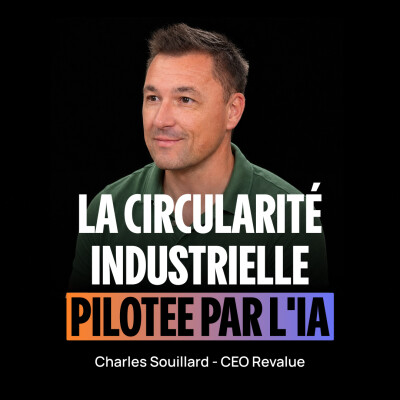
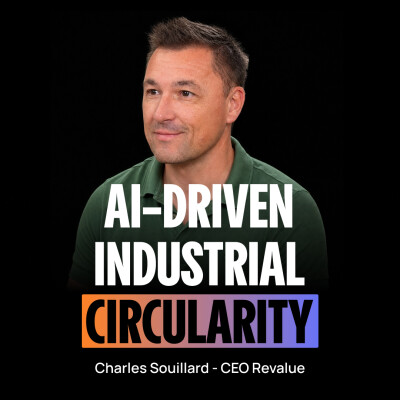
In this episode, Antonin Léonard sat down with Charles Souillard, co-founder and CEO of Revalue.
Revalue is a field-built software company tackling the messiest part of the circular economy: what happens to an industrial product once it's in use or at end of life. Unlike a brand-new appliance, every used product is unique, with its own wear, dents and history, which makes the decision to repair, refurbish, dismantle or recycle brutally complex.
That decision usually lives in the head of one expert, "Robert", who can tell in twenty minutes whether a product is worth saving, but only when he's on site. Revalue captures that expertise with AI and turns it into decision trees that operators run from a phone, so the call gets made early, reliably and at scale. The trigger for industrials isn't ideology, it's economics: facing Asian competitors 30 to 50% cheaper, European manufacturers move upmarket, and premium means premium after-sales.
Before Revalue, Charles spent more than 15 years co-founding and running Bonitasoft, the open-source software company he started in 2009, taking it from CTO to COO to CEO through hypergrowth, a hard 2015 restructuring back to profitability, and a private-equity buyout. Revalue is his return to entrepreneurship, this time at the exact point where a successful business also means a healthier planet.
In this conversation, we explore:
→ Why used and end-of-life products are radically harder than new ones: every unit is unique, and one wrong return decision costs hundreds of euros
→ How Revalue extracts the tacit expertise of shop-floor operators ("Robert") and turns it into shared, improvable decision trees, the part of the job Robert is happy to give up
→ Why the real trigger is economic, not environmental: European industrials going premium to escape Asian price competition, with after-sales as the differentiator
→ The design-partner model: signing a blank-page promise with clients like Fnac Darty (30+ warehouses, tens of thousands of appliances a year) and learning on the ground together
→ Standard exchange over slow repair: qualifying equipment remotely so critical clients are back up in days, not months, and workshop load is smoothed
→ The three tiers of circularity (product, component, material) and the hidden value trapped in assets accounting has already written down to zero
→ Circularity as sovereignty: keeping the material stock in Europe instead of shipping it to Asia, and why profitability, not regulation, is what makes it happen
To learn more:
https://asterionventures.com/en/contact
Hosted on Ausha. See ausha.co/privacy-policy for more information.