- Speaker #0
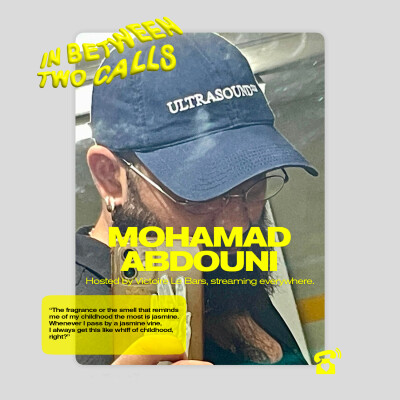
Hey Mohamed, I was born in Lebanon in 1990 and to be honest I know very little about my country of birth. You were born in 1989 in Beirut where you still live and work. Would you be open to talking? Here is how I reach out the Lebanese photographer and director Mohamed Abdouni. This question marked the beginning of our conversation. It feels especially significant. It unfolded between Beirut, Paris, London and Berlin, and began during the Israeli attacks on southern Lebanon, then Beirut and eventually the entire country. I'm deeply grateful to have had this dialogue with Mohamed. His work serves as a form of documentation of queer history in Lebanon with a particular focus on trans lives. At the time of our conversation, his first film, Treat Me Like Your Mother, is being shown in London during the British Film Institute Flair Festival.
- Speaker #1
Hello Mohamed, I'm really happy to be doing this podcast with you and thank you for your email. I've taken note of everything.
- Speaker #0
Actually, when I spoke about Lebanon, I was of course thinking about the current situation. But yeah, it's almost like an eternal circle for sure. But What I meant was more like what is the fragrance of your Lebanon you know in the yeah I love to hear about your childhood and your personal memories and at the same time I yeah of course I completely understand if this feel uncomfortable given the current situation but yeah hope this makes sense um let me know what you think So, hope to hear from you soon. Um, hope you're doing well. And a fastball.
- Speaker #2
And here for the circle, distance, northern and water-loving city lines and the DLR.
- Speaker #1
I'm sorry it took me a while to get back to you. Paris was a bit of a whirlwind and I just landed back in... Welcome to Paris, please share your video. Yeah, I'll send you another one. I love how the first voice note I'm sending you is in YouTube with all that noise. I just landed in London yesterday and it's also been a bit of a whirlwind. Yeah. I'll get out of the subway and talk to you again when it's a bit more quiet. Good morning. Okay, yeah, this is much better. I don't know what I was thinking talking to you from the subway. I meant to talk to you when I was in Paris, but it was a very fast trip and it was all over the place. I just took the train to London now for a couple of days to premiere the film and then I'm back in Beirut on Sunday. How have you been?
- Speaker #0
Hey Mohamed, I'm doing late voice notes, so good evening. I'm so happy to hear from you and above all to know that you're safe. So, how was the premiere of Treat Me Like Your Mother? How did it feel? I hope you're really, really enjoying this moment. Yeah, I'm wondering by chance, is there one playing in Paris soon, maybe? How do you feel juggling all these journeys? between Beirut, Paris, London, because each day seems so short that it must be hard to, yeah, maybe really adapt, you know. except maybe in your country of birth. And yeah, sometimes when we travel a lot it's hard to really feel at home. Sorry I had the window open and suddenly it smells like weed so yeah I lost my focus.
- Speaker #1
I'm walking home from the closing party. I'll speak to you again once I'm in the hotel or tomorrow morning. I know that scent of weed going through the window very well. I welcome it now. I've been mostly sober for a year now on March 30th. Tomorrow actually. Tomorrow is a year. So I usually welcome that smell. It's a nice smell. It looks like I'm gonna crash for the night.
- Speaker #3
So I'll talk to you again in the morning.
- Speaker #1
Honestly, the London screenings went pretty well. I hadn't been in London for almost 10 years. So it was nice to be back there. It was fun. It was a lot of fun. It does get exhausting to travel so often. I mean, I'm used to it, but at the same time, I don't think you ever really get used to it if you don't enjoy traveling. And yeah, it's not something I specifically enjoy. But it does honestly, it does feel like sort of a like a privilege to be able to fly out of Beirut right now. So it feels strange to be complaining about traveling, especially right now because I mean I have that little privilege of being able to step outside for a bit of a breather. But yeah, it does get a little tiring from time to time, but I have my tricks. I have my little tricks to kind of try to feel as much at home as I can wherever I am. Like whenever I remember. for example to pack it i usually take my mug with me like my the mug that i drink my morning coffee with and with and uh yeah so whenever i remember to pack it i usually do that way at least I start my morning having my coffee with something that feels like home. So these are kind of like little tricks I've picked up along the way. I should have a Paris premiere for the film quite soon. We're ironing out the final details but the film is finally coming to Paris so I am excited about that.
- Speaker #0
Hey it's a pleasure. To hear your voice and feel your good vibes about your premiere in London. I'm just trying to make something edible to eat right now and I'll be back in a bit to pick up the conversation. If I remember correctly, you also like having flowers. wherever you are, right?
- Speaker #1
Yeah, that's very true. Flowers as well. I don't always get to have flowers around me whenever I travel. But if I'm staying for a bit of a while, I make it a point to pass by a little market or a florist and make myself a little bouquet.
- Speaker #0
Hey Mohamed, I hope you're doing well. Sorry for the timing, I'm sorry, I was a bit rushed.
- Speaker #1
I'm currently in Marseille until April 15th.
- Speaker #0
But to get back to the fluo thing, it actually reminds me of my grandparents. They lived in Nantes, quite far from the Dordogne, where I grew up with my parents and my brother. Whenever they came to visit, they always had a beautiful white camellia. in a little cup hanging from the car's radiator. It was, yeah,
- Speaker #4
I remember that so well. It was probably a little piece of their home.
- Speaker #0
What I like about the idea of a flower as a kind of home is that it's something alive. also something that will fade. So there is something reassuring in that. I'm wondering what's your relationship with flowers? Do you have one favorite?
- Speaker #1
I do have a favorite flower. I think I have a favorite flower. It's daisies. I don't know why I like daisies so much, although they're like very common and easily found flowers, but I do. and who love daisies a lot.
- Speaker #0
In France, I remember when I was a child, we used to make necklaces or bracelets with daisies. By the way, I think it's a flower we may have overlooked when we're thinking about our favorite one. I was scrolling through your Instagram before starting this conversation. and kept thinking about one of your posts with the caption, forever sad boy. Yeah, recently I wrote a text about the terrible news around the world, specifically in the Middle East. I wrote that we drew dark eyebrows to give a voice to those. who are often silenced because yeah I'm really really obsessed with dark eyes and big eyebrows as I often say they are the speaking eyes so yeah I remember when I was young in in the south of France, it really wasn't the trend, you know, it was the trend of very thin eyebrows. Yeah, I don't really remember when that trend began, but now I really think that if we clean this part of the face, we also clean all the words we couldn't say. I don't know if it makes sense, but yeah, I was just thinking. um about that right now
- Speaker #1
I'm trying to remember which which which uh photo I had uh forever sad boy as a caption on I don't really remember could you describe it to me like what was it a photo of but I mean I think even without knowing which photo you're referencing I can already tell that it's probably just uh just my uh Overly emotional Pisces victim self manifesting through a caption. Yeah, forever sad boy. Even though I'm a pretty lucky boy with pretty beautiful things around me, pretty beautiful people around me, I think I'm a forever sad boy. It's within me. It's inherent. I think I get it from my father.
- Speaker #0
Also, when I began this conversation, I asked you about the fragrance of your childhood in Lebanon. Can I ask you if you remember it?
- Speaker #1
But funny enough, the smell or fragrance or the smell that reminds me of my childhood the most is that of jasmine. Whenever I pass by a Jasmine Vine, I always get this whiff of childhood right smack in the face.
- Speaker #0
Do you think it's possible to forget a smell or fragrance? I think some smells stay with us forever. I mean, I feel like smells stay with us more like images.
- Speaker #1
For me specifically, it's very difficult to forget smells. I think the sense of smell is one of my most developed senses. Yeah, yeah, it's... I think smell is the thing that sticks the most. with me. I remember smells more than I remember things I see or things I hear. And smells are the things that can trigger a memory for me much more than looking at a photo or listening to something. Although of course like maybe listening to certain music or certain songs can bring back a lot of memories, but I think smell is what sends me the most backwards in time. There is a perfume, for example, which I still don't know what that perfume is. I don't think it's very widespread because I don't smell it very often on people. But every few years, maybe three or four years, I'll be walking in the streets and someone will pass by, like someone will be walking in the opposite direction and we will like run by each other and I will get a whiff of their scent. It's usually most of the time it's been women and I will smell that perfume and I will automatically be transported to kindergarten and I think it's because my one of my kindergarten teachers had that perfume and it becomes very vivid like whenever I smell it all those memories come back in a very vivid way.
- Speaker #0
Sense can create a bond between two moments in time. Certain scents can bring back images, but I think not the other way around. Do you use or get inspired by scents in your work? I remember the first time I smelled the scent of boxing outside the ring. It was the oil we use. To warm up the body before fights. I was in a store and it immediately made me feel anxious. Just like I used to feel before stepping into the ring.
- Speaker #1
It's very funny you say that because there's this smell of a very... Specific type of foam. The foam that they make the matla of the... Not of the rings, but because I used to do taekwondo when I was a kid. And I remember I used to hate it. And my parents enrolled me in it. And I used to really hate it. I mean, now I'm very happy that I did it. But I did it for a long time. I did it for... Maybe nine, ten years when I was young and I used to hate going. I used to hate everything about it. And so there's this the smell of this matla, the smell of this type of foam. Whenever I smell it I get super anxious.
- Speaker #0
You hated but why didn't you stop taekwondo if you hated it? Was it because of your... parents or to prove something to yourself or maybe another reason?
- Speaker #1
I mean I didn't quit at the time because I didn't really have a choice. I was very young and my parents really wanted me to keep doing it which kind of like right now I'm happy they kind of forced me into it even though I stopped now and I don't do it anymore. But I think I'm happy they forced me into it now as an adult, but at the time I really hated it. But I couldn't just not do it. I didn't really have the choice.
- Speaker #0
Is there a famous national sport in Lebanon? Because I'm currently working about having a famous and powerful national football team in Arabic country. On the differences in how football represents people in the Middle East and Maghreb. I found a football club called Sages Sport Club. I don't know if you understand a bit of French, but yeah, I think it's a beautiful name.
- Speaker #1
I'm not sure there's like one national sport. We do many things. I don't think there's one. Yeah, I went to a French school. English is my third language.
- Speaker #0
Maybe we can switch in French from now on. I switch to French, so I was thinking that maybe to continue and finish this podcast, we could talk about your work and especially about the film that you recently presented in London, which is entitled Treat Me Like Your Mother. And if you want to tell me a word about this work.
- Speaker #1
The film I'm currently touring is a documentary, is a feature-length documentary called Treat Me Like Your Mother. It's kind of the latest installment of a project that I've been working on since 2019, mainly an archival project on trans feminine histories in Lebanon.
- Speaker #0
documented too because there is a huge amount of documentation work in your work. If you remember that moment.
- Speaker #1
I don't know what I would be if I weren't an artist. Mainly why I am an artist, which is funny to say because I have been many things and I have done many things. So it's kind of strange to feel today like I wouldn't know how to be anything else. Or I couldn't imagine being anything else. because I have been many other things. But, yeah. Yeah, I think for as long as I can remember, that's all I ever really wanted to do. And it was never really defined in terms of medium. I didn't always know I wanted to take photos, but I always knew that I wanted to take photos. Does that make sense? At times I thought what I wanted to do was paint, and so I did. At other times I wanted to make sculptures, and I only started doing that very recently. I don't really remember growing up. up ever really wanting to make films but then I started making films so in terms of mediums nothing was really ever set but I just always knew that I I didn't want to do anything else that's being an artist and making art no matter what form that took is and always was what I always wanted to do and be.
- Speaker #0
As I was saying by message, I edited the podcast, in any case, everything we had before the last Voice. And I thought I might have missed some questions, some interactions. So I'm going to go back to Forever Sad Boy, which we talked about. that you had put in caption of a photo. And at the end of what you say, you say that probably, I imagine, sadness comes from your father. And I wanted us to talk a little bit about this heritage, maybe emotions, and what you wanted to say there.
- Speaker #3
I don't know if I would call it inherited sadness, but yes, it's a kind of sadness that I could never really describe. And it's only by reading my father's poems that I was able to put words into it. In fact, it's not me who put words into it, it's my father who put words into it. And it's the first time that I find words that can... I can describe this sadness or this loneliness that comes even when we are surrounded, when we are not really alone, when we have a kind of support system that is good, that is strong, but still sometimes finds itself alone or sad. And it's something that I've tried to explain several times to friends, and I've never really succeeded in doing that. And so, yeah, maybe in this sense, it could be considered as a sadness inherited from my father. I borrowed some of his writings from my father for one of the exhibitions I did a few years ago, called Bare in Seeds, an exhibition I had shown in Marfa, Beirut. The exhibition was inspired by seven of his poems. My father writes in Arabic. He writes strictly in Arabic. One of his poems, one of the poems that I used for Berencid's, is called Al-Bahlawan, Le Cloune. I was going to read it myself, but I asked him to read it to me and send it to me in a message.
- Speaker #4
Bahlawan. Your longing for the past is drawing you in, then it surprises you. You mix things up, and you start hating what you love, and loving what you hate. And you don't know whether you live your day or yesterday. Your past imaginations interfere with your real plans. You turn around like someone who got hit by a stroke of madness. Or you look at your face like someone who lost his compass. The four sides disappear, and the seven colors blend in with each other, and the clocks of the hour move fast backwards, to connect your soul to the times and possibilities you were in other than what you are today. You try to hold on to some memories, you try to live a new life, and the waves of the rough reality pull you back into the void like the pahlawan. who breaks the safety rope to show his innocence by walking on the barbed wire and falls down on the ground of reality, his first and last fall to be able to break his soul and destroy the height of his soul and his glory. Try, O man, the pious, to leave the longing for your past and hold it, as it is enough for you what you lived from them. كما لا تحاول إطالة حاضرك إذ يكفيك ما تقترفه يداك فيه أما المستقبل فهو موعد أو أكثر على رزنامة الحياة لا هو رهن بماضيك ولا هو وقف على حاضرك
- Speaker #0
This is the first time an issue of In Between Two Calls is presented almost without editing. following the rhythm and sequence of our exchanges. As Richard Hollis and John Berger show in their book Ways of Seeing, a text such as a caption beneath a painting, for example, can shape the way we perceive an image. Choosing to use voice recordings rather than a studio setting is also a way of capturing context. grinding the conversation in its setting. At one moment, an Israeli drone can be heard in the background beneath Mohammed's voice. It doesn't seem particularly anxious about it. It feels more like a sound so present that it has become embedded in the Lebanese sky. and in the heart. The poem read by the father of Mohamed is called Le Clown. We hear the nostalgia of the past, we just came back from Forever Sad Boy. I write to Mohamed, Le Clown is the saddest figure of joy. Thank you for listening to us. Remember to like, comment and share on all listening platforms and on Instagram. On my side, I'll see you very soon. dans le prochain numéro d'In Between Two Calls. Thank you for listening and there will be more episodes in English soon.