- Speaker #0
It's with a heavy heart that I leave Senkan for Rantepao. I'm then invited to a traditional funeral, a moment apart, and one that will leave me a deep mark on me. Enjoy the episode. Keep your wings, le podcast. Chapter 8: Trail of Blood. It was time for me to leave Sengkang, my heart was heavy after experiencing the warm hospitality of its people. Once again, in Sulawesi, there was no question of being in a hurry. You never really know when you reach your destination, as public transportation is practically non-existent. Hitchhiking or catching a ride with a private driver is the best option. Yet, finding these vehicles is far from easy. You have to know the right people, know where to wait, and above all, be sure you're heading in the right direction. During my journey, I met Marian, an English teacher. She was surprised to see me hanging around there. We quickly started talking, and she asked where I wanted to go. I'd like to go to Rantepao, I told her. I heard it's the place where some rather unusual religious ceremonies take place.
- Speaker #1
Oh yes, it's about 200 kilometers from here. It takes roughly 6 hours to get there.
- Speaker #0
6 hours? I kept repeating to myself. I imagined it would be the same kind of journey I had faced coming here. I also assumed the road condition would be terrible with several stops along the way. Marianne gave me her Facebook so we could stay in touch.
- Speaker #1
I want to make sure you get there safely. My cousin knows someone who makes this trip very regularly. I'll ask him.
- Speaker #0
That's very kind of you. While she was on the phone for several minutes, I realized repeatedly that Marianne using a word that sounds like boulet in French, meaning a very annoying person. I left to myself far from suspecting that the word she was using was boulet. which is rather pejorative. A boulet is basically a tourist, white, wealthy, traveling across the world and often thinking they have all the rights. That's why people try to scam them. Whether you're a modest traveler or a rich idiot floating your wealth in a developing country, no distinction is made when it comes to money. Prices can range from double to five times the initial amount. You have to be humble and accept paying more than locals, that's true. But when the prices are exorbitant and unjustified, It's quite annoying. For example, to visit the Borobudur temple on Java, foreigners pay 325,000 Indonesian rupiah, while locals pay 50,000. A more than six-fold difference. Indonesia loves its bule and extracts as much as possible from them. When I travel to Rantepao, of course, I pay more than local, twice the price, and it seems completely reasonable. Yes, double the price, but far from excessive. A minimum of decency on both sides allows for understanding. I'll later clarify this with Marian. A tourist is there to enjoy his holidays. He doesn't have a lot per year, so he wants to please himself. Luxury hotels, nice food and restaurants. He doesn't really interest about meeting people. Just looking for sun and beach. Traveler, we always choose to refuse the easiest way. We'll save money and try to do like the locals. Public transport, eating at Warung, the name for the restaurant in Indonesia. Trying to learn a little bit the language. like to meet people and talk. Because traveling is not the same as holiday. I don't eat in fancy restaurants. I don't take taxi. I don't party in clubs. I just like to travel. I don't buy expensive phones or fancy clothes. And there are good deals from island to island in Indonesia. And it really depends on what you do and how you behave. But you can travel without spending too much money. And sometimes it is also a matter of choice.
- Speaker #1
Thank you very much for opening my mind.
- Speaker #0
Once I arrived in Thanaturaja, a region seen in southern Sulawesi, I went to meet my host at the homestay I had booked, only to learn it was under renovation. He invited me to go to Dewi's place, his mother, who also runs a guest house. Very friendly and well-traveled, her English was good and it was easy to chat with her.
- Speaker #2
You arrived at a good time. There's a funeral ceremony happening. As you're just going with the diet, but I'll be there too. You can join us afterward. You're welcome at my table.
- Speaker #0
Thank you very much. Yeah, I'll find a guide quickly.
- Speaker #2
There's a small office at the left corner of the main square. You'll find it easily.
- Speaker #0
Later, I realized that the guide wasn't necessary at all. I could have gone alone on a scooter, but being unsure, I preferred to be accompanied. After booking my guide, he told me.
- Speaker #3
It's customary to bring a gift for the family.
- Speaker #0
What kind of gift, I ask?
- Speaker #3
Oh, cigarettes, money, alcohol.
- Speaker #0
Okay, yeah, I'll see what I can do. Alcohol, you say? Well, yes. Although the majority of Indonesia is Muslim, some areas are Christian. In Rantepao, aside from whole tradition and cults, Christianity is practiced. In South Sulawesi, 11% of the population is Christian. It's almost a million people. It was surprising to see churches in Indonesia. I didn't expect it at first, probably due to my lack of knowledge of the country. It's worth noting that the Netherlands colonized this part of Indonesia relatively late, 1905-1907. Evangelization was slow, but despite the overwhelming Muslim majority elsewhere, it persisted. After several conflicts, a genuine syncretism still exists. Alongside religion, local customs survive. Most Toraja today are Christian, but despite conversation and irreversible socio-cultural changes, particularly those brought by Indonesian state intervention, globalization and international tourism, the cultural and religious fact continue to play a key role, as evidenced by traditional funeral ceremonies. That's something you can read on a special website about Indonesia. The next day, after buying a pack of cigarettes, I went to the office where the guide was supposed to meet me.
- Speaker #3
Do you have the gift?
- Speaker #0
He asked immediately. Yes, I bought a pack of cigarettes. I handed him the pack and he looked embarrassed. He sighed and warned me it wasn't enough.
- Speaker #3
You need to buy a wool carton of cigarettes and preferably a brand that's popular with the local.
- Speaker #0
Of course, I thought. But I had no choice but to comply if I want him to take me to the ceremony. Went to a friend of his,
- Speaker #3
who sold me a carton of cigarettes from a brand very popular with the locals.
- Speaker #0
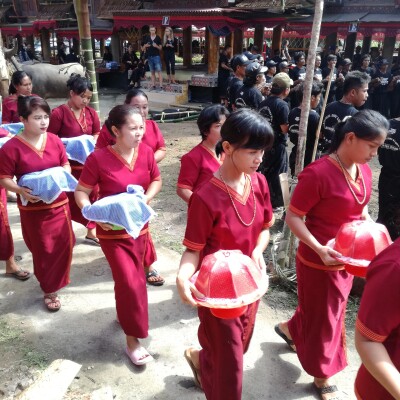
He assured me with a big smile. Right. Sitting behind him on his scooter, I was eager and curious to see how the ceremony would unfold. I had heard about it upon arriving in Sulawesi, but hadn't realized its importance. Only the night before had I delved more into Toraja funeral customs. Truly, it's a tradition completely foreign to us Europeans. Parato Tsikali, in Toraja culture, the deceased isn't buried immediately. After being mummified, they continue to live in the house, taking part in meals and family activities, awaiting the funeral. Funerals are expensive and prestigious, sometimes requiring months or years for the family to gather the necessary funds. I vaguely remember upon arriving at Makassar airport, a man telling me about these ceremonies. But how did he know one was about to take place? Indeed, the ceremony has increasingly become a dead tourism attraction for curatorial seekers. The ceremony spans several days, offering tourists everything they've dreamed of seeing. Animal sacrifices, tribal dances and chants, parades with mummified bodies... Until that night, I had no idea what to expect. It was a real shock. Barely arrived, I was struck by the number of people present. Forage a funeral gathered all family members, over 500 people, not counting a few tourists. Something was unusual. Photographers and cameramen documented everything at the family's request. We are used to filming happy events like weddings and baptism, but who will film a funeral? The place was surreal, almost like an amusement park. People everywhere, traditional houses, women in colorful clothing, men in black skirts, a DJ announcing arrivals and family members through loudspeaker, way too loud. At the center, tight pigs squealed, anxious and rightfully so. They were offering for the ceremony. By chance, or misfortune, today was their day to be killed and cook for the hundred attendings, including me. Initially, there were about 10 pigs, but as the day progressed, the number rose to 50. Buffaloes were also present, but we'll have another day before being slaughtered. The Fod chilled me. I was uneasy, dreading this moment. The disease seemed important. The funeral would last 10 days. Depending on social rank, the ceremony lasts longer. In Toraja culture, rank matters in life and death. A photo of the deceased was displayed along the path visitors took to reach the family. Each arriving guest presented condolence and a gift. Afterward, men dressed in black form a circle joined hands and sang to the ensembly while a few squealing pigs were nearby. A shiver ran down my spine. The atmosphere was strange, the frantic activity, the singing, the terrified animals, the laughing children and the cheap DJ speakers. A voice grabbed my arm. I jumped. My guide, interrupting my thoughts, urged me to follow.
- Speaker #3
It's time,
- Speaker #0
he said, drawing his finger across his throat. I froze, unwilling to watch. I told him I prefer not to attend, but he ignored me and guided me to the sacrificial area. 50 or 60 pigs were waiting, squealing. A man grabbed a knife and swiftly cut the nearest pig's throat. Its body convulsed as blood spilled across the dusty ground. I tried to look away, telling my guide, I've seen enough.
- Speaker #4
Don't you want to take a photo?
- Speaker #0
He asked mischievously. Why? Could I take a photo in the slaughterhouse? I retorted.
- Speaker #4
Look over there.
- Speaker #0
He pointed. I follow his gaze. The slaughter progressed quickly. The pig was already handled by hunters, gutted and cleaned. Minutes later, a man used a flamethrower to burn the hair for the cooks preparing the meal for hundreds. After finally freeing myself from my guide, I wander aimlessly, wanting to erase this graphic image from my mind. I met Dewi and her song sitting under a guest at chatting with family. We remove our shoes out of respect and I sat with them. They kept asking what I thought of the ceremony. Very impressive and unprecedented for me, I said, avoiding mention of the animal sacrifices. We continued discussing the region and interesting site. They told me about tree cavities where dead babies and young children were placed. The belief being that once the tree healed, the child could start a new life after death. Suddenly, a woman carrying a tray brought bowls of vegetables, rice and juicy pork. Oh, great, I thought.
- Speaker #2
Eat, it's fresh,
- Speaker #0
they exclaimed, grabbing a bowl and chopsticks. The joke being, it was freshly killed 25 minutes ago, of course it's fucking fresh. It was probably the hardest meal I've ever eaten. Not only did the pork taste of blood, but I heard the pig scream in the distance, being slaughtered minute by minute. It was a harrowing experience where... Reason couldn't control my feelings. I stay for another hour before asking my guide to take me back. I have had enough excitement for one day, and the actual burial wouldn't take place for a week. I wouldn't see the coughing place in the funeral niche, usually located on the upper floor of traditional Toraja houses. A few days before I arrive, tragic news has struck the area. During a funeral, the floor of such a niche collapsed, dropping the coughing onto a man, who later died of internal bleeding on the way to the hospital. Ironically, it was the song of the deceased. After this wild experience, I decided to eat vegetarian for a few days, reflecting on my own hypocrisy. I hate meat, but I'm sensitive to animal cruelty. I kinda decided to reduce my meat intake. This even traumatized me more than expected. But I wasn't ready to become fully vegetarian yet.