Description
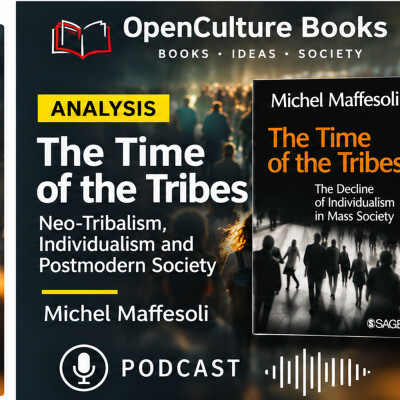
🎯 THE TIME OF THE TRIBES by Michel Maffesoli: Neo-Tribalism, Individualism and Postmodern Society
🔎 Are we really becoming more independent individuals? What if our social lives are shaped just as much by shared emotions, shifting communities and the need to belong?
🎧 In this episode of OpenCulture Books, we discuss The Time of the Tribes: The Decline of Individualism in Mass Society (Le Temps des tribus), Michel Maffesoli's 1988 sociological essay. The book proposes a way of understanding social life through emotional bonds, informal gatherings and collective identifications. Its ideas have contributed to debates about neo-tribalism, everyday sociology and postmodernity.
👥 FROM INDIVIDUALISM TO MULTIPLE BELONGINGS
Modern sociology often emphasizes the autonomous individual, personal interests and rational choices. Maffesoli redirects attention to the experience of being together: celebrations, lifestyles, shared tastes, social rituals and the feeling of belonging to a group. A person may move between different circles without committing permanently to any single identity.
The episode uses the image of a lava lamp to describe social formations that emerge, change shape and dissolve. Yet a metaphor is not evidence. How can we distinguish a lasting community from a temporary gathering?
💬 EMOTIONS, IDENTITIES AND EVERYDAY LIFE
The concept of neo-tribalism draws attention to emotional affinities, shared codes and gestures of recognition. Music, fashion, leisure activities and digital interactions may help establish belonging. Identity can then be understood as something negotiated through situations and relationships rather than a fixed personal characteristic.
But a group that offers solidarity may also impose expectations. Who is welcomed, who is excluded, and how do informal rules shape behavior? The discussion considers the tension between collective warmth, peer pressure and individual freedom.
🏙️ POLITICS, SOCIAL MEDIA AND EMERGING COMMUNITIES
Fan communities, associations, cultural networks and civic mobilizations can be considered through this sociological lens. Social media accelerate the circulation of feelings and symbols of identification. Yet digital platforms do not eliminate institutions, material interests or long-term political commitments.
Maffesoli's arguments remain open to debate. Can shared emotion explain political action on its own? How does a “tribe” differ from a social class, a network or an organized movement? The episode treats neo-tribalism as an interpretive framework rather than a universal law.
The distinction between a collective's social energy and institutional power raises another question: can spontaneous forms of belonging influence public decisions without becoming formal organizations?
🎙️ IN THIS EPISODE
- 📖 Michel Maffesoli and The Time of the Tribes (1988).
- 👥 Neo-tribalism, sociality and the decline of individualism.
- 🎭 Fluid identities, group membership and shared rituals.
- 🎶 Lifestyles, collective emotions and everyday interaction.
- 📱 Online communities and contemporary civic mobilizations.
- ⚖️ Belonging, exclusion and critiques of tribal thinking.
🔔 Listen to OpenCulture Books, tell us which communities shape your sense of belonging, and subscribe for more discussions of sociology, philosophy and the social sciences.
#MichelMaffesoli #NeoTribalism #PostmodernSociety
Hébergé par Ausha. Visitez ausha.co/politique-de-confidentialite pour plus d'informations.