Description
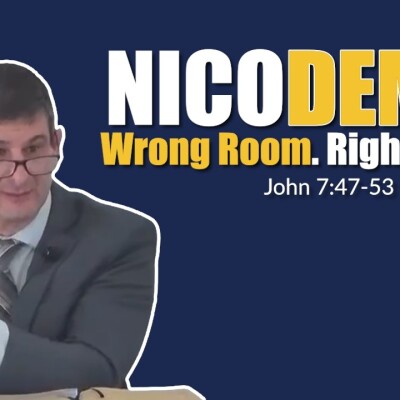
📖 John 7:46-53 • When the officers said "Never man spake like this man," the Pharisees didn't ask what He said. They attacked the men who said it.
⛪ Preached at Pilgrim Baptist Church • Cookeville, TN • March 15, 2026
The officers returned from their failed attempt to arrest Jesus and said something that stunned the room: "Never man spake like this man." The Pharisees didn't ask what He said. They had no interest in investigation. What followed was a masterclass in how institutional religion defends itself — not with Scripture, not with argument, but with three weapons: credentials, class, and geography.
Nicodemus steps into that hostile room with something the Pharisees didn't expect. He had been doing his homework. Armed with four texts from Deuteronomy they were supposed to know, he asked the one question nobody in that room could honestly answer. And in doing so, he followed the exact pattern Jesus modeled earlier in John 7 — expose the hypocrisy with their own law.
This message traces Nicodemus's slow but steady movement toward the cross — from John 3's darkened conversation to John 7's risky stand, to John 19's 100 pounds of burial spices. It shows how God honors partial obedience. It shows what judicial blindness really is. And it ends where the chapter ends — every man going to his own house, no guilt, no sleepless night — which is the most disturbing line in the passage.
This verse-by-verse exposition walks through John 7:46-53 and connects:
• Why "Never man spake like this man" was the beginning of the Pharisees' crisis, not a victory
• What was really underneath all that fury — and why fear never stays hidden long
• The three weapons religious elitism uses when it can't answer the argument: credentials, class, and geography
• How Nicodemus armed himself with Deuteronomy 1, 17, 19, and 25 — their own law — to expose their lawlessness
• Why the Pharisees' claim "no prophet from Galilee" was a lie they should have known was a lie
• Jonah from Gath Hepher (2 Kings 14, Joshua 19, Matthew 4) — a Galilean prophet who was the blueprint for the resurrection
• The difference between judicial blindness and honest ignorance
• Why darkness is not inevitable — it is preferred — and what that means for every person in the room
Hosted on Ausha. See ausha.co/privacy-policy for more information.