- Speaker #1
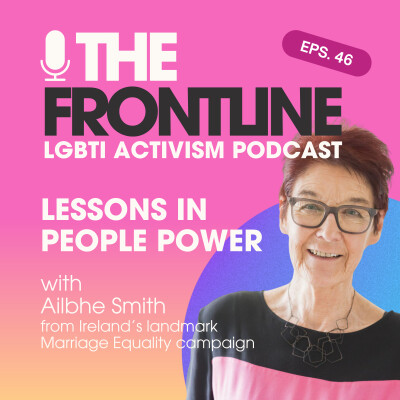
Hello and welcome to The Frontline, a podcast from ILCA Europe for anyone who's organising, campaigning or fighting for LGBTI equality. This year marked 10 years since Ireland voted for marriage equality and before the anniversary year is out, we wanted to share this episode with you, featuring our very special guest, Ailbhe Smith. Ailbhe was one of the founders of the 2015 Marriage Equality Campaign. and has been a leading voice in Ireland's biggest social movements for decades. What you're about to hear was recorded at the ILGA-Europe annual conference last October. It's part storytelling, part strategy session. Ailbhe talks about how ordinary people built extraordinary power, the moments that shaped both the marriage equality and abortion referendum campaigns in Ireland, and the choices that helped turn grassroots energy into real national change. All right,
- Speaker #2
let's get into it, here's Ailbhe Smyth. I'm just going to you know plunge straight in and say that over you know the past decade in 2015 and again in 2018 we had really great victories in ireland which broke through centuries of repression and oppression and which signaled really the end formally if you like of the end of the power of the Catholic Church over the secular agenda in Ireland. So I think that one way or another, it's certainly true to say that Ireland is now a more secular and liberal country, although I would also say that we are deeply capitalist. So those things kind of go together and also tend to go against one another. In 2015, we had a constitutional referendum. on marriage equality, which was about the universal right to marriage. And in 2015, a couple of months later, we also had legislation passed by our parliament, which was the Trans Recognition Act, which is still, I think, actually the most forward looking legislation in Europe, although service provision and actual policy provision lags far behind, particularly in relation to health. And then in 2018, we had another huge referendum, which was to repeal a constitutional provision which had made abortion illegal and a criminal offence since 1983. And we repealed that to ensure that abortion would be free, which it is, safe and legal up to 12 weeks on request and afterwards it's problematic. Okay, so things are not altogether rosy in our gardens. So today is really... a kind of what you might think of as sort of distillation of some of what I've learned. And by the way, those two, I mean, you know, as my friend Brian Finnegan said to me yesterday, he said, this is not our first rodeo. It absolutely isn't. We've been out there campaigning and fighting like many people here for a very, very long time. And I always think that when the going gets tough, we've been there. We know how to do this. We know how to kind of get through it. It really, what I'm talking about today is more sort of a pulling out of some of the things that I have learned for myself over campaigning and particularly maybe campaigning in really big kind of society busting referendums. We're lucky in Ireland in one sense because we have a constitution, unlucky because it can prohibit things, but lucky in that we can actually get out there with people power. and say we want to change this constitution because we don't like it anymore. So I've been through many referendum fights, two divorce referendums, the second one we won by a hair's breadth, six abortion referendums, marriage equality and a few other things in between, not always so glorious. Seven to ten years later, ten years after marriage equality, seven years after the abortion referendum globally, I don't have to tell anybody here to remind you that times have changed. And we are now in much darker, more bellicose, militarised times where there is anger and hatred, which is being spewed around and also re-emergent and resurgent fascism in so many parts of the world, and not least here. in Europe and a major move to the right even by our liberal governments in many countries. Although not actually everywhere we have a presidential election which is being voted on today in Ireland. Our president doesn't have much power, it's soft power, but it's absolutely certain that the person elected will be left-wing and definitely a socialist, which is a kind of signal to government that we don't like the move to the right. But when it comes to our everyday lives, We want to... a centre-right government to bind our economy because capitalism is what pays our way. So it's very complicated. It's also, of course, very important to say that at the moment we're in a very different social media space. There's been that mega explosion of growth and change of pitch and tone in social media, swerving towards coarseness, negativity, hatred and violence as a very destructive force and I do think that it's It's really important for us to understand that unless we can have power and control and actually begin to get rid of the algorithms, we are all actually in trouble. Overall, therefore, without wanting to depress you too much, it is a time of great danger, where in many countries rights are being taken away and we're fighting to protect and hold on to what we have, we have while at the same time we're having to fight for freedoms that we don't yet have and that is true in very many countries including here where we are at the moment and sometimes we're both trying to hold on and fight to expand you know the left hand is doing one thing the right hand is doing another and we're trying to bring them together so i think that it's really important for me certainly as an activist to be saying to myself all the time that it's really important to hold the line to keep what we have and to never, never, never underestimate the power of oppositional forces to take it away from you and to preserve it and protect it, while at the same time never giving up the determination and the, I suppose, really, yeah, determination and the ambition to always be fighting for more because we live in such a very difficult and always imperfect world. My point, I suppose, here that if in Ireland we were fighting for marriage equality and for trans rights and for legal abortion now, I don't think we would be fighting exactly the same kinds of campaigns. And I think it's very clear to us that we learned from previous campaigns that we are capable of inventing, finding and putting into action new strategies, new ways of dealing. with changing situations. Things don't change the same, which is really, I suppose, my first key point, which is that there isn't a template or a blueprint for a campaign. People very often after marriage equality or abortion would come from elsewhere and say, oh, tell us how you did it. We want to do that too. And I'm saying, well, no, actually, there isn't a model. There isn't a template that you can write down on a piece of paper and give you. But what there are, I think. or maybe key elements and principles that we have actually found useful that grounded us in our campaigning. So I'm really quickly going to go through some of these. And the first one, I think the first point I want to make is that it's really important and it follows on from what I've been saying is that it's really important to be sensitive to your own context. We in Ireland were overwhelmed often by people coming to us and telling us what to do. because they had done it here or there or elsewhere. And very often we were in the situation of saying, yeah, but that wouldn't work here because Ireland doesn't work like that. Politics don't work like that. Irish society doesn't work like that. Our value system is different. Our history is different and so on and so forth. That what works in one place at one point in time may not work in another. No one set of strategies and tactics is transferable from one place. to another. We can learn from other campaigns and we can select out what we think will work best for us in our context. But always remember, you know your context better than anybody from outside it. So it's up to you to assess and evaluate and work out, is that something that will fly where I live and at my point in time? And of course, the context always has an impact on strategy. We knew, for example, with both marriage equality and abortion, that it would be historic if we won because it was moving the Catholic Church definitively out of the political arena and signalling a move towards this more secular society. Therefore, these were whole society issues. It was not just about the LGBTIQs. It was not just about women. It was not... just about those who could become pregnant. This was really about what a whole society thought about itself and the freedoms that its residents and citizens could have. And I make a difference between residents and citizens, because as we know, not every resident is a citizen in our vastly, swiftly moving world, sadly. And those of us who were fighting for reproductive rights realised quite quickly. that marriage equality needed to come first. And I think that's kind of interesting that abortion was the harder issue in a way for us, or at least that if we got at marriage equality that we could then move on to ask for abortion. Because in marriage equality, we were asking the Irish voters in a referendum to vote for something they approved of. They approved of marriage. They liked marriage. They get married in droves all the time. So we were simply saying, we as LGBTIQs, a lot of us, not necessarily all of us, but a lot of us want to be able to do that. We want to have the freedom to do that. Whereas with abortion, it was different. We were saying, we want you to allow those who want abortions to be able to have something that you may not approve of. But to say, that's not my business. We don't walk in your shoes. So they were both the same and not the same. They're both about autonomy and about... bodily autonomy and about freedom, but coming at it from different angles. So the campaigns reflected, I think, in their messaging and framing of the issues, those differences. So you always need to be thinking about what is my context here and what am I really asking, what am I really asking for and who has to be convinced? What is as difficult and if so, in what ways? Is there something easier and if so, in what ways? The second point I make, and I'm really flying here, is it's so important to have a very clear, manageable, achievable goal, something that can be done, something that people can latch on to very concretely. And I've always found in my own experience that demanding rights is too abstract for people. They kind of get lost and they say, well, they want freedom. All right, OK, what does that look like? So name it. It is, in one case, marriage equality, it was the freedom to have the choice to marry. In the case of abortion, it was the freedom to have an abortion. But we didn't ask for freedom. We asked for those specific things. And sometimes, of course, you have to break it down into bits. And I'll maybe come back to that in a minute. But you need a very concrete goal that you name. So with trans legislation, for example, we were asking very specifically. and it was over a long period of time, 20 years, for recognition to be written into our laws. So where you need something concrete, if it's vague, people don't get it and they don't hold on to it and they don't do it. I think related to that is really a third point. I think with campaigning and it's so difficult in the world we live in that you need what the French call the longue durée, the long view. You absolutely need to accept that this may take a really long time and that you may have to, you know, break it down into achievable, manageable bits as you go along. When I think about it, marriage equality really started in 2005. Abortion started in 1983 when we had a constitutional referendum banning abortion. Trans recognition, as I was saying, was started by one very brave woman way back in 1993 as it happened. So in a way, as activists, I think it's always important. And whatever stage of life you are at is to say I'm training for the long haul. I may not be able to go the long haul, but I'm kind of in it for life. And of course, it's also true that once activism grips you and grabs you, you really don't know what life is without it. Well, maybe I'm exaggerating slightly there. But the point is, it is long haul work. So patience and sustainability need to be built in to your campaigning if you can possibly do it. Finding ways of sustaining yourself and sustaining others. And I'll come back to that, I hope. So change can take a long time. It may be necessary to do it incrementally, and that's a judgment call. Sometimes you've got to go for the whole full shilling. Sometimes you can break it down. But I don't really, I don't actually want to be depressing you. And I also want to say that in a campaigning mode, there is not always, but very often, something that happens, an event, a happening, a mood, it can be a shift in mood. a shift in the political makeup that tells you that is your kind of aha moment. This is a time for us to move. Sometimes it can be very, very obvious. And I think with marriage equality that was created by Catherine Zappone and Anne Louise Gilligan, the couple who actually took a case to our High Court about taxation and seeking to be taxed as a married couple because they were married in the US. but that marriage wasn't recognised in Ireland. In abortion, it was the very sad, tragic death of a woman who died because she was refused an abortion and she died of sepsis. So, you know, appalling things happen. It can also be a change in mood. It's just something that you're always looking out for the change moment that is the catalyst that allows you to go. So the case that was taken in Arlington in 2007. was the catalyst for the building of a social movement for marriage equality. The death of Savita Halepenavar, who is that woman who died in 2012, that was the catalyst for actually again renewing our pro-choice movement. But I would also say to you that there are other occasions where it's hard to grasp, there isn't something happening and you just have to do it now. Now, now we cannot wait any longer. And you actually have to put in place the kinds of pressures that will get people out there. So after you then need to set a time frame, because I think my own experience is if you say to people, this could take forever, it could take your whole lifetime. People say, oh, yeah, I don't think I can put my hand up for that one. Thank you very much. So you take a punt and you say it's going to take us five years. five years is good people can do five years three years is too short and everybody knows that five years sounds good ten years forget it so i always say this could take us five years sometimes it takes longer sometimes it never happens sometimes it takes shorter but what i'm saying is be practical be concrete be specific say everybody can do this for five years to build a movement and then remember that you've got to maintain momentum you've got to keep it going they've got to be. You've got to get out there on the streets. You've got to have events. You keep people moving at all times. And you would have seen that in Vanessa and Linda's great film last night. I was saying, you know, the pace of the film was actually also the pace of the campaign, that there was something going on all the time. And the time frame means that you could actually do long term planning and think strategically across a long term. And that's very important. And then number five. you don't have to keep the numbers i have them all here but number five is Really central. Building unity, building solidarity. I cannot overemphasise how fundamental it is to create unity. And even more today than it ever was, our strength lies in collective and collaborative action. And it also tells us that we are many when you build unity and you go across cross-sectoral. cross-political, transgenerational, you begin to think there are many connections between movements, there are many connections between different kinds of groups and organisations. We can work with trade unions, we can work with student groups, we can work with radical political groups, we can work with queer whatevers. We need all of this to come in and to be unified and to come together for a common goal. even if we disagree quite frequently and quite often about the means, as we work together for a common goal, we will come closer in agreeing on the means and the strategies. And I've certainly found that in my own experience, that you put in that long-term work, and that is actually what happens. People agree to disagree about certain things, but to work together for the common aim. And it doesn't matter what you call this coalition, allies, alliances, platforms, networks. I don't care. The point is, is it about solidarity? Is it about going for a particular thing in a particular time frame to get it together? And then what happens afterwards? Whatever you're having yourselves. Right. But you need really to work at it. And what are coalitions, platforms and networks about? They're about relationships. They're about building. relationships. So you are constantly out there working, talking, convincing, phoning, you know, on your social media with people, contacting, saying, are you coming to this? Did you do that? You'd be great at doing such and such. And it's great to have a posse of people who are prepared to do that kind of work. And when people slip off the wagon and go and disappear, try and hold them back. If they don't come back first time around, forget them. They're gone. Never mind. plenty more from some other source. Don't mind about losing people. Keep your main people and keep in contact with them and try to do things that really help you to enjoy one another's company. That can be difficult. I have worked with a lot of people that don't really like very much, but that I ended up kind of respecting and thinking, oh, I do like the things I do. They've got quite good sense of humor, really. are they're able to let their hair down and dance or whatever it is or we can have a beer or a glass of wine or a picnic together so it's about kind of also looking for it's the white water rafting of campaigning and we all need those moments in our campaigning number six is strategic thinking from the very beginning you're saying we're going to be strategic here we have a name we know what we want and we're thinking about the best means to achieve this. And your strategy is always rooted in an analysis of the situation. What are your challenges and obstacles and what are your opportunities? You're always looking at those two ends of the spectrum and actually thinking, what do we have to deal with and in what order do we deal with it? And that's going always to be your strategy. And you keep your strategy there, it will evolve, it will change. circumstances change it, but you start off with a clear strategy, you know what you're up against, and you know how you need to tackle it. And that can take a while to work out. It's best done collectively. And it's also great if you can actually write it down somewhere, because then you'll see where it needs to change as you move along the way. And I'm not telling you what the strategy is, because that depends on your goal. You know, if I think about trans legislation, That was judicial and legal. So it was all the lawyers and some of the politicians. Marriage equality was politicians first, people second. Much the same with abortion and getting the Catholic Church out of the picture to the point where it actually removed itself after marriage equality, saying, no, no, we stand for different things now on the sidelines. And then within that strategy, you can embrace a mix of tactics and approaches. all focused on and every everything you can possibly bring in. I remember, you know, that we had all kinds of there was a lovely thing during marriage equality, which was phone your granny and you had to ring your granny and say, now, granny, I think really be great if you could vote for marriage equality with the grannies of Ireland saying, excuse me, young one, I was there long before you. Of course, I'm voting for marriage equality, not to be condescended to. So there were lots of really lovely transgenerational conversations. But, you know, lots of tactics. Never forget the importance of the ground troops mobilising on the ground, getting out there on your feet. Why? Because it terrifies the politicians to see crowds of people. And they hate it when you stand outside their parliaments. And the second thing it does is it creates solidarity. There is nothing more amazing than being in a huge protest of people, singing songs, holding hands, shouting slogans, power to the people because the people have the power. You can hear I can't sing, but you know, I don't care. We do it anyway. That sense of marching with people. is really important. So even if it's not going to convince the politicians, do it, because it brings people together in that collective attempt to change the world. And who doesn't feel good when they're not? You know, when you feel good when you're out there, you feel this is I'm doing something meaningful with my life and for other people and with people. So you feel connected, you feel powerful, you feel you've got purpose in life. It's really... fantastic, never underestimated, even when it's raining. And in Ireland, that happens quite a lot, actually. I'm going to move on now, but framing the issue. Oh, my goodness. You know, we all spend so much time on working out our messaging, but there is a kind of that first moment where you think, how are we going to talk about this issue with our public, whoever our public is, our electorate, our voters? the judges, the lawyers, the politicians, whoever, how are we going to actually frame it and communicate it? And I think it's always really good to root that, if you possibly can, in some kind of research, qualitative research, to find out what ordinary everyday people are actually thinking about this particular issue. And particularly, what are their fears? What are their reservations? What are they really afraid of? What are they wary of? What do they think is not? good or right or difficult or dangerous about this issue. And very often as you dig, you kind of discover that actually the fears are quite easy to push back. I mean, maybe not easy, easy, easy, but it's giving you that understanding of what you're up against. And also an understanding that actually people are very rarely I reckon in Ireland there is about a third of the population is completely, you know, anti-marriage equality, anti-trans, anti-everything. We've moved it back to a third, but those people are not going to be moved any further at the present time. Our job is to make sure that that doesn't grow. But the others are more open, can be shifted, can be moved. Sometimes they're called the movable middle. Sometimes they're called the conflicted middle, but most people have. a desire to be good. Most people have a desire for love and peace rather than hate. I'm not saying everyone. We know the forces of hatred are there, but the majority still want to think that their values are rooted in humanity, in love, in peace. You might think, oh my God, that's crazy when you just look around the world. But fundamentally, I think when you scratch beneath the surface, you do discover that. And that's what you're going to try and appeal to. So marriage equality, for example, the messaging was quite flagrantly and blatantly about love. This is about love. Love shouldn't. And there are posters out there for other people's ME campaigns. It's about love. It's about family. It's about wanting to be part of society. It's about not being dangerous. And there are many queer people who felt, well, you know, I'm not so much for those things. but I do understand that other LGBTs have a right to those things. So I'm going to go with this. I'm not going to go against the at the vote for abortion, for example, which was very different. That was not about love. It was not about stability. It was not about family in a very direct way. What was it about? It was about health. It was about well-being. It was about the well-being of women. And it was about equality of women. So you're always looking for how do you you frame it? People used to say to me, but these are moral issues. And I would say, no, they're not. They're social issues or they're health issues or they're practical issues. Let's get it out of the domain of morality. What's that got to do? Ethics do matter. But actually, when you look at these issues practically, they are about how people can live their lives on an everyday basis and can do so fairly and with a degree of equality and dignity and respect. So... Getting your framing right is really important and you move from there then to begin to develop your messages.
- Speaker #0
So love, as I say, and a big heart was really important in marriage equality. The second bit of that, which is point number nine, is actually pitch and tone. We were fighting referendums. In a referendum in Ireland, the people believe they don't want the politicians to interfere. You always have to convince the politicians to call the referendum. And then the people want the politicians to get out of the picture. Why? Because the people... are sovereign. We, the people, make the decision. So this is, it's almost a kind of mantra, we, the people, make the decision. And people want to feel that they are actually making up their own minds. So you don't go out and lecture the people and hector them and say, you've got to do this and you've got to do that and you have to vote for the other. You don't lecture, you don't tell people what to do. You say, this is what I'm doing. What do you think about that? What's your view? Tell me about it. Have a chat with me. Talk to me. I want to hear what you think. I want to know what you're thinking. I want to have a conversation with you. And you might think, oh, that takes ages. OK, so get more troops on board. You know, we have to have those kinds of conversations. And while social media is a help with those conversations, it can also be a hindrance. So be careful. Social media is not going to do everything. It can't. and it won't. What actually does help is people in their communities, people in their families, people in their neighbourhoods. So you need it to be local, local, local, as well as national, national, national. So that goes for every size of country. I mean, I know I was saying last night that it's kind of easy to knock on every door in Ireland because small country is only five and a half million or something. And you can actually get around pretty well to all the doors. Big, big, big countries keep it local. You know, it's like. You've got to think, how do we get to talk to people? Because it's that conversation, that even if it's in a meeting, that really makes the difference. And people are flattered and honoured. They feel respected when you say to them, I think this, but what do you think? I'm interested in you. I mean, what is it that everybody loves in their life? To be noticed, to be wanted, to have your opinion sought after, to be... You know, we all want to feel important and that what we think really matters. So you have that conversation. Some people are never going to be convinced. And I say, I don't think we're going to agree on this. I respect you. You have your own opinions. We'll just part company and I'll move on to somebody else. So on the doorstep, I was great at saying, OK, I have to move on to somebody else who I might be able to convince and just leave them. Just leave them. They're not going to change their minds. I'm not going to change my mind. on the things that I believe in fervently. But it's our job to try to bring those people who are not quite as fervent onto our patch. Okay. And also keep the tone conversational. Don't make it all pompous and goody-goody and holier-than-thou. Keep it everyday. This is about everyday life. It's about reducing distress, creating freedom, making life a bit easier for people. Less hurt, more love. Less hurt, more... more peace and calm and and possibilities and always always always remember that talking to people in real time irl is worth its weight absolutely in gold um you also need to remember and this comes with the talking i always try and remember that what you're really trying to do is to move people's hearts. It's not so much you need the formal debate. things for television, stuff like that. On the ground, you're trying to get to emotion, you're trying to get to heart. So what really matters are the stories and the real life experiences. And we know now when people are so distrustful of our politicians and our governments, that people want what's genuine, truthful and authentic. They want to know this is real, this is real life. And I think that... That's something which can be hard to get to, but once you actually do get to it, of speaking really truthfully from experience or from other people's experiences. I mean, we had wonderful poster campaigns that showed families and what they looked like, you know, what LGBT families actually looked like. And they actually looked so like everybody else's family. I mean, they had things like dogs. There were friends of mine who had a dog and I said, you can't have a dog. And he said, but part of our family. So it's about saying, you know, this is what we look like. We're not. We're not what you I don't know what you think we are, but this is actually who we are. I suppose my kind of concluding point on messaging and so on is social media. And I would say to you immediately, why on earth would you listen to me at my stage in life saying anything to you about social media? Because I am not a social media native and I can learn how to operate stuff. But I actually don't have that built in DNA that those of you who are so. decades and decades younger than me. But what I have learned is that I don't know how to do that from within me somehow. Therefore, I, we need the very best expert people that we can possibly find around the place to do it. Because I was looking at, for example, the Zoran Mamdani campaign for the mayor of New York, the Democratic nomination, and his ground team was hugely important. people drafted in from all around to actually do the canvassing on the ground. And his social media, his social media work was absolutely superb. So we can control this. We can make it work for us. It's a really fascinating campaign to look at in terms of learning how to how to do things. You know, but the other thing is, of course, that it's moving all the time. As I understand it at present, it's still with Insta and TikTok. But who knows? Who knows where it's going to be tomorrow? I know that from 2015 marriage equality up to 2018 abortion, we had massive changes and had to, you know, rethink how we dealt with social media, huge changes. And from 2018 up to 2025, you're talking about different world, completely different, which have to be done very differently. So and the haters and the trolls and the bots have to be concerned, have to be controlled. But the one thing I would always say to you, remember, social media is for your message. You use it for your message, not to waste time on interacting with those who hate you and who are against you. That is a distraction. That is a waste of your time. You are out there with your message all the time, all the time. Think about how corporates advertise. I rarely, rarely take a lesson from the corporate copybook, but I do there. They never stray on to somebody else's territory. They keep with their message all the time. So I think that's really important. Finally, money is great and money is really necessary, but it is not absolutely everything. I know funding is really tough at the moment, but what people power can do does not cost a huge amount. Your jobs cost a lot. I'm very well aware of what's at stake for those of you working. in LGBTIQ organisations, believe me. But it need not totally stop us campaigning. When I began, way back when, beginning of the 1970s, in the women's liberation movement and the movement for gay liberation, God, when you think why did we get rid of those words liberation, let's bring them back. We didn't have any money. We didn't think about money. It was almost pre-capitalist, almost, not quite. and we just got on with it and we got out on the streets. There is something about doing our campaigns in a more homemade kind of way now that people actually really like. They don't want super slick. They believe you more if you're not super slick. They don't want to see that you're all corporative. They want to see this is homemade. This comes from our hearts. So worry about money, of course. We all worry about money. But don't let it get out of control. Don't let it get out of control. We had no money when we started both of those campaigns. And in each case, money kind of just sort of came. Not in millions and millions, but enough. Finally, finally, finally, finally. We talk a lot about self-care, but I always say take care of each other. Look after one another. Self-care is a huge responsibility. Am I responsible for my own care? Share the care. share the care. If you look after others, they will look after you. And I think it's really important for us to remember that, to allow ourselves to be looked after. And take a break when you need it, but never, ever, ever give up. So just a few little concluding words. Don't know how I'm doing for time, but it is really, I think, a very dangerous time. But that means that it is more important than any other time I can think of in my own campaigning life to keep faith with our beliefs, with our values, with our ambitions, with our desires for a different, better, kinder. fairer, more equal world. And that that is possible. We have gained and changed a lot over the past 20, 30, 40, 50 years. A lot has changed. We can do this again. We have to hold on tightly to what we believe in. But I think that our humanitarian and egalitarian values can actually help us through to something which has brighter, brighter light. And in any case, we can't afford to sit inside our sorrows, as the great black American activist June Jordan once said. We have to keep hope active. Hope is not a thing. You can't just put your hand up there and pluck it down from the sky because it's a verb. It's an action. It is a doing. Through the action, through the doing, you understand that you are hopeful. and hoping. You do hope, you make hope, you act hope, you be hope. It's not a thing. So the more you keep doing, the more actually you are able to keep hoping. I mean, I just think that fighting together, that unity, unity in hope for this different world is really important. So my final three words are hope is a verb. we're stronger together and finally we resist to exist if we stop resisting so many of us will actually not exist so finally this is no time to turn our backs the great new reed it is power to the people and we are powerful
- Speaker #1
Well, I'm from the Irish Embassy. Hi, Shane. I'm curious about the kind of method by which you take the models and the strategy. So in the film, it was kind of a dysfunction of the civil partnership. And I am interested in how do you weigh up the incremental versus the... What goes into the decision to look for increasing rights and freedoms versus deciding to go fully?
- Speaker #0
Well, actually, that's a really kind of very key issue. There isn't an absolute answer. I think it's definitely context specific. I think incremental or what Sarah Schulman in her. great new book on solidarity called Gradualism, can be very, very useful. But it's always a judgment call. And you have to weigh up, if we go for that incremental gain, how long before we can go the next step, so to speak. And I think in marriage equality, that there was sufficient sense, because marriage equality was actually existed elsewhere. that this was a real thing and that if we started going halfway house in Ireland that we could be stuck there for a long time because our politicians might become nervous, conservative, whatever. They were centre-right anyway and that we were almost on the cusp of being able to ask marriage equality so we needed to create the conditions where that became more part of the conversation. But that was definitely a judgment call and, you know, trying to move between those two things, because there was an organization, as people saw in the film and as you saw last night, calling for civil partnership. And there then was an organization called Marriage Equality calling for marriage equality. And in the end, the two taint. came together, which is where the unity and the solidarity came from. But at one stage, I mean, it definitely looked as if the whole thing was going to be kind of toppled by the call for civil partnership, because that appealed more to the politicians. And I think there was something there that taught us that there comes a moment when you kind of know it's not intuitive, it's really based on listening to what's going on, that there is enough space to ask for the 100%. and that you'd be better off going for that even if it's going to take you a couple more years to get it, which is exactly what happened. And I think that's very, very important. And it happened in the subsequent referendum as well, that we had to keep going to get more than we might have got in the first instance. are not stupid. They actually know when you're asking for a halfway house. And if you kind of can just feel it, can I just trust the people a bit more, that I can push them a bit further? Will it take that much more to push them? And I think in marriage equality, we absolutely felt we could push them a bit further. At the same time, there was much that was really admirable. about the civil partnership people. And I have to say, without giving any secrets away, that a lot of people I knew, several people I knew in marriage equality, actually went and got civil partnerships as soon as they were introduced, because that gave them certain kind of legal protections where their families and kids and so on were concerned. But it's always a judgment call. At the moment, I think you're always, well, I think it's always sensible to say this is what we really want. Now, let's work out what's the best way to get to that. Do we go for that now or do we go incrementally? That's conversation, research, listening to people. It's not an absolute. There is no yes or no answer to that one. Okay? And that's what campaigning is about. You cut your top. You have to cut your top.
- Speaker #2
Thank you for this detailed perspective. Hi London, I wonder according to your opinion, considering a campaign which foresees people in the street advocating, talking with everyone in the street, no? So, for example, a campaign not for a referendum, but another tool which is popular law, okay, we have in Italy this tool, no? But it's such a kind of referendum that is different. How would you train?
- Speaker #0
these people how would we how would you plan a training for people which are really being an activist does that mean that people are ready to talk to anyone first of all i just as you were saying that i thought to myself it isn't always safe everywhere to be on the streets i'm very well aware of that so again you know you you're always thinking of the safety and security of the people that you're you know, who are your activists, you know, your sister and brother activists, so to speak. But I mean, we always try to do, throughout our campaigns, to actually do those training sessions. This is how you talk about it. This is how you be. This is how you relate to people. And, you know, actually to do active training. So it is about those who are more experienced in doing this kind of work. of actually working with the activists. I mean, we didn't have money to pay people to do training. People often came from elsewhere, other countries as well, to help us. We did a lot of it ourselves and it was a constant, it's a constant thing throughout a campaign because at different times you're training people to do different things. So for example, in marriage equality we had an out to your TD campaign, out to your parliamentarians campaign. People had to be trained. How did they go in and speak to their Parliamentary representative? How did they find out where the office was? You know, they're very simple things. So we'd have those, we'd put stuff out in writing, online, and also then have sessions. And people would have little scripts, which sometimes they kept to and sometimes probably they didn't. And so you'd have all of this. And also then, you know, for other more, how did you do debates? If people were going to be on radio or on TV, how? we would have training very often given by ourselves and then at the later stages of a campaign maybe more professionally where we would be able to call in free professional help and so on so you're always thinking about working with the people who are doing the work to make sure that they can do that more safely sometimes it's called training sometimes it's called your weekly meeting and your weekly meeting you have now let's actually look at What tone of voice do we use when we're talking with people? Next week we're going to take on this particular argument. How do we deal with this? How do we deal with obstreperous, difficult people? You know, so you're looking at different things all the time. So training is always part of it. And the other dimension of that is training. Yes, people go out and they do their work, but then you also have to think about support for them when they come back off the street. because the street can be a difficult or the knocking on the doors can be a dangerous, difficult, soul-destroying place and you can get knocked back by people, maybe not physically, I would hope, although that too can happen, but we always try to set in place some kind of laughter support for people. We didn't always do that very well, by the way, because that's more kind of labour intensive. But where you can do it, put the best support possible, that there's a number people can call or a text or whatever to say, I had an awful experience today. I don't know what to do. I'm very upset. You know, we used to have people crying. But the other thing we did was always to have people going out in twos and threes. You never went out on your own. at least not in principle. And I would never, ever, ever say to somebody to go out and campaign on their own. I think now we need to do it in groups. You know, there is some safety in numbers. And there are also even in Dublin, even in Ireland, which we're just beginning to get outright far right extremism really hitting the streets. Bad incidents this week while I've been been away, you know, I would be really, really, really careful. about people not going out on their own. It's not a great idea. Anyway, it's more enjoyable. So does that kind of respond a bit to your question about training? I hope so.
- Speaker #3
So what helps sustain collective hope and energy for change?
- Speaker #0
Camaraderie, friendship, fun, some play, being gentle with ourselves, looking after each other. saying, I know you're a bit depressed today. Why don't we go out and do something really nice? Why don't we take three days off or a whole week? Treating each other like human beings who need a break now and then. I raise you up when you're down and you'll raise me up when I'm down. So keeping one another going, holding hands, holding on to one another, really, really, really helps. And the other thing that really helps... I think all of us as activists have that really deep kind of commitment that you keep going absolutely for as long as you can, because people need that. Their lives depend on it. And that does help us, I think, to keep going. And there is nothing, I mean, after all the big campaigns I've been involved in, there've always been usually tons of young people saying, but what am I going to do with myself in the evenings now when I'm not out canvassing and campaigning. I say, oh, no problem, no shortage of issues for us to keep working on. And sometimes they say, yeah, but I have a job, I have family, I have other commitments or, you know, I've fallen in love. I need a bit of time to fall in love. Absolutely. But don't give up the campaign and come back when love has settled a little bit. Remember that life is for living as well as for campaigning. I think that's really what keeps you going. And loads of vitamin C. Great believers. Vanessa will contest. I always remember a group of much younger women actually at some particular meeting saying we're exhausted i'm saying you're not taking enough vitamin c um and there's something about believing believing that you can kind of get there as well and just enjoying it as much as you possibly can if it becomes too much of a burden you need a break you really need a break and then you'll come back maybe repressed or go and do something entirely different.
- Speaker #4
Thanks for listening to this episode of Frontline. I hope Alva's insights left you feeling energized and reminded of just how powerful people can be when we organize together. If you enjoyed this conversation, there's plenty more where it came from. The Frontline features organizers, activists, and change workers from across the region of Europe works in, all sharing the lessons they've learned on the ground. So make sure you follow or subscribe. and check out our other episodes. Thanks again for tuning in and we'll see you next time on the Frontline. Bye for now.