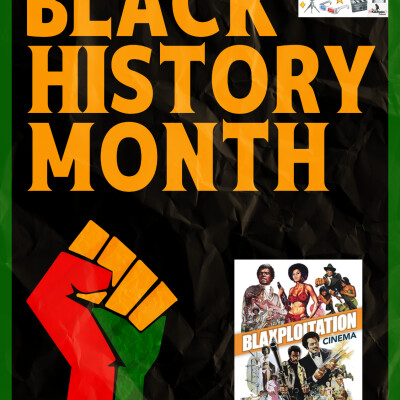
Speaker #0Hello boys and girls and welcome to Movie Goodness here on the KB Radio Network. I am your host Kevin Reed and we have reached the month of February in the year of our Lord 2026. And of course we all know that February is Black History Month. And every year I do a Black History episode on... Movie goodness and here on the KB radio network and I take great pride into Doing it. I know black history month is kind of iffy around the country when it comes to the teachings of black history and you know, celebrations of black history, but we we're not we're not Those people, we are going to dive into black history and not the gloom and doom version of black history. I hate I shouldn't say hate because it is important to learn about the doom and gloom portion of our history. But I can't stand it. That's all we hear about. Oh, all you hear about is Martin Luther King. All you hear about is Malcolm X. All you hear about is the civil rights movement of the fifth. fifties and sixties and so on. All that's fine and good, but there's more history to black history. There's black history being made every single day. And this year in 2026 marks the 100th year that we are celebrating black history month. February of 1926 was the first commemoration of black history. And now back then in 1926, it was negro history week and that was brought to us and and launched by the great carter g woodson who spearhead and launched this uh phenomenon this this commemorative event that takes place every year and you know i've heard the argument in this one black people it's for my own people i've heard the argument that oh why we get a black history month or why do they get a black history month you don't get white history month and stuff like that okay that's their business you know they got 11 other months to celebrate you know but we got a month and we we should take this time to commemorate all that has been before us all that has happened before us i should say and celebrate and this is the theme of the 2026 Black History Month. Every year has a theme. This year is a century of Black History commemoration. And we should look back not just on one era of time, all the eras of time that African American or Blacks have made an impact not just in the United States, but around the world as well. Just a little history about Carter G. Woodson. He was born in 1875 in Virginia. He is a historian, or was a historian, an author, a journalist, and he was the founder of the Association for the Study of African American Life and History. He is a founder of the Journal of Negro History, which was first published in 1916. he has been called the father of black history carter g wilson he devoted his life to historical research he worked to preserve the history of african americans and uh accumulate a collection of thousands of artifacts and publications uh he noted that african-american contributions were overlooked ignored and even suppressed by the writers of historical textbooks and the teachers who used them. Now, this was a hundred years ago. And I'll like to say that hasn't changed. Well, I don't like to say it. Let me rephrase that. Sadly, that has not changed. It's still being suppressed by the powers that be. If you don't believe me, watch the news, man. I mean, you can't even teach certain subjects in school. Critical race theory and all this here. they want to rip all that out of the schools you you have a president who's taking down monuments that acknowledge the fact that former presidents own slaves and stuff like that that's that's That's ripping away history. This is something that Carter G. Woodson fought to preserve. And sadly, here we go, 100 years later, and we are sitting back and allowing it to happen again. We're falling right back into that. And it's sad, man, because I'm thinking about my or not so much my kids, but my kids have. graduated college and all this other good stuff they're pretty much grown women now which they love to remind me of these days but i'm thinking to my grandchildren whenever that come along way down the line and uh nieces and nephews little nieces and great nieces and nephews that i have who are in school who are learning or not learning about this stuff and it it hurts me it hurts me to think about that that there will be a generation after we're dead and gone i'm dead and gone that will have no clue what took place generations before you know it's sad to say that i was what 40s maybe just turned 40 late 30s i don't know but it wasn't too long ago that it really dawned on me how close how how little time has past since slavery since oppression on blacks you know the uh uh segregation and all of this stuff it didn't really dawn on me and it's sad because my father my mother they taught me all this stuff because they went through it you know my parents grew up in mississippi you know they were born and raised in mississippi during the time of segregation and all this here literally my parents grew up on a plantation no lie they lived on a plantation you know and not in a big house and so it was that close my great-grandparents and grandparents were slaves so it was that close of time and the way it's taught in school like it was centuries ago like it was in the time of noah Like, like you have to launch an archaeological dig to find evidence of slavery. No, I don't. I can go to a family reunion and see that, you know, it is that close. And that's the part that infuriates me, that infuriates millions of other black Americans who have to hear, oh, we need to get over. How? how can you get over something that just took place and that you don't even that you haven't even apologized for that's the part that gets me and then even with even closer when we talk about the jim crow era when we talk about the civil rights movement that was literally 60 years ago or whatever you know it was that close so the thought of them erasing that from history from something that people literally are still alive who lived through that and trying to erase it from the history books is the most mind-boggling thing and what's even more mind-boggling is the fact that we are just sitting back and allowing it to happen and you know this little platform that i have that isn't nothing but it's something i'm dedicating my life to speak on stuff like this you know because it needs to be spoken on and you know i do live in a bubble so i'm not out i'm not out in the world and i don't hear every little thing know every little thing but i don't hear the uproar as much as i hear the uproar about other issues that i feel are a bit trivial and from my standpoint i know everybody's gripe is greater depending on those who are griping about it but this is a serious thing because not only is the the issue of what we all went through as black americans in historically in this country uh bad and not being taught is the fact that to an extent we're still going through it it just the system found the way to legally do you know to legally keep you down now i know i wasn't gonna i know i said we weren't gonna go doom and gloom but i'm getting to a point here the point is the whole purpose of black history month is to learn the history and history unlearned is history repeated it's not just a saying it's not just a motto it's the truth and so we need to learn our history we need to actually do research we need to look back those of us who still have grandparents who are still alive we need to sit down and talk to them and it asks them what they went through when they were our age or younger when they were children and so on and so forth you know pick their brains find out what you know hey did you experience x y and z did you have to go through this did you have to come in through the back sit in the back of the bus or do this and do that you know learn that so you can take that bit of knowledge you might probably can't apply it to your daily living but you can spread that knowledge and and help help This young generation who has absolutely no clue on what took place 20 minutes ago, let alone 20, 30, 40, 50, 60 years ago. So the point I'm trying to make, we need to teach our children. You know, if the schools refuse to do it, if the government is is not allowing the schools to do it, it's up to the parents. It's up to the grandparents. It's up to the uncles and the aunt. and friends and loved ones to do it and so i say all that i say all that to say this today today on movie goodness as we celebrate black history month we're going to move away from the the dark side of the history and we're going to talk about an uplifting portion of black history black black americans have like i said before contribute blood sweat and tears into this country to help build this country uh this country wouldn't be where is that if it wasn't for black americans if you think in the aspect of what black people have brought to the table here what we've invented invented you know all of the uh uh systems that black americans have put in place that were ripped from us and uh uh stolen to make it look like the other side came up with that idea or that uh uh for example for example the welfare system the wick and all this here you think the government came up with that no that was not the government that came up with that it was actually the black panther party they came up with that they had a system going hence why the government wanted to shut them down it wasn't because they were walking around with uh guns and all this here now that played a part but that wasn't the main reason they wanted the ideas they wanted to script them of that power and they did they and took it for themselves but it's one thing it is one thing as far as cinematically that black americans did that white Americans just could not do or other ethnicities just could not do and that was cornered the market in one era of time with one genre of film that just took the world by storm and still to this day is talked about as one of the greatest errors in film history and that is Blacksploitation Films. Black Sportation Cinema is something of a sub-genre of Sportation Cinema, and it was fundamentally comprised of independently produced, low-budget, B-level films, or grindhouse films of the 1960s and 70s, that these films typically revolved around violence and taboo subjects that you didn't find in mainstream cinema around that time and are engineered specifically to attract an audience through, no, no sensation and controversy. You know, it was aimed at a particular audience and it hit with that particular audience of black sportation films featured black actors in the leads that you didn't see. It's hard to find them now. You can count on one hand. I'm going to challenge you here. This is your homework. Count to me on one hand. how many leading black actors are in hollywood uh you might get to the second hand and it's gonna be hard but it's you might get to the second hand i'm gonna help you out you got denzel you got michael b jordan ildris elba maybe and i don't know after that i don't know and i'm talking leaked yes there have been black actors to lead films they are currently leading films but i'm talking on a big blockbuster box office uh studio backed film can you name them there's not that many and it's not because of lack of talent because there are a lot of talented black actors out there it's just that the opportunity you know the the material isn't there there's not enough uh uh uh franchise films i guess they're not guess i gotta go that route because that's the big thing these days are franchise films and you you don't have too many the only one we had was black panther and black panther took the world by storm as it should and what happened the lead star passed away untimely and that was that for that now they're going to still continue they're probably going to recast but i mean look how hard it is to recast when have you heard anybody cast is black panther late there are rumors but nothing nothing defiant and even with those rumors and we're going to get back to the subject but even with those rumors of black panther a new black panther the list is small the reason the list is small because there's not that many black actors that hollywood trusts to be the league. I would imagine it was tough to go with Chadwick Boseman because he was kind of lesser known. He popped up in some things. He was Jackie Robinson in 42. He was James Brown in that James Brown biopic. But that's about it. Nothing that really took the world by storm. So I know it was probably a tough sell for Chadwick Boseman, but they end up being the perfect. and I mean absolute perfect casting. RIP to Akeem. Anyways, back to the black sportation films. Yeah, they featured back actors in the lead, typically centered around African Americans overcoming oppression, overcoming antagonistic forces, just to put it kindly. Or generally, just to put it plainly, generally it was white authority figures. As the villain. And they were often referred to. None other than the man. In those movies. Now more often than not. The protagonists in. Black exploitation films. Were outlined as. Stereotypical character. Characterizations. Such as. Pimps. Pusher's. Prostitutes. Or I think the highest ranking. You probably got was a bounty hunter. But at its core, it promoted a message of black empowerment. It wasn't about, you know, glorifying violence, which, you know, a lot of people point to Boys in the Hood, Minister Society, films of that ilk of promoting violence, which I don't look at it like that. I look at those films as telling a story of what's going on. It's what's actually happening. in black communities uh but the world the rest of the world took it as oh they're promoting violence and drive-by shootings and this that and that that's not the that's not that wasn't the perfect purpose of those films but um the term blaxploitation was coined by julius griffin and at the time he was the head of the uh uh uh la naacp that so he He coined it black sportation in the early 70s as a criticism for the less than positive image of African-Americans depicted in the genre. And his influence would later contribute to its demise. However, not everyone in the black community agree with the NAACP's assessment. despite the genre's potential to reinforce negative stereotypes. A large majority of the black community considered black sportation cinema as a sign of progress and this is where this is where you kind of get upset with people in the community who instead of celebrating looking at the positive they go to the negative and just harp on it yeah yeah i get it they were pimps pimps players and hustlers all throughout those films but did you get the message did you understand what the movies were about did you get the point that these were black filmmakers with black actors independently uh funded these films in showing that hollywood may not cast these people but we're still gonna find a way to get on the screen we're gonna find a way to impact the community positively Might I add the end is positive because you're not looking at a pimp player, a hustler on the screen. You're looking at a black person up there, you know, as a black man. That's what I when I was a kid. Now, I wasn't old enough or or born. I wasn't born when these movies came out. I came a few years later. I just missed the boom. But I did watch these movies later on when we. when we were blessed with a VCR and my dad used to watch these films and I'll watch them with him. And I was so amazed by it because around that time, all you saw was white folks. You saw black people, black people, a black man was either the sidekick or whatever, or he was a pimp or, or, or, you know, a drug dealer or the bad guy. You didn't see a black as a lead, you know? Also, to see movies like this i was like what is this this is this from a different dimension is what what are these movies you know and it just encouraged me it helped me fall in love with those type of movies and movies in general i was already in love with film but that just made me feel like oh if i ever go this route there is a path there's a path for me now Life got in the way and that path didn't really take me that way, but I still I'm still Happy that I was able to watch these movies and enjoy these movies for what they were now Getting into the creation of this genre It all started in the 60s now in the 60s. We all know as I mentioned earlier It wasn't the best of times for race relations in this country But it was also that way in Hollywood. You know, it was there was an insurgence of television around that time and a rapid decline in popularity to musicals, which was a big genre in film around that era as well. And the film industry was bleeding out and facing pretty much bankruptcy around that point. And with the proud proclamation of black power becoming. progressive more audibly throughout the country it became impossible for hollywood to ignore black society making it easier for black filmmakers and actors to begin to kind of penetrate the system and so amongst the first of these filmmakers was melvin van peoples and he lit the match that would ignite the black sportation subgenre with his independently funded sweet sweetbacks badass song which he wrote he directed he produced he edited and starred in it in addition with composing the uh the score for that film and so upon the film's release in april of 1971 it blew black audience is mine with its uh proclamation depicting a a black man fighting against the system and actually winning and so prior to sweet bag there has never been a film where a black man running from the police got away and so the film made a justifiable splash within the black community. You know, it managed to grow 50. million dollars despite having an x rating and x rating it wasn't even r but they gave it a straight up x and it there's reasons for it but uh the reason for one of the reasons is because of the sexual nature uh which van peoples turned into a positive for the films uh rated x by an all-white jury tagline mind you um with sweet sweet bag Van Peebles laid the framework for black sportation genre and gave Hollywood the formula that that would prove to be the deliverance from ruin. So if Van Peebles. was the match that sparked and united the black sportation movement gordon park's shaft was the fuse that lit the dynamite shaft is shaft is arguably the most well known of the black sportation films in a film that's still referenced today i don't care i don't care how old or young you are you know who shaft is you know about shaft he's a bad mother well shut up you know shaft is man and so the film it was released by mgm only what a few short months after sweetbeck's uh surprise success but i had it was a hell mary toss for the once reputable studio that gave us such classics as the wizard of oz MGM also gave us Gone with the Wind. But Shaft couldn't bend the last nail in the coffin for MGM. But the film single-handedly liberated the studio from the looming threat of liquidation. The iconic theme from the movie even earned Isaac Hayes an Academy Award. And the name Shaft became... commonplace. Shaft gave audiences a more commercially accessible brand of black sportation. One that boosted a catchy, energetic score, a hip hero, a depiction of urban life that was previously unseen in Hollywood films. It also proved to Hollywood that black directors can be just as successful. inside of the Hollywood system. You know, it's the same thing that I was discussing with black actors, black filmmakers as well. You know, black filmmakers weren't making movies. You know, they weren't in the mainstream. And so Gordon Parks, if it wasn't for Gordon Parks, we wouldn't have Spike Lee. We wouldn't have John Singleton, God rest his soul. We wouldn't have Ryan Coogler. You know, these, filmmakers are running because gordon parks walked it is it all stems from this era of time in film both shaft and sweetback marked a turning point in these type of films it gave rise to a demand in hollywood just that they haven't seen before in following the release of shaft and Sweet bag. Another black sportation feature would surface and rise to the same iconic status as those predecessors. The independently funded Superfly. And it was backed by Curtis Mayfield's soulful soundtrack, which I remember listening to. My dad had the vinyl. I remember listening to that. I hate, I hate Hurricane Katrina. I hate it with my soul. because Hurricane Katrina took all of those records, all of those vinyl records my dad had. Oh my God. And this was one of them, Superfly. And it took the depiction of urban life to an all-time extreme. Because the protagonist in this film was a coke dealer. He was a cocaine dealer trying to score one last big deal before retiring from the life of crime. The film further troubled the NAACP as it depicted its hero as the richest, most respected man in the neighborhood. But the reality is, that's how it was, and it still is in a lot of senses. You know, depending on what neighborhood you go in, the richest, most respected person in certain neighborhoods is a crook. I mean, the richest, most respected person in this country sits in the right house, but... But I digress. By 1976, nearly 200 black sportation features had been produced, rather being independently funded or Hollywood backed. However, regardless of the film's financials or action and gratuitous sex and violence, the dynamic of white versus black always was at the core of the genre. and it remained a defiant element. And so the secret to the Blacksportation sauce was also its musical counterparts. I mentioned Isaac Hayes' Academy Award-winning score for Shaft and Curtis Mayfield's score for Superfly, just to name a few, which added depth to these films. It just added a different element. And that's what a score is supposed to do. But it was sometimes, sometimes the score was the biggest star of those films. Throughout the years, the black sport Asian genre succeeded in creating its own stars. For example, you have Pam Greer, Ruby Ray Moore, Dodamite himself. You have. Fred Williamson, Fred the Hammer Williamson. However, as the years wore on, the genre began to flounder for new ideas and pondered any available genre to keep afloat. This gave rise to horror. And that was a different element to this genre. Instead of going with the action, we got films like Blackula. blackenstein you know i remember watching blackler back black euler oh my god how old was i that's when i was first getting into horror and i was like oh a black dracula this should be interesting and yes it was very interesting i didn't see that i have never seen blackenstein But I would love to find that and find it and watch it just just for giggles, just for giggles, man. You also got gangster variations. You got films like Black Caesar. You also got black westerns. You got a kung fu films, among others. They tried to switch it up a lot in black sport. It was it was nothing was off limits. You know, nothing was off limits. That's what made it so awesome. You also had comedies as well. Now, the black Spartan genre may have died, you know, dried up in the 80s. But the lasting impression of the genre left young filmmakers who would spawn a revelation that we still see it today. I mentioned earlier, you know, you had Spike Lee do the right thing. You had John Singleton's Boys in the Hood, which also focused on urban life. of young black americans how however this was a new wave of black filmmakers and not a mere regurgitation if you will of the typical black sportation plot uh plots you know these films that emerged in the late 80s and early 90s would incorporate elements common to black sportation while simultaneously blending the... criticisms of the genre's glorifying uh criminal behavior if you will perhaps the biggest contributing factor to the revelation of the genre would come in films of quentin tarantino and see a lot of folks don't realize that if it wasn't for black sportation films we wouldn't have quentin tarantino and if you want an exciting example of what If you've never seen that one Blacksportation film and you want to watch a modern movie, a more up-to-date film, watch a Quentin Tarantino film. You know, in Pacific, watch Jackie Brown. That's pretty much a Blacksportation film. All of his films, all of his films are heavily influenced by Blacksportation. And he'll tell you himself. he has He has not shied away from giving credit to black sportation film as being a big. influential part of his life uh or career i should say now a few more black sportation films appeared in the early 2000s uh most most of them parodies you know such as pootie tang uh undercover brother black dynamite i love black dynamite and then you got the reboot of chaff which was my god man was the john singleton one was all right but but after that it it just went downhill but yeah they tried to make uh it was more of a novelty thing it was a joke thing uh to poke fun at blaxportation another one that kind of pokes fun at it but in a good way is i'm gonna get you suck i'm gonna get the ken ivory wayne film from the was it the 90s i can't remember what year it came out but i almost reviewed that film but i didn't watch it and i wanted to have a fresh look at it because i it's been a couple of years since i seen i'm gonna get you suckers so i didn't review it but it i still remember i remember it to this day it is one of my favorite comedies of all time it it is a black sportation parody yet it is All right. is perfect is everything that a black sportation has to offer but any who's that was kind of the rundown in the history of black sportation films the genre continues to be alive and kicking today and will likely continue to be strong and and considered as a very popular genre you look in comic books look at luke cage luke cage is black sportation that is that is the that is the marvel comics version of black sportation it is it is awesome man you you had uh you had uh a remake not too long ago of superfly and i i it's i struggled to get through it actually i don't even remember anything about that movie i remember sitting down and watching it but i don't remember anything i didn't take anything whitby from that film um another film another film that i i forgot to mention that is an extension of black sportation films that came out in 1988 it was uh action jacks action jackson jackson if i could talk that is the Duh. I guess you could say 80s version, late 80s version of Blacksportation. The same concept, just with 80s style action. A bigger budget, if you will, we call weather, as God rest his soul. And so, yeah, there are still elements of Blacksportation still in cinema today. It's a sub-genre that I would love to see resurrected in some shape, form, or fashion. I know... this is 2026 and i know people's sensibilities and sensitivity is on an all-time high every little thing is offensive to every little body and there's no way you can make movies about the black man rising up against the white they already feel that way the white folks that what what they call it the great replacement theory or whatever whatever i don't know what that crap is anyways there's no way you can get away with this unless you do it independently like they did started in the 60's but these were good movies man and it wasn't about overpowering the white man taking over for the white man it's all about them just wanting to live their lives at the core of it leave us alone that was the basis of these movies just leave us alone and just let us live our life you know it was such it was such fun watching these movies yeah there was some deep subject matter there was some heavy issues that they were tackling in some of these movies but it was more of a depiction of the time it was it was a mirror or a telescope into the black neighborhoods the ghettos the hoods and showing what's really going on heightened level about what's going on in the black community and how we were feeling at the time as a black community you know we felt that the man was holding us down and these films were about pushing back fighting back and uh coming to power and it was it was more of a system instead of one singular person that the film depicts you couldn't show a whole system fighting against them you had to bottle it up to one individual one antagonist and it turned into the man. And so I still think these movies are important today. And I still think you can make some of these movies today. And now, do I think you should remake some of these? I don't think so. I don't think we tried that with Shaft and it didn't work. It didn't work. No need to remake them and just, you know, try something new. Try something different. There are always some, trust me, there are some stories in the black community that can be shown on the big screen and be entertaining in a sense. But still tell the world what we are currently going through. Show the world what we are going through, what we're fighting against and what we're up against as a community, as a whole. But yes, black exploitation. If you have not watched blaxportation films and you were curious if you're curious i implore you to check them out these aren't best quality show them in imax type films they're not that the acting is spotty yes the action is even more spotty but that's what that's what adds to the charm of it all if you want to laugh you want to get a good laugh watch dolomite watch how rudy ruby ray moore does kung fu in those movies there's a film uh eddie murphy did it's on netflix eddie murphy uh wesley snipes and he played dolomite it was the story of dolomite and the making of that film and whatnot if you watch that you'll get a deeper appreciation for these films and what they had to do to make these movies and how they had to make them. Basically, they were put together with duct tape and spit and bubble gum. That was how these movies were made. And somehow you got a story out of it, an entertaining story out of these films. And all of them, to a degree, well, most of them, I didn't say all of them, because some of them did have backing of studios. But for the most part, you had the. independently owned or funded films and they did the best they could with what they had but i i implore you to check out these films you know foxy brown cleopatra jones uh uh uh what was the one with isaac hayes he even starred in he starred in you know he not only did he compose he starred him was it trucker uh Ah. Man, I can't think of the name of it. Why is this escaping my head? It was just there. I should have mentioned it when I thought of it earlier. But anywho, yeah, watch these movies. You know, Dolomite and Shaft and Superfly. Oh, my God, man. The list goes on and on. And if you're in a scary horror mood, watch Blackula. These are some good films, man. Check them out. And continue to celebrate and learn the history of black history and don't just stick to one era in time go through the entire history of black history because there were some phenomenal phenomenal moments throughout black history for the century that we've been celebrating and beyond that um even even before all that and still to this day i think about a film like sinners I think Sinners can be constituted as a big-budget blaxportation film. Actually, yeah. Now that I think about it, Sinners is the most up-to-date blaxportation film. But look at what it did at the Academy Award nominations. It broke the record. 16. 16 nominations. I don't know. how many of those is gonna win is it gonna win best picture or not i don't know it was best picture in my eyes from 2025 but you know there were some other good films one battle after another and all this here which can also be considered a black sportation film man when you really sit down and think about it black sportation man it is it is back in a way i've been crying for it to come back it is back in a way uh two of our best picture nominees at the academy awards this year are black sportation films um one one does have an african-american director the other doesn't uh paul thomas anderson for one better after another, but that is... a blaxportation film and so the influence is still there and is still prevalent in cinema i would like to know did you are you a big fan of this genre of film did you enjoy watching these movies and which one was your favorite which one you enjoy more which one what's what's your go-to in the blaxportation genre let me know email the show kbradiopodcast at gmail.com You can also search for the show on all social media platforms. Just search for the KB Radio Network. Also, don't forget about YouTube, ladies and gentlemen. Subscribe to the KB Radio Network channel and like this video if you don't mind. Don't forget about the five stars, the reviews, and sharing this show if you're listening on Apple Podcasts, Spotify, iHeartRadio, wherever. You are currently listening to movie goodness here on the KB Radio. Network. Everybody, thank you for joining me for this Black History Month edition of Movie Goodness as we explored the history of black sportation films. I want you all to know that I love you. Continue to love everyone. And until we speak again, you all be blessed.