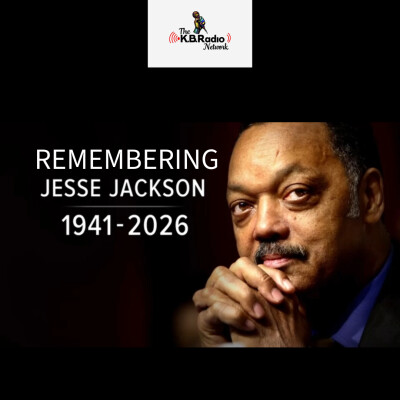
Speaker #0Hello everyone and welcome to the KB Radio Network. I am your host Kevin Reed. I'd like to welcome everyone to the show who may be checking it out for the first time. Welcome. If you are a continued consistent listener, welcome and thank you. I hope those who are checking out the show for the first time become consistent listeners to the show. I welcome you all. Today, we're going to pivot a little bit. We know we talk movies here. We talk reviews. We talk sports. We talk wrestling. But today, we're going to talk about the Reverend Jesse Jackson, who passed away this past Tuesday on February the 17th, 2026, at the ripe young age of 84 years old. Jesse Jackson is known for being a civil rights activist, for being a politician. Of course, he is a Baptist minister as well. He's also known widely for being a prodigy of the great Reverend Dr. Martin Luther King Jr. during the civil rights movement. And he is one of the most prominent civil rights leaders in the last, I don't know, 20. early 21st centuries he he was he was the last of that well i'm not gonna say the last but prominent you know uh figure from that era of of civil rights and segregation and the fight that we are still fighting by the way but i will say as a black man living growing up raised in the I appreciate All of those gentlemen and ladies who pretty much died, died for the cause, man, who fought for the cause during that era and continue to fight because their fight, the sacrifices they made is the reason why I'm able to do what I do or, you know, my children are able to do what they do. And It's because of their efforts, and I greatly appreciate it. I don't care if it's somebody you probably don't 100% agree with or with everything that they say or stand for, whatever the case may be, you still got to give their respect. For example, Louis Farrakhan. I'm not a big Louis Farrakhan fan, but I can acknowledge that Louis Farrakhan is fighting a good fight. And I respect everything that he does, you know, as far as his fight. Now, I may not agree with everything that he says, but I do respect the fight. It's kind of like, and we're going to get back to Jesse Jackson, but it's kind of like during that era of the civil rights movement when you had Martin Luther King Jr. on one side and you had Malcolm X on the other side. Both had two different methods. to achieve a goal but they both had the same goal you know the one was peaceful and non-violent one the other was the opposite they were yin and yang but they had the same goal for those of you who are in the comic books just look at x-men x-men is pretty much the same thing When you look at Professor Xavier and Magneto. Both extremes to their own degree, but different size of the coin. But they had the same goal, or still had the same goal. And that is equality. To be treated as normal, functioning human beings on this planet, more specifically in this country. And Jesse Jackson was right in the middle of all of that. after the assassination of Martin Luther King Jr., he was the next up, you know, next man up. And he took it and ran with it, literally. I mean, he ran for president twice. He ran for president twice. One of the founders of the Rainbow Coalition, his efforts spanned beyond the United States, you know, going as far as... uh south africa with his uh stance against the uh racial apartheid there in south africa you know uh so much he he did so much and we're gonna go over a good portion of it we'll be here about a week and a half going over all that he did throughout his life through those 84 years and i just can't do it we can't we i don't have the time the voice or the uh or storage space on this program to discuss every little thing that he did throughout his career and life. But we're going to go over some big points that took place throughout his life and his time as a civil rights activist, as a political figure in American politics and so on and so forth. So. Let's dive into the life and times of Jesse Jackson. But, well, before we get, I'm getting ahead of myself. Before we get to this, let me give you my other little tidbit about Jesse Jackson. I never really followed Jesse Jackson growing up. Now, granted, all the civil rights movement happened before I was born, thank God. But, you know, my parents went through it all. And... you know i didn't but i he wasn't taught about like uh martin luther king jr was like uh malcolm x was like megger evers was you know we we didn't get lessons about jesse jackson but now granted when i was growing up he was still in the cultural zeitgeist he was still out you know out and about working, doing God's work. And so it wasn't like he... had a made made for tv movie about him during that time or anything like that so or books or anything of that sort that i was able to pick up on and so i didn't really gravitate to jesse jackson i acknowledged him i knew who he was you know i knew what he was about and but you know following his career in life that i didn't really do that but As I got older, especially more of an adult, which was about a week and a half ago, I really started to pay attention to everything that he did and spoke about, even some of the controversial stuff, which I'm not going to go, which we're not going to talk about. And I'm not doing it because, you know, I feel a certain way about it or I don't believe it and all this other stuff. It's conspiracy. theory and it's a time and a place for that and i'm not i'm not diving in on that and if and if you know you know i'm not i'm not diving into that because there's no proof it's all speculatory and now i'm not i don't know because i wasn't there but i'm gonna speak on the stuff that i do know for a fact that he did throughout his life jesse jackson was born jesse lewis burns believe it or not uh jackson wasn't his name uh burns uh on october the 8th 1941 in greenville south carolina to helen burn and noah lewis robertson and the big thing about that is his mom was 18 when she got married which isn't you know crazy but the crazy part was uh The man she married was 33. So there was a little gap there. But that marriage didn't last too long because a year after Jesse was born, Helen remarried a man by the name of Charles Henry Jackson, who was a post office worker. And he adopted Jesse. Hence, he gave him his last name. But in spite of the fact that he took his stepfather's last name, he still had a close relationship with Robertson when he grew up, as he grew up. So he said that both men, he considered both of them fathers. You know, he had two fathers. He was he was blessed. He had two dads to rear him as a child. But as a child, Jesse Jackson was. pretty much picked on like every other child really but he was picked on for being born out of wedlock and that's a thing at least it was it was it was a thing when I was young, I remember that, I remember, going to school with kids who were pretty much bastards, that's what, that's what a child out of wedlock is, a bastard, but, man, kids were cruel, man, still are, but they will mess with you about anything, and I, I, I seen, I seen a few kids get picked on about that. But... nowadays i don't think that's a thing because i think actually it's crazy how it flipped and i'm gonna get back to jesse i'm gonna get back to jesse but it's crazy how it flips because my kids my daughters were picked on for not being born out of wedlock for for having two parents that were married ain't that crazy they used to come home and tell me this and i was Blown away by that. I'm like, wait, that's a thing? That's a thing? But it just goes to show you how stupid kids are. And I mean all kids, including when we were kids, for those of us of a certain age. Kids are just dumb. They're just dumb. I don't have any other words to describe it. But back to Jesse Jackson. He said that those experience. experiences helped uh motivate him to succeed you know most people would well not most but there's a contingence of people that take bullying or being bullied or being mistreated take that trauma bottle it up and let that draw you down throughout your life and i'm speaking to people uh personally i'm talking about myself i don't know why i'm dancing around i'm talking by myself because I did that. I did that, man. You want to talk about getting picked on. I got picked on so bad in school. The teacher picked on me in school. That's how bad that's how bad it was for me. And so I took all that bottled that up for well, well into my 40s. It wasn't until recently when I started really focusing on my mental health, whereas I was able to let that go. I could not let that go. I mean, it hurt me that bad. And so I'm envious, even though you're not supposed to be, but I am. I'm envious of people that can take that and flip it and allow that to motivate them. Because I wish I would have did that. And Jesse Jackson did that. And so during the Jim Crow segregation laws era, he was taught to go back, go to the back of the bus. You separate water fountains, you know, that was the thing, which we're pretty much heading back to now under Trump. But that was the status quo, and he accepted that. He rode with that, literally, on a bus. He accepted like every other black American around that time because that was the law, you know. But it wasn't until the Montgomery bus boycott in 1955. That's when it all changed for him. He saw that you can stand up against something that is wrong, that you can fight against segregation, you know? So he attended this racially segregated school, Sterling High School in Greenville, where he was elected class president and he finished 10th in the class and he earned letters in basketball and football and... I think baseball, too. He was a super athlete in high school. And so after he graduated in 1959, Jesse Jackson, he rejected a contract from the minor leagues in baseball. And so he could attend the University of Illinois on a football scholarship. And so after his second semester at the predominantly white college there at the University of Illinois. He transferred to North Carolina A&T, which is a historically black college at HBCU. And the reason he changed schools or transferred to North Carolina A&T is because of, of course, racial issues. It was it was it was because they prevented him from playing quarterback at the university and they limit his participation. you I think a public speaking class that he was taking. So he left. He went to HBCU. At North Carolina auntie, he played quarterback. He was elected student body president. Um, he became active in local civil rights protests against segregation, including segregated libraries and restaurants of that sort. He graduated with a, bachelor's bachelor's in science of science degree, in 1964. After graduating, he attended a seminary in Chicago on a scholarship. So he had left the seminary in 1966, three classes short from earning his master's degree to focus full time on the civil rights movement. He was ordained as a minister in 1968. He will later earn a degree. And the year 2000 from that seminary, based on his previously earned credit, along with his substantial work and life experiences. I guess I guess better late than never. It took him it took him, what, 40 years? Well, what, 32 years to be exact to get that degree. But hey, at least they gave at least he got it. It well earned, I must say, on his behalf. Swinging back to his activism in the civil rights movement he uh he was known for this commanding public uh attention since his first since he first started working with martin luther king jr and so in 1965 he participated in the selma to montgomery marches which was organized by james bevel uh martin Duquesne and other civil rights leaders in Alabama and Impressed by Jackson's drive and organizational abilities, Martin Luther King Jr. soon began giving Jesse Jackson a role in the Southern Christian Leadership Conference. So in 1966, Dr. Dr. King and Bevel selected Jesse Jackson to head the Chicago brands of the SCLC account of economy on which was Operation Breadbasket. And he was promoted to the national director the following year in 1967. Now, Operation Breadbasket had been started by a leadership of the AC of not the AC, but the SCLC as a job placement agent for black. So under Jesse Jackson's leadership, the key goal was to encourage massive boycotts by black consumers. as a means to pressure white-owned businesses to hire blacks and to pressure goods and services from black-owned firms. Fast forwarding to 1971, Operation PUSH, which is People United to Save Humanity, officially began operations on December 25th, Christmas Day of 1971. From the beginning, Jesse Jackson planned to use Project push towards politics and to pressure politicians to work to improve economic opportunities for blacks and poor people of all races and so the sclc officials reportedly fell felt the new organization would help black businesses more than it would help the poor in 1978 jesse jackson called for a closer relationship between blacks and the republican party Telling the party's national committee that black people need the Republican Party to compete for us so we can have real alternatives, which I agree. I do agree with that, even though I can't stand the Republican Party, at least what it what it is now. I don't care for it. Don't care for Democrats either. But that's that's a whole nother show. But the options, bro, is almost like we have no options. You know, most black people, most black people vote Democrat as just inherit that you vote Democrat because Republicans don't show that they are willing to help the black community. And now I know there are those people who are out there who feel like, oh, it shouldn't have to focus on black people. Why not? You focus on white. They blatantly. focus on white. I mean, all black folks want is a chance, you know, just a little crumbs off the table. We can't even get that. But we don't have... We don't have an alternative. You know, one side says they are going to help us even though they don't. But at least they say they're going to help us. The other side just flat out say they're not. Now, I do respect them because at least they ain't lying. But that's the truth. We don't have any alternatives. And it's sad. It's sad that it's like we never had a choice. And that's why I changed, you know. I changed. I went, I went. straight independent registered independent you know i'll choose for myself i'm not going to be pigeonholed by a party you know and nobody should be it should not come down to whether it's blue or red a donkey or elephant it shouldn't come down to that just because they have a r or d by their name i'm gonna vote for them that shouldn't be the reason why you vote for somebody you should vote for the best candidate. I don't care what party they're in. I do agree with Jesse Jackson in that sense, you know. Now let's jump to 1983. This is when Kevin Reed was around. I was around around all these good stuff. So I remember all this to a degree. But in 1983, Jesse Jackson announced that he was running for president in the 1984 election. And he was only the second black person to ever do this. And the first one was Shirley Chisholm. I believe her name. They made a movie with her. I think Regina Hall played her on a Netflix movie last year, if I'm not mistaken. But anyways, yeah, he mounted a campaign in 1984. Of course, it wasn't sunshine and rainbows. His candidacy kind of divided support. amongst black politicians one prominent name who didn't support him or endorse him in 1984 was the widow of martin luther king jr coretta scott king she did not endorse uh jesse jackson and it is not for any nefarious reasons i think her reasoning was uh she didn't believe that he would win the nomination so she didn't throw her support behind Needless to say, he didn't win the nomination. He did participate in a few debates, but overall, he didn't win. I don't think he won any caucuses. Definitely didn't win Iowa. He didn't win no votes, to be honest with you. But who went to, that's the trivia question, who did get the nomination? It was against Reagan. Was it Gary Hart? I can't remember now. Now I'm blanking. But anyways, at the 1984 Democratic National Convention, he had a speech. He delivered his Rainbow Correlation speech. And what makes that speech so prominent and etched in the annals of history in this country is because that was the first. speech of any national con uh conference to mention gays and lesbians this was 1984 and it wasn't it wasn't homophobic it was a it was a it was a speech to talk about how america is a quilt or a blanket no america is a i can't uh i'm gonna butcher it so let me shut up but anyways the the Three years. and paraphrasing it now, the threads are made up of whites, of Hispanic, black, Jews, women, Native Americans, farmers, lesbians, gays. It's all made up of this fabric. And that's what America is. It's an American quilt. Just to give you the layman's version of it all. And it's the truth. But that was the first time that America was described that way. It wasn't just for one singular group. It was for everybody. And that's awesome. Of course, I didn't listen to it in 19. I was five years old. But I did listen to it later in life. And I thought it was powerful. It was a powerful message that he spoke. that date. Now, At the same time as the inauguration of, what's his name, Ronald Reagan, I think it was his second term, his second inauguration, Jesse Jackson, he led a protest. He led several hundred supporters to the, I think, I think to the Washington Memorial around that time. And he was stressing that they need to. keep alive the hopes of those who are falling through the safety net and challenged America to protect the poor. And so that was what that protest was about. So we fast forward to 1986 and there was speculation that Jesse Jackson would try it again, that he would run for president again in 1988. So in October of 1987, Jesse Jackson announced his candidacy. in the 1988 presidential election. At the time of his announcement, polling showed that he had led in nine of the 12 southern states that would hold primaries or caucuses in March of the following year. And he led the Democratic field at 27%. So in November, Jesse Jackson announced that Speaker of... the speaker of the california state assembly willie brown would serve as his campaign chair while uh political strategist gerald austin became his campaign campaign manager later that month jesse jackson announced that he would stop his tour of the persian gulf to attend the funeral of his friend uh harold washington who was the mayor of chicago before changing his mind um Jesse Jackson's campaign platform included a call for a single payer system of universal health care, higher taxes on the wealthy and defending spending defense spending cuts intended to reduce federal budget deficits and increase, increase education, housing, welfare and child care spending. Also ratifying the Equal Rights Amendment. An executive order. to ban discrimination against gays and lesbians in federal agencies, the army, and to recognize gay couples as for spousal benefits, reducing the supply and flow of drugs into communities, the creation of a domestic version of the World Bank called the American Investment Bank that would have the authority to sell government bonds to rebuild America's infrastructure, suspending the development of new nuclear weapons in order to eventually ban them altogether, and a very different relationship with the Soviet Union involving a constructive partnership. In the Iowa caucus that took place that following year, Jesse Jackson came in fourth in the voting. He would later go on to lose the New Hampshire caucus to Mike Dukakis. Yeah, Dukakis, whatever it is, by a wide margin. And also on Super Tuesday contest, he did win in Virginia, Georgia, Louisiana, represent Mississippi and Alabama. One of the big surprises... Jesse Jackson had a surprising victory by winning the Michigan primary by a landslide. He blew out the rest of the competition there in Michigan. This made him the frontrunner in the race. But a horse that runs hard doesn't run long. He started to sputter out a little bit, losing the New York primary. He lost the Wisconsin. primaries he uh it was like back to back to back to back and then by the end of the democratic primaries jackson had received uh i think it was 6.9 million votes and he won 11 contests uh seven primaries uh alabama uh the district of columbia georgia louisiana stand up uh mississippi puerto rico virginia wait wait wait wait let me bet puerto rico So, Wait, Puerto Rico is a part of the United... Anyways, yeah, he won those territories in four caucuses. He won Delaware, Michigan, South Carolina, and Vermont. And so the day after the last primaries, Jesse Jackson met with Mike Dacostas, and they discussed some of Jesse Jackson's platforms, such as the Universal Same Day... on-site voter registration and changing the rules before the winner take all delegation and so jackson felt he deserved uh uh uh decocted consideration as a running mate you know in case if you win won't you consider me as your vice president you know and he agreed but added that jackson was with no special or greater consideration simply because he finished second in the primaries and so poland in april found uh the caucus jackson ticket would defeat george bush in that in that presidential race but that either along would lose the bush so you need it you need it both in order to defeat well he was vice president at the time vice president bush um but the caucus he picked uh lloyd lloyd uh i think benson i don't know i don't know i don't know who that i think he was a senator or something and jackson responded you know that he had the right he had the right to make his own little strategic choice well we all know what happened Yeah. We all know what happened. It was a landslide. George Bush defeated him. I'm talking Daddy Bush. He defeated, I mean, wiped the slate with Mike Dacoste. It wasn't even a race. But if everybody's point that if he would have chose Jesse Jackson as his vice presidential candidate, he would have won. And look what happened. So we fast forward, let's fast forward to 2007. I know we skipping over a lot. There were about 20 years here, but, and he did a lot in those 20 years, but we, we, we've, we, we're going to get to a part that I found funny and, and heartwarming at the same time. It is crazy as the, Jesse Jackson, he, he declared his support. for senator barack obama in the 2007 or 2008 uh democratic presidential primaries so he later criticized obama for acting like he's white in response to the uh jenna six beating case and in case you don't know what the jenna six is in jenna jenna uh that's here in Louisiana, Jenna, Louisiana. That was the case where I think in 2005, 2006, somewhere up in there, when six black teenagers, they were convicted for beating up this white kid at the high school which they all attended. So the white kid, he was injured by these six teenagers and received treatment at the hospital while the case was pending. It was often cited by the media by his racial injustice in the United States. It was a thing. It was a whole thing. I'm not going to get into it. That's a whole other show. Because thinking about it, my head is starting to hurt. I remember all that took place around that time. But anywho, they was on two opposites. Two opposite sides of the coin on that issue there. And so there was an interview. It was an interview that Jesse Jackson had did. I think it was on Fox News, ironically enough, but he didn't know his mic was on at the time. And he was whispering to somebody that was on the panel with him. And they were talking about Barack. And he said that, you know, he wants to cut his nuts off. And he didn't know he had a live mic. And so he did not like Barack Obama, at least at that moment. And so Jesse was expressing his disappointment at that time. Because Barack Obama had delivered this speech, this Father's Day speech, and he was chastising black fathers. And I remember that speech because I was a black father at that time. Well, still is, but I just became a black father around that time. And he was chastising them, you know, and he wasn't lying. But that rubbed Jesse Jackson the wrong way. And so in another interview... He did with Fox News. Jesse Jackson, he apologized. And he reiterated that he does support Barack Obama for president. So in a, I remember this moment like it was yesterday. Jesse Jackson, he was at Barack Obama's victory rally in Chicago. And I remember that moment when they announced it, when they called it on. whichever news i was watching probably cnn or one of them i forgot which one i was and in chicago at the park you see everybody running in the park to the stage it was just a remote i'm getting goosebumps now thinking about and jesse jackson was there of course and they showed a clip of jesse jackson and he was just in tears he was crying like think about it just think Think about what he did throughout his life and where it all started. Being on back of the bus, drinking in white only. Well, not he could drink white only, but drinking in the colored water fountains and being picked on and all kind of racial injustice that took place and what he was fighting for and what was sacrificed. friends and family dying around him and all this here to the point where you see a black man elected president and he's there to experience it and you saw the tears running down his face and at that moment i didn't feel any emotion at that moment but that did prompt me to call my parents and i called them and i remember my mom answered the phone and she wasn't watching it because she she didn't want to get stressed out and she didn't you know you And because just to back up a little bit, when I talked about what Jesse Jackson went through and all this here, my parents went through all this. My parents went through all this. And, you know, because Jesse Jackson, the same age as my dad would have been. Well, actually, he's a year younger. My dad is a year older than he would have been. But anyways, he went through all that. And they grew up in Mississippi. So you can rub a little hot sauce on what my parents went on in comparisons to the rest of the Jim Crow era. But anywho, I thought about them and what they went through and the stories they told me growing up. And they literally lived on a plantation, you know. So it's not that far-fetched. And so when I called my mom and she answered the phone, and the first thing I said, I said, Mama, we did it. and it all all she did she screamed she like he won and i said he won and my mom she just broke down and i just all i could do was hold the phone and cry it was like people just don't get it bro this goes deeper this goes deeper than what you can imagine to to black folks to black people especially black people who lived through that crap bro and that's how monumental that moment was now i don't care about the politics behind roc obama whether you agree with him or not that's debatable whatever you can feel how you feel but that moment when he won it it was it was like the first time breathing fresh air. You know... And I just felt it at that moment. And it was it was glorious. And so what spawned that off, what inspired me to call my mother was when they showed Jesse Jackson crying. Now, there's two ways you can look at. He was emotional, thinking back and recounting what he went through through his life or. Or he could be thinking about, man, that should have been me. That could have been me. Or. I can't stand this ninja. And so it's up to you to interpret. Right now, we don't know. We'll never know, unfortunately, what he was truly feeling at that moment. But I would like to think that he was reflecting on his life and getting to this moment. It was beautiful, man. It was beautiful. I will always appreciate that moment. Because if I wouldn't have, I wasn't going to call my parents. I really was because my mom had already told me she didn't want to know. She didn't want to know. She'll read about it tomorrow when she wakes up. She didn't want to know. And so if it wasn't for me looking at Jesse Jackson and calling my mom and her having that moment, which allowed me to have that moment, hey, bro, thank you, Jesse, for that. Just for that. Because it will last a lifetime. It's going to last. That was 20 years ago, and I still remember it like it was yesterday. It was one of the most beautiful moments I've ever had with my parents, and I'll never forget it. Jesse Jackson was married to Jacqueline Brown on December 31st, 1962, and together they had five children. But on February the 17th, 2026. Jesse Jackson died in his home in Chicago. The family announced the death on social media, and he received tributes from all stretches of the world. You know, Al Sharpton, of course, Bill Clinton, along with Hillary. Barack Obama had a lovely tribute to him. Joe Biden. Current politicians such as Chuck Schumer, Martin Luther King III, Kamala Harris, Andrew Young. The list goes on and on. Even your president, Donald Trump, he actually had kind words. He didn't. Of course, it was written. And everything in my heart tells me he did not write this because it was too legible. It made too much sense and it was too heartfelt to come out of his mouth. But it was a beautiful tribute as well. To a man well-deserved. Just to wrap it up, speaking of well-deserved, let's go over some of the awards and honors that the Reverend Jesse Jackson received over his lifetime. Ebony Magazine named Jesse Jackson to its 100 most influential. black American list. that was back in 1971 and 1979. Jesse Jackson received the Jefferson award before greatest public service benefiting the disadvantage in 1988, the double, NAACP awarded Jesse Jackson is president's award in the year 2000. Bill Clinton awarded Jesse Jackson, the presidential medal of freedom. the nation's highest honor bestowed upon civilians in 2015 jesse jackson was awarded the honorary degree of dr honors uh causa from the university of edinburgh in recognition of decades of campaigning for civil rights and just as recent as 2021 jesse jackson was appointed commander of the Legion of Honor, France's highest order of merit presented by French President Emmanuel Macron for his work in civil rights. Also in 2022, Jesse Jackson received an honorary doctorate from Benedict College. Rest in peace to the Reverend Jesse. Jackson, civil rights icon, politician, Baptist minister. The list goes on and on. But an icon, an American icon. And he will be missed, man. He will be missed. And I hope and pray. This is what I always worry about when people, especially my community, the black community, when crying for help. You know, we, where is that person? Who's that person that's going to stand up and fight for us? You know, we don't have Martin no more. We don't have Malcolm no more. We don't have, we don't have Jesse no more. And so who's that person? Well, you. you're that person you're that person you need to stand up and fight yeah fight one man can't do it alone we all gotta do it together and uh these guys all all of these soldiers who fought for the cause for who walked so we could run uh they're all gone now you know and jesse jackson is is one of the last uh ones from that era who really fought for the cause and uh my hat goes out to him rest in power uh awesome life he lived awesome uh uh bridges that he built for the community and not just the black community not just the black he fought for everybody he fought for those for all of the disadvantage let's just wrap it up like that for the disadvantage for the overlooked you for the poor, for the hungry. That's who he fought for, and he will be missed. And so my condolences to the Jackson family. Very symbolic that he passed away on the 100-year anniversary of Black History Month, right? Dead smack in the middle of Black History Month, the 100th edition. So it is poignant, and that is... uh somewhat poetic i must say and so i would love to know what did you think of jesse jackson did you uh follow his life and career and his speeches and his point i'm telling you i am somebody i still listen to that i am that is one of the best uh affirmational speeches you ever gonna hear it actually is a poem it is it is beautiful beautiful I am somebody, you know. I would love to know what are your thoughts about Jesse Jackson throughout his life. Email the show, kbradiopodcasts at gmail.com. You can also search for the show on all social media platforms. Just search for the KB Radio Network. Also, don't forget about YouTube. Subscribe to the KB Radio Network channel and like. Like this video if you don't mind. Don't forget about the five stars, the reviews, and sharing this show if you're listening on Apple Podcasts, Spotify, iHeartRadio, wherever you are currently listening to the KB Radio Network. Everybody, thank you for joining me as we look back at a small portion of the life of the Reverend Jesse Jackson. Rest in peace. I want you all to know that I love you. Continue to love everyone. Until we speak again, you all be blessed.