- V.O
Welcome to The LatinNews Podcast, a fortnightly deep dive into key developments from across Latin America and the Caribbean. Here's your host from Bogotá, Colombia, journalist Richard McColl.
- Richard McColl
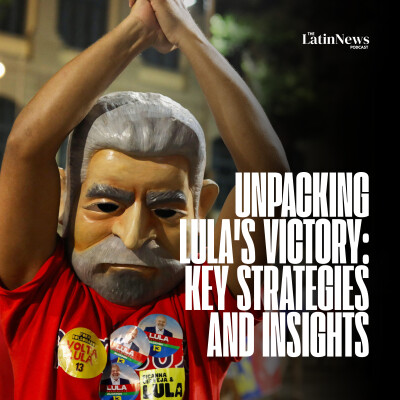
This is The LatinNews Podcast. I'm your host Richard McColl here in Bogotá, Colombia. This week's episode is all about the elections in Brazil and I'm speaking to Andre Pagliarini, who is the assistant professor at... the Department of History at Louisiana State University. It is an absolute pleasure because you are the author of Lula, a People's President and the Fight for Brazil's Future, as well as Claiming the Nation, the Politics of Nationalism in Modern Brazil.
- Andre Pagliarini
Thank you for the invitation, Richard. It's a pleasure to be speaking with you.
- Richard McColl
So we need to get into the crux of things. Now, a lot has been made of this, obviously, of this incredible victory by Luiz Inácio Lula da Silva. in the second round of elections, defying, I would say, the right-wing shift and the anti-incumbent movement in Latin America at the moment. But let's talk about, let's go quickly right into it. What happened on election night?
- Andre Pagliarini
In hindsight, the challenge of overcoming the difference from the first round, in which Flavio Bolsonaro beat Lula by about two percentage points, 47% to 45%, In hindsight, it should not have seemed perhaps as daunting as it was because the number of people who didn't turn out to vote in the first round far exceeded the difference between the two candidates. So the challenge the Lula campaign faced was not necessarily to convince Flavio Bolsonaro's voters not to vote for him. It was to galvanize the people who didn't show up in the first place. And what we saw as being key to the turnaround. was precisely that, was getting the people who maybe thought that Lula had it in the bag or maybe thought that Flavio didn't have it in him to win in the first round. Because again, the polls in the first round indicated Lula would probably win in the first round. There would be a runoff, but Lula would be ahead. When that didn't happen, I think it galvanized maybe soft Lula supporters who didn't show up to say, oh, I better turn up for the runoff. So what we saw on election night in the second round on October 25th was that, was Lula more than making up the difference between him and Flavio in the first round by reducing dramatically the number of abstentions. It was the smallest abstention rate in the runoff in 20 years. So that was the key to victory, and they pulled it off.
- Richard McColl
They really did. I mean, he won by 4.4 million votes. But you said, how did he manage to... galvanize and get people out to vote? How did he get these sort of soft voters out there? Because he wasn't, he obviously wasn't pulling votes in from the other, you know, the other candidates, they were all on the right, they weren't going to go to Lula. So what happened?
- Andre Pagliarini
It's a two part story. One is the online organizing that the campaign was much better at in the second round, but also real world engagement from people who I think we should understand as being freaked out, as sort of terrified by the prospect of a Flavio return. Even in the night of the first round, when much of Lula's coalition was incredibly dispirited and just, you know, it looked like the writing was on the wall, Flavio was going to trounce, you know, waltz to victory in the second round, Lula said something, which is, we have to have a completely new campaign. We have to, that campaign is over, this is a completely new campaign. And I'm not sure a lot of people really thought that that was plausible. Yeah, sure. What does that even mean? But what he meant was we need to completely rejigger, reimagine our online presence. And he did this by bringing to the center of the campaign, first of all, those small bright spots for his party in the first round of the campaign, people who had won election in the first round. Flavio's allies did really well across the country. So he called people who had done well on his side. to help with messaging, to help with strategizing, including by bringing in Andres Arnones to help coordinate his social media presence. And that's one of the things that a lot of international outlets are covering was this WhatsApp group that reached 11 million people during the runoff, known as the Exército de Lula, Lula's army, overseen by this congressman, Andres Arnones, who did something... unprecedented in Brazilian elections, which was to combine the sort of day-to-day conversations that millions of Brazilian people have on WhatsApp. It's one of the largest users of WhatsApp in the world to embed within that political organizing, marching orders every day. Today, we're going to do this. Everyone's going to do it. And it reached a scale that helped reach people that were otherwise not engaged in the campaign. That's one of the ways that they reduced the abstention rate. The other element of the story were these massive urban rallies, some of the biggest in a Brazilian campaign since the return of democracy, that in part were organized online. But even before that WhatsApp group reached the heights that it did, students in particular in Miterói, in the state of Rio, for example, were spontaneously, organically taken to the streets to signal their repudiation of Bolsonaro. We do not want another Bolsonaro coming back. And that, I think, helped shake things up. The way I would describe the last point I'll make on this is I think the fact that Flavio beat the odds to come out ahead in the first round suddenly made him the incumbent effectively for the runoff. And he was on the defensive against this large part of the electorate that said, oh, we have to take this prospect seriously. And so I think that was a very healthy thing for the Lula campaign to all of a sudden treat. the challenger as the incumbent and put the onus on him to defend his vision for Brazil. And I think Flavio got a little bit ahead of himself. They were talking already about cabinet members and things like this, that I think rubbed many voters the wrong way.
- Richard McColl
That is a fascinating way of looking at it, flipping it on its head entirely. Flavio being the incumbent because of the first round victory. And of course, it could have been so different. could have been so different, but this real world engagement of which you speak, it made people feel as if they had a definite participation, a real role to play. This real world engagement of which you speak, it gave people a sense of participation. And of course, this very slick social media campaign. And I'll bring it down to the Columbia because we do talk about the region. Of course, we talk about the region and the way that so many elections, the majority have swung to the right. De la Esprea in Colombia had a very slick social media campaign, whereas the progressive left under Ivan Cepeda had almost zero. The Lula campaign saw this. They took a leaf out of this book and said, we cannot be in this situation such as in Colombia. Would you say so?
- Andre Pagliarini
That's right. I mean, Brazilian campaigns, particularly, I would say, the PT and the workers' party, the left, have been for years now. And for years, they have recognized this as a problem, but have done little to address it. Rooted very much in the 20th century. I mean, primarily campaigns in the real world involve flyers, you know, posters, flags, things like this. Fernando Haddad, who was Lula's finance minister, who lost his race for governor of Sao Paulo in the first round. I remember there was a lot of infighting, stories about infighting in the press. And one of the things that people behind the scenes were fighting about was deliveries of posters. And I'm thinking, seriously, this is what we're arguing about, these posters and handouts. What we saw in the runoff was a recognition to say, like, look, that stuff might matter at the margins. But where the political fights in the 21st century are happening are on these networks, the algorithm, social media. And that's one of the things that Janone is... Andres Arnone is the man responsible for this group. It's not that he diagnosed a problem nobody else had. I think most in the PT, you know, sensed that. What he offered was a diagnosis and a plan. Like, this is how you do it, A, B, and C. So it has been so successful that he is already being courted and invited by Pedro Sanchez in Spain, by leftists in France and Mexico. I think a lot of people in the Colombian case was a recent counter example of what not to do. Many political forces, particularly progressives, are scratching their heads about how you go up against reactionary political forces that are backed by the scale of power, essentially, in our daily lives that big tech wields.
- Richard McColl
Let's talk about... the campaign a little bit and let's talk about these new policies that Lula obviously discussed in between the first round and the second round, the change in the labor law. uh the betting the prohibition of betting platforms and of course we've done the social media but how did this as well mobilize people or were they sort of like was he was he throwing anything out there and trying to make it stick as well so that too i
- Andre Pagliarini
i i might say a little bit of the latter because this is a traditional play in in campaigns and i think the campaign it was quite in the first round, quite staid. quite traditional, quite safe, assuming that incumbency would lift Lula in the end. And so they did the traditional thing that an incumbent does in Brazil in an election year, which is, as you say, lots of new programs, maybe increasing the amount of Bolsa Família, this conditional gas transfer program, the hope being that over the course of the campaign, this would steadily increase Lula's approval numbers. The problem was that didn't happen. They did all these things, they promised all this money for new programs, and we got to the first round, and it had had very little effect translating to votes. The second round, though, they did not abandon that part of the playbook. As you said, particularly what's called the Scala 6x1, which is the six working days to one day off, that has been the norm in Brazil for oh so long. was done away with in favor of a five to two, which is five working days, two days off, a 44-hour work week to a 42-hour work week. In the context of what we were discussing earlier, of a dynamic online campaign, this move of the government doing things in a campaign to try to appeal to people, that hadn't really had an effect. But in the context we were just discussing of a dynamic re-energized digital presence, I think that helped. And so then that message was supercharged in a way that had fallen flat before. So these things, old school and new schools, campaign styles, worked in the second round together to amplify each other, whereas in the first round, it had largely fallen short.
- Richard McColl
This is really interesting that the old and the new could come together in this fashion and actually sort of, you know, benefit one another. Let's talk about the opposition at this moment in time. Flavio Bolsonaro, obviously, passports were cancelled, but he managed to get across into Argentina. We know now that he's in Miami after fleeing via Ecuador. Does this erode the supremacy of the Bolsonaro clan as, you know, the figure on the right now? I mean, are we looking at someone like, you know, Tarcisio de Freitas taking over? What can we see is going to happen to the Bolsonaros?
- Andre Pagliarini
I think the biggest loser in the presidential campaign is the Bolsonaro family itself, because their camp, their broader ideological movement, as we said earlier, did quite well. Allies sweeping to power across the country, in many cases in the first round, winning governorships in many places around the country. setting up a next generation of like-minded political forces. But the family itself, I think, has now lost the argument, even before Flavio chose to flee, has lost the argument that the family itself is indispensable. That was one of the arguments in selecting Flavio to run in the first place. Many argued at the time on the right that, you know, wouldn't it be better? If we selected someone who represents the right, but doesn't necessarily carry the baggage of this tarnished last name. That Jair Bolsonaro, the former president now serving a lengthy prison sentence for attempting a coup. Many people love him, but many more people would not vote for him because of what he tried to do. So what if we ran someone who might like conservative politics, but is turned off by the name? And so. So, Tarasizio de Freitas, who you mentioned, the governor of Sao Paulo, was at one point considered the most likely candidate of the right-wing camp. But Jair Bolsonaro, from prison, insisted on his son running. Now, in hindsight, looking at this from the moment of defeat, I think Jair Bolsonaro and Flávio Bolsonaro have largely discredited themselves as movement leaders. And what the cherry on that cake is the decision to flee. because I think The fact that he is now supposedly going to try to organize the opposition from abroad, from the United States, even their allies. in the right-wing camp, I think, will not look upon that well. They might talk about it in certain ways, but it's hard to imagine they will accept taking direction from Florida.
- Richard McColl
Why? Was it pure vanity by Jair? Say, no, it has to be Flavio that runs it. It has to be him as the figure. Or is it a continuity of the surname? Maybe, you know, that recognition factor for the right.
- Andre Pagliarini
Yeah, I think one way of reading it is that he thought I am the only person to have defeated the PT at the ballot box, at least since Lula's first victory in 2002. We shouldn't take for granted my personal appeal, he might say, as Jair Bolsonaro, this rough and tumble character. And the best way to incarnate that is not by a cabinet minister, it's someone directly connected to me, my son. I think that's the most generous argument of the logic behind it, was to say, I did something no one else had done. My son is best positioned to replicate me as a political force. But I do think there is also a sense that Jair Bolsonaro chafed at the apparent imposition by his allies of people who were polling better. Again, Tarcísio, Ronaldo Caiado, the governor of Goiás. Romeo Zema, the governor of Minas Gerais, many of them polled competitively with Lula at the start of this year. Many of them were jockeying for position to try to be the chosen candidate. But I think there is a certain allergy on the part of Jair Bolsonaro to be told, hey, we're going to do this. And so once it became clear that his party might prefer a different candidate, I think he doubled down even more in what was ultimately not a good bet, of course.
- Richard McColl
Ultimately not.
- Andre Pagliarini
In fact, considering where Flavio is today, it's worth remembering a report that the head of their party, the Partido Liberal, told Flavio at the start of the campaign, when they were still debating this, he said, Flavio, you realize if you run and lose, you will not have parliamentary immunity because you are not running for Senate. You will have lost your Senate. You need to be prepared for that reality. If you lose, you are no longer immune to inquiries. As a way, I think, of telling Flavio, do you really want to run this risk? And things have played out the way they have. And Flavio, now having lost his immunity, or at least he would lose it in February, has decided to escape potential investigation in Brazil.
- Richard McColl
So let's, if we talk about the government and the situation that Lula now... will be taking on. The Senate has a conservative majority. And of course, there'll be the desire to impeach Supreme Court judges. But also, do you think that Lula will then, he's going to shift a little bit and maybe include some moderate or democratic sectors of the right in his administration?
- Andre Pagliarini
I think he certainly will do that. Yes. He did it in 2022 after he won there also, which was to include centrist sectors of largely center-right parties into his cabinet. Figures from the MBDB, from the PSD, parties that, you know, have aligned in the states, sometimes with the right, sometimes with the left. You know, these kind of centrist parties that sort of do their own thing and are... are most concerned with their own power. He will certainly continue that and perhaps even expand it in the second term. That said, I really think the best anyone can expect from this next term, as exciting as many people might be by the result of this second round, is that of a largely caretaker government. I don't think there will be many substantive achievements. in either house of Congress. As you said, the Senate is largely controlled by the right, as is Congress. Lula's party is the second largest in the lower house, but it's quite a gap from them to the PL, the Bolsonaro party at the top. But that sounds like small bore, but it's no small thing because I think the fact that Lula will be president will, if you like, kind of keep the barbarians at bay for four years. to allow the left to reorganize itself, because they need to prepare for the post-Lula moment. So if I had to imagine where we're going in the next several months with the Lula government. relatively few major policy wins, but a clear attempt to empower new, younger forces within his broad ideological camp to begin getting a sense of where future leaders might emerge from. I think that's really the project of the fourth term, is to prepare the democratic, small-D democratic progressive camp for facing this entrenched right. Once Lula leaves the stage.
- Richard McColl
So, you know, these progressives, this left, they can't lower their guard at all then, as you say, a caretaker government. I mean, a lot is being made of who could be the successor or the heir to this. I mean, fourth term of Lula, now 81 years old. And I've been seeing names like Flavio Dino, Rafael Fonteles, Guillermo Luz. Geraldo Alckmin, even Fernando Haddad, and Camilo Santana. What do you think about any of these possibles?
- Andre Pagliarini
I can imagine two different lanes when thinking about the succession question. One is the lane that says, in the face of a far-right opposition, we, the left, should return to our combative, anti-establishment roots. The identity that made Lula a mass national leader in the first place, that kind of combative insurgent energy. Someone like Ileana Rebolus represents that. Someone like Erika Hilton, who is, I think she beat the record. I think she was the most voted congresswoman in the state of Sao Paulo. She's a trans woman, young, dynamic, very good on social media and all this. In fact, she was the one most responsible for that reduction of the work week. measure. It's often associated with her efforts in Congress. So that is one lane, combative. The other lane is, I think, institutional, moderate. It's the sort of institutional face of Lula, the person who works within, works with Congress, works piecemeal, little by little, progress moving forward steadily. Someone up until this election, I think Fernando Haddad, his finance minister, former education minister. former mayor of Sao Paulo, was in many ways the presumed heir. The problem for Haddad is that now having lost the governor's race, he has lost three elections in a row, twice for governor and then re-election for mayor. He might be burned politically after so many losses, although we'll see. Other figures, you mentioned Camilo Sultana, the former governor of Ceará, who came out greatly empowered in this race. Rafael Fontaine is the young governor of Piauí. He's the one most people seem excited about. Whichever lane the party ends up going, what I do think will happen is a reorientation of the party's center of gravity away from the southeast, where the PT was born, Sao Paulo specifically, to the northeast, which has become, over the past 20 years, Lula's political firewall. The thing that delivers Lula the presidency time and again is his overwhelming favoritism in the Northeast, which, of course, is where he was born. So I think we don't exactly know tone or style where the party is going to go, where the left is going to go. But I think in regional terms, it's probably going to look more and more Northeastern than Southeastern, which cuts both ways. because part of the concern one might have about that is that the party could become increasingly, could become possibly... increasingly a regional party. It struggled, this race, almost everywhere else except for the Northeast. So those are two sort of tracks of this debate that I would have my eyes on. What tone and style the left looks like going forward, but also what part of the country doesn't seem to be taking direction from.
- V.O
This podcast is brought to you by Latin News. the leading source of political and economic news and analysis on Latin America and the Caribbean since 1967. Access Latin News' full portfolio of reports at www.latinnews.com.
- Richard McColl
And of course, voters' main concerns, as it seems when you read about the elections and situation in Brazil, crime, violence, corruption and cost of living. How do we think the Lula government will address this.
- Andre Pagliarini
This was one of the things Lula, the campaign struggled with in the first round, giving the sense of not being up to the task of debating, frankly, in a lot of ways, public safety. Because As the incumbent, Lula was hit very hard by Flavio Bolsonaro on issues of public safety. And one could tell Lula would get very frustrated in interviews and things like that, because he would point out, look, according to the Constitution of 1988, public safety is not an attribution of the federal government. So he would kind of, I think, chafe at this idea that he is held responsible for public safety concerns. which of course is not a satisfying political answer at all. And so he would say he campaigned in part on a constitutional amendment to give the federal government more powers, to create a cabinet ministry of public safety, to try to take this on. The problem is, Bolsonaro allies in the legislature did not embrace that measure. In part, a cynic might say, because they didn't want to see that as a political issue. You know, they didn't want to empower Lula to address it. It looks like that might move forward now, a constitutional amendment to create a national public safety force, because that's another one of these things. We talked about how the Workers' Party sometimes has been slow to adapt. It has been slow to recognize the political potency of this argument of public safety in fueling the rise of the far right. It's not the only thing, but it's one of the things that has... fueled these people because of a legitimate concern millions of Brazilians have about whether it's safe for their children to walk down the street. Understandable. Anyone who's a parent or anyone who's walked in a city understands that fear. So I think we will probably see movement on that. Cost of living is a tough one because one of the arguments that the opposition made, again, is that the profligate spending of the Lula government was largely responsible for high interest rates. Brazil has some of the highest interest rates. if not the highest, in the entire world. So Flavio was, again, very able in making the connection between the high cost you pay for goods, high interest rates, and government spending. And it's Lula's fault for promising all these things and spending all this money. In the short term, I don't see an easy way for Lula to address that, because he is not going to come and start cutting willy-nilly. What his economic advisors have argued Dari Durigan, the current finance minister, argued during the campaign, for example, that, look, he was in a debate with one of Flavio's main economic advisors. And his point was, we recognize, we the government, that we need to cut costs. We need to bring down total spending. But the question is how we do that. He argued that the only way to do that sustainably, to cut costs, is by including society in your calculations, doing it. gradually, as opposed to the chainsaw of Malay. And he argued only Lula is in a position to do that, to gradually cut costs sustainably without provoking protests, without provoking backlash, that what Flavin was promising was too traumatic a cut. And it might help in the short term, but it would hurt you in the long term. So I think we are going to see a determined attempt to reduce the cost of total government spending gradually to see if they can bring down the trajectory of interest rates and alleviate some of the cost on ordinary Brazilians' lives. You mentioned Vice President Jaldo Alkimi. There is some talk of him being the new finance minister in this fourth term as a way of signaling. He's a conservative, former governor of São Paulo, former opponent of Lula, actually. But he would signal to the markets. The government is serious about cutting costs, reining in spending to hopefully bring down the interest rates that are bearing a lot on Brazilians' ability to buy a home, buy a car, buy appliances with those interest rates as high as they are.
- Richard McColl
You mentioned Malay. And of course, we had to get to it. We had to get to the international policy, foreign policy for Brazil. Brazil, obviously the biggest hitter in Latin America. First, I wanted to say, I read somewhere, the, the, Almost, I would say, a conspiracy theory type thing that Millet wanted Lula to win so that, you know, his influence in Washington, D.C. isn't sidelined. Do you read anything into that? Any credence into that?
- Andre Pagliarini
I have heard that from, you know, sources in not too high up, but in Brazil's foreign ministry, that they had heard something similar about Argentina that, you know. Millais wants to be seen as an antagonist of Lula because it elevates Millais in a way. And one of the ways to do that during the campaign was to. celebrate, if you're Malay, to celebrate Flavio, to support Flavio, to boost Flavio, but the logic
- V.O
of what you're describing makes sense. Because if Flavio had won, all of a sudden, the largest legislation in Latin America, Flavio becomes almost a de facto leader of the ideological camp represented both by Millet and Flavio. Someone like Kast in Chile has been, by comparison, I think much more subdued, much less interested perhaps in this kind of leadership role. Malay is a much bigger personality. I think he wants to be seen as the vanguard of this movement. So I think he was happy to allow Flavio to leave the region through his country. Let's put it that way. I think he was happy.
- Richard McColl
Yeah, stepping around it and then up by Ecuador. Very good. But so... Obviously, we've now got, we have Lula. How is this going to affect relationships with, I mean, obviously, it's not a great relationship that's going on between the United States, the government and Brazil. But as we, again, we read in various places that Trump, President Trump actually quite admires Lula, I think, for his combative, no-nonsense nature and his pushback.
- V.O
This is one of the most difficult things, I think, to read, the relationship between Lula and Trump, which interpersonally, by all indications, as you suggest, they seem to sort of get along. In fact, when Lula won in 2002, I wrote a piece for Foreign Policy in which I said, I think these two might actually get along better than anyone would expect. And I was ridiculed. My friends ridiculed me. Family ridiculed me. But I argued that. These are both men of a certain generation. These are both men who feel aggrieved by what they consider to be lawfare against them. You know, they are men who understand themselves to be indispensable to the success of their relative political movements. They're both men who have won against the odds politically. So I said, you know what? It wouldn't surprise me if they get on better than people assume. And that has more or less borne out. The problem is the structural. incompatibilities, I suppose, in Brazilian interests at the moment and U.S. interests at the moment. Marco Rubio, Secretary of State of the United States, is very much not aligned with anything Lula stands for. This is a very conservative, very anti-left person motivated by hostility to the Cuban revolution and Lula, who was an ally of the Cuban government. So it's one of the great, I think, unknowns as we look to what have... a fourth Lula term might look like. Either we get continued detente and maybe even some warmth between Lula and Brazil and the United States as Trump becomes a lame duck if Republicans lose in the midterms. I think Trump would find himself, you know, sort of backed off a little bit and maybe that opens the door to better relations. Or we could see things, you know, harden and become sharper. If Lavie, for example, finds a way in the United States to keep pressure on Brazil to lobby the White House to do that, that could spell trouble. So it's really hard to predict which way this might go because Trump, his foreign policy everywhere is just ups and downs and left and right. One doesn't know where they stand. But I am not necessarily that alarmed by where things might go. I think Lula has shown that he and Trump, despite the difficulties, find a way. to avoid the absolute worst case scenario.
- Richard McColl
I definitely read that piece in Foreign Policy. I remember talking about it. I remember it being a little bit thinking, yes, this is unusual. But there was definitely, you know, there was reason to it. There was reason to it. I can understand how your family and friends might have ridiculed you, but there was definitely reason behind it. So if we take it as a whole now, so we see, again, caretaker situation for this government. What is going to happen next for the right in Brazil?
- V.O
I think there's going to be, we talked about the various lanes on the Lula side. I think there are various different luminaries on the right who will be competing for national attention too. I do think at this moment, as we think about the period. After Lula has won, before his fourth term begins, the frontrunner as of now... for the post-Bolsonaro national leadership, probably goes to Tarcísio de Freitas, the governor of Sao Paulo, simply because of the size and power and prominence of the state that he governs. It's the largest, most powerful state. Anyone who governs that state is probably in a prime political position. On the other hand, though, what he has going against him is no governor of Sao Paulo has won the presidency since 1960. So very, very long, since Jânio many, many, many years ago. It's not necessarily... a launching pad for successful national candidates, in part because much of the rest of the country resents Sao Paulo. Secondly, Tarcisa doesn't have a particularly charismatic political presence. He is not like Jair Bolsonaro, who had this strong, fervent, devoted following. So that could prove difficult. I mean, there's also the generational question. We talked about these young, media-savvy candidates on the left. The right has perhaps maybe even more of them. Nicolas Ferreira, congressman from Minas Gerais, Lucas Pavanato from Sao Paulo. These are really savvy, one might say politically shallow, but savvy, savvy political players who will certainly be part of the story for years to come. So that, though, is I think the main storyline, is the dispute for the post-Bolsonaro protagonist role on the right.
- Richard McColl
And of course Bolsonaro, while he's... saying that he's going to coordinate the opposition from Miami, as you say, he's taken himself out of the equation largely by going overseas. And if we look at a final sort of final thing here is, you know, we've discussed the strength, obviously, of the PT and Lula in the Northeast. And, you know, when you look at the voting, you know, the map of how people voted, how can Lula build bridges with Sao Paulo? Rio Grande, Azul, and places of this nature, Santa Catarina, which I don't think he want to vote in. Yeah,
- V.O
there was a story in the days immediately after the second round that Lula is already planning a battery of meetings with governors from states he didn't win precisely to do that, to try to tamp down tensions, to try to, you know, let's let's govern. We all have to govern governors. me, the president, we all have to find a way to govern, to deliver for our constituents, and so on and so forth. I do think even his opponents, Lula's opponents, would recognize he is personally in a good position to do that. He, for example, he worked with Tarsoesio, the federal government and the state government, to build one of the largest tunnel projects in recent Brazilian history near the port of Santos. There was a moment where Lula was on stage with Tarsizo. They were announcing this partnership and they were laughing together. And it was it got a lot of attention because who but Lula could at that point, it looked like Tarsizo might be the candidate to run against him. And they were laughing together, you know, saying, hey, look, look what we can get done despite all the noise around us. So that's a point at which I'm actually fairly optimistic that Lula will be able to establish. decent working relations with the governors of the various states, even the Bolsonaroista ones, because the synergy between federal government and state government is such that there are dire political consequences, to say the least, if the governors slap that hand away, as it were. The challenge will be in the legislature, I think, because there is much less incentive for the Bolsonaroistas to work with the federal government. So that's... where I think the trouble spot would be. The governors, I think Lula might be in a good position actually to tell a better story about federal and state collaboration despite ideological differences.
- Richard McColl
Oh, refreshing to hear that, to hear that there is a solution here or potential solution. I think, well, obviously, you know, we look back and we will look back on this election where Lula winning with 51.8% versus 48.2% for Flavio Bolsonaro, you know, and exceeding 4.4%. million votes ahead of his rival, having lost the first round. So many interesting points in this conversation. Let me take this moment to say to André Andre Pagliarini, the assistant professor at the Department of History in Louisiana State University, thank you so much for your time and for sharing insights into these elections and the potential for Brazil in this four years as the 81-year-old Lula. Takes the reins for the fourth time.
- V.O
It was a real pleasure, Richard. Thank you for the invitation. I could talk about this stuff all day. And it was a joy with you. So thank you.
- Richard McColl
No. And of course, be sure to look out for Andres' books, Lula, A People's President and the Fight for Brazil's Future, and also Claiming the Nation, the Politics of Nationalism in Modern Brazil. What a great conversation. Remember to subscribe and of course, share The LatinNews Podcast. You can find it on all platforms, YouTube, iTunes, Spotify and beyond and we'll be back in a fortnight's time discussing more issues from the region. I've been your host Richard McColl in Bogotá, Colombia. Thank you again.
- Andre Pagliarini
You've been listening to The LatinNews Podcast. For more news and analysis on Latin America and the Caribbean, visit www.latinnews.com.