- Speaker #0
Welcome to The LatinNews Podcast, a fortnightly deep dive into key developments from across Latin America and the Caribbean. Here's your host from Bogotá, Colombia, journalist Richard McColl.
- Speaker #1
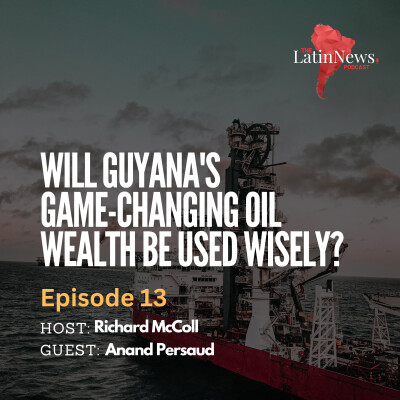
This is The LatinNews Podcast. I am your host, Richard McColl here in Bogotá, Colombia. Our very special guest this week is in Georgetown, Guyana, Anand Persaud, who is the editor-in-chief of the Starbrook News. And we are going to be talking about... Well, obviously, Guyana is in the news for all of these discoveries, the oil discoveries as they were found in 2015. And this is game changing wealth for Guyana population of 800,000 people, more or less. And the GDP of the country is set to well, they say it's set to quadruple to 13 billion by 2025. So we really want to look at what might happen or what is happening to Guyana. So Thank you.
- Speaker #2
this is good i'm going to give it over to anand to talk about the situation presently all right so uh good day thank you very much for having me so uh you know essentially the the oil discovery is really the story of uh this uh period uh since uh 2015. so essentially we're up to about 11 billion barrels of oil equivalent that's been found and this figure of course is growing all the time So because there are further exploration wells, ExxonMobil and its partners have sunk and are sinking many more wells. And only recently, last week, I think they have bid for another offshore block to continue this. So they found a mother load in what they call the Stavro block, which is very similar to the name of the newspaper. So they've found so far about 11 billion. And they now have two platforms producing. in the Atlantic. So roughly about 380,000 barrels of oil a day, not an insignificant amount for a country that didn't know about oil until 2015. A third platform with the rated capacity of about 220,000 is going to come on stream maybe in a month or so. So essentially you could be up to about 600,000 barrels a day, which is a fascinating figure when you consider where we were before. But it does, of course, come with a whole series of jeopardies and issues that relate to climate change and the internal dynamics of being an oil producer. That is, do we have to look at whether or not we are early victims of the Dutch disease, the resource course? All of those are problematics. How are we beginning to distribute the wealth that we have? Are we trying to reduce the gaps between the haves and the have-nots? So it has come with a whole series of challenges that will test us from here on in.
- Speaker #1
This is it. I mean, what I'm reading the most and what I've researched the most is there's a focus on what could go wrong. I mean, we can list those. Will the money be used wisely? Will it entrench the current government in power? Will it entrench them? Obviously, there's a huge ethnic polarization in Guyana, the Dutch disease, as you said, and of course, corruption. So, I mean, how do you feel about this right now with the current President Irfan Ali and the Progressive Party? How do you feel that they're moving ahead with this?
- Speaker #2
Well, I think they are definitely things to be concerned about. I think definitely as it relates to the Dutch disease, what you're seeing is a conflict. concentration of quite a lot of resources in the oil and gas industry. So even though the government says we are going to move away from the oil and gas industry and invest in other sectors, we are not seeing that as yet. You know, all up and down one of the main rivers in the country, the Damarara, everything has now been assigned to warehouses for oil and gas, lay down yards, different areas dealing with waste disposal. So everything that we're seeing here is definitely in line and in sync with concerns about the Dutch disease, that is the confinement of all of your resources into one sector, as opposed to using your oil resources early to diversify and to sort of like to begin looking at high paying jobs and other sectors that can bring you a different kind of development and sustainable development in the years to come. So though the government has said that it's investing in areas like Soya and livestock feed and agriculture. There have been a lot of initiatives that have started, but I think it's too early to say that they can be successful or that enough is being put into them. So there are concerns about that area. There are also concerns that a lot of people raise continuously with us that only a certain class of people and only a certain group of contractors and others are benefiting from the outflow from oil revenues and that obviously is of course a concern. We do, we have established you know a sovereign wealth fund, our equivalent of a sovereign wealth fund, and we've begun to put away for intergenerational equity but people say what we're putting away is not enough and that the expenditure into the economy is going to become problematic because it's going to overheat, absorptive capacity is sort of limited and What you're really concentrating on at the moment is a lot of infrastructural development. But a lot of the people down at the bottom are continuing to complain that they are seeing the outturn of a significant rise in the cost of living that isn't being alleviated for them. Whereas the people up at the top may be earning much higher as a result of this. We've actually been doing a series which is in its 41st installment here this week. We speak to 10 people from all across the country and we just simply ask them about the cost of living. I mean, usually people always complain about the cost of living. But what we've seen is that they tell you in great detail how the prices of a lot of basics and staples have gone up. And they're polishing down at the bottom, sometimes having to make decisions about whether or not, you know, they can afford this meal or that meal, transportation for their children. medication for elderly or for themselves and so on. So there is that really intense battle that's going on at the bottom about how it is we are benefiting from this thing. You know, we've been producing oil since 2019 and how are we benefiting? And that discussion has begun and I'm not sure that the government has fully accepted that they need to address that. What they've done, they've been handouts, you know, like with all governments they want to be the benefactors, they want to be the people who are going to take the credits and you don't have to handouts. But those handouts are not part of a comprehensive overall program that looks at how you can lift people out of either poverty that's extreme or poverty that is burdened. So there is that discussion that has begun. And I really think it has to be looked at in the remaining two years of this government's term. There are other issues, but those are some of the major things that are on their horizon.
- Speaker #1
Well, you're discussing this, you know, as you say, these reports, interviewing people across the country. And if we if we give some background, roughly 40 percent of of the population lives in poverty in Guyana. And what you're saying then perhaps is that we're not seeing the necessary investment into health care, education. But there is some investment into infrastructure. These are kind of handouts.
- Speaker #2
Yeah, so there's a lot of investment in infrastructure. As a matter of fact, quite a lot of hospitals are going up. But what people over here consistently complain about is the lack of adequate basic care. That is, you may go to a health center and need a wrapping for some wound that you have, only to be told that we don't have the gas today or you'll have to come back the next day. So this government is good at big infrastructure. They're into that. So hospitals are being built. And, you know, the infrastructure to go with it is being built. But do you have the adequate staff? Do you have the facilities? Are you able to order drugs in such a way that an outlying post has the basic supplies that it needs? So those are the basic issues that go with having all of these resources, but still making sure that you're taking care of basic health care needs and you can portion medication from a central point all across the country. is supposed to having some without and having one standard of care in one part of the country and nothing at all in another part. So I think those are the disjunctions that are occurring and I'm not sure that the government is fully in tune with what it needs to do to get that done. And so those are the things that you know we record people on a regular basis complaining about. What's the sense of building a specialized maternity and child care hospital if you know at the prenatal level. You're going to have issues at health care centers or you have to go to the main hospital and you wait for three hours before you're seen. Because we continue to see cases like that and people do complain about them.
- Speaker #1
it sounds a lot like running before you can walk and the basic things are not being done you know okay the great big brand new hospital but yet without the necessary uh insumos as we'd say here but the necessary medications and so on and so forth so uh but let's talk about the politics a little bit then because you said there's two more years that's plenty of time for uh Irfan Ali, the president and his progressive party, the PPP, C to to, to, you know, really, really, you know, get enough handouts out there to ensure that they stay in power. Are we seeing that as well?
- Speaker #2
Oh, sure. That's definitely on the cards, you know, so some of the big infrastructural projects are meant to be winners for the next election, those are going to be automatic shoe in. So once you deliver those, you can be guaranteed that you are going to win. At least that's the thinking. So there is a new bridge that's going over one of the main rivers and it's meant to be finished sometime next year. Whether or not it'll be finished is another issue because one of the things that goes with all of these big structural projects and they're finding it out is that you give these things out but what you find invariably with a lot of of infrastructure projects, there are shortages all over, shortages of contractors, people. material resources, so sometimes your plans never work that way. So even though there are like three or four different things that they can point at in infrastructure work that they expect to win the election with, it's not a sure thing, there's no guarantee. But they are definitely interested in spending to ensure that they get themselves re-elected in 2025, of course, as you can understand. And of course there's a little subtext here that in 2020 during that election They battled for five months with the incumbent to ensure that their results, the final result was accepted. The final result being that they had won and they were trying to roll back an attempt to rig the elections. And finally, they succeeded with the help of the international community and so on. So when they came in after that five month gap, they were intent. I think there was a resolve that we'll do everything that we can to ensure that we don't lose this election. And knowing that they were then coming in. on the backs of this incredible jackpot of oil, you know, everything is set in train. We are going to spend our way into winning next election. Now that is, that could be a good thing for them, but it's not necessarily a good thing for the country. That is, if you have this unrestrained spending that leads to delays or leads to projects that are not done the way they should be done, you can end up with a bigger disaster. But they are definitely headed towards the expectation that in 2025, they will win and they will... automatically get back in and they see this oil bonanza is sort of like leading to, you know, government in perpetuity, at least for, you know, the next foreseeable decade or two. And I think they're very excited about that. But, you know, that also raises concerns about are they going to be accountable enough? Is there this aura of invincibility and something about having all of this that they don't need to sort of be accountable to the public over? And that I think is something to be concerned with. of course, independent media and other parts of civil society try their best to restrain that sort of like psychology and thinking.
- Speaker #1
The idea of an aura of invincibility is quite terrifying when you think of the democratic process. So that brings me sort of the ethnic polarization when it comes to voting in Guyana with this success story of, you know, huge, again, as we say, game-changing wealth and of course this party in power uh are people going to shift will this change the voting patterns will you find people from uh the the sort of afro-guyanese people's national congress people who have loyally voted for them will they shift towards the progressive party just with the handouts and so on well i i don't i don't think so um we've just come off
- Speaker #2
of a local government election, which was meant to be one of the first syndicates as to whether or not this handout syndrome could definitely work in your favor. So in Georgetown, which is the seat of the Capitol and the stronghold of the opposition PNC, as you mentioned, there was an attempt to spend large amounts by the PvP in the hopes that they could sort of significantly change the equation in Georgetown. So originally they had I think as many as eight seats out of 30. And so they've improved their standing, but they were not able to shift that. That is, despite the handouts, despite the alliances and attracting over some prominent Afro-Guyanese from the other side. they were still unable to win the capital. So I think it's been a sobering experience for them because I think it tells them that we're not necessarily going to be able to defeat their opposition as handsomely and as handily as we might think, just simply by handouts, because we have this deeply entrenched divide that is ethnic, political-based. And so they're working on that front, but they're also working on the other front. That is, there is a 10% indigenous population. that both sides have been trying to cultivate because 10% in the context of our voting could essentially be maybe a seat and a half or two. That would be enough to swing the election one way or the other. So both sides have been working very assiduously to try to attract that 10% to their side. And it is a floating vote. It's increasingly independent-minded. A lot more of the indigenous people who come to Georgetown, migrate to rural areas. They have their own views and feelings about things, and they're not necessarily homogenous in the way they think politically and how they might vote. So the 2025 elections could produce still results that are interesting if, for example, you find an inspirational leader who comes up and says, okay, the indigenous people will speak with a different voice and speak a different voice, and we will endorse who we like. So It could be interesting, but both sides are trying very hard to cultivate support from that arena.
- Speaker #1
Well, that's fascinating. What kind of things are either side doing to try and court this indigenous vote?
- Speaker #2
Oh, yeah. Well, you may have heard that we had this huge carbon credit deal tied up with Hess, which is one of Exxon's in the Staple Block offshore. So what this government has done is to say, of course, there is. good reason for it, that is, HESS is providing jurisdictional credits, it's taking up jurisdictional credits and providing 750 million U.S. over 10 years. So essentially 75 million U.S. per year. And since it pertains to forested areas where indigenous people live, what the government's position has been is that a portion of that will now be assigned to each indigenous community. your oodles of money that are now going to be assigned to indigenous communities for them to come up with their plans for use of this money so you know it's been a lot of interest in that a lot of energy in the sense that um people have now you know a lot of these groups have begun uh submitting plans and programs uh to be financed by uh this massive tranche of money so that is one way that the the government is trying to entice over those communities. So, you know. So the thinking, though, is that the communities will take the monies, will use them for the things that they are intended to be used for. But that doesn't necessarily mean that they're going to vote your way when the time comes. But there should be significant development in those communities, let's say, over the next two years. If they use this year's tranche in 2024 and 2025, I think by that time, there will be significant changes in those communities, more infrastructure, more abilities to earn income. Is that going to change how they view this government or the opposition? Well, it could be an open question then.
- Speaker #1
That's very interesting indeed that the kingmakers could be, I would say, the most traditionally overlooked community in Guyana itself. When we look at the development, as you mentioned, the development along the rivers for the warehouses and everything else being set up for the oil industry, of course. Does this not encroach into indigenous land?
- Speaker #2
No, in the Damarara, which is where we are here, the Damarara River, there are a couple of indigenous communities further up the river, but they're not necessarily affected by those. There may be other areas in other parts of the country where we are running. One of the major projects, too, is the piping of the associated gas from the Exxon wells to shore. We then are going to be setting up a gas to liquids plant and then a liquids to energy plant, which is meant to cut energy costs by 50%. Now, that is another one of the promises of this government, another major promise that we are going to cut your energy costs by 50% by the end of 2024. So that's another major promise that has been made that could go south, depending on how things happen. But for the most part, most of the infrastructural work is going on. in Jamarara, which does not really include significantly on indigenous areas.
- Speaker #1
Okay. Because I mean, of course, we read as well about the land selection policies that have been accused to favour one side rather than other, the East Indian population, I'd say. Is that something that you've been seeing taking place?
- Speaker #0
This podcast is brought to you by Latin News. the leading source of political and economic news and analysis on Latin America and the Caribbean since 1967. Access Latin News' full portfolio of reports at www.latinnews.com.
- Speaker #2
So what the government has tried to do over the last three years is to come up with a figure of how many house lots it's going to hand out. And it's also building some houses, which they do provide to certain groups. So there have been allegations that some groups are being favoured. I do not see that as such at all, because what they do is they open it up and by a lottery, you can pick your lot out of a bag and that's your lot used to develop. So I don't think one can reasonably say that. I haven't seen any evidence of discrimination in how they address that. What you may be able to say is that perhaps maybe land has been allocated in in certain communities as opposed to other areas where They may need development, but they're not being addressed. So I want to make those arguments. But from the evidence so far, from the house lots that have been handed out over the three years, it seems it's really whoever applies, they can come forward. And then on the day of allocation, everybody puts their hand in a bag, and they pull out a lot, and they get. So there haven't been plausible and cogent cases put together of I've been discriminated against. There will be cases of discrimination, I'm sure you'll find, but that may go both ways. So I don't think there has been any ground to be able to say that.
- Speaker #1
Okay, very good. And so back to the oil again. So let's just do that. We have 14 offshore exploration and productions, and the bidding came to a close on the 15th of September, I believe, or 12th of September. Well, 12th of September, ExxonMobil. continues to be a major player. Who else have we got in the mix?
- Speaker #2
Well, the two other major players would be Total and the government of Qatar. They are interested in those blocks. The others are smaller companies. But I think one of the major things I think we should learn about the oil and gas and because it's something that really does hold a lot of faults and could result in a lot of shortfalls in terms of the revenues that we were supposed to expect that i think listeners should understand that um for every 100 barrels of oil extracted 75 of that goes to cost oil and then the 25 percent is split evenly between us and exxon mobil and its partners so we essentially get 12.5 barrels out of every hundred plus we also get two barrels from them for royalty. So we end up with 14.5 barrels out of 100 barrels. That is our take. That's our profit. It's a very low figure when you look at things and when you consider that they're finding more and more oil. So what the big argument here has been that certainly if when you found 1 billion barrels of oil, this was the agreement, the more you find the take to the country should increase because this is our resources. We should be able to argue that and we should be able to have more. So we shouldn't be locked into a deal at 1 billion barrels that is similar to 12 billion barrels, because really we should be having a higher take. That's one of the issues. The other major issue is that out of the 75% that you've taken as cost oil, we need to be sure that that is indeed cost oil. And that in that 75 barrels that you took, six of it was cost oil, but then you also snuck away with 15 barrels that you're not supposed to have. because that's essentially even above your profit. And so one of the major things that we were waiting for is an audit that had been initiated by the former government in 2019, which showed that about 12% of the claims made by Exxon were unacceptable and were not substantiated. So what it essentially meant was that 12% of their 1.67 billion U.S. claims could not be verified and should have been struggled. And that would then locate our concerns in the area of auditing. That is, you could very well be duped and you could very well be denied. oil and really should be due to you because your partners are claiming costs that don't exist. Now, we were expecting that this report, the final report done by this UK audit firm, IHS Markit, was submitted to the government in 2021. And for two years, it lay hidden until we broke it in April this year. Two years after it was submitted. When we broke it in April this year, it was the first time anybody knew publicly that 12% of the claims could not be substantiated. They still have not finalized this thing that is working out how you then recapture what is owed to the country. But in the meanwhile, there was even a more scandalous development. That is, though the final audit report was issued, behind the scenes, ExxonMobil and the Ministry of Natural Resources had been discussing cutting the figure that was contested, 214 million US to 3 million US, which would have meant that we would have gotten zilch really from this work done by IHS market audit. When we published the fact that the revenue authority in this country had accepted the 214 million figure and that that should be the final one, that forced the government to then say that at ExxonMobil. and the Ministry of Natural Resources had been engaged in unauthorized negotiations, and those must now come to an end. But what was happening there was, there are two things there. That is, the first, artists found that there were large expenses that could not be accepted. And secondly, even that figure, ExxonMobil, was engaged in surreptitious dealings with the government ministry to have that figure brought down. Now, in any other place or in many other places, that would have resulted in dismissals of the minister and the head of the patrol unit. So far, nothing has happened, but we are going to continue to push that. But it shows how we have to be very vigilant about what is happening here, because people have argued and argued convincingly, and the evidence is dear to see, to be seen, that the government operates as a partner to ExxonMobil and its partners, as opposed to being a caretaker of revenues for the country and a steward of the country's future and interests. So it is one of those major issues that we have to look at going forward. There is a second audit that has just been finished of $7 billion in expenditures, and that has not seen the light of days yet. So nobody knows for sure what has been found in that audit, but that is just as important. So auditing their expenses is extremely important because they're hiving off as much as 75%. of your teeth on a daily basis. And that is something that has to be examined carefully.
- Speaker #1
This is a real concern. There are people behind this, of course there are. I mean, this comes back to the issue of corruption that we mentioned previously. I'm curious then, on this effect, well, you guys have to keep, be vigilant, as we said, you have to keep pushing it out there. But how do you, how do you police
- Speaker #2
a company such as let's say Exxon or so on and how do you police if they're not making these reports and these studies public it's very difficult indeed yeah yeah so I mean Exxon Mobile is known globally as a behemoth that can navigate through all kinds of interstices and get past things you know it has this reputation and of course if you went back to 2016 which was one of the reasons and one of the grounds on which we were saying, and everybody's argued for the last seven years, that is this contract that they concluded with us in 2016 should have been abrogated because when we were forced to negotiate it, we did not have a single expert on our side to confront Exxon. So we sat opposite the table with Exxon without a single oil and gas expert, certainly even an independent oil and gas expert, because Exxon has access to people across all
- Speaker #0
areas of the oil and gas industry. So finding somebody who is not contaminated with Exxon mobile connections would be difficult. But we sat across the table in 2016 and agreed a production sharing agreement that locked us into this thing of a 2% royalty and the 75% cost soil without a single expert on our side. So how could that agreement be just? There would be very good grounds for upturning it because we had nobody. there was no parity or evenness in terms of negotiating skill. And so that's been one of the things that everybody in civil society and the newspapers have lobbied for seven years to have it overturned. ExxonMobil is completely adamant that it won't do that. And the government is also unwilling to do that, which should raise concerns and eyebrows. That is, why would you come in in 2020 knowing fully well that you've had this dastardly contract done, but yet being in charge and being responsible for the future of the country's revenues, you wouldn't consider bringing them back to the negotiating table. So that has been one of the things that has raised concerns about the way the government is approaching Exxon. And it's more of a partner and sort of a shareholder than trying to look out to the interests of the country.
- Speaker #1
Locked in is, of course, the key thing here. Is there any possibility that this might change?
- Speaker #0
Only if we... ended up at arbitration, but it does require both sides to agree that it will have to be negotiated. So if neither side is agreeing at the moment, that is a problem. However, what quite a lot of people in civil society have done, maybe three or four hardly souls, they've approached courts on a series of things here, including things like their environmental permits being applicable for years longer than the law allows. And there have been challenges in port that have actually yielded results that have obviously concerned both ExxonMobil and the government. There was one several months ago where a judge ruled that ExxonMobil had to provide a full guarantee in the event of any spillage in the Atlantic. Because you can imagine that in the Atlantic, we do not have at all any kind of ability to contain an oil spill of any sort. And more than that, an oil spill occurring where they are located could infringe on other areas and pollute other waters, you know, Trinidad, Venezuela and other places in the Caribbean, leaving us with a massive bill to clean up and liability. So this judge ruled that ExxonMobil has to provide this guarantee. Now, this has been appealed by ExxonMobil, but it's also been appealed by the government of Ghana, the Environmental Protection Agency. has also appealed quite unbelievably a decision that is really in favor of the country and the people of the country. So when you have your own environmental agency appealing a decision that is meant to favor the environmental standards and status of the country, you have to be worried.
- Speaker #1
Well, I mean, keep up the good work because you need to keep revealing these issues that are not out there as much. You mentioned Venezuela. That's a good moment to segue into Venezuela. Of course, Venezuela claims all of the Ezequiel, two thirds of Guyana. And of course, that includes that that includes a lot of the oil and the production and so on. I mean, what do we see? You never know exactly what the regime of Nicolas Maduro might come up with in order to keep himself in power.
- Speaker #0
Yeah. Yeah, so there's a lot of irony there. I mean, historically, Venezuela has worked very hard to ensure we didn't tap oil resources. So, you know, one of the claims of Ezequiel, you know, the claims to Ezequiel arose out of the Cold War period, where there was this confrontation, this battle definitely between Soviet and U.S. interests and so on. It arose out of that, but there was also this avariciousness on the part of Venezuela to deny it. to deny Guyana access to oil and gas resources. So over the period from 1962 onwards, you know, you know, they intimidated and used warfare in many different ways, you know, overflights by F-16 fighters and other things. And until we got to the point in 2015, because the actual well that we found in 2015 was off not the Escribo, it was off the Damarara. So it was in an area. that was completely out of the area of claim by Venezuela. But even that didn't stop it. It then issued a decree a couple of days after this fine was made extending its line. over in the direction of this well into another county. So that was unbelievable, but that was Maduro making his act. But you obviously have to look at what it is they're doing, but our approach to the International Court of Justice for a final settlement of this matter is really our hope at this point that we will be able to win a ruling from the courts that the 1899 arbitral award is full final settlement of our boundaries and that we wouldn't have to be concerned about, for example, exploration of Escribo closer to where Venezuela's border is, that we wouldn't have to be concerned about that. But as of now, you know, we're taking up, we're trying to make sure that the International Court of Justice case moves ahead with Venezuela originally not participating they have now launched documents and The court is now deliberating on that. The other issue, of course, is there are domestic issues and how that might impact and whether or not, you know, they may do something that is out of the ordinary. And we have to sort of pay careful attention because we've taken in about, I think, estimates, maybe 35 to 40,000 people who fled during a very bad period. A lot of people who are from the indigenous communities that neighboured our northwest region. So we do have various areas where we have to have engagement with Venezuela. And hopefully, you know, whether or not there's going to be a prospect of free elections there and, you know, discussions there internally, we have to look at that. But one thing that has always stood out for us is there is no part of the Venezuelan polity that is on our side. And that no matter who is there, we will have to have concerns about. their intent as it relates to Ezequiel and the fact that they will continue to push aggressively. So our main aim is to ensure that we elicit a ruling from the International Court of Justice that will provide us now with some sort of cover that will prevent them from taking any action that will be untoward or along military lines.
- Speaker #1
Of course, I recall the maps in Venezuela with all of that section of the essequio shaded in red you know contested area And then comparing yourselves with Suriname, how do you see the progress there in neighboring Suriname?
- Speaker #0
Right, so they have a major decision that is coming in terms of Total deciding whether or not they will proceed with a lucrative oil well. So Total has visited and they had discussions with the Surinamese president. And I did mention to you that Total has interest in one of our blocks. What I think it's trying to do there is to see whether or not they can have unitization across the boundary. So in case they could tap both sides, they'd have some sort of agreement to be able to do that. But they are on the verge of making an investment decision, which will come sometime I think in 2024. So if it does come then, then Suriname is going to be able to sort of tap into significant resources at the current price. The Surinamese economy, of course, continues to to be very difficult and even though they have been extracting onshore and they've had access to other resources, their economy, of course, is in a very difficult position. And, you know, so they're waiting to see if this decision is made by Total that will provide them with, you know, even greater revenues and allow them to sort of like get on more even keel, you know, so we'll see how that goes.
- Speaker #1
Well, we hope obviously all the best. I mean, we've heard the whole situation that's taking place, not only in your country, but in neighboring countries, it does sound very challenging indeed. But of course, there has to be hope. There has to be hope that this, again, this windfall will reach the most needy and, of course, the population in Guyana. You must have hope.
- Speaker #0
Yeah, I mean, and, you know, that's the thing about newspapers. We sweepers are... deliver hope on a daily basis. I mean, that's the whole purpose of being there. I mean, we've been here since 1986. So this is, you know, our 37th year. So we deliver hope by trying to hold people accountable. And the whole purpose of doing that, like I said, was sort of like encapsulated in what we did as it relates to that audit report. That is, we are giving you hope by providing you with information that helps you to sort of understand how your government is functioning, whether or not it's doing what it is it should be doing and leaving you to help decide. how you can participate in the process. And that I think is what we try to deliver. That is, we are a forum and a voice for people to raise their concerns, but also to see from the work that we do. how they can then become more active citizens and how they can advocate for themselves. And I think that's really important.
- Speaker #1
Fantastic. Thank you so much for your time and for your such profound knowledge sharing it with us here on The LatinNews Podcast. I've been Richard McColl here in Bogotá, Colombia, speaking to Anand Parsud, who is in Guyana, Georgetown, the capital. He is the editor-in-chief of the Starbroke News. It has been a really... really interesting conversation about something that obviously does not get as much coverage as it may may need. So thank you so much for your time. Thank you for your knowledge and being here on The LatinNews Podcast.
- Speaker #2
You've been listening to The LatinNews Podcast. For more news and analysis on Latin America and the Caribbean, visit www.latinnews.com.