- Speaker #0
This is UNESCO Radio.
- Speaker #1
To be free is not to oppress someone else.
- Speaker #0
To save the monuments of Nubia.
- Speaker #1
We have all realized the importance of education.
- Speaker #0
This is UNESCO Radio.
- Speaker #2
Hello and welcome to the UNESCO Courier Podcast Series. From culture to education, science and much more, this podcast will be your window onto the world.
- Speaker #3
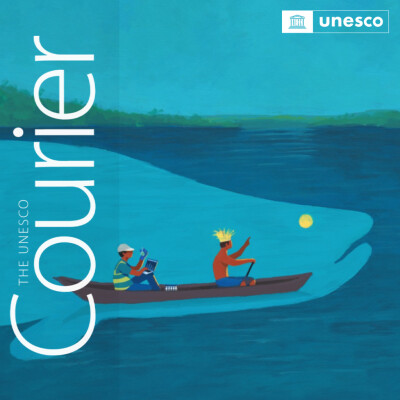
From the wide deserts and isolated islands to African brushlands and the frozen landscapes of the north, the front line of Earth's conservation looks and sounds different than you might think. Did you know that indigenous people own, occupy, or use around 20% of the world's land? Yet, these very same territories contain 80% of our planet's remaining biodiversity, safeguarded by people whose way of life inherently protects the natural world. Today, their voices are reaching us, holding the keys to a more resilient world. But will we choose to put these solutions to work? Taking you beyond the pages of the January 26 issue of the UNESCO Courier, this podcast will transport you to the four corners of the world. to discover how indigenous insights and modern science are already pairing up to forge a sustainable future. The Power of Indigenous Knowledge is a UNESCO Courier podcast by Anulina Savalainen, sound design is by Emmanuel Rudovsky, and the narration is by me, François Vibaud. In autumn 2025, journalist Marcelo Silva de Souza was out in the field in the state of Amazonas in Brazil, reporting on a story for the Unesco Courier. If you listen closely to the sounds he caught, you'll hear a boat crossing the Puras River, where indigenous Paumari fishermen are bringing a massive pirarucu to shore. Just one of these fish can reach three meters in length, so catching one means enough food to feed the entire village. But two decades ago, Pirarucu had all but vanished from these waters, having fallen victim to excessive industrial fishing. This pushed the community dangerously close to a hunger crisis. Chico Pamori explains to the journalist how they felt when they went to the shore and realized there were no fish left.
- Speaker #4
Since ancestral times, nature has brought joy. and deep satisfaction to us. There is a specific desire to reach the edge of the lake and see fish moving, to see the water churning. When we reached the shore and saw the water dead and still, sadness hit us. We understood that nature was begging for our help.
- Speaker #3
If today the river is teeming with over 10,000 pirarucus, it is thanks to a pioneering collaboration between scientists and the Pamori people. The rescue project involved five years of total protection, followed by an annual census and a strictly regulated harvest quota. Biologist Felipe Rossoni explains how this collaboration transformed his approach to science.
- Speaker #5
The role of academic science was to help systematize management, based on the deep ancestral insights the palmari already possess regarding fish behavior and the ecosystem. The palmari are known as water people. Their entire cosmology, their way of understanding the world, is rooted in the water. So, by nature, they're expert fishermen. I learned a lot about ecology and fish dynamics from their knowledge, which contains their level of detail. unprecedented for my understanding, even as a researcher.
- Speaker #3
This is just one of the many examples of how indigenous knowledge can offer valuable and scalable lessons on how to tackle environmental threats. From biodiversity loss to food insecurity, for Chico Palmori the results are about much more than just fish. It's a lesson in dignity. We, the water people, were once more discriminated against than praised.
- Speaker #4
But today, Brazil and the world know who the Palmori are. We have been recognized and we never want to be forgotten again.
- Speaker #6
So the bird or the fricking bird, which tends to navigate itself or fly around in the coastal areas, it may fly away and it may hover from afar, but it will always return to water. And that metaphor is used often when Samoans travel or when we... send a child to school overseas and we expect them to return.
- Speaker #3
This cultural metaphor that indigenous Samoan journalist Lagipoiva Cheryl Jackson remembers from her childhood feels like a wink to the Paomori people from across the globe. Just as the Samoan bird returns to water, many Paomori families who had left for the cities have now returned to their ancestral lands, drawn by the revival of the Piraruku.
- Speaker #6
In Samoa, our chiefly language is based on metaphors, and these metaphors are based on nature itself and the interaction between nature, wildlife, marine life, and other interactions in the ecosystem.
- Speaker #3
In her work as a journalist and as a teacher, she spreads the word about climate solutions that indigenous people have held for millennia.
- Speaker #6
Indigenous knowledge compared to science. frameworks of our modern times is essentially the science of indigenous peoples based on spiritual understanding, on ancestral knowledge, and also is very much founded on where we're from. Indigenous peoples had that science, had that understanding of nature, of life, and everything around us before western science frameworks were introduced.
- Speaker #3
Laghi Poiwa wrote the introductory article for the January 26 issue of the UNESCO Courier, an issue that highlights just how deeply indigenous science and local knowledge systems can help us understand the world around us. The examples are many. What you're hearing right now is a yoik. It's a traditional song of the Sami people in the northernmost corners of Europe, recorded in 1914 on a fragile wax cylinder. It's dedicated to the land of reindeer herding and originates from Carl Tiren's collection that was recently inscribed on UNESCO's Memory of the World Registry. This song resonates deeply today, as traditional reindeer husbandry faces mounting pressure, with the layers of ice getting thinner and traditional pasture lands competing with modern developments. Yet the hundreds of words used by the Sami to describe snow and ice are not only helping indigenous herders navigate changing migration routes, but also providing scientists with crucial data to track Arctic climate change. Indigenous knowledge systems can provide a different way of seeing, from farming to medicine to architecture and even astronomy, as Leggy Poyva describes.
- Speaker #6
The beauty of indigenous knowledge, especially as it relates to climate, is that it is through trial and error. For thousands of years, Polynesian voyagers read the stars and found their way to our islands, right? And these were developed by complex systems of... thinking and ways of knowing. And it resulted in very sophisticated navigation systems based on the stars, wind patterns, wave patterns, and just based on the human ability to read nature and interact with nature in a very healthy way. A very good example of this is the Samoan Fale or the indigenous Ms. Samlin. structure or home. It is made of all native wood and also the thatch, the roof is also made of natural products. All of these materials can be found in nature, extracted by locals and fashioned in a way that then creates a structure that is climate resilient. And the way that we cover the open sides of the structure itself or the phale uh allows for wind to blow through. In some cases, these are on stilts when it's on coastal areas, so therefore allowing for any floods to go underneath.
- Speaker #3
Now, did you know that among the world's approximately 7,000 languages, the majority are indigenous? But the sad news is that these languages are disappearing at an alarming rate. And every lost language erases ecological knowledge embedded in vocabulary and place-based understanding. What you just heard is a few words in one of Africa's most endangered languages, the click-based Nuu. That was Nigel Crawhall, chief of section for Small Islands and Indigenous Knowledge. at UNESCO. He spent most of his career studying and defending the wisdom of the world's indigenous and local populations, which in passing has allowed this South African sociolinguist to gain conversational fluency in many rare languages.
- Speaker #7
What I said is, hello, I learned to speak the new language with the people, community I work with, and my name, what they called me, was oi jan, which means to the one who walks alone.
- Speaker #3
Nigel has a couple of theories on how he got this nickname. One is that he ended up being seen as part of the San community he worked with, so they named him after one of their ancestors.
- Speaker #7
The other hypothesis is several of the grandmothers were hoping I was going to marry their granddaughters, but in the end I did not. So they said, oh, he's the one who goes by himself.
- Speaker #3
It was during the same period, early on in his career, when he was working with an NGO in the Kalahari Desert on a land restitution initiative. that Nigel really came to understand the power of indigenous knowledge.
- Speaker #7
I went up to the Northern Cape and I went all along the Orange River and I met thousands of indigenous people, many of them speaking their languages. But then we worked with this one group and then we found these old people who spoke this really ancient language, one of the oldest languages in Southern Africa, the Ngu language. None of the old people I worked with had ever been to school at all. They couldn't read and write. And yet they had these super sophisticated knowledge systems and incredible memory capacity. And one day we were working with his grandmother to gather terminology about anatomy. And we were two PhDs working with her. And then she was making a distinction between a pancreas and a spleen. And my father's a doctor, so I meant to know the difference between a pancreas and a spleen. And in her language, she knew all of this. And we two PhDs were like, which one is the pancreas? that we realize how how advanced this knowledge is. You spend all this time going to university, but there's other people who have very sophisticated knowledge systems. That's really important for us to understand.
- Speaker #3
Nowadays, Nigel is busy elevating that understanding to the highest international level. He sat down with the Corrie in UNESCO's radio studio, sharing how he carries this mission forward through UNESCO's program on local and indigenous knowledge systems.
- Speaker #7
It's a program that's been running for over 20 years at UNESCO, and it's also the only unit in the whole of the United Nations system purely focused on Indigenous peoples' knowledge and the knowledge of local communities. Some of the observations by Indigenous peoples and local communities could really help us understand climate adaptation, improved resilience, changing crops, even dealing with health issues, that we realize is this vast store of human knowledge. observation and analysis that we're not making use of. So in the idea we want to achieve the sustainable development goals, trying to bring the whole of human knowledge into understanding the dynamics of how we're living and the challenges on the planet, this is probably a better way to work. But also UNESCO has a mandate on cultural heritage and cultural diversity. And so we're very much at the interface of that process of what is transmitted culturally and what is epistemological and intellectual work.
- Speaker #3
His work ranges from supporting national ecosystem assessments all the way to hosting dialogue between modern scientists and indigenous communities, connecting them at the global level as well as on the ground. His work also involves connecting communities directly with one another across borders, like you'll hear in the following example.
- Speaker #7
We're working with a group of hunter-gatherers from northeastern Namibia to work with hunter-gatherers who are in Tanzania. They both speak click languages, they're very unique to Africa. And what we realized through a feasibility study is that the Hadzabe, who are a really ancient population, They've been in their territory in Tanzania probably for more than 60,000 years. They're now starting to lose their language for the first time, which is quite shocking because they have this really highly sophisticated knowledge system. And so what we're working with them on is how to use geospatial technology to help young people learn from their elders to identify wildlife, birds, pollinators, all sorts of information about the natural environment. But not just having oral knowledge like they would traditionally, but to turn that into data, so that trying to bridge between information technologies and traditional knowledge systems.
- Speaker #8
Concretely,
- Speaker #3
the bridge is a mobile app called Cybertracker. Since May 25, UNESCO has conducted three training sessions in the Yeda Valley, deep within Hadzabe territory in northern Tanzania to test it out.
- Speaker #9
Our languages and the tools we are using are very different,
- Speaker #3
but our way of life is similar. That was David, a member of the Namibian Hunter-Gatherer delegation, recorded in an interview during the May 2025 training session by Yohannes Sazana from UNESCO's regional office for Eastern Africa. In the accompanying video, we see men of all generations walking through a rocky landscape dotted with wild shrubs. They're equipped with traditional wooden bows, as well as smartphones. This icon-based app also helps elders pass their knowledge down to the younger generations. In the words of Jacqueline Osman, a Hadzabe community member,
- Speaker #10
We try to conserve and protect our environment. We want to transmit our culture and lifestyle to the next generation.
- Speaker #7
And if you want another example, we're working with communities in the Guyana Shield. So that's the countries of Venezuela, Guyana and Suriname, but also in Botswana to look at traditional fire management. So under colonial law, many countries stopped indigenous people from doing controlled burns because they had the idea it was bad for the environment or bad for their crops or, you know, it could get out of control. Whereas in fact, most human populations in savannah grasslands and other particularly tropical and subtropical areas, they always use fire management for multiple purposes, including promoting biodiversity rather than damaging it, but also pest control and invasive species control. So now we're helping these communities document that and bring that into national policy dialogue.
- Speaker #3
Such examples bear witness to a crucial shift where indigenous populations are not merely the subjects of science, they're the ones defining the map. Laghi Poiwa illustrates this approach through the concept first put forward by an indigenous elder from Nova Scotia in Canada.
- Speaker #6
The two-eyed thing essentially marries both western systems of science and indigenous knowledge for the sustainability of nature. This collaboration, according to Mick Moore, Albert Marshall, is vital because Indigenous practices actively protect over 80% of global biodiversity. So ultimately, the framework shifts environmental policy away from short-term resource exploitation, which is very much founded on the ways of the West, toward more long-term ecosystem sustainability.
- Speaker #3
That was archaeologist Ora Marek Martinez, interviewed by the UNESCO couriers Katerina Makalova in 2025. She began the conversation by reclaiming her identity.
- Speaker #11
I just introduced who I really am. I am Navajo, a citizen of the Navajo Nation. I am a member of the Mountain Cove clan, very specifically.
- Speaker #3
Ora is one of a growing number of indigenous scientists who act as ambassadors between two seemingly opposed worlds. As a Navajo archaeologist from the United States, she works to dismantle the western paradigm that has dominated science for centuries. For her, being an indigenous scientist means looking seven generations ahead and taking into account the whole of humanity.
- Speaker #11
When I first started in archaeology in the 90s, right, um There were very few Indigenous people in the field at that point. And when I suggested utilizing oral histories and other kinds of Indigenous knowledge about different archaeological sites, I was ridiculed. I was critiqued. For a lot of us as Indigenous peoples, our experience has been that our knowledge has been relegated to. myth and to fancy, and it has not been accorded any kind of academic weight. And so folks like me, Indigenous scholars, we are reclaiming that space and bringing our knowledge and our Indigenous research methods into academia, and it's creating all of these amazing insights into what we know about who we are.
- Speaker #3
Today, Aura leads the Centre for Braiding Indigenous Knowledges and Science. at Northern Arizona University. Their mission is to break open rigid scientific boundaries and create a true home for Indigenous methods.
- Speaker #11
If you want to work with Indigenous communities, you need to ask permission. And so for me, it is really changing the research paradigm because for many years, research has been extractive and Indigenous communities have a very long memory and they share stories about these practices from one generation to another. And so I specialize in Indigenous archaeology and working very closely with the Navajo Nation to create a very special, unique Navajo place-based archaeology. Then they have observed from generation to the next about different phenomena. And so part of that sort of knowledge transfer is through oral histories. There's also rock art, right? Petroglyphs, pictographs. And some of this is written down in ways that's not recognized by Western academic disciplines. Part of braiding is the incorporation and the acceptance of that kind of knowledge. Research methodologies that are based in, again, this very long relationship with the landscape.
- Speaker #3
Decades-long fight for a place at the global decision-making table finally paying off. Nigel Crawhall and Lagipoiva Cheryl Jackson are hopeful.
- Speaker #7
Huge change, enormous change.
- Speaker #6
More often now you see the representation of indigenous peoples with governments when they are represented at environmental negotiations or international meetings. The fact that indigenous peoples has its own convention and also are acknowledged. in the UN system is an extraordinary way forward. UNESCO has played a really key role in the Pacific in the protection of indigenous knowledge. And this is something I have seen firsthand as a journalist.
- Speaker #7
When we started LINCS 23 years ago, this was really a specialized area and mostly what we were concentrating on. was indigenous and local knowledge related to UNESCO designated sites, the biosphere reserves and the World Heritage Sites. But now in the subsequent years, now most of the major multilateral environmental agreements include a component on indigenous and local knowledge.
- Speaker #3
Ultimately, this could mean a fundamental shift in our relationship with the planet, moving away from exploitation and back towards care. With this in mind, we leave you with a final thought from Ora Marek-Martinez.
- Speaker #11
part of our experience as Indigenous people is that our homelands have given us our language, our identity, right, our cultural practices. And so in return, we take care of our homelands, we steward the lands and all of the elements. And all of these elements are our relatives.
- Speaker #3
And that brings us to the end of this UNESCO Courier podcast. But you can read more about the topic in our January 2026 issue titled How Indigenous Knowledge Drives Scientific Discovery. It's available for free in six languages on the UNESCO Koryo website and can also be purchased in print from the UNESCO e-shop.
- Speaker #8
Day of my life, I'm gonna get it done