- Speaker #0
Family businesses are different than any other corporation because we're not talking never only about business. We talk about family, we talk about wealth and the business. But family businesses are important for everybody in a country because they are building their communities, they are building the country. So if we want to help them, if you want to protect them, if we want to grow here, multi-generational wealth, we need to understand them, we need to see them. And this book, It's going to give us the language. It's going to give us those lenses to understand them. And therefore, everybody can help them to grow and make our communities and country economically more powerful.
- Speaker #1
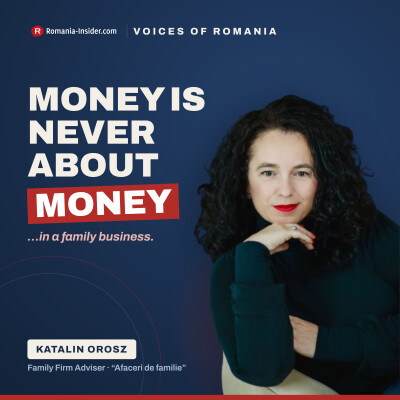
Every family business carries two discussions, the one in the board meeting room and the one home. What remains unsaid home is said at the office and needs to be said at the office. Someone, Catalina Rose... just released a book with Nemira called Apache of the Family, Family Businesses. And we are now with her. We have the great honor to be with her after two decades spent between Romania and Canada to talk about this book, which is launching now. Hi, Kathleen.
- Speaker #0
Hi.
- Speaker #1
It's a great pleasure to have you here today to discuss with us. And I have a first question for you, an easy one. Let's start with you. Like, who are you? What have you done? I've seen that you've lived two decades between Canada and Romania. You've studied in Canada. Can you please tell us a bit about you?
- Speaker #0
So I'm in sales. I'm a natural born salesperson. I had 10 years of career here in Romania in top management. And then I did my MBA in Montreal. And then I started working there because the adventure was too good not to continue in Canada. It was lovely. And I am very, very humbled and I'm very grateful to Canada. that adopted me. And then of course that I started to have my own family, I have two kids, my father, my mother, they started to age and we decided to come back to Romania. So the family should be together. Unfortunately, I lost my mother and I couldn't even say goodbye to her. So that was the decision maker for us to return to Romania. And of course that we started immediately to be business consultants because that was our comfort zone. And we ended up working with family businesses by chance. And we realized that some of the things that they should work, they were not working. And that's when the journey and the research started. So why? What is the difference between a normal company or a different company and a family company? And this is how we landed with Family Farm Institute in Boston, Lumina Learning in London. So for two years, we are taking classes and we are learning and while continuing to advise family businesses, mostly in business, but also in succession and in family and a little bit of financial education to understand the wealth part.
- Speaker #1
And what brought you back to Romania besides family? Was it for you like a challenge, let's say, because after a while in Canada, that's a big change as well, to come back to Romania? If it was a while ago, what made you come back?
- Speaker #0
It was just about the family, honestly. We love Canada and we are very grateful for that adventure. And my kids, they were born there. It was, I love the multicultural part of it, the food. So we love that part. But... you do realize that the biggest gift I can give to my kids is to be with their grandparents. So of course that now when I see my daughter cooking with the grandma, that's just something that we couldn't have had in Canada. So it's as easy. I know everybody is trying to see if there's an angle. We still have our house there. We still have our friends. Our life right now is here and we love it.
- Speaker #1
This is great. We can call you a repatriot, as they say here. Exactly.
- Speaker #0
I am a repatriot.
- Speaker #1
This is really nice. And talking about this book, Afa Tchad de Familié, Family Businesses. So you've worked a while with family businesses in Romania. And from which point did you say, OK, let's write a book about it? Because you've seen a lot of common mistakes, a lot of common points between these families. What motivated you to write this book?
- Speaker #0
I think that the most important thing is about the lack of language. So right now we talk about Romanian local businesses or Romanian businesses, but we don't even use the term family business. We don't have the tradition. Our entrepreneurship here in Romania is actually very, very young. Everything started in early 2000. We do need language because before strategy and before optimization, we do need to have a shared reality. And that's what I think that we don't have right now in families. So right now, I find Romania as a laboratory because there are so many family businesses that they go through the first succession. But on the other hand, there is a huge economic shift also. So from a deficit economy, we are transitioning towards a very competitive market economy. And so these two things, they happen in the same time here. And the first succession, globally, the success rate can be around 30%. But here, with the lack of tradition, with the economic transition, I am a little bit worried that it's going to be even less. And we're going to lose amazing businesses, amazing families, and the opportunity to create really multi-generational wealth.
- Speaker #1
So then when should it be like the moment where family should have this book on the table? When should it be like for in which situation you want, like you have a family business, you need this book?
- Speaker #0
Now, summer. It's a coffee table book. So I wrote it for the busy entrepreneur. It's very easy. It's like talking with me. some of my clients they are saying like oh my god i can hear your voice it's easily written so it's like a discussion at coffee it's i think it is a beautiful font and it's easily synthesized to be able to easily synthesized it's a similar reader so i would say as soon as possible because at that point It's the conversation starting with the family, with the experts, with the employees. So sooner we start the conversation, sooner we start the process. Because this is not a task. Changing a family business or doing a succession plan or anything, governance, it's not a task. It's a process.
- Speaker #1
And what is the most, the pain point you faced the most? into like transition in family businesses, succession? What is, let's say, the success rate? And what would be like the main issue like families are facing together in this process?
- Speaker #0
I think these are the two biggest problems. First is the succession, because we don't have a tradition with it and we don't have mechanism and methodology. So succession planning is not like, oh, I'm changing, you know, the name on the organogram. So that's not going to work. And the problem with the succession worldwide, not just in Romania, is that the moment we start to talk about succession, it's talking about irrelevance of the founder or, you know, of them or even death. So that's why we always push it. Like maybe we have time. Maybe it's not because I am still young, because I am still powerful, because my mental capacity is there. I understand the market so I can do this. but Succession is not about death. It's not about irrelevance. It's about responsibility because it's not going to happen overnight. So everybody needs to find their rhythm and their role to be comfortable around the table. And the next big challenge is this changed economic context. Everything that these founders, they did, they were very... courageous they were they were working a lot the problem is that whatever they did we cannot repeat it now because the context is different so that is hard these are hard discussions yeah
- Speaker #1
and I believe like let's say this tradition like in western Europe or in the US is pretty well like made because they prepare like the kids from where they are a kid to take over the company So I believe here, like when you have, let's say, the discussion at 30 years old, 40 years old, it's mostly like, OK, but I'm already established in my life and why would I change? So this is when the company like is losing this family business trend. All right. So they have to sell the company. So maybe the company die. This is, is it like what is mostly faced when it's not working in this way?
- Speaker #0
So we always, we tend to think in two ways. The kids, they don't take over the company or they take over the company. But there are so many roles in between. So as an owner or as a family member, you can take on so many roles as in terms of the family cohesion, in terms of the wealth management or in an operational world or even just as an owner, you know, to be on the board or. So there are so many roles. But because we don't have the language or tradition, we don't know. So we cannot choose them. That's the problem. The second thing is that there are so many ways. Some family members, they want to sell the company. Some family members, they want to milk it. You know, till it's giving money, it's fine. Let's take it out. And some members, they want to create multi-generational businesses. And all of these are very... very valid. The problem is not that we have different perspectives. It's that we don't have a shared reality. So that's why when I work with families, the first thing is to speak the same language and to share the reality. And then however, in which rhythm and however way we want to go, that's going to be their way.
- Speaker #1
You've said in a recent interview, In a family business, what remains unsaid at home returns to the film. Can you unpack that thesis and tell us where you saw it in your time, like to spin it in the book?
- Speaker #0
Well, I think that's one of the biggest differences between a corporation and a family business, that we don't talk about things. We don't talk because we think that we're going to hurt the other person. So, a brother... It's not going to say to the brother that, well, you didn't achieve your target, you know, because or it's not going to say, well, you your salary is going to be smaller because I'm the CEO and you are just the marketing director, because that's going to be about love and identity. So these are the things that sometimes it's very easy to talk about compliments, what we do right. but when it's about the real feedback. when we need to optimize something or we need to change something. Sometimes we don't have the words for it.
- Speaker #1
And this is where I've been through the book, where you have this family constitution, right? So I believe it's in playing this part.
- Speaker #0
Well, governance is important because love is not going to be enough. So a family constitution can be one of the instruments that we talk about. how we are deciding, how we're going to communicate, how often we're going to communicate, who is part of the family. So if we are going to adopt somebody, is that going to be an owner someday? Is going to have the full right? If I am divorcing my husband or my wife, does she still be part of the family? Can she work in the family company? So these are the discussions that have to happen. But again, this is not a task. I work with a family that they wrote their family constitution in seven years. So it doesn't have to be long because I always say that it has to be something that you can easily understand and change. So I am not a fan of 50 pages of strategies or family constitutions or strategies. But it has to be a working document that is just to show some of the rules. How are we going to work together to eliminate some of the... unnecessary conflicts. And it's good to do it while everybody's at peace and everybody's happy because it's easier than in a crisis.
- Speaker #1
It's kind of like having someone in the middle where you have to refer to when there is an issue in the family. You've built this book around three fundamentals, family, wealth and business. With those three, why those three pillars? And where do they most often collide with each other inside the real? Romanian family?
- Speaker #0
That's a great question because the idea that a family business is different from any other company, exactly that's why. Because in a company, we talk about performance, we talk about business. But in a family business, we talk about family dynamics, we talk about wealth management, and we talk about the business. So think about it. If somebody dies in the family, it will have an impact in wealth. and it will have an impact in the family business. If the business doesn't go well or goes really, really well, it's going to change the family dynamics and it is going to impact the wealth. If somebody gets divorced, it's going to impact their wealth and then, of course, the family dynamics. And, of course, that will go to the business side also. So these three dimensions or pillars or, I don't know, I call them circles, they cannot be separated. So we have to have a system thinking to understand the family business. And that's very important for the employees, for any consultant and expert that works with the companies and the family itself.
- Speaker #1
And talking about this dynamic in Romania with this circle, let's say it's pretty new in Romania, this family business trend, because after the collapse of the communism in 1999, it's real like companies started to grow. Now these entrepreneurs, they have, let's say, 50, 60 years old, 70. So this is where they have this succession-like period. What is unique about this Romanian moment compared to Western Europe and Canada, for example?
- Speaker #0
I think that the double transition, so the economic shift and the first succession. So I think that that's what's happening in the same time. And I'm not even talking about AI, which is changing the world. So this double transition, and that's what actually said Mario Stefan in the foreword, that's the part that hit him the most, because this double transition makes everything much more vulnerable. Thanks. too much to handle. And if we think about the fact that we don't have tradition and language to talk about it, none of it, not the economic shift and not the first succession. So we don't have language around it. We talk about macroeconomics a lot. We talk about entrepreneurship a lot, but not about what we do different because the market has changed and how do we do the first succession. So we don't talk about these two things, which is actually the good thing. The Good news is... It is under the entrepreneur's control because we cannot change the world. We cannot change the macroeconomics or the fiscal issues, but we can change what we do inside of our families and family businesses.
- Speaker #1
So from your perspective, what does a good endover look like?
- Speaker #0
What do you mean?
- Speaker #1
I mean, after the succession, how can the family switch? Let's say the founder gives the end to the new, let's say, general manager, like his kid, his son or his daughter. What is a good endover? in the family?
- Speaker #0
I think that in my perspective, and allow me to say that, it's a better question, what kind of family we want as a family to build that is going to be sustainable for multi-generation. So that's the question. And there is no recipe. Every single family and every single family business is different, has a different rhythm, has different values, has different dreams, foundation. And that's fine. The big question is how are we going to work together and what kind of company we need to build and what kind of changes we need to make in order to build a multi-generational wealth.
- Speaker #1
And you have the other side of the table of the discussion. So you have, let's say, the father or the mother giving to the kids and you have the kids taking the company. And it can be a lot of responsibility for them. And as well, you have to build the respect with the employees, for example, the relations that your parents could have. How do you help a son or a daughter step into a family firm on their own terms without either running it or being flattered with it?
- Speaker #0
Well, the first, I think that in a family firm and in any other firm, we need to think about competence. So competence... and I write about this in book is education plus experience multiplied by talent. So when I work with family members, I always look, you know, what is their superpower? What is their talent? Because if we understand somebody's talent, it's much easier to build experience and education on that because it's going to be a multiplication. So we need to find first the role. of these next generation. Many times what I propose is, what I recommend is to build an incubator where anybody from the family can come and even sometimes employees and do projects. So these projects are very limited in terms of deliverables and budget and, you know, the idea. So this is where we are testing the roles. We are testing these people. We are understand, you know, their weaknesses and their... their strengths. So this is not something that the kid comes, here you go, this is the company that you will lead, because it's going to be a failure. It's more about creating value. And first without the function, it's more about the value creation. And then slowly, we will find a role where they are very comfortable. And if they are comfortable, they create value, they increase their competence. The employees, they will feel safe, they will feel respected, and they will respect the family.
- Speaker #1
So it's all about anticipation, preparation. And wealth is one of the three points of your circle. but I think it's the one which is the less spoken in the family. It's not really discussed openly. Why is money the hardest conversation, let's say, in a family dinner? And what changes when a family finally have this conversation openly?
- Speaker #0
So I would say two things. One is that during the time of the communism, we always associated, well, the Communist Party associated money with the devil. So the capitalism was really, really bad. So we grew up with thinking that money is bad. But money is not good or bad. What we are doing with money, that can be good or bad. So that's one of the limitations, that we are not really good with talking about money. And the other hand, in any family firm around the globe, when we talk about wealth, when we talk about money, we don't necessarily talk about money. We talk about love. We talk about identity. We talk about our place in the family. So if one of the sister gets more, is she loved more? Is she more worthy? So I think that's what makes it in a family business so hard because the parents, they want to, they love their kids equally. But sometimes when it's about money, it's not about love. It's about performance or it's about roles. And that's why we need to create clarity and separate these issues so the conversation can flow organically with love.
- Speaker #1
Really interesting. And looking across all the different families you've worked with, what are the two or three mistakes you can see a mile away? You can anticipate a lot. And what is a good early warning sign that the family business is heading through one of them, heading to one of them?
- Speaker #0
I talk in the book about the shadow government. So when, you know, there is a meeting, we take a decision, and then there is a phone call or a family dinner, and the decision is changed. So that's very, very dangerous. Because in a way, that's going to absolutely destabilize the family. Everybody will know that nothing is certain. But that's going to be even worse because the employees, they may feel this. So all these meetings are going to be pointless. So you will see the best people leaving the company because they will feel that anyway, the power dynamics are very, very different. So I think that's one of the biggest risks in a family business. On the other hand, it's about the succession is always hard. Because we need to talk about the end. We need to talk about, honestly, about relevance, about innovation, about market. And that's very hard because founders, it's not just their company, it's their identity. So to step aside or back, that's a very, very hard thing to do. Even if you do it with a lot of respect and love, that can be very, very emotional. So these are the risks.
- Speaker #1
And about the risk, let's say, and the way you anticipate it, without naming any company or anyone, was there any family business that shaped the way you advise and that really inspired you with this book, like your family business that for you was the best model, let's say, in family business? Was there one you had in mind?
- Speaker #0
I am there to serve these families. And not only they choose me, I choose them. So I am very proud to serve them. And my role is to find the problems, to point out the risks. So it's not an easy role. I bring the hard conversations to the table. And honestly, I worked with around 30 families since we came back from Canada. And I can say that I love these families. I respect them. Not even one person, because nobody is perfect. Not the family is perfect. Everywhere there are going to be good days and bad days, but these are good people. And I know that in Romania, sometimes when we think about entrepreneurs, we always think about people that they are very hard to work with. But I am absolutely sure that for every single entrepreneur that you cannot work with, there are five that you would love to work with. And this book is for them. Those that they want to change the community they live in. they are the the foundation of this country. So it's not that one is good or the other is bad. Every single situation is different. And every situation can be always optimized because these are very complex businesses, the wealth, the family dynamics and the business. So my role is to search for the weaknesses, to point out possibilities, to optimize and to bring risk to the table.
- Speaker #1
So, for example, an entrepreneur would want to change, like having a family business, reading the book on a Sunday and then on Monday morning being like, OK, let's change something. What would be the first thing you would like him to change or to do?
- Speaker #0
So what I do, I usually I start with five meetings together with the family. And we actually, in an anonymous questionnaire, we pull together the family cohesion, the legacy capital and the entrepreneurial spirit. And we calculate 24 indicators. And why I do that? because I love anchoring the reality in mathematics because then we are not talking about who's right. We are talking about numbers. So it's easier to start the discussion and to bring it to a rational level. And it is anonymous because it is not about me. I'm not the main character, but neither is the founder. So everybody in the family needs to have a voice. And in this way, you know, we are creating a shared reality. So after these five sessions, they are going to know why they want to work with me and I will know why I want to serve them. And that's when the real work starts because they have a language, they have a shared reality and they will know what they want to change. Because again, I am not and a consultant is never the main character.
- Speaker #1
It might hurt your feelings, but you have to do it. You seem to be really passionate about what you do. What do you love most? about family businesses, about your daily role with them? What do you love the most?
- Speaker #0
So I think that, first of all, I love selling. So I'm a salesperson. I'm a marketer and a salesperson. So I love the business part. Whenever I see, you know, my clients, they are increasing their sales numbers or their profitability or profitability per client or they're lowering their client acquisition costs. Like I am very, very happy. And I come up with always these very creative ideas. I love to play the marketer part. And so I love that part. But also, I'm at that stage when I myself, I have kids. And for me, it is important to have an impact in the country. And I know that some people, they will work from politics and from top down. But I think that my work is... through the families, from every single family and every single family business, I am bringing a positive impact to my community and to my country. And this idea that I am building every single day a country where I want my kids to live, that is an honor, honestly.
- Speaker #1
So this is exactly my next question. If we come back to this conversation, to this table in five years. What would you want to see of change in our Romanian family businesses? Talk to each other. And what will you be working on to help that happen?
- Speaker #0
Oh, so I have so many plans. So I started the podcast and the book just because I wanted to start a conversation. I work with the families every single day to make sure that I can impact their businesses or their family dynamics. But also what I would like to see is I'm working with a university now to do a next gen program. So to start with young people, to make them passionate about their family businesses, to see the multiple roles so they have more options to choose from. On the other hand, I would love to start the research project to understand, you know, what are the best practices in the world and how many family businesses and where they are in Romania. So we can start maybe lobbying for legislation because these families, they build this country. So if we can just change a little bit in their fiscal laws or, I don't know, the tax laws, that would be a huge impact for real businesses, real families and the employees. So our community. So I do have a lot of plans. Really nice. Thank you very much, Catherine. Usually I do the outro, but I think it'd be good. I will give you the book and I will let you make, let's say, like a 10-second speech. Like, why should you read the book? If that sounds good to you.
- Speaker #1
10 seconds, wow.
- Speaker #0
Or maybe 30 seconds if you want. I think it could be great.
- Speaker #1
Okay.
- Speaker #2
Family businesses are different than any other corporation because we're not talking never only about business. We talk about family. We talk about wealth. and the business. But family businesses are important for everybody in a country because they are building their communities. They are building the country. So if we want to help them, if you want to protect them, if we want to grow here, multi-generational wealth, we need to understand them. We need to see them. And this book is going to give us the language. It's going to give us those lenses to understand them. And therefore, everybody can help them to grow. and make our communities and country economically more powerful.