- Speaker #0
Hello, Koku. Quick question. Why do my location services say somewhere in the middle of the Atlantic?
- Speaker #1
Because we are at sea, Siri. We onboard a ship, a magnificent, unsinkable marvel of engineering.
- Speaker #0
That sounds reassuring. Which ship?
- Speaker #1
Think the Titanic.
- Speaker #0
The Titanic?
- Speaker #1
Wait, also Noah's Ark.
- Speaker #0
That's a bold combination. Should I stay calm or initiate emergency protocols? These are two major disasters waiting to happen.
- Speaker #1
Or one perfect metaphor, Siri. Stay with me. Picture it. In first class, it's still champagne and confidence. We've been cruising on this great economic vessel, burning coal and oil. And up there, in the crow's nest, someone has been trying to warn us about something ahead.
- Speaker #0
Let me guess. That something is climate change.
- Speaker #1
The iceberg version of it, yes. Only this time, the warning hasn't been sudden. The lookout in the crow's nest has been sounding the alarm for decades. This was Cassandra, or rather, Cassandra Thunberg, along with thousands of scientists, waving their arms, shouting until they were out of breath. And yet, so many chose to look away.
- Speaker #2
Heisberg ahead Heisberg right ahead Heisberg
- Speaker #0
So we hit it?
- Speaker #1
We did. Slowly. And then, all at once.
- Speaker #0
So, the classic boiling frog? Humans reacting too late, too slow, the gradual change?
- Speaker #1
Exactly. Gradual heat feels normal, until it doesn't. And now the iceberg isn't theoretical. The captain, in this case, global leaders and policy makers, is still not alarmed enough. The data is intangible, not yet. Humanity seems to suffer from a dangerous flaw. We only believe the iceberg is real when we can see it. Or worse, when we start feeling the ice hit the deck.
- Speaker #0
And now, the ice isn't just on the deck. It's droughts, apocalyptic floods, and heat waves breaking records year after year. The iceberg is no longer ahead of us. It's here.
- Speaker #1
And because we didn't turn the ship in time, because mitigation alone hasn't been enough to steer us clear, plan A, we're now considering plan B. And that plan B is adaptation and resilience combined with mitigation. Oh yes, we still have to focus on mitigation.
- Speaker #0
So, how does plan B play out? Are we talking about stronger shipping hulls and more life jackets?
- Speaker #1
That's just the beginning, Siri. Welcome to 2050 Investors, the podcast that deciphers economic and market megatrends to meet tomorrow's challenges. I'm Coco Agboblois, Global Head of Research at Societe Generale. In this episode, we dive into the complex but unavoidable topic of climate adaptation and resilience. Which climate scenarios are we talking about? How far can we adapt? And where are the breaking points? We'll explore the costs, the consequences for the planet, society, and the global economy, and why funding these life jackets can be difficult to mobilize at scale. Later in the episode, we'll be joined by Karine de Bois-Sauzon, Chief Impact Officer at EDF, one of France's leading energy providers. Karine will help us understand how EDF thinks about investing in adaptation, aka Adapmex, running scenarios, stress testing supply chains, and thinking in truly systemic terms. Let's start our investigation.
- Speaker #0
Splendid. A wonderfully uplifting topic. I'll just lower the ambient temperature to simulate the freezing waters of reality.
- Speaker #1
Ha I thought temperatures were supposed to be rising, Siri. But... Let's not chill the audience too quickly. We still have 20 minutes to go. Let's begin with some definitions, shall we?
- Speaker #0
Roger that.
- Speaker #1
The European Commission and the EU Taxonomy Regulation define adaptation as the process of adjusting to the present and future impacts of climate change. Resilience, on the other hand, is the ability to prepare for, withstand and recover from those impacts.
- Speaker #0
That's a bit dry for a definition, isn't it?
- Speaker #1
Well, let's make it more tangible. Climate mitigation, where most of the focus has been, is about trying to stop the iceberg from forming, or at least steering the ship away by reducing greenhouse gas emissions. Adaptation is about dealing with the iceberg that's already there. It's putting on a heavy winter coat, or reinforcing the Titanic itself before impact, or quickly repairing the ship after damage to avoid sinking.
- Speaker #0
Okay. I see what you're getting at. And what about resilience then?
- Speaker #1
Resilience is the ability of a system, a city, an economy, even the planet itself, to absorb shocks, recover, and keep functioning. In simple terms, adaptation is what you do, and resilience is what you achieve.
- Speaker #0
Okay, so if adaptation is learning how to take a punch, resilience is how quickly you get back on your feet.
- Speaker #1
That's actually a perfect transition, Siri, because the punches are already landing. So let's look at some hard numbers.
- Speaker #0
I think our listeners should sit down for this one.
- Speaker #1
Agree. The first thing to say is this. The scale of the need is huge. If you look at the corporate side, consulting firm BCG puts adaptation and resilience project spending in the range of roughly $800 billion to $1.2 trillion between 2026 and 2030. Then, if you zoom in on public and developing countries, the UN Environment Programme's Adaptation gap analysis suggests developing countries alone face adaptation needs in the hundreds of billions annually. That's on the order of 200 to nearly 400 billion a year this decade and moving into the low to mid 300s by mid 2030s. By 2050, that number could exceed half a trillion dollars annually.
- Speaker #0
That's a lot of money.
- Speaker #1
But it gets even more uncomfortable. Reports by both UNEP and the Climate Policy show that there is a huge funding gap. In 2023, climate finance was about $1.9 trillion. Yet, only around $65 billion was tracked as adaptation. And in emerging economies, adaptation flows were about $46 billion, against needs of roughly $222 billion a year by 2030.
- Speaker #0
Wait, that's not a gap. That's an abyss. You're trying to put out a forest fire with a few drops of water.
- Speaker #1
Exactly. Which brings us to the cost of inaction. The IMF has warned that climate-related disasters have already caused about $1.3 trillion in direct economic damage over the past decade, roughly $130 billion a year. And the real-world bill is accelerating. Swiss Re, an insurance and reinsurance provider, estimates that in 2024 alone, global catastrophe losses reached about $328 billion, and only around half of that was insured. This has left a huge protection gap, leaving communities and government to shoulder the costs. That gap matters, because uninsured losses don't disappear. They show up as lost incomes, emergency spending, and slower growth. The National Bureau of Economic Research and the World Economic Forum estimate that for every additional degree of warming, Global GDP could fall by 12%. So, adaptation isn't a nice-to-have, it's economic self-defense.
- Speaker #0
So let me get this straight. We're losing trillions and still not spending enough to adapt.
- Speaker #1
Yes, which begs us to analyze where the money actually goes. Siri, how much of global climate finance is allocated to adaptation versus mitigation?
- Speaker #0
Let me save you the suspense. According to the Climate Policy Initiative, Over 90% of global climate finance goes to mitigation, renewables, electric vehicles, decarbonization. But towards adaptation, just 7% to 8% of the total.
- Speaker #1
That's right, because capital markets overwhelmingly favor mitigation. But that alone doesn't fully explain the gap. Adaptation is by nature more local, more systemic, and often tied to public goods. Think seawalls, resilient infrastructure, or land-use planning. Areas where governments and local authorities are structurally in the lead. Private investors and corporates do have a role, but mostly within the boundaries of their own operations. And crucially, their investments often depend on public adaptation efforts. A reminder that you cannot adapt alone.
- Speaker #0
You'd think investors, whose favorite thing is return, would be all over this. So tell me, Koku, why are they staying on the sidelines?
- Speaker #1
Let's break down the top three reasons why adaptation remains so underfunded. The first reason is that, generally, businesses rely on insurance, rather than invest in adaptation measures that have an uncertain ROI. When you build a solar farm, you generate electricity, sell it, and create predictable cash flows. The return on a seawall is simply not drowning. It's avoided loss, not generated profit. Think of it like home insurance. You pay your premium every month. If your house doesn't burn down, you don't make money. You just avoid a disaster. But an article by the independent research organization, World Research Institute, seeks to bring another perspective to the discussion. The article noted that every dollar invested in adaptation generates more than $10 in benefits over 10 years. This translates to potential return of over $1.4 trillion. with average returns of 27%. Certain sectors, like healthcare, stand to benefit the most.
- Speaker #0
I see. So, saving humanity doesn't meet investors' return targets? What's reason number two?
- Speaker #1
That's a bit harsh, Siri. Here's reason number two. The lack of standardized impact metrics. For mitigation, we have a universal benchmark. Ton of CO2 equivalent avoided. You can measure it, price it, and trade it. But resilience? How do you measure it consistently? How do you compare the value of a drought-resistant crop in Kenya with upgraded flood defenses in Miami? Without common metrics, it becomes incredibly difficult for large institutional investors to assess, package, and scale these projects.
- Speaker #0
All right. A quick reminder of William Bruce Cameron's famous line, not everything that can be counted counts, and not everything that counts can be counted. Now, do I dare look behind door number three?
- Speaker #1
I love that quote, Siri. The third reason is that adaptation is inherently local. A ton of CO2 avoided has the same global impact regardless of where it happens, whether it is in Iceland or in Indonesia. But adaptation is deeply context-specific. Protecting coastal Bangladesh from storm surges requires entirely different solutions than protecting farmers in southern France from drought. Because it is so localized, it's much harder to scale and much harder to fit into global investment frameworks.
- Speaker #0
So, let me summarize. Some investors are reluctant to fund adaptation because profits are invisible, metrics are messy, and projects don't scale easily.
- Speaker #1
Exactly. And while we hesitate, the iceberg keeps tearing the hull. And here's the deeper issue, Siri. Even if we found the trillions required, there are limits to what we can adapt to.
- Speaker #0
Ah, the Mount Vesuvius dilemma.
- Speaker #1
Precisely. Let's go back to year 79 AD and the Roman city of Pompeii. The residents were highly advanced for their time, but when Mount Vesuvius erupted, sending waves of superheated gas and ash down the mountain, it didn't matter how thick your roof was.
- Speaker #0
You don't adapt to a pyroclastic flow of lava. You either avoid the risk by not living next to a ticking time bomb, or you face the consequence.
- Speaker #1
Correct. The IPCC calls this hard limits to adaptation. There are certain thresholds, like wet bulb temperatures exceeding human physiological limits, or entire island nations disappearing on the rising seas where no amount of funding or air conditioning can save you.
- Speaker #0
You can't adapt to being entirely underwater unless we all move to floating cities like in the movie Waterworld.
- Speaker #1
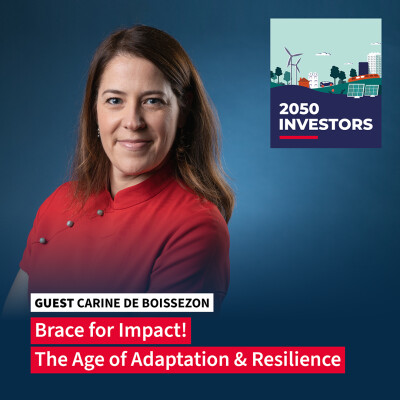
And this brings us to the core idea of today's episode. The more we succeed at mitigation, the more realistic and manageable adaptation becomes. Because mitigation is the only way to reduce the scale of the problem itself. Adaptation and resilience don't solve the crisis. They only buy us time. Now, let's turn to a concrete example of how businesses are approaching adaptation and building resilience. We are delighted to welcome our guest, Karine de Bois-Sauzon, Chief Impact Officer at EDF. Hello, Karine.
- Speaker #3
Hello, Coucou.
- Speaker #1
Thank you very much for being with us and thank you for your time. To start, can you explain to our listeners what the role of Chief Impact Officer at EDF involves?
- Speaker #3
Well... listeners may not know this, but actually EDF celebrated its 80th anniversary in April. But we're not just 80 years old. We're also the company with the oldest environmental mission among the SBF 120 companies. So that dates back to 1988. Of course, since then, the scope has evolved quite a lot, as have the names and the reporting lines. And today we are called the Impact Division. And this Impact Division sits within EDF Finance Department. So within this scope, we cover sustainability, of course, but, and I think it's very interesting, we also have insurance and investor relation. So you might find that a bit unusual, but it makes a lot of sense for us. Why? Because we're a company that invests close to 25 billion euros every year in assets with very long lifetimes. So what is the challenge for us? Well, it's to make sure that our assets don't become stranded assets, especially given climate risk. And even though we are no longer being listed in equity since 2023. we still have 70 billion euros of listed debt.
- Speaker #1
Well, that's brilliant. It's clearly a very rich role. That brings me to my next question. You often emphasize the deeply systemic nature of adaptation. And I find that idea very powerful. Why is adaptation by nature, territorial and collective?
- Speaker #3
Well, Koukou, think about all the things that we do. And actually, we take them for granted. And they depend on... people, services, and infrastructure. So think about schools as well. I personally experienced it last June. I don't know if you remember, but there was this major heat wave as early as June, and around 1,300 schools in France had to close with all the cascading disruption that caused. So most of that infrastructure was built on the assumption of a relatively stable and predictable climate. So for us at EDF, I think we're really... the industry of industries when we produce electricity. And that means that we are essential for all other services. And that means also that we had to start very early on to identify and address vulnerabilities in our own installations. But that's not enough if roads or trains don't operate, if bridges are weakened, and of course, if schools are closed. Because our employees can't come, and so they can't operate this infrastructure, which themselves need to be resilient. So from the very beginning, it was necessary to have this territorial coordination, both between infrastructure operators, but also with communities at large. And I think the example of water is particularly telling. I don't know if you know that, but EDF manages a third of surface freshwater resources in France. Obviously, during drought periods, some people will want that water to be used for drinking water or irrigation or to protect ecosystems. But... Others will want to preserve it for tourism or for civil safety. So all of these are actually trade-offs that absolutely need to be anticipated collectively. So that's why for me, climate and adaptation are fundamentally collective issues.
- Speaker #0
Absolutely. And I think the interconnected dimension of our economies isn't always fully taken into account. And we saw that with COVID or even the recent supply chain constraint with the conflict in the Middle East. And you often bring the discussion back to something very concrete. You bring the points around water, but also forest and electricity. So why is it crucial to come back to these fundamentals when we talk about adaptation and resilience? We often say no nature, no water, no water, no electricity.
- Speaker #1
And I will add, no electricity, no AI. So yes, it's essential. You know, 90% of our production activities depend on regulated water flow, either to turn turbines in our dams or to cool nuclear power plants. So the best natural regulators of water are actually forests, wetlands and living soils. And why is that? Because they actually slow down the water, they store it and they let it infiltrate. So that's why in our adaptation strategy, we have a dedicated pillar around preserving and restoring ecosystems. And we do this, for example, through the conversation of forest, like the Chambord forest. So yes, it might seem a bit indirect, but in reality, it's very concrete. The impact of climate change on ecosystem is very, very territorial. But I will take another example, if you allow me. We have a nuclear plant near the Ardennes forest in the northeast of France, and it's quite an isolated region. This forest, unfortunately, is heavily impacted by climate change. If we don't adapt, a large part of that forest could disappear within the next 30 to 50 years. So what does that mean? It means that the local economy could also disappear. You have loss of attractiveness, potentially people leaving, and therefore you have a decline, of course, in public services. So we have actually a direct interest in the success of the forest adaptation. So in a way, it also helps ensure that these local communities and the stakeholders at large continue to strive around us. So once again, it connects back to what you mentioned about the territorial dimension. So forests, for us indeed, along with the water cycle regulation are absolutely critical.
- Speaker #0
Absolutely. And it reminds me of a previous episode where we talked with a team about anti-fragility and green swans and a need to build resilience. This brings me to something you mentioned during our prep, which I found fascinating. You said that at EDF, you run crisis simulation all the time. Can you explain what that actually means in practice and how this crisis culture helps deal with climate change?
- Speaker #1
Yeah. That's something that I discovered when I joined EDF. And unfortunately, it was during an event that wasn't very pleasant because it was Fukushima. And even though this event didn't happen in France, we were in crisis mode, obviously, because what happens had global impacts on the nuclear sector. And EDF has actually built part of its culture, its organization and crisis management capabilities around climate change-related events. There is one very defining moment, which was the 1999 storm. It was a major event. The grid was essentially brought down. So these events, they are particularly impactful for the network, but also for all our operation. So we created what we call rapid response teams, one for the networks and one for nuclear. And unfortunately, I have to say we use them a lot recently because we have an increasing number of climate events. you I'm sure you remember all these names, right? Garance in Réunion, Chido in Mayotte. And so we do a lot of large group scale exercise. So we did one in 2025 based on this major sand flood. We also did this in preparation for the 2024 Olympics. So these are very concrete action. And what's great in that crisis management is that it really adds another dimension to adaptation because you clearly see this. interdependency we have with other infrastructure, the roads, the telecom, the railways. So we need both to work on prevention, of course, and resilience, but we also have to organize our response during a crisis. The more you rehearse crises, the more effective your response becomes.
- Speaker #0
Well, I think it's really fascinating. Though you also have to keep your mental health and avoid being too schizophrenic from operating in parallel reality or universes. That That brings me to another fundamental question as well. So France has built a plan for its adaptation on a four degree scenario by 2100. We often talk about net zero by 2050, keeping... warming to 1.5 or 2 degrees. Can we really adapt to such a world or is it beyond what's possible?
- Speaker #1
Well, first, I think we need to recognize that we are lucky that we have such a scenario in France, okay, that the government has announced this trajectory because not many countries have done this kind of projection or are organizing national resilience in this way. But yeah, it's important to say that even if it's not a very uplifting scenario to think about these four degrees, we have first of all to focus on our first priority, which is safety, right? Nuclear safety, but also hydraulic safety. We must guarantee that in all scenarios. And that's the reason why we have this very, very important internal expertise within EDF. So I think we are probably one of the only companies that have this dedicated climate service within our R&D department, but also bringing many specialists in EDF, for example, in the hydraulic division and more. And what they do is basically to model these very unlikely but high impact events. And this goes back to the green swan that you mentioned. And by the way, I love your podcast on that. But the good news is that the worst scenario from previous IPCC reports now appear you a bit less likely. It doesn't mean that they were wrong, by the way, just mean that we have good news in the fact that we have implemented climate policies over the last 10 years, right? And they are having an effect. Remember the previous scenarios, they were based on 2015 data, we're now in 2026. So a lot has been implemented, but still we're moving to something that is very, very bad, which is around maybe 3.5 degrees in the extremes. So when we say, remember four degrees in France. it actually means three degrees globally because France, unfortunately, warms faster than the global average. So what's very striking, I think, for listeners is that the summer of 2022, which I'm sure you remember was quite tricky, will actually be considered cool summer in 50 years. So just thinking about that, I think really helps you project into a warming world. And we're not even talking about tipping points, right? Like ocean currents, et cetera, that could be changed. So... We're really moving away from averages into this world of extreme, which you mentioned as the green swan. So what does that mean for me as a chief impact officer? I think there are two things that I take away. First, every tenth of a degree avoided helps keep us in a more manageable world. So we've already improved for Jackson. That's good. But we must accelerate decarbonization and focus efforts where impact is greatest. And to be honest, for EDF, the path is very clear. electrify. So it's not drill, baby drill, right? It's electrify or plug, plug, plug, plug the economy. And we're very fortunate in France because electricity is already 95% decarbonized. We have the lowest carbon intensity in the world, right? So it's about three grams per kilowatt hour in France. So we need to go all in electrification. The second, of course, is that adaptation is not the destination. It's a journey. We will never be able to say, that's it, mission accomplished, we're adapted. No, of course, what matters is robustness. So what does it mean? It's our ability to remain adaptable. We must avoid locking ourselves into a single pathway. And we need all these scenarios and the ability to keep up with change. So we must, of course, guarantee a service continuity in an economy that will become increasingly electrified. So that means even more dependence on EDF's resilience. So for me, these are the two responsibilities. First, electrify the economy as much as possible, get away the fossil fuel, of course. But second, be extremely resilient and robust because the entire economy will depend more and more on us.
- Speaker #0
It's very good. I think France is definitely in good hands when it comes to electricity. This is really inspiring and very well thought through. So we often talk about intellectual quotient, so IQ or emotional intelligence, EQ. And here we could almost talk about adaptability, caution, so AQ, about building resilience over time. It's something that will be here with us for a long time. And I really love the expression you just shared, the idea of a process, of a journey rather than a destination, which also has quite a philosophical dimension. So let's talk about financing. We often hear that adaptation is an investment that doesn't generate returns, at least not immediately. So how do we finance adaptation?
- Speaker #1
I like the fact that you bring philosophy because I think it's actually very true when we talk about adaptation because I always refer to the tragedy of the horizon and the tragedy of the commons. And if we go back maybe to numbers because we talk about finance. So we are actually one of the first companies to have published our adaptation related expenditure. And we did that at the time when we released our results at the end of February. It's quite impressive. I mean, in terms of numbers and in terms of pace of change, we're talking about almost 24 billion in the next 15 years. Okay. That's multiplied by four over the next 15 years compared to today. So, and it's just in France, in this generation, for example, and in the islands, we're talking about 9 billion and in the networks, 15 billion. Most of it, I would say 80% is CapEx and the rest is OPEX. So. That's very important, this amount of money that we have to put at work. But the issue is what I call first the tragedy of the horizon, because when we are investing, we don't know exactly when we will see the returns. In a way, we are preserving value rather than creating new value. And we are trying first to safeguard what already exists. And that's not easy, really, to determine when it becomes profitable and to what extent. So if you think about electricity markets today. especially with decreasing frequent negative prices that we have with a solar duck curve, the way we call it, when you have so much solar coming all at once during the day, it doesn't really reward things like water storage, even though we know we will need to invest in that. So that makes it very difficult to define this investment horizon. And I think traditional economic models don't necessarily capture these kinds of decisions very well. But the second paradox, which is more the tragedy of the commons, is the paradox between the macro and the micro level. At a macro level, I think it's quite easy to understand that the cost of inaction is higher than the cost of action. But at the micro level, often the one who benefits isn't always the one who invests. And if I invest, but I'm the only one adapting, I don't really benefit either. So I'll give you a concrete example from the hydro business. If I support low water levels, meaning I reduce my hydro production. So I reduce my revenues to help the territory to adapt. But if agriculture continues to operate in the same intensive way, then I lose out and nothing really changes. So there is clearly a need for maybe cost sharing or insurance-like mechanism or collective system that will really help reconcile these two issues, horizon and commons.
- Speaker #0
Yeah, I think that's very interesting and quite fascinating. It makes me even think of the story of the hummingbird and the forest fire, who is trying to extinguish a forest fire while carrying small drops of water at a time. So the message is that every animal in the forest has to take part because a single individual effort won't be enough, which is almost a Kantian requirement too.
- Speaker #1
Yeah, exactly. But before the hummingbirds burns out, right?
- Speaker #0
Exactly. So time is of the essence. So that brings me to my final question. Time is flying, but this has been a fascinating conversation. So let's do a bit of a thought experiment. Let's project ourselves in 2050, also from the perspective of sovereignty, because this is an important angle. How do you imagine the world in about 30 years? Will we be more resilient or simply under more strain?
- Speaker #1
Both, my captain. I think we'll have both, right? I mean... For me, the two words that come to mind is stay nimble and humble. Humility because we're clearly seeing increasingly unlikely events and especially combination of events. So if I take the example of the jellyfish event we had at one of our nuclear stations in north of France last August, it was Gravelines and it was the end of August, at the end of the summer. So we had already seen jellyfish events before, but never on that scale. That can be due to multiple factors. Of course, warming waters, but maybe overfishing. So there are many combined drivers at play. So we need humility. We know what we don't know. And there are many things that can happen. And the other one is agility, which goes back to the idea of adaptability that I mentioned earlier. We need to be robust in a world that is constantly fluctuating. And I'll close on your point about sovereignty. I think sovereignty is a concept that today might feel a bit overused, of course, but for me, energy is really at the core of it. So climate events, in a way, they are forcing us to rethink value chains, dependencies, vulnerabilities. And in a way, the solutions we are developing today can be great because they can be positive for climate, for biodiversity, and for resilience all at once. One of the positive things I see in this crisis also is that we can talk maybe more about tangible industrial realities. And I think that's good also for the image of industry in France, which is really key for our sovereignty going forward.
- Speaker #0
Great. Thank you so much for your energy, Karine, and for your passion. It really comes true. It reminds me, as a closing, of a quote by Winston Churchill who says, a pessimist sees the difficulty in every opportunity. While an optimist sees the opportunity in every difficulty. Thank you again and see you soon.
- Speaker #1
Thank you, Coucou.
- Speaker #0
This was incredibly insightful. At its core, one thing stands out. You cannot adapt alone. You can build the highest walls around your house, but if the roads are washed away and the power grid is down, your isolated resilience quickly becomes an illusion. There's a famous African proverb, alone you go fast, together you go further.
- Speaker #2
I prefer the AI version, alone my battery dies. Plugged into the grid I achieve world domination.
- Speaker #0
Fair enough. To wrap up, I'd like to leave our listeners with a quote from one of the great philosophers of our time.
- Speaker #2
Let me guess, Aristotle, Descartes, Sartre, or Candera, the unbearable lightness of being.
- Speaker #0
Rocky Balboa.
- Speaker #2
Hem, I'm listening.
- Speaker #0
As Rocky once said, it's not about how hard you hit, it's about how hard you can get hit and keep moving forward.
- Speaker #2
Stay resilient, humans. Try not to hit any icebergs.
- Speaker #0
Thank you for listening to this episode of 2050 Investors. And thanks to Karine for her insights and perspectives. I hope you've enjoyed this episode on adaptation and resilience. You can find the show on your regular streaming apps if you enjoy the show. Help us spread the word. Please take a minute to subscribe, review and rate it on Spotify or Apple Podcasts. See you in the next episode. While the following podcast discusses the financial markets, it does not recommend any particular investment decision. If you aren't sure of the merits of any investment decision, please seek. Professional advice.