- Speaker #0
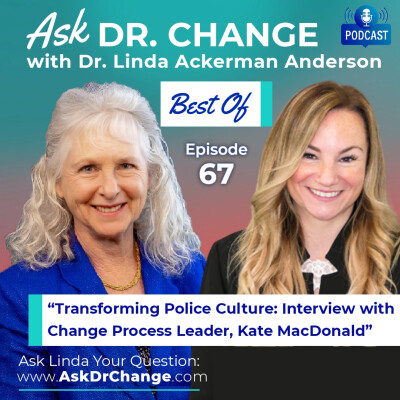
Welcome to Ask Dr. Change. I'm Dr. Linda Ackerman-Anderson. I'm happy to have you join me today to explore how to seriously uplevel your leadership and consulting to transformational changes, all through conscious change leadership. Welcome to today's episode. Today we have a very special opportunity to hear from a living, breathing, experienced change process leader, Kate McClain. McDonald, who was the change process leader for the transformation of York Regional Police. The transformation at YRP has been taking place since 2019 with Kate and her partner, Al Alameda, also a senior ranking member of the police force in the change process leader role. Today, you'll hear a lot about what they did, how they did it, what successes they had, what limitations they had. So you'll get a real view into what it really takes to be a change process leader. I'd like to begin by giving you a bit of background about Kate reading her bio. Kate McDonald, Executive Director of Professionalism, Leadership, and Inclusion at York Regional Police, YRP, has been practicing law for 20 years. She spent the first half of her career as a criminal prosecutor in Toronto. before joining YRP full-time in 2014. Kate provides legal and strategic advice, coaching, and training on a wide variety of issues in policing to law enforcement organizations across Ontario. From 2019 to 2022, Kate co-led YRP's organizational culture transformation using Being First philosophy and methods. She is the creator of the Mastery Academy, an innovative career-spanning personal growth leadership program tailored to the unique needs of the policing industry. Kate is also a trauma-informed yoga teacher with a practice focused on the prevention and management of PTSD. We are honored to have Kate share with us her real experience as a change process leader at YRP today. So Kate. Let's begin by you giving us an overview of this transformation of YRP.
- Speaker #1
Thanks. First of all, thank you so much for having me, Linda. I'm always thrilled to get to work with you. Back in 2018, I was working as in-house counsel for York Regional Police, and the Me Too movement was making headlines all across North America. In Canada, our military was the subject of a civil action, as well as some other police services, based on allegations of sexual harassment. and systemic barriers for female members. Our executive command team at the time, at the urgence of our Women in Leadership support network, thought that it would be a good idea for us to look proactively at ourselves rather than sit back and wait to see what was going to happen. So we did. Over the course of a year, I was tasked, along with a sergeant, to interview over 300 of our female members and several of our male members. And as a result of that research, we concluded that there was opportunity for us to uplevel our culture, to remove some unintentional systemic barriers that existed, and to really be innovative and proactive in this area. So we started a project called Vanguard and retained being first to help us with that small portion. This was initially a risk management exercise from my perspective as a lawyer. But what we recognized very quickly was that the issue was actually bigger and the opportunity was actually bigger. So we retained being first to give us a hand. And one of the first pieces of advice Dean gave us at the time was to look at what other cultural projects were happening inside the organization. So at the time, another team, our Professionalism Through Ethics Committee, was working on our core values and code of conduct. Obviously, that has a heavy impact. on the organization's culture. Our lead psychologist had several initiatives he wanted to get up and running. Our comm center, so our 911 and dispatchers were looking at modernizing. And a new project was about to get started that would redo how our frontline officers delivered their service. So all of these projects had a human theme to them. And what Dean had suggested is to bring them all under one umbrella. On that advice, we did that. And I was assigned as a change process leader, along with now Deputy Chief Al Almeida to co-lead.
- Speaker #0
Wonderful. Thank you for that, for setting context for us. So tell us about your initial understanding of the role of the change process leader and how it has evolved over the course of time.
- Speaker #1
Well, I'll confess that I had no idea. what I was getting into. I knew that I was passionate about my workplace. I work with a wonderful group of people and passionate about the opportunity and passionate about culture work. But as a lawyer and as a cop, Al and I didn't have any experience in this area. So initially, I think we thought we would just be doing almost like project management, just sort of coordinating a couple of things and making sure that tasks were met on time, really task focused. focused and project management focused. And it wasn't until Al and I actually came to Foresight in Colorado with you and Dean that we really started to understand that this role was going to be very different than we had anticipated. When we got started at first, Al and I would sometimes say to each other, I don't feel like I did anything today. I feel like all I did was put out fires and handhold and give advice and do some strategy. I don't feel like I did anything. And then after a little bit, we realized that's actually the job. you know part cheerleader part coach part psychologist part sherpa a little bit of that all together and um you know when we recognize that that's actually what this was going to be about that you know as as i believe it was dean puts it we were going to be symphony conductors for this big undertaking and you know rather than having people in their silos banging and making noise we were going to help them work together to collaborate um and avoid collisions and look for opportunities to share resources. And that our job really was to keep that high level view and make sure all of these things were sticked handled perfectly.
- Speaker #0
Yeah, thank you. So what kinds of things did you and Al do to structure the transformation given its complexity? How did you set it up for success?
- Speaker #1
Yeah, so we did set up the alternative reporting structure. First, I should say we did use the Change Leaders Roadmap. We made sure that all the project teams were singing from the same song sheet. There are many different ways to do these types of projects, but it doesn't make sense if the project teams and project leads aren't speaking the same language. So we brought 70 or more of our members who were working on the project teams through Leading Transformation, which gave them the song sheet to sing from. It gave those of them who hadn't done any project work an idea of what this should look like. But most importantly, from our perspective, it It emphasized the importance of collaborating across the organization and across those projects to break down those silos, working toward a common vision of getting the transformation done. So that was important. A parallel reporting structure was established, which in a paramilitary organization was a novel concept. It required our very senior leaders to wear two hats. So they were wearing their change leader hat. but they also had to keep operations going at the same time. And sometimes those two roles came into conflict, particularly where resources were at stake. So trying to assist our senior leaders in understanding what the bigger picture was and why we were asking for certain things was important and giving Al and I direct access to the chief. So as a lawyer, I did have direct access to the chief in that aspect. But normally when projects are going on inside a police service, The chief isn't necessarily involved in the daily operations of that. It just doesn't make sense for their role. Here, having that direct access to the chief and having a smaller navigation team built up of our executive sponsors, who happen to be our deputy chiefs, having that core group to try to be a little more agile and speed up the decision-making process was really important. In addition, we had a change leadership team. That was Al, myself. the chief and the executive sponsors, as well as the leads of each of the projects who met regularly to keep each other informed of the major events that were happening, looking for those collisions, those opportunities for collaboration. And as resources were always an issue, looking where we could help each other out. So in a nutshell, that's it.
- Speaker #0
Awesome. That's a lot. Yes. So you and Al work very closely together. And in many cases, there's only one change process leader. You had two here. So how did you and Al work together? How did you work it out that you were each in this role over time?
- Speaker #1
So Al and I have very different skill sets. So I approach things from a legal perspective, a risk perspective, very analytical, linear perspective. And Al, as a seasoned investigator with 30 years of experience as a police officer, has the most incredible ability to look at things from a high level, as well as in the minutiae, looking for those opportunities. So we recognize that we had various different skill sets. What we did is we divided the projects in name only. because there were seven, actually eight at one point, which was a lot between the two of us. But what we did most importantly was we met almost daily to talk about what was going on and to support each other. From a paramilitary perspective, it was helpful for us to have a female member and a male member, a sworn member and a civilian member so that we each brought those perspectives to the table as well. Obviously, there are cultural implications on the civilian side of the house that an officer might not anticipate and vice versa. Al was there to recognize how things would land with our sworn members, particularly when we were rolling out the initial transformation. So he and I worked very closely together. You know, I can say he is one of my best friends as a result of the work we did on this. And we supported each other. You know, when one of us was really, really tired, the other could pick up the slack. When one of us was feeling frustrated, the other was there to support and re-inflate the wings.
- Speaker #0
Beautiful. That's great. And I will say, I recall in working with the two of you, that you were working so closely, we referred to the two of you as Cal, Kate and Al. So Cal. So we were always communicating with both of you. So tell us a bit about some of your major successes with the process, major breakthroughs that occurred. What were some of the highlights of your experience?
- Speaker #1
So from a permanent perspective, a couple of really important things happened for our organization. So first was the establishment of an Office of Continuous Improvement. This is an area of our strategic services that operates under an enterprise change agenda for the first time ever in our history as an organization. We're large. We used to have several projects running simultaneously where no one really knew what anyone else was doing until maybe it came time for there to be some sort of conflict in scheduling. in mandate. So for the first time ever, this office focuses on prioritizing projects that impact the organization more than one unit. It provides project support to those areas as they're doing their projects. It makes sure things are radically resourced and it makes sure that our executive leadership team is aware of what's happening at all times. So that office was new. We've also... had the office that I'm in charge of now, which is the Professionalism, Leadership and Inclusion office to carry on the cultural aspect of the work we were doing under the transformation. So my office is responsible for leadership training of our members, and I can talk a little bit more about that later on, inclusion and professionalism, so our values and our ethics. So that's new. We now have a team of 14 working in that office. We had an organizational culture champion network that came as a result of the transformation. So this was a group of people following, again, the Change Leaders Roadmap, whose responsibility was to flood the grapevine with positive gossip, and more importantly, refer information back up. So in a paramilitary organization, information tends to flow down, and there isn't a lot of opportunity for that information to come back up. So our Ravens, as we call them, we are Game of Thrones fans. are out there gathering information for us about how things are landing with our membership, what topics are out there, what concerns people are having. They're also there to clarify any misconceptions about any of the culture work that's being done, any changes in policy or procedure. They're there having those one-on-one conversations on the ground. And at the same time, each and every one of them is also on a personal growth journey, which is a huge part of the work we embarked upon with our culture transformation. So they spend time meeting monthly, doing self-mastery practices and spreading messages about self-care and about meditation, sleeping properly in alignment with our organization's wellness strategy developed by Dr. Kyle Handley, bio, psycho, social, spiritual. So the Ravens are out there helping with that. They are now a permanent fixture of the organization. And I'm happy to say we are still 100 strong, which is great. I see new applicants every day. So yeah. And then two new leadership programs also flowed out of the work we did as a result of the transformation. One is a personal growth program tailored toward individuals so that. Each and every one of us is showing up at work trying to be the best version of ourselves. The culture can't help but improve if everyone's doing that. And the second is a formal leadership program based on our core values and the leadership principles we've developed.
- Speaker #0
Do you want to say a little bit about the values and leadership principles?
- Speaker #1
Sure. One of our staff sergeants, Craig James, worked very hard in collaboration with members of my team to come up with a leadership roadmap. And it's really looking at how we can make the organization more humanistic and encouraging. Early on in the transformation, we did an organizational culture inventory where we got a snapshot of where our culture was. And what we learned is like most paramilitary organizations, we were heavy on competition and conformity. And that our members actually wanted to be more humanistic and encouraging, more innovative. And so we spent most of the transformation. adjusting things to try to get there. And one of the key steps to that is to identify those characteristics in who we recruit, all of our promotional processes, eventually our performance appraisals will be geared toward that. But in our leaders specifically to gear all the teaching we're doing in formal leadership roles toward those key things we're looking on the humanistic side. Operational skills are crucially important in a policing atmosphere. What we've done is shift the mindset to being that those are an expectation. We expect that you will have operational excellence. What else do you bring to the table from a humanistic side when it comes time to being in formal positions of leadership? But marrying that to the personal growth work I mentioned, those qualities, regardless of your position within the organization, an organization is a bunch of people. So if each person is doing their part to make things better, the rest flows.
- Speaker #0
Awesome. I was going to ask you, you started into this. So what are the... What benefits of the orientation towards the personal development work in partnership with the operational excellence work? What are you seeing happen as a result?
- Speaker #1
I'm seeing people becoming more engaged. Early on, I think policing tends to be a little bit of a skeptical industry due to the nature of the work. And so when you say you're going to do culture work, the tendency is for people to want to sit back and wait to see what's going to happen before they commit. to participating or to doing anything. When we take away the idea that the organization is its own person, it's this entity out there and recognize that the organization is actually us. And we each have a role to play. You know, Al and I used to say over and over again, this is not a spectator sport. If you're not going to contribute, the change isn't going to happen. You're looking at a wall that you want to paint and you're sitting there with a brush in your hand saying, why isn't it changing color? You know, you have to actually do something about it. So.
- Speaker #0
That's great.
- Speaker #1
Yeah. And so what we noticed is as these little incremental improvements started to happen and changes were evident in things our chief was doing and saying right at the very top of the organization, things our deputies and our senior leaders were doing and saying were starting to be different, members started to get interested in seeing what they could do. Now, we still have a lot of work to do. It waxes and wanes. The pandemic certainly didn't help in our efforts. But that sense of ownership and that sense of engagement. is crucial.
- Speaker #0
Wonderful. Thank you. Well, you've entered into the next question, which is, what are the challenges that you faced? What showed up that were inhibitors or blockages, and what did you do about them?
- Speaker #1
So capacity, I would say, was the number one challenge. We are obviously a government organization. We don't have endless supplies to funds like private entities might. So we were trying to do something massive. on a shoestring, very conservative budget. So that remained an issue. Al and I were seconded full-time into our roles, which was an expensive thing for the organization to do. And then many of the people working on our projects were doing so off the sides of their desks just because they had operational positions and obligations as well. So that tension, that capacity was constantly there and trying to decide where our resources should be allocated was difficult. The paramilitary command and control structure of our organization, which is natural and normal for a policing organization, establishing a parallel reporting structure was something that was a little foreign. Asking people to talk about how they were feeling about things or to relate to each other in a different way was new. We were grateful that so many people embraced it. But at the outside, it was a challenge. And one of the things we overlooked and didn't anticipate is that. our discussions about wanting to shift our culture. To some people who'd been here for a very long time and who had worked really hard to contribute to the success of the organization, to them, that was seen as a slight. And we weren't careful enough about that to say, listen, we're wonderful. We just want to be even more wonderful. And so that was a challenge to making sure that the people who've been here a very long time were feeling included and recognized and appreciated and interested in doing what we were doing. So that was tricky. Communication, very difficult. As I said, we're a large organization as far as policing goes, but we have four generations in the workplace. So knowing that, you know, a Gen Z wants everything on their phone with a QR code, where my generation, we're fine with email. Trying to figure out how to actually get our hands on our members to give them information, but also understanding that, you know, corporate comms are different than change communications. So working with our very talented corporate communications department. And asking them to try things a little differently or to let us run with some things that traditionally we wouldn't have done in a police organization. That was difficult. And then understanding the difference between communication and engagement. So getting beyond telling. Again, at a paramilitary organization, we figure we send an email, an order is issued. Well, now everyone knows. And that may be true. But as you all taught us, you know something or you can know something. And really getting in your head versus your heart. we can tell people. Things are changing, but until they're actually engaged, until they're skin in the game for them, they see what's in it for them and they see things actually happening, that engagement doesn't happen. So we really struggled with that. And then aligning our leaders at the very outset. So on the advice of being first, which was the thing that attracted us to your firm in the first place, was starting at the very top of a paramilitary organization. You know, having our chief and deputies and our superintendents and our highest ranking people, sworn in civilian, engaged in what we were doing under a common vision, working together toward doing something different. That was an onerous task just because of the number of them and what it took to get everyone through the training process on that. So it wasn't a matter of the challenge being in the willingness. It was in the how are we actually going to do this and how are we going to have the place? with the lights on, keep doing what we do, and at the same time, undertake this massive task. Those are a few of the challenges.
- Speaker #0
Oh, wow. Really amazing. I do have to say, you mentioned the Foresight program that you went through with us, which is our advanced training four-week program, and Leading Transformational Change, our online program. Now, you are remarkable in how you took. the guidance provided in those programs and put it into action. It's just amazing. I mean, hearing you describe what you did and how you did it, in my mind, it's like, wow, you really have taken it to heart, designed it, tailored it, put it into practice, and ultimately, obviously, reaped the benefits of it. Really remarkable, Kate. It's just remarkable how seriously you took all of this.
- Speaker #1
Well, we couldn't have done it without your support. You know, the guidance and consultation we had with you and Dean and Andrew was absolutely crucial to the success of this. And having the ability to do that, to touch base with you regularly, to have your input and your guidance, really. And recognizing when we needed that was important as well. You know, it's important to invest in your own people in an organization, but recognizing there are experts out there and those experts have information and skills. can get you that much further, accelerate your success.
- Speaker #0
Beautiful. Thank you. Thanks for that. So conditions for success for the change process leader role. So clearly what you've described, what happened and what was done, you actually were in, you and Al, in charge of designing all of that and putting it into the organization and orchestrating it and course correcting it. What conditions had to be in place to really... optimize the value of you in this role?
- Speaker #1
The first and foremost was the buy-in by our chief. Our chief from day one was committed, publicly committed to the change that we were trying to make. He was the face of the transformation. I say that for our current chief now who carries on this work and our past chief who was here at the inception of the transformation. Both of those individuals were very strong and passionate and authentic about the willingness to do things differently and to try new things for the benefit of all the members of our organization. So having Chief McSween. still be the face of this and be out front of that was really crucial to my now success in this role. And him making it clear that when Al and I were doing things, it was on his behalf. So this wasn't just a project that Al and I decided to do. We were acting on the chief's behalf for the betterment of the organization. So that was important. Having the two of us seconded full time to this role, we could not have done this part time. You know, there are two of us and I know we're doubly lucky some organizations only have one. But having two of us doing this full time allowed us the capacity to really dive in without worrying about other operational concerns. Although Al at one point was doing the two full time jobs running our ops command at the same time. But that's just the kind of individual he is. Having that access, that direct access to the chief was crucial. It allowed us to speed up the decision making process. It allowed him to hear information firsthand. So there was no broken telephone. about how things were doing, the updates were firsthand from Al and I directly, and then including our executive sponsors in that circle of information and in that ability to make decisions quickly on the navigation team really helped Al and I just get things done. Army of Volunteers. We had an army of volunteers. At one point during the transformation, we had nearly 400 members working on the project teams as part of the Ravens. in various capacities and most of them, the vast majority of them were doing it while still doing their full-time operational jobs out of the goodness of their heart. They took on this extra work. We wouldn't have been able to do most of what we did without those dedicated people who were just interested in, in doing some really cool stuff for the benefit of the organization. So, um, having a common vision was really important. Um, something to, to true up to, or to keep coming back to as a touchstone. Why are we now. Why are we here? Why are we doing these things? What is it we're actually trying to accomplish? Where are we trying to go? And keep returning to that point to guide us when things would go a little sideways, which of course happens. So understanding the difference between a transformation and regular project management or regular change management, you know, expecting the unexpected and having that be okay and rolling with curveballs. And boy, did we have some, you know. Our executive command team, as we then called them, changed entirely over the first couple of years with some retirements and with one of our members going to be the commissioner of the OPP. I'm very proud of him, but he was a huge loss to our organization. So having new members come on and take the reins and keeping them up to speed and engaged in everything we were doing was really helpful. And I would say strategy as well. Having that assistance from being first, having those tools in the Change Leaders Roadmap, being able to follow those instructions when things became uncertain or to remind us where are we going next and why, and prioritizing using that strategy was very helpful.
- Speaker #0
Awesome. Really, really helpful. Thank you. So we understand that given the impact of your work now known across Ontario, in policing organizations, other organizations are coming to you to for some guidance, for some support. What are they coming to ask for? What are they looking for? What do they think you have that they need?
- Speaker #1
They're hearing different things. So some are wanting to embark on a full-blown transformation like we did. And the question I get most often is, how did you get started? And so I'll explain. the context that I did at the outset of our discussion today. But some are also coming with just wanting pieces of what we were doing. And I'll explain to them, well, you can't just have a culture champion network if they're not working as part of something bigger. You can't just have that one thing in isolation or you can't just have one project working in isolation over here when the rest of the organization is pulling in a different direction. you I've really focused on trying to get them to understand the magnitude of the undertaking and to make sure that they're able to allocate sufficient resources. Don't underestimate the capacity needed for something like this. Invest in your people, invest in good consulting, invest in the future of this thing. Workplaces with healthy cultures, you know, if you want to look at it from a cold-hearted perspective, save money, whether you're private or public. Happy people coming to work. are less likely to become ill, are less likely to become disgruntled, are less likely to leave the organization for somewhere else. So this kind of proactive work and this investment in members is a no-brainer from a financial perspective. And so I encourage them to point that out if they're looking for funding from their boards, from for police service boards. You know, ours, we have a very close, very positive working relationship with the police services board here. They recognize that this is an ounce of prevention. that spending this time, this energy, and these resources on our people was a valuable investment. It was a wise investment.
- Speaker #0
Beautiful. Thank you. Well, this has been absolutely incredible. You're so articulate about what you've done. Any additional words you would like to share for the need for a change process leader, for the job of the change process leader, the impact of this role, for others who have listened to the prior episode on what a change process leader is conceptually, you're real. You walked the talk. So what additional guidance advice would you give?
- Speaker #1
To organizations embarking on this type of endeavor, I would say you must have a change process leader. Two, if you can spare it. Two, not put someone or a couple of people into this role will slow down your progress. If there isn't somebody keeping an eye on what's happening and helping to conduct that symphony, you may just make noise for a lot longer than necessary. For individuals taking on the change process leader role, my advice would be, don't forget why you volunteered to do it or why you were assigned to it. Remember that passion, that vision, that feeling of wanting to make your organization the best possible place it can be for your fellow colleagues. You know, there will be days where you're going to want to quit and that's okay. And just coming back to why did I want to do this in the first place? Why did I agree? What's the bigger thing than me? What's out there that's bigger than me that I'm actually working on? Just to keep the faith. because it's a lot of work, but it's wonderful work. So it's a labor of love.
- Speaker #0
Beautiful. You know, one thing that you mentioned early on that I wanted to ask you to expand on as the creator of the Mastery Academy, tell us a little bit about that, what it is, how it is delivered and its impact.
- Speaker #1
Yeah. So Mastery is a career spanning program that's premised on what we talked about earlier, that organizations are made up of individuals. And if each individual is on a personal growth journey, working on themselves and coming to work with an effort to be the best version of themselves, workplace conflict will be reduced, collaboration will be increased, harmony will exist. In the policing industry in particular, there's an extra layer to that. We deal with occupational and operational stress injuries. So if we can early on encourage our members to take care of themselves, to guide them to our Wonderful wellness programs. We have a very robust, talented staff of psychologists who've put together this great program, get them interested in those self-care practices early, working on communication with each other. So we pepper that through the first few years that they're here. And then there's a retreat that we take them on. The four days are similar to your Walk the Talk of Change program for executives. It's structured the same way. However, this programs geared toward newer employees. to get them interested early in that personal growth work. Some of it is premised on Dr. Gabor Mate's seven A's of healing. There's a little bit of Brene Brown in there and some Simon Sinek in there. There is some Dean Anderson and some Dr. Linda Ackerman Anderson in there, little nuggets of wisdom. And really the idea is just, you don't have to be in a formal leadership role to be a leader. And so we want to invest in all of our members, not just those who. assume supervisory positions. And then that's the basic premise of it.
- Speaker #0
Beautiful. Absolutely beautiful. I'm realizing that you clearly have laid out the benefits inside the organization. Since the power of policing is in its interface with the community, the larger community, what do you see the impact has been in relation to the policing relationship with community and the delivery of your... security and protective services?
- Speaker #1
It goes back to Robert Peel's principle, you know, the people are the police and the police are the people. And in order to relate to the community and to serve the community, which all of our members do, they need to be in a good headspace. They need to be well taken care of by their employer. And if people are feeling good at work, they will naturally do better out in the field. So what I'm noticing... as a trend across our province. Our chief is now the president of the Ontario Association of Chiefs of Police. And he is really promoting this humanistic side, this people first leadership aspect. And that's catching on across the province here. So we're noticing that as a trend. We do in York Region have a really good relationship with our community. We're very proud of that. But there's always room to do better, always. So the fact that other police services are doing the same. work with the same philosophy, I think will just be a fantastic service to the public.
- Speaker #0
Awesome. Just awesome. Any last thoughts, Kate? We've covered so much ground here. Any last thoughts you'd like to offer?
- Speaker #1
No, other than just my gratitude to you all. Without foresight, and I swear I'm not being paid to say any of this. I sound like a commercial for you all. But doing the personal growth work that came from foresight and doing the transformation has really changed my life for the better. I take care of myself. I feel that I am a better lawyer, a better mother, a better daughter. better sister as a result of the personal growth aspect of this work. And I think so often that's overlooked. I think we focus so much on system and process and we forget that there are people behind all of that and that that's where the real work starts. So thank you.
- Speaker #0
You are so welcome. I want to say thank you, one, for taking the time to share your experience and your growth process with everybody around being a change process leader. And I personally love the fact that I hold you near and dear, not just as a client, but as a friend in life. So thank you so much for taking this time with us all. I really appreciate it. Thanks for spending some time with me today. I hope you gained some valuable insights for your work. Please send me your questions and challenges by going to AskDrChange.com.