- Speaker #0
Buen provecho. Smakula Keiton. Afiyet olsun. Smakling Maltese. Enjoy your meal. Smach negaw. Bon appetit.
- Speaker #1
Karuaka halua. Bon appetit.
- Speaker #0
Kalmok kresnina.
- Speaker #1
Hello and welcome to Cities at the Table, the podcast that dives into the heart of urban food systems around the world. I'm Jessica Ferre, Executive Director of the Food Capitals by Dailies Network.
- Speaker #0
I am Felipe Garcia. President of the Board and CEO of BC Tucson. In each episode, we explore how cities are tackling food challenges and reinventing astronomy.
- Speaker #1
From vibrant culinary scenes to cutting-edge food policies, we bring you stories from global food capitals and their inspiring leaders driving change.
- Speaker #0
Whether you're a city leader or a food lover, join us at the table.
- Speaker #1
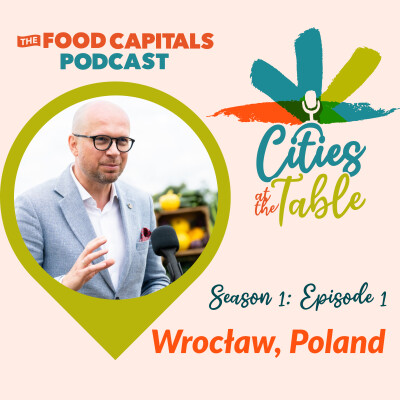
Today, we invite you to explore the vibrant and historic city of Wrocław, located in the heart of southwestern Poland. Famous for its stunning architecture and rich history, Wrocław has gained a growing reputation as a culinary destination, even more so as it was recently included in the prestigious Michelin Guide, featuring 22 distinguished restaurants. In this episode, we invited Jakub Mazur, Deputy Mayor of Wrocław, to take a seat at the table. He will share his insights into the city's unique food scene and its commitment to building a more sustainable future.
- Speaker #0
Hello everyone, bonjour, jean d'abri, I'm very happy to be here. My name is Jakub Mazur, I'm deputy mayor of Wroclaw. This is the third largest city in Poland. I'm very proud of my city and of course I love Wroclaw. I was born there, I've been studying there, I'm deputy mayor for six years. And Wroclaw is a wonderful historical city. One thousand years, almost one million population, because we received 200,000 Ukrainians. So now it's mid-size, but very successful. We used to be relatively poor 30-40 years ago, but since we started to be a part of European Union, that proudly we admit to be, we started to transform ourselves. Eight years ago, the whole population of Wrocław was German. Now, after the Second War, it was changed into Polish one, and now it's again European. We are proud of this 1000 years history because... we are truly European. I'm proud that city is very European, very open. Then we used to be European capital of culture. So we had a lot of investments in culture, buildings, institutions, and it brought the total different quality also with food. Because we started like 20 years ago to invite people to Wrocław. That used to be relatively not attractive among many, many European cities. but Then we invest a lot of money and a lot of emotions. We created the really free city. We have the slogan, the meeting place. And people are willing to meet by the table sometimes. So we rely on history, culture and, of course, economy. That is essential to develop such a beautiful city. Gastronomy is always the essential part of every city, every culture, every community. So for us it's as a meeting place. We want people to meet by the table with gastronomy. I'm living in the city center, so it is natural to concentrate all those new restaurants. The fancy ones, but the street food, the food courts that are appearing especially during the... hot days in the spring summer period and because of this i experience like every week i i can be in a completely new place some of them are disappearing some of them are appearing with the better quality people are learning and at the same time my fellows they are expecting unexpected they want to be surprised with the taste in wrozo for instance we have a couple of young guys who I decided to have something like kebab, so Arabic food. But it's so fascinating that every time I'm crossing this point, this is not even a restaurant, there is at least 20 people waiting for this, day and night. I haven't tried it because I don't have time to spend an hour in line waiting for this, but it must be something significant. And apart from that, of course, you know, we have about 200,000 Ukrainians, so they also brought a lot of culture. So we have new tastes, new preparation. On the other hand, we have a strong Korean community. 5,000 Koreans because 20 years ago, LG, the company, they had huge investment and since then they are investing even more. So they are bringing a lot of Korean companies to the region. So it's not only Korean restaurant or the Asian one, but it's also the production of food that we can enjoy. It is amazing. But at the same time, we experience a lot of Italian, French, the Spanish restaurants and we enjoy it a lot. We love to have. Even English restaurants that are not so famous with excellent food, but we have some and proudly enjoying to have it mixing with the products that we have from local agriculture local producers so them plenty of tasties that you can enjoy but everybody can Pick his own or her own and that's the beauty of gastronomy
- Speaker #1
Wrocław has been inspired by the Food Capitals Network and one of its founding city members, Lyon, France, for many years. Being part of this network means sharing, learning and connecting about gastronomy with peers from around the world.
- Speaker #0
As Wrocław, we are relatively young, with huge ambition, and we know how to learn from our older brothers and sisters like Deliz. Deliz Network and Lyon as a city, as a capital itself, provide the unique example. how can we achieve the knowledge, experience and some uniqueness. And by gastronomy we understand the restaurants from those that are affordable, accessible for our students, but also for those who are looking for something more sophisticated, the most fanciest restaurants. And for the first time Wrocław will be in... Michelin Guide because we were trying so hard for last couple of years and we failed probably several times. But this year they said, you got it. And this is history happening on our eyes. When I heard about this, I was so excited and I knew that this was the confidential news, so I couldn't even share with anyone. I was really excited about being there. Finally, eventually, after so many years of dreaming about this, Michelin Guide is something exceptional. It's a cherry on this cake and we've been waiting for. But personally, I have to say that I was involved in this process from the very beginning. In my previous life, before I used to be deputy mayor of the city, I used to travel a lot and eat a lot. I used to eat a lot and I experienced lots of bloods. stars all over the world from Tokyo to of course France and Paris itself and Burgundy. I was a huge fan of becoming one of the members of this guide and Polish gastronomy needs to be adapted, needs to learn. We love Polish cuisine and affordable, accessible, of course, because this is our mama's and grandmama's kitchen. But there is always an ambition to be at the top and And the most well-known brand is Michelin, for certain. That's why I wanted, when I became deputy mayor, I wanted Wrocław to be one of these cities, part of the big family. And no one knows, but with Michelin stars, that it brings even bigger economy, the growth, development of restaurants, ambition to other chefs that are operating in the region, money. So, It has huge impact on economical development and in my city I'm also in charge of economical development and those people who are coming with foreign investment expats. They are asking where is fine dining restaurant? How can you prove it's really fine dining? So now this is a kind of starting point for Wrocław but I'm sure that step by step, year by year we will achieve more stars maybe. or more awards and more good chefs. But of course I'm very happy, very proud that we managed to be a part of Michelin Guide family. As a young city with gastronomy, with mixed history, we were always very ambitious about establishing a variety of chefs and the variety of choice. And that's why we, for example, we have Gastro Academy, Academy of Gastronomy, we would say. And Gastro Academy is a program dedicated to young chefs, young and old, because we are all young, to become masters, to get to know what is essential to produce good quality of dishes, of food. It is dedicated to all those people who want to leverage the knowledge. but also for those who are starting their path becoming chefs.
- Speaker #1
For years, Wrocław has focused on sustainable urban development, particularly by promoting a healthy, local and sustainable food scene. One of the city's projects includes Wrocław's City Farm, or Urban Farm, an ambitious initiative to increase local food in its citizens' plates.
- Speaker #0
Wroclaw for many years was trying to become a capital, maybe one of those cities who is sustainable in many many ways. So that's why we want to have sustainable agriculture in surrounding municipalities, so as a metropolitan region we also work on this. We want to have our own resilience. And self-sufficiency. It is impossible to achieve the 100% of self-sufficiency. But Wrocław had this ambition, OK, we need to have good quality of life for our inhabitants. And since we are growing and we double our population in the last 30 years, so you can imagine, we have new demands, new approaches, and people are aware what is happening with climate change. So for us it's even more important because we are proud who we are and who we can become. The food sovereignty and city farm that we established last year is a part of it. It's essential and it's working perfectly well. Two and a half hectares we started this last year and we are proud to produce 70 tons of potatoes, kabachi, pumpkins. those products are already in our institutions, public institutions like schools, kindergarten, nurseries and they are working. They are eco-productive, sustainable, very responsible production and it is produced by people who are in some difficult moment of their life. So you can only imagine that we try to provide many solutions. with one initiative. We are the first one in Poland to have this significant change on the way, but also the first one who is trying to bring this approach in a scalable dimension. And now we are thinking how to scale up and how to find another places, not only here in Wrocław, but also with other cities, not only cities in the region that we are capital of. But also with the capital of Poland, Warsaw, we have this discussion and with all the biggest cities in Poland. It seems to be so attractive. Everybody wants to know what is it? How did you do this? It is always about good people. If you have dedicated, full of passion people who want to make it happen, it will be done.
- Speaker #1
To address ecological challenges, Wrocław also launched one of the largest zero-waste campaigns in Poland a few years ago. One of the unique examples that really struck me is the open fridges, where people can share their leftovers with their neighbors, helping to tackle food waste effectively.
- Speaker #0
Another initiative of becoming sustainable cities, Wrocław Do Not Waste. We started this in 2019. It is about education, because we started with this. How to bring the awareness of drinking tap water in Wrocław, not to produce any plastic bottles. How can we do not waste any food in our schools, kindergartens and this public educational system. Of course, we started with food, with water, with resources that we have. One of... Very symbolic, significant part of it is that we have like open backyard fridges. So if you have too much food, especially after long weekends and holidays or some kind of celebrations we all love, and we are buying a lot of producing and cooking a lot of food, and you know it is not possible for you to eat it all, you can share it with people. we have it Tens of those fridges open, accessible from the street, that are located in all the city. And people are using it. And people are donating food. And even the private sector, so the shops, are using it. Food has the superpower. to improve quality of life because it has impact on inhabitants, visitors, tourism, ecosystems that are created not only in the city but also in metropolitan areas. Food connects people to build community, to make life better and food makes them smiling. Thank you very much. See you in Wroclaw hopefully.
- Speaker #1
You just listened to Cities at the Table, a collaborative podcast from The Food Capitals, a network connecting cities worldwide that use food and gastronomy to build urban resilience, boost local economies, and enhance city life. Want to hear more about all this from cities around the world? Subscribe and follow along on our website, thefoodcapitals.com. Thanks for joining us at the table. See you next time.