- Speaker #0
Bon appétit Enjoy your meal Enjoy your meal
- Speaker #1
Bon appétit Bon appétit
- Speaker #0
Bon appétit Hello and welcome to Cities at the Table, the podcast that dives into the heart of urban food systems around the world. I'm Jessica Ferre, Executive Director of the Food Capitals by Dailies Network.
- Speaker #2
I am Felipe Garcia. President of the Board and CEO of BC Tucson. In each episode, we explore how cities are tackling food challenges and reinventing astronomy.
- Speaker #0
From vibrant culinary scenes to cutting-edge food policies, we bring you stories from global food capitals and their inspiring leaders driving change.
- Speaker #2
Whether you're a city leader or a food lover, join us at the table.
- Speaker #1
Today, We are excited to present a special episode of Seats at the Table,
- Speaker #2
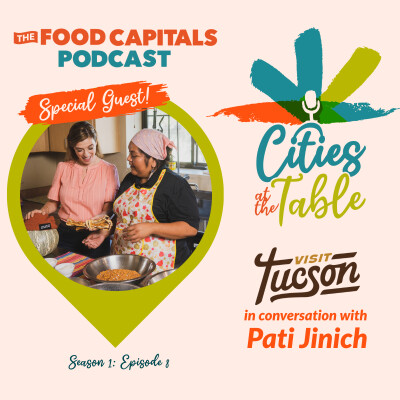
recorded in my hometown and food capital, Tucson, Arizona. And again, we have a great history of culinary heritage, creative gastronomy. But in this amazing setting, I'm very thrilled to welcome an equally remarkable guest. Patty Hinnich, acclaimed chef, gosh, author, storyteller, and just an incredible human being, period. Patty's work beautifully connects cultures and unites people throughout the power of food. In this episode, Patty shares her insights on the vital role that food plays in bringing communities together across borders. This conversation provides an inspired look at how culinary heritage can preserve traditions and culture while also encouraging innovation. Hi Patti
- Speaker #3
Hi Felipe I'm so happy to be here. I'm so happy every time I see you. I'm so happy every time I come to Tucson and any activity I can do with you just brings me so much joy.
- Speaker #2
Well it's mutual and we can see and we can feel that energy and we're excited and I want to start by again we have listeners and people who will be listening to this podcast throughout the world. Tell us a little about your history about Patti, how you got started in again food and storytelling.
- Speaker #3
Of course. So, Felipe, I'm from Mexico City, Mexico born, Mexico raised, all my family's there. And I wanted to be an academic, so I trained as a political analyst. Then I got married because of my husband's job. We moved to Dallas, Texas. And what happened was that I became really incredibly nostalgic about Mexico, its food, its culture, its people. I got really homesick and the way I was able to connect back to my hometown was by cooking the foods that had nurtured me. So I stubbornly continued with a political analyst path. I did a master's in Latin American studies at Georgetown, then worked at a policy research center, another think tank in Washington, D.C. and was very unhappy. And I decided to switch careers. You know, I was 33, 34 already with two young kids. And decided to, instead of doing political analysis where I could tell that I wasn't being able to make any change or connect with people because there's just gridlock, you know, with people from opposing views. I realized that when you bring food to the table, there's a door that opens, people connect. And I decided to jump head on into cooking, did culinary school, La Academia de Cuisine in Maryland. And then started food writing, started teaching cooking classes, started talking so much about food that I eventually ended up with a cooking show, travel show. And I've had Patty's Mexican Table for, it's going to be, it's 15 season now.
- Speaker #2
Wow.
- Speaker #3
And then after that, I decided that I wanted to go even deeper and use food to bring the microphone and the cameras. the people who want a chance to tell their stories and give them the agency to do it. So my way to do it is by, you know, finding the people that represent the DNA of a place, artists, athletes, entrepreneurs, come connect, share a moment of their life and eat something with them. And I do. So that's who I am. That's what I do.
- Speaker #2
So you have, I guess, three different TV shows. then you have published author okay and then again just an advocate about that understanding and building community and again receive multiple awards because of again your work and in and it's fascinating when you mentioned that you're trying to connect people you don't come with a recipe and say okay this is how you fix your community this is your story you just go and bring a spotlight a microphone to that story yes yes you know like for example we're here in tucson we're working on season
- Speaker #3
two of my docu-series called Pati Hinnich Explores Panamericana. And here, I'm trying to follow the Pan-American Highway. We started at the top of Alaska, headed down to, you know, Ushuaia, the tippy-tip of the south of Argentina, and tried to reimagine what it means to be an American. You know, of course, we're American in the U.S., but we're American in the entirety of the Americas and we can understand who who we are as a whole and in the U.S. where our communities come from, I think that we can just live a happier, more productive life. So wait, going back to your question, in that along that path, we're trying to find the people and the stories that represent, you know, something meaningful from the place that we're visiting, which, of course, we could visit with everyone because everyone has such an incredible story. But just. you know a bird's eye view of what that place is and then we land and we connect with the poet with the musician with the athlete and invite them to let us come in and and share something that represent something to them and by way of food like let them tell us what's important to them and it's so meaningful and I could just do this every day of my life it's just so enriching and so humbling Felipe I mean I've been here in Tucson I think this is my sixth time and every time I come back I realize how little I know of a place that I've grown to love so much you
- Speaker #2
So tell me about, I remember, I think one of your first times coming here was going to Canyon Ranch to do an event there. Yes,
- Speaker #3
ah, yes.
- Speaker #2
And that was more like an isolated, I guess, trip. You didn't experience the whole city. Then you came back. What happened that first time you came back to Tucson? What was like any aha moments, anything like, wow, this is, and what has happened in your other visits, including the one you're here today in Tucson?
- Speaker #3
Yes, I think that the next time that I intentionally came back for my work, we went to visit Don Guerra. and connected with him. And he has such an incredible story. And by way of eating his bread, connected with a very important ingredient, which is the Sonoran wheat. And so we crossed the border south of the border to Sonoran. And we went to the wheat fields and connected with the people that harvest, that grow and harvest the wheat. And it was, I think it was the first time that I did content for my shows that had to do with connecting the U.S. and Mexico. In fact, that led to wanting to do, in part, to wanting to do the La Frontera docuseries, where I traveled the entire U.S.-Mexico borderlands. It was that hunger for showing people what I had started to witness, which is the sister cities north and south of the border have many times much more in common with each other. than with cities in their own states or their own countries. And they're so misunderstood. And there's blood ties, business ties, collaboration ties, cultural ties that proceed and go beyond any political boundary. And as humans, I think we are needing so much to shine a light on that today.
- Speaker #2
And it's fascinating because we've been talking about what is pure cuisine and gastronomy. and we think that If you are bringing food from another place, oh, you're going to be, you're a bad person. But it's, that's what makes the world unique. We talk about the Mexican food here in Tucson. If you go to Barcelona, there's going to be influence from maybe South France, cuisine as well. If you go to Puebla, Mexico, Norfolk Capital, same thing. Malmo in Sweden, I remember being in Malmo, and they have a great festival for migrant food. And I think Shawarma or, at least I do not think that it's Swedish, but they have brought it to the community. So through your storytelling, through your, again, in Panamericana, you're starting to see that, that food travels. And when individuals, you leave your city, as you mentioned, you left Mexico, but the food culture remained with you. And you knew that it was through food that you can bring that and you wanted to share it with other people.
- Speaker #3
Absolutely. I think that cuisine is, you know, the most noble space where we can connect and understand each other. and it's a place that has different categories, different labels, cuisine is really borderless. And I think that it starts to become problematic when people overly, seriously protect their thing and they don't want to share it with others because you can asphyxiate that cuisine. So, for example, I try to walk two paths in my approach to cooking. I really try to respect. respect and honor everything that has come before me. The classic dishes, the techniques, the recipes. But then I walk a parallel path of opening the window to innovation and where and playing with ingredients and playing with food. Because if you think about it, a classic today, Chile Nogada, Mole Poblano, that was new one day. When somebody came up with a Chile Nogada, they must have said, what? What the heck is this? Lukewarm, fire-roasted poblano chile with a savory, sweet mix of pork and fruits and nuts. And then topped with cream and then whipped with sherry and pomegranates. It's like, what is that? And today, that is an emblematic, I would say, one of the dishes that really define and represent Mexicans. And it has an intense intermarriage of native Mexican and Spanish ingredients. So when you try to say, I want to be pure, I want no connection, I don't want to mix, then you're kind of denying the existence of 500 years of existence and evolution of Mexican cooking. So I think, of course, we must protect and pass on the heirlooms, the DNA of what makes us, but we need to be open. And. to the new generations, to the new ideas. And look, I'm drinking coffee. Yes. That's like a mole coffee of a wonderful coffee shop that you took me to. And, you know, in the beginning I was, wait, mole cafe? What is that? That's going to be nasty. Because there is a way to do it that is respectful. And there is a way to do it that doesn't work. I've tasted so many desserts and coffees and hot chocolates that people just... chile powder to it. And it doesn't work. Just because you throw a jalapeño into a pot, it doesn't make it Mexican. You have to know the technique, the ingredient, how to weave it in. And I think this coffee that I'm drinking is addicting. It's so good. It's not the mole in your face. They found a way to like really weave the mole spices with a coffee. And it is so good. When we leave here, I want to go get another one. Amazing.
- Speaker #2
So something fascinating you're talking about, and again, we're talking about Puebla and Chile and Nogada. Puebla is a member of the food capitals. And something that I'm excited to see, and yes, I'm pretty sure one day when it was new, people were like, oh, they're messing with our history, culture, gastronomy. But now it's emblematic not only to Puebla, but all of Mexico. But I love that even in Puebla, they're trying to also set a little parameters. They have signed restaurants. We visited them a few years ago through the food capitals. And I remember they had a conversation, the restaurants are committing to not doing Chile Nogada off-season because they need, they say, we need the walnuts that are fresh. We need certain ingredients, so only during harvest season. And restaurants say, yeah, we'll lose money because some people might come in December that is off-season and want a Chile Nogada. It's easy to sell them, but we know it's not be prime. So it's great when cities, again, they want to protect, but also open the doors for creativity.
- Speaker #3
I think that nuance is so important. And I think that we humans have such a hard time living in a space of nuance. We wanted all or nothing, black or white, good or bad. You know, there's people that are mean in every possible cultural group, ethnicity, country. Not because someone is white or black or brown or Asian or Middle Eastern or Israeli or, you know, whatever it may be. It defines them as, you know. And living in that space of nuance in the world of food, I think is crucial. What you're saying is so important. Like, yes, we want to preserve and continue and pass on the classic recipe and technique of making chile en nogada. What you're saying is essential. Pomegranates in Mexico are seasonal. Walnuts as well. And the fact that you can find some things only during certain weeks or months of the year respects everything. them in their soul and it makes them more special so i think that's pretty brilliant so it's not only like oh pass on continue and then do that all the year but it is you know there's a time for ponche there's a time for romeritos con mole and the fact that you can only find i don't know about you but i love romeritos romeritos oh yes is like these wild green that you eat with dried shrimp patties. That's. eaten right now actually i remember it's a lens dish for me yes and it's when you find it in a restaurant this season is like i'm licking the plate i don't want to have it every week of the year or bacalao navideño oh yes and
- Speaker #2
and i think that makes it special and i think that's very smart very smart that's part of preserving and that's what is great i think when we talk to food capitals it's like i remember i think it was riga or one of our members news. There once I asked them, if I go to your city, what should I eat? And they asked me, what time of the year you'll be coming? So it changes and varies, but also gives opportunity, flexibility, be creative and be always modernizing and evolving. So coming back to Tucson, I remember one of your episodes in Pati's Mexican Table. And by the way, if you are in the U.S., you can watch your show on PBS, but also Amazon Prime. Yes. You have access, but around the world.
- Speaker #3
YouTube too,
- Speaker #2
yeah. So make sure to go and look for Patti's, just Google Patti Hinnich, and you'll be able to see many of her shows. I will recommend you to go see them and be inspired to travel and connect to an individual that tells a story. She's one of the best storytellers that I know. So I remember you came once, and we were at one of her tribes, the Tohono O'odham, and we went to their farms. And I was talking to them. Can you share a little bit of that experience? and, and, um, and, and talking to, I think it was Amy Juan, I think it was? Yes.
- Speaker #3
Yes, that was such a wonderful experience. So we went with Amy Juan and we're talking about, you know, her efforts in bringing back the heirloom ingredients that have been through history. There's been the efforts to erase them, to suppress them, and how important it is to bring back those ingredients and those techniques and those recipes. to become whole again and to because food is not only you know oh yeah that's a dish but that's a way that you nurture yourself that's a way there's the ceremony around it i remember she sang this beautiful harvesting song and we were both crying because it was so moving and it's connecting to the ingredients to the soil that nurture it to the sky that gives it the sun and the rain it just helps you live a different life. And I know you... care a lot about sustainability and connecting to you know we're talking about the chiles ennogada and the work of amy juan there is a seasonality and when you're forcing nature to give you something year round it it is just um it complicates things and and also thinking about something that i found here in tucson that i found to be remarkable we were just talking about it We went to the seed bank and learned about their work of preserving the seeds, sharing the seeds with the communities that may have lost them, and sharing amongst the people in the communities and bringing those fruits and vegetables and grains back to life. And these protecting and sharing and preserving is not only helping us now, but... it may save us in the future with climate change and sustainability. When you bring back the seeds of the foods that nurture communities, you know, out in the hottest parts of the world with the least amount of rain, where maybe the, you know, the communities here will help teach so many lessons to the rest of the world. That seems to be getting harder.
- Speaker #2
And it's affecting, I mean, I was talking to some friends from a northern Italy, I'll remember the city very sure, and we were talking about their cheese and how it's being affected by climate change. And this is, well, the goats have less access to some of the herbs, so their, our cheese production, it's also being affected. So that's something I think Tucson is trying to spearhead, those conversations about sustainability, making sure you're protecting your assets, water resilience, and we're keeping that story going on. So we were chatting earlier today about food capitals, and our name was the Delis Network, Can we change it? We have a new name that is the Food Capitals by the Delis Network to try to give more visibility. And we had a lot of conversations with other cities like, well, I feel capital is a very strong name because I think the main people when they think of capital, they think about the political city, the largest city in your country. And we said, no, to me, at least Felipe Garcia in Tucson, a food capital is a city that is using food, gastronomy, as a key differentiation, as a pillar for... economic development, the well-being of your community. So when you think about a food capital, what do you think, Patti? What comes to your mind?
- Speaker #3
I love what you guys are doing at Delis Network with changing these. You're like flipping to the other side of the tortilla. You're like turning upside down the argument. And I think it is essential because there is the political denomination and demarcation of how the world functions. politically with political power. But then there is the power of the soft power, which is food, cuisine and culture. And you may have many food capitals in one country. And by saying that it is a food capital, you're just saying that this is an important place for food. It's an important place that really cares about its ingredients, its techniques, its dishes. But I think you mostly care about the people behind the food. And you have such an emphasis on storytelling. And I think that is... Because you can have, you know, an amazing pizza, but once you learn that the pizza makers came from this, you know, part of Tucson and this was their mission and this is a flour they're using and this is how they're roasting, you know, the ingredients, it just, it connects you in a different way because that is the one human quality. We have emotional intelligence and we're rational and we connect. Our brain to emotions and food is so essential, which in a way, I guess this is ironic because that makes us very animal. So I think that food really brings those two sides, you know, the animal sustenance. We need to feed ourselves with the need to feed our minds and our souls and our emotions and food, those both.
- Speaker #2
And I think that food, again, plays that central role of. of getting people, I mean, and I love something about the Mexican culture. I mean, both you and I were from Mexico, migrated to the United States, but we keep that element of food, it's so vital. I will never invite you, Patty, even if you were not my friend, for, hey, let's get together just to talk. There's at least a cup of coffee involved. Even with someone you don't know, it's let's have coffee, let's have a pan dulce, let's have breakfast, lunch or dinner. But there's always food as a way to bring people together, even in the business world.
- Speaker #3
Absolutely, because it's just by saying let's go for coffee or let's go for pan dulce or let's go for breakfast, you're immediately telling the person I want to break bread with you. I want to share a moment. I want to convivir. I want to spend the time. It's not about just getting business done. It is about opening that door that you open it through food. I have to be honest with you. Whenever I have meetings, except... for when it is a virtual yes and you have no choice but i'm always eating and drinking in my virtual meetings that is true i can attest to that it's like sorry felipe having breakfast sorry felipe snacking all my coffee just because oh my gosh i don't know why i eat so much if i go to a meeting or anything and and there's no coffee i feel insulted or no cookies on the table I'm like, what kind of? people are these that didn't have you know some crackers or some candy or some like nuts like for me it's an essential part of getting together and if they don't put it on the table where the reunion is happening i'm asking hey do you guys have any crackers because i feel like i need to bite into something in order to like relax and connect and it's interesting because you mentioned even the virtual side when I mean,
- Speaker #2
I've been fortunate to talk to you be it's each other in person many times yeah but when we have once in a while a virtual meeting zoom google whatever before i go there i know oh i'm gonna have a google meet with patty let me go and get some coffee and to set up so hopefully people when are listening to this podcast or any other from the food capitals get a cup of coffee get a snack listen i mean if you're driving maybe not but maybe find some time to get get some food and get a drink and enjoy.
- Speaker #3
It makes you pause so if you're listening you can hit pause go make yourself a cup of coffee and come back and join us for this conversation the fact that you're gonna snack on something or drink something it makes you stop because you can't be using your two hands you have to stop with the keyboard you have to stop with your phone because you need your hands to eat so i think that is so important I'm sorry.
- Speaker #2
So Patti, talking about again, let's go back to your travels and what you're doing. So you're bringing a spotlight, you're bringing a highlight to individuals. What is your purpose? Because I see that you have a purpose in your life and it's not win an award that you've won many James Beards and you're very decorated and we can see you on television. What makes you happy? What is like when you go back home from these trips and then people say, oh, my God, you have a travel and food show. That's amazing. You work a lot. At what time are your call times in the morning when you're filming? At what time you're up?
- Speaker #3
435. 435 in the morning to get rolling.
- Speaker #2
So it's a lot of work. But you go home in what do you feel is your mission? What do you feel like? Wow, I'm accomplishing this.
- Speaker #3
I like I feel like my mission is to help build bridges, to help people connect and understand each other, to help find new ones, to become humbled and awed by the blessing that it is to be in the world for a day, for a week, for a month. And... I do it for myself too, Felipe. I love being humbled and I love to learn and I love to connect. And the more I do this, the more I want to do this. And I see how empowering it is. So I want to bring these, you know, the cameras, the microphone, I want to bring them to more and more people. And I just want to help unlock these, you know, these, these, I don't know why I feel like I have these, this thing where I need to connect deeply with people and I really feel how deeply they connect with me and sometimes I feel like people don't have a happy opportunity to do so and if I can be away into that happening and people hearing their story and being told by themselves and I just want to keep on doing it and like in the beginning I started Patty's Mexican Table because I wanted to break myths and preconceptions about being Mexican in the U.S. And then it moved into also breaking myths and preconceptions about the people in La Frontera. And now it is about, you know, a greater mission in my head, which is understanding what makes us all American and in the entirety of the Americas and finding... Like finding the nuance in the people that have come throughout the centuries to make America their home. Why? What was it about the Americas that, you know, made people come? And that ties to just my ancestors. I come from refugees of so many different parts of the world that wanted, that needed to flee and found in America a safe place to grow roots. but also The people that have been here before any others came from any other countries. Absolutely. And they need to find their home in a home that was their home. And so it's these themes that I think may seem obvious to people, but I find that if I can help people tell their stories and help us understand ourselves better and get us out of our individual bubbles, then... I think I've done something good.
- Speaker #2
And I see it when you send me a comment in social media with someone saying you, when you reply to you in social media, I see that you are happy and excited that you connected someone, that person that you brought the spotlight, you connected to another individual that very likely is going to go to their restaurant business. And I see the excitement. They're like, oh my gosh, I do this connection.
- Speaker #3
Oh yeah, that is what gives me fuel, Felipe, because I do think, you know... We arrive here on this earth and there's so much that's been here before. So the recipes, all the stories, and we are here and all these treasures are here for us to enjoy, to learn, to share. And then I want to make sure that when I leave, I have...
- Speaker #0
allow other people to connect and to find i get so many emails of oh my gosh i hadn't found this recipe that was what my grandmother made and she was never able to go back to zacatecas and i she didn't have a written recipe now i can make this for my kids that makes my day or even if it's i just i made your whatever like mexican mac and cheese style a dish and and now i tweaked it this way and now it's part of my weekly repertoire, I'm like, oh, great. They now took this, it's theirs, and now they're going to pass it on. So if we can all, you know, focus on just giving one grain of sand to someone that they can then spread, then I think we're in a good place.
- Speaker #1
Well, you're doing a great job. And I know that here in Tucson, as you know, we have two tribes, the Tohon Loram and the Pascua Yaqui tribe. I will not try to say the phrase of the Pascua Yaqui tribe, but one of the tribal members, Piju Cupicio, once was telling me, I mean, the story, and I agree with him, that we are here temporarily in this land, and we are, we have the responsibility of taking care of it to pass it to the next generation. In a hundred years, well, everyone will remember you in a long time, some will not remember who I was or who was Felipe, but what have I done? What have I done to make this place better for the next. And I feel... the burden but also the excitement because I know we have great stories to tell and when I go to food capitals whenever we travel and we get together you share those things and you learn from others and it's exciting to have the world becoming smaller and for us to have those possibilities so again Patti I think we can talk for hours and hours and I really want to thank you for being here spending the time coming back to Tucson
- Speaker #0
I really think that food has a superpower to not only give us sustenance and nurture us and help us stay alive, but I also think that food helps us tell our stories and understand who we are. And food is powerful.
- Speaker #1
Food is powerful and we encourage everyone to keep exploring, keep visiting, keep that appetite for not only food, but for learning. Go to other places. I've been fortunate to go to Cali, Colombia and talk to about how they're doing and connecting with the tribes in the Amazons and how they're trying to protect that identity. Again, in Malmo in Sweden, everywhere in the world, there's amazing stories to be told. So we encourage you through the food capitals, through Tucson, Arizona, to learn more. And of course, watch your TV show and listen to the podcast and again, travel, eat and be open to discover the world. Thank you, Patty, very much.
- Speaker #0
Thank you so much, Felipe.
- Speaker #2
You just listened to Cities at the Table, a collaborative podcast from the Food Capitals, a network connecting cities worldwide that use food and gastronomy to build urban resilience, boost local economies, and enhance city life. Want to hear more about all this from cities around the world? Subscribe and follow along on our website, thefoodcapitals.com. Thanks for joining us at the table. See you next time.