- Speaker #0
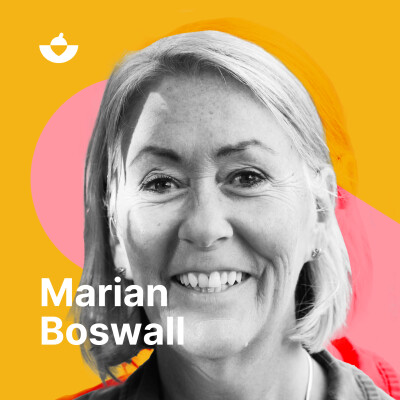
My name is Marion Boswell. I'm a landscape architect. And my personal story began when I was four. I camped outside in a den with my sister in the garden. And I woke up in the night needing to go to the loo and I was terrified of the dark. And I peered outside this den and was trying to get sort of from here to the house, which wasn't too far. And just didn't know how I was going to get there in the dark and the bogeyman and the fright. I was so afraid. And suddenly I saw sitting on a bench, on a chair with a rug over her knees, my grandmother. And she'd been sitting up all night to look after us. And her being there transformed this terrifying, scary nighttime full of wild creatures into a place of magic and wonder. and a place that I could explore. And I could smell the roses, and I remember how warm it was, and I remember the feeling of just deep connection with all the other plants and with all the beings in the garden. And that essence of there being a garden full of love, which my grandmother brought to it, is something which I've tried to recreate in every garden that I have made ever since. And really that was where my journey began. Fast forward many years in search of validation and achievement and an Oxford degree. And I worked for a management consultancy. And my world imploded when my second daughter died. And I left the world of sort of corporate and decided to return to that very special place of the garden where I'd started. And so I decided to teach myself how to. I knew how to garden, but how to really garden. So I studied horticulture, advanced horticulture, garden history, garden design, and finally landscape architecture. And about 25 years ago, I set up my landscape architecture practice. And really from there is where it's all begun. That's where it all started. I was designing lovely spaces. I was invited back to lecture at Greenwich University. And I lectured in historic garden conservation. So a lot of the work that my studio was given was to do with historic houses and estates. And gradually I began to ask them what they were doing over the fence, what they were doing, not just in the garden, but how they were working with their woodlands. And I began to be much more interested in nature recovery projects and working with re-wiggling rivers, re-flooding floodplains, building up woodlands and creating natural... corridors. But it was only maybe four or five years ago that I suddenly realized what was happening in the middle of the field. And I had never thought about how our food was grown. And when I understood, I have to say, I was a little bit horrified. I was giving a talk on land energy one day, and a lady came up to me at the end of the talk. And she had tears in her eyes. And she said, I am a grower, a large scale radish grower, actually she was in eastern England. And she grew millions of radishes and had done for years. And every year the agronomist came and tested her soil. And this year, she said to me, this year they say my soil is basically dead. What do I do? And I realized I didn't have that answer. So from there, I kind of made it my. my next chapter, if you like, to understand how we grow our food, how soil works, and how we can do better, how we can grow better for our microbes, for our guts, and for Gaia as a whole. And that's been the last bit of my journey. So yes, that's kind of the long version, but those are the different segments, if you like, and that's where I am now.
- Speaker #1
You mentioned land energy? Is that right? Could you maybe tell me what that is about?
- Speaker #0
Sure. So, I mean, everything's energy. We're energy. We're beginning to understand more and more with quantum biology, quantum physics and so on, that everything is energy. And land energy is an important part of that. And I'm really interested in how to work with some of the more subtle energies with both the visible and the invisible. Like if I meet you, there's a certain energy which we can both feel. And sometimes you can feel, if you meet someone, that there's a good energy and it's all going to be great. And sometimes, particularly if you're sensitive, you can feel that it's not so great. And it's the same with land. The layers of things which have happened in a place all leave a memory. And we can work to heal that energy, or we can just live with what's been left behind by others. It's usually people, other people, but other events. Or we can work to make it better. So I'm very interested in how we can work regeneratively in landscape design. And that includes working with the energy. So, for example, I often put in a labyrinth in a space because that's a fantastic concentration of energy and a healing point for where land energy can go. Might plant trees. Some people use earth acupuncture. Some people place standing stones. I mean, obviously, Stonehenge, you'll have seen wonderful, on your trips, you'll have seen wonderful standing stones in different places. These are all ways really of connecting man, woman, you know, people to something much bigger. Like Rudolf Steiner was very interested in. It's a question of just working with these subtle energies. So that's something which I don't always talk about when I'm working with clients. If they were interested, then I explain it to them. But it's something which we're always bringing to the party as part of. a complete regenerative toolbox.
- Speaker #1
Fantastic. Since you mentioned the spiral, maybe you can move on to that part of the garden and you can show us what this is all about.
- Speaker #0
Yeah, lovely.
- Speaker #1
You're standing right in the center of that spiral you were just telling us about a minute ago. Could you tell us more about it?
- Speaker #0
So, well, you just experienced the slight lift that you get in the center here. So this is a natural energy point. But it's doing a few things as a spiral. One is that it's a wonderful energy point. The other is that it's a meditation spiral. So there are seven loops for the seven chakras. And it's, in fact, in lockdown, I did some lovely sort of meditation videos, which people really appreciated just to connect. It's a wonderful way of connecting and being mindful because... A bit like, you know, how your gut is looped up so much as the size of a tennis court. If you do this even in a small garden, it makes the garden so much bigger because it takes about five minutes to do this whole meditation, whereas in walking around in circles, whereas if you just walked across this lawn, it would be a really small lawn. My dog uses it as a racetrack, which is not quite meditative, but it still works really well. The other thing which is really important for its use is that it has... increases the edges of things so much and the edges is where the magic happens so the liminal spaces we have so much forage here with things like this chicory which actually I planted for the depth of the roots because we're on heavy wielding clay but it's still flowering now and so that's forage for lots of pollinators but it's also habitat for loads of pollinators and and spiders and we have the um the wasp spider which was quite rare until a couple of years ago I first I saw it at NEP and I thought it was the most... exotic thing but we have it here now um we have orchids because i used strewings from great dickster hay so the the biodiversity here is just huge and in such a really small space so it's a lovely thing to do in a smaller garden that people that people can do and it's so simple so i i can show you a picture but basically all you need is a lawnmower and a stick and the stick is the width of the lawnmower and you start in the middle and you just mow round in circles and hey presto you have a wonderful uh wonderful spiral um and also here we're lucky that we are by tall trees and hedges so that increases the biodiversity even more and i have had um andy um phillips from uh he also did the great dickster biodiversity audit and a few other people and he's come here for the last couple of years and mapped um the amount of creatures that we're now living with. It's just gone off the scale. Some lovely, really rare things which have come here just because we've created more habitat.
- Speaker #1
That's wonderful. Could you talk to us about the importance of beauty for gardening, for agriculture, but also just for people, for human health, for what it brings us?
- Speaker #0
Oh, yes, what a lovely question, particularly when we're standing in such a beautiful place here. I love the Scott Fitzgerald quote when he said, she was beautiful, but not like the girls in the magazines. It's beautiful for the way that she thought. And I think that beauty is something which shines from within rather than being a surface thing. So some people would look at my garden and think it was quite kind of scruffy, but I think it's like a woman who is very comfortable in her skin and will throw on comfortable clothes and feel great. And for me, beauty is about that feeling you get you when you can feel a good intention, a good intention of a person or the love that's left in a place, but also is the aesthetic. So, I mean, here we're particularly lucky. So I'm standing next to three beautiful trees. One is, two are English natives. One is our lovely ash tree, which is the Fraxinus, which is a gorgeous, beautiful tree. Then I have Sorbus tauminalis, which is an ancient woodland indicator, which is a really, really special tree. Then I have this lovely liquid amber, which is very bright and sweet gum, which is a North American native, but sits very well in our climate as well. And at this time of year, when you come outside and you're just embraced by all these colours and the energy that that gives us, our eyes, and the feeling that transmits all the way through us. is so good for our health. And if you can get outside, if you're feeling a bit miserable, if you can get outside and see something beautiful or listen to a piece of amazing music or taste something delicious or smell, we came past these sassidophyllum on the way here, which smells like candy floss, that delicious kind of toffee scent. And all of these things are signals to our bodies that all is well in the world. And that's so important because we can listen to other humans who are constantly telling us that everything's terrible and if we're not careful we can believe that and and maybe i i sometimes think you know if chicken nicken says that the sky is going to fall on my head maybe it is but do you know what i'm going to enjoy every moment until it does so beauty is is just one of those things which helps us to do that and to feel that we're part of nature that we're connected that we are all one i'm
- Speaker #1
talking about health you
- Speaker #0
mental health and physical health how else can we take better care of our health physically and mentally uh gosh that's a big question but uh and i'm not a doctor but i'll answer from my own personal experience uh so we talked about beauty and sensory pleasure which is amazing to feel connected i think that feeling of connection and community is so key because uh if you're alone you can really sort of get stuck in your own mind. But if you go out for a walk either and then are in the company of all beings or all other human beings, you immediately feel better. So there's that mental understanding. I think gratitude is really important. Sort of gratitude practice of coming from a place of thankfulness and understanding abundance. If you have an abundance mindset, then more comes. It's an extraordinary truth that more comes from more. So in terms of mental health, I think those really help. I think setting clear boundaries is very important. And one of the things I think that we can get into a trap with these days is around money and thinking that money is the only energy. Sometimes people will say, well, you know, you're paid to do this, therefore you must do such and such. But actually, I have... My team know that I would explain to them money is only one of the many energy exchanges that we partake in as a society. It's a very important one, but it's not the only one. So understanding that we are free and that there is so much abundance around is so liberating. I think that's incredibly good for our mental health as well. Physical health, well, we are what we eat. So that all comes down to soil. It comes down to seed. It comes down to the plants. It comes down to nutrient density. So eating really well, avoiding, I mean, people are very quite aware of this now, but avoiding ultra processed foods, avoiding too much processed sugar, avoiding too much of anything really. And so that, I mean, I'm not very good at moderation myself, but I do love to eat really well. And I think that makes a... A huge, huge difference. When I say I'm not very good at moderation, I mean, I don't, I wouldn't go overboard on what I eat, but, you know, I'd like to go down a major rabbit hole. So if I'm interested in something, that's what I mean by not being into moderation. I would like my soil, you know, I went geeking about into that for at least two years. I'm not out of that hole yet. But looking after our guts involves what we eat, but it's so important to then look after the soil. And I'd love to show you my compost bins because compost bins are where it all starts. But what we put into the soil is what we get out of it. And really, yeah, dust to dust, ashes to ashes, we eat the soil in effect.
- Speaker #2
Just a quick post to tell you about the official partner of the Deep Seat Podcast, and that's... Soil Capital. Soil Capital is a company that accelerates the transition to regenerative agriculture by financially rewarding farmers who improve the health of their soils. They are an incredible company. I love what they're doing and I'm super proud to be partnering with them for the Deep Seed Podcast.
- Speaker #1
So you were just telling me about your love for soil and the rabbit hole you went down in the last couple of years. Maybe you could tell us a little bit more about that.
- Speaker #0
Yes, absolutely. So I had this really interesting sort of wake-up call when somebody said to me about how our food was grown. And I thought, I need to understand this. So first of all, I studied with Elaine Ingham from the Soil Food Web, who is this extraordinary woman. She's actually just retired, but big shout out to everything. that she has done and left as a legacy for the rest of us. And then having studied with her, I then read Nicole Master's book, For the Love of Soil. And in that book, she described how you can take really heavily compacted soil, and if you add milk, very diluted milk to it, how it will basically flocculate the soil with the calcium, and how that will loosen the soil and I tried this in my chicken coop which is just behind us which is really heavily compacted and over nitrogen and within a week I had worm casts coming up and then I could sow wild flower seeds in there and I thought what is this witchery what is this wizardry I need to meet this woman so I went to Althorp and met Nicole Masters on a weekend and immediately signed up you have to apply it wasn't actually that easy to get on I'm not sure. to her Create course, which is a 38-week long deep dive into agroecology coaching mindset and how we can work with soils. And I just, I can't get it enough of understanding our soil. And we're only just, as humans, we're only just really beginning to understand the amazing microbes, what goes on beneath our feet. So the reason we're here is that compost is the most brilliant way to begin to improve soil in our own back gardens. If you collect your garden waste, then you can put it in a bakashi bin. Bakashi is a bran which helps to ferment it. You can put it then into a wormery. And also, those two are really good because it means that you can have them in a small, like a city space and it avoids rats and so on coming to eat it. Then you can also do it out here like we are here in a compost heap. So to make this compost, this is using the Elaine Ingham thermophilic method. So basically I have 10 buckets, if you think of it in percentages. Six of them are brown ingredients, three of them are green, and then one is what Elaine Ingham calls the party food, because she's American, and that is the high nitrogen, high bacteria, which gives the compost the wumpf and really gets it going. And that can be things like manure or chicken poo, or in my case it's chicken poo or duck poo. and you can also use alfalfa and other things which are high boosting. So what happens is you get those 10%, so 10% of each loosely, you put it in, it needs to be a certain moisture level, put it in a heap, and then you turn it three times, from side to middle, over, each time it needs to get up to the right temperature, so I have a temperature gauge here, and when it gets into the greens, you keep it in the green for... 48 hours and then you turn it again if it gets too far into the red there is the possibility not at this time of year in England but there is a possibility of combustion because it can get really hot in there so you need to keep it you need to keep it turned and then after it's sat now this you can see this is in the actually it's gone right down to the white but it's finished it's finished it's decomposing its first part and then we'll put it in these bags where it will sit until we need it. And I can just show you what happens then, which is pretty special. I've also just brought this tube, this is not particularly elegant, it's just a plastic piece of plastic pipe with holes drilled into it. But if, for example, you're not able to turn... physically or you don't want to turn you can also use the johnson sue method which is to have a square container it could be pallets or a chicken wire mesh and then you put these in at 30 centimeter 12 inch gaps and that's that means that there's air the oxygen can get into the pile all the way around so it stops it from going anaerobic because what we don't want at this stage is it for a The compost to go anaerobic, we need the oxygen for the decomposition. Otherwise, you get that terrible kind of sulfur-y smell and you can get some of the less beneficial microbes, which you don't really want in the compost. So yes, keeping the air, keeping the heat, keeping it turning. And it's magic.
- Speaker #1
Fantastic.
- Speaker #0
Look at the little robin behind you. Just turn around, you'll get him. Oh,
- Speaker #1
hello.
- Speaker #0
So this is the compost which has been, I think this is about, since about June, so July, August, September, October, it's about four months old, which is pretty quick for creating compost. And it will sit in these bags now and then I will add some inoculants to it, like diluted milk or like fish, hydrolysate, etc. And that will just increase the diversity. of the microbes. And what I'm looking for, because this is mostly for vegetables, is a sort of one-to-one fungus to bacteria ratio. And then I want the complete spectrum of protozoa, nematodes, and bacteria and fungus in this compost. So I mean, it smells amazing already, but I put it under the microscope quite often and I see what's in there and see if I've got enough of the biocomplete ingredients. And if I haven't, then I play around and add a bit more. So it's incredibly satisfying. So, I mean, it smells amazing already. It smells of humus. And you can see it's kind of that dark chocolate colour, which is what we want. So that's all the humic acid which is in there. It's still got quite a lot of leaf mould in it. It's also got lots of little wood in it, which is really good for promoting fungus. So we're trying to get as much fungus in there as well. And it's under these trees, which also helps to get my own local microorganisms. And I have a little recipe for making indigenous microorganisms. I say it's not I didn't make it up, but I use it, which I can also show you, which involves burying rice in a cardboard box or a wooden box and allowing the microbes just to come from the woods. So it's all just working with nature and co-creating. We'll come and have a look in here. Ready? Lots and lots of wormies. And then if we lift up the next layer. Oh, wow.
- Speaker #1
Okay.
- Speaker #0
They need to go out.
- Speaker #1
Yeah.
- Speaker #0
So when they're happy, they breed like anything. And they're saying, let me out. So I have to let some of those out in the garden now. Yes, they're essentially, they're all in here.
- Speaker #1
How does this work in the different layers and the top here?
- Speaker #0
So here we go. If I dig in here, you'll see there's loads of them. Loads of them, look. So basically what happens is that you put your scraps and your food in the top here. And then they digest it and it goes down into the next layer. So the next one is more digested. And the one below will be even more digested. So they all come up through holes. So there's holes in the... Can you see the holes in the bottom?
- Speaker #1
Yeah.
- Speaker #0
So they all come up through the holes to eat the next layer of things. Oh, I'm going to squash you, sorry. And they're these little compost worms, which are different to the big worms that you get in a garden. And people think that they eat like the scraps and so on, but actually what they eat is they're eating all the microbes in the soil. In fact, you can see he's got them or she's got them inside. And they basically, they take the soil and they squeeze the exudates out. So they take all the goodness out. And then what they poop at the end is highly nutritious for the soil. So I do feed these a little bit of partly made compost. And then I put some of these into the compost. And it just makes it, yeah, it breaks it down. And it's so satisfying. Because if you have food waste, sometimes people say, oh, well, I don't have any food waste. But actually, if you start doing something like a worm, you soon realize how much food waste you do have. And it helps you to be more intentional about what you buy and what you eat. And also, I think it's quite funny. If you wouldn't give something to your worms, like you wouldn't give them a half a miles bar or some ice cream or something. Why would you give it to yourself? So if you think, oh, that's not very good for the worm. Well, no, it's probably not. But it's probably not very good for you either. So I love the way that it makes you just think about the closed loop system. It makes me really happy because the waste goes through these and the Bokashi bin and the compost and we just waste much less.
- Speaker #1
Is it possible to get a sort of smaller version of this in an apartment if you live in the city?
- Speaker #0
Absolutely, yes. So this is from a company called Wiggly Wigglers, which is a great name. But yes, you can get them from lots of places online. I've had this one for 24 years and it's the same. little packet of worms that I had at the beginning. But yes, you can get versions of these. You can get little ones this big. You can get a Bokashi bin, which is only tiny as well. And you add a Bokashi bin. This is a big Bokashi bin, which is an empty one. But basically the way this works is that you put your food waste inside it. You add some Bokashi bran to it. And it becomes... And it basically, you put the waste in there and you put the lid on with the Bokashi. It kind of pickles it, which means that the worms, after they've been in this, will also eat things like orange peel and so on, which they wouldn't normally like. They don't really like anything too acidic. But the wonderful thing about a wormery is you can put things like cooked meat in here, which you wouldn't want to put on a compost bin because you would get too much vermin, particularly in a city. Yeah. So this is an absolutely tiny way of getting water into the garden. It's just literally an old, well, an old tub or trough. And what I've done is to put this lovely brick, but it's a rather beautiful piece of stone in there, which has moss growing on it. And there's so much in here. You can see the water's really clear. So they haven't got kind of green algae and so on. And that's because there's so much biodiversity in here that it's kind of looking after itself. So we've created a little ecosystem of its own. John Little, who runs Hilltop Garden, who is a fantastic gardener, he always says that a stream in a town centre with a shopping trolley in it has better biodiversity than a stream without a shopping trolley in it. because If you think of like a sunken ship or coral, things cling to. and can start growing when you have more surface areas. So what I've done here is just really increase the surface area. So I have bricks in here. I have some gravel at the bottom. And then I have placed this rather lovely sort of old piece of stone, which I just found. Actually, I think it's even concrete, which I found around the garden. And also by having this, it means that the bees have somewhere to sit and sip because of the moss on top. And yes, we just find so much living in here. And it's just such a simple thing to do in our water. So we're 70% water. Water is a finite resource and has been through all of us before. So it might have been through the trees. It might have been through our friends, our enemies. It might have been through dinosaurs. I just love the idea that we're all connected through water. And I don't know if you know the work of Masaru Emoto, the or Victor Schauberger, the sort of hidden meanings of water or the memory that the water holds. But I think it's absolutely fascinating to think that it does hold a memory. And so how can we be water guardians so that when the water that lands on our properties leaves the property, it can leave in better health than when it arrived? So rather than filling it with chemicals and hormones and microplastics, If we can capture it...
- Speaker #1
in the roofs if we can capture it in little things like a tiny little rain garden like this um then we're kind of doing our bit as water guardians i um i heard that some people are is that what you're referring to some people are freezing water and you can see different patterns depending on what
- Speaker #0
the energy of the water or something like that speak to it yes i haven't done it myself but it would be fun with it to um yeah so if you if you say nasty things to a petri dish of water and then freeze it or if you say beautiful things to a petri dish of water and then freeze it then the patterns come out very differently and this was the work of Masaru Moto and I have not done it myself but I am fascinated by this idea that our intention is everything and it's the same with the garden design you can feel you know when you go into somebody's garden you can feel the intention of whether they're welcoming you and it's going to be a joyful experience or better Maybe it's just for show and they want you to feel intimidated. I think that some of the Italian Renaissance gardens are fascinating because you sort of arrive at the bottom of these massive steps and you're made to feel small straight away. And you're made to feel that whoever owns this is so important and so grand. But even these days, some gardens can be full of so many toys and flashy bits that you can arrive thinking, well, you know, this is a lot of this is for show. Where's the real person? Where is the... Whereas the feeling of the person, what are they hiding behind in a way? Whereas if we can show our intention to be one of welcoming and one of authenticity. I don't know if you're familiar with Feng Shui at all, but they have a, it's a great way of sort of putting into practice some of those things, which perhaps we all understand at a very intuitive level. One of the design... things in Feng Shui is to have a Ming Tang and that is the entrance hall, the hall of abundance. And I think of it as like the big hug when you arrive. So when you arrive at a property, if you see some of my designs, you'll often see that there's a space where you arrive and you immediately feel, yes, I'm here. I'm welcome. I'm now part of what's going on here. I'm not exactly part of the family, but I am welcomed. And I think that's a lovely way of setting the intention.
- Speaker #1
This podcast is usually centered around the topic of regenerative agriculture or the question of how do we keep feeding 8 billion people, but instead of destroying the planet and life on it, we regenerate it. First of all, I'd like to know what you think about the regenerative agriculture movement.
- Speaker #0
So I'm very much aligned with the regenerative agriculture movement. having done the Create... course with Nicole Masters. I'm an agroecology coach. So one of my roles is I co-founded something called Chalk to Coast, which is a large scale nature recovery project across the north of Kent, where we are looking to work with three big clusters of farmers and some many private individuals as well and companies to create a regenerative food growing. corridor so it's not rewilding it's about how we can grow food and and do it with nature so i I'm a great friend of many people who are in the movement. Sweetly, Andy Cato gave me a lovely endorsement for my book, which you can see, and he was on the great course with me, and many of the others, Liz Jennifer, Tim Williams, all these people are doing the most fantastic work. Nick Padwick, Tom Fairfax, I mentioned before. I think what's really exciting about the regenerative movement is that it's a mindset. that it is in a fast startup phase where really people are concentrating more on results. And so my first job was as a management consultant. And we used to look at the four phases of how a company would evolve. And we used to call it, well, to begin with, you have the entrepreneurial phase, when you get really impact, high impact, high fast movement. And that's kind of where RegenAg is at the moment. People are doing brilliant things. What often happens then in the second phase of a big company is you get into the slightly bureaucratic stage when people start saying, hang on a minute, you know, what are we doing? How do we control this? How do we make sure everybody's doing it right? And you can get bogged down in some bureaucracy. And I know that some people think that the organic movement had got to that point where actually sometimes it's more not so much the spirit of the law, but the letter of the law, which is being followed. And I won't go into that in too much detail, but what's exciting about RegenAg is that if we can learn from that and move swiftly through the entrepreneurial to the bureaucratic to the really stage three company, which is when you're really becoming quite effective and all the stage three movement, when you can be quite effective, have enough control so that people can feel comfortable. And so it doesn't get sort of hijacked because already we're hearing... So we're hearing quite a lot. It used to be that sustainability was suddenly the buzzword and then it was hijacked by the big, big companies and big ag. And then it was like, okay, right, well, how could we keep ahead? But now you also hear about people saying, well, I'm doing this regeneratively and you think, okay, really, you know, how are you doing that? So I think if we can keep the momentum, keep growing food, which is really important, but bring in... understanding for the wider public of things like seed sovereignty and understanding how much power we can have with our own purchasing ability, how important nutrient density is to ourselves and how important community is. Because actually, if we can gather together and work as one, as many voices going in one direction, then we can change huge things. It's a really exciting time to be. to be working at the moment.
- Speaker #1
A lot of the regenerative movement also focuses on technical solutions and on measurable results and sort of hard science.
- Speaker #0
Yeah.
- Speaker #1
What could sort of this movement, this regenerative movement, learn from your work and from looking a bit more at things like kindness, energy and beauty?
- Speaker #0
Well, you say it focuses on hard science. I mean, there's a lot of left brain, but there's a lot of right brain as well. And actually, I think that the feminine energy is quite exciting in region. If you go to groundswell, very rare you see that concentration of female, which I know doesn't mean to say it's necessary feminine energy, but there's a lot of women who can now feel that they can come into agriculture because the way we're doing things is different. And there's a lot of men with a feminine approach. who are coming in as well. So I think that the left brain and right brain are coming a little bit more balanced. And I think that's also really exciting that if we understand that if we work with good intentions and with kindness, that isn't everything because of course you can do that and you can kill with kindness by overfeeding something and overfeeding your soil and so on. So that isn't everything, but it's a really good start. If you can be kind to yourself, if you can be kind to all the... beings in your garden or in your land, then that emanates out to everything. And also, you know, some farmers don't actually eat the food that they grow, or they wouldn't let their children eat the food that they grow, but they'll sell it to other people. I think that's a major thing which we can address with kindness.
- Speaker #1
A lot of the land is used for agriculture, for food production, but there are also many, many people who have gardens and natural spaces. Are they also part of the solution? Are they sort of citizen scientists experimenting with what we can do with nature?
- Speaker #0
Well, in terms of giving a... basis for pollinators, for example. So there are 23 and a half million gardeners in the UK and the garden area spans a larger area than I think the national parks is the statistic. So there's a lot that a gardener can do as well as that a farm or a landowner can do. We can provide habitat for pollinators, we can increase biodiversity, we can look after our water, we can look after our soil By looking after our soil, we can then look after our guts, which is what then goes back into the water system. And we can look after our energy, whether it's the sun, the solar energy, wind energy, how much electricity or other fuels we use. We can be mindful of all those sorts of things and we can create community, which is really important. That sort of bond between other human beings. So, yes, a gardener is as powerful and there's so many gardeners. And anyone can be a gardener. You don't need a big space. You can have a windowsill, you can have a balcony. If you can somehow connect to any growing life outside, you are a gardener. So you ask me if I'm a hopeful person. Yes, and I will show you this as one of the most hopeful things which has happened in the UK in the last 10 years. So 400 years ago, we extirpated the beaver from the UK and we used them for their, basically their anal glands for many things, for healing, for scent, for the castoreum which they produce. And also they annoyed us because they are these extraordinary busy creatures that take down trees. However, In the last 10 years, we have started to reintroduce them. And for me, when I first saw that, that was one of the most hopeful things which has happened, that we can learn how to co-create with other beings. And if you see the work that beavers are doing down in Somerset, they were already in Scotland, but in Somerset and Cornwall, other places, in fact, we have them in here in Kent as well, the way they are bringing life back, bringing biodiversity back. They're creating wetlands which we as humans would cost us millions of pounds to do and a lot of physical and fossil fuel energy to do. And by co-creating with these creatures, we are understanding that it's not just us that can regenerate. So can the bees, so can the birds, so can all other life. So if, yes, you ask me if I'm hopeful, I often carry a beaver chip in my pocket. which is just one of their chippings that they've taken off, just to remind me that if we can bring back beavers, then there's so much that we can bring back.
- Speaker #1
Thank you so much for your time and for sharing all of this wonderful knowledge and wisdom with the listeners of the Deep Seat podcast. Thank you.
- Speaker #0
Well, I'm just really honoured that you came. Thank you very much. And thank you for doing the podcast. What a wonderful gift.

![The Joy and Wonder of Being a Regenerative Farmer [Naomi Oakley & Gunnar Thelin] cover](https://image.ausha.co/RTVMsUtz5pRE96mm18UXNKSfjQxd40dUaIlgKKRc_400x400.jpeg)
![Why the Food System is Breaking and How to Fix it [IVO DEGN] cover](https://image.ausha.co/fTFEznYzZMBV799WOkfBCMki1hJ0DZkYk6BVMkAC_400x400.jpeg)

![The Farming System Is Broken... And Farmers Know It! [DAVID WHEATLEY] cover](https://image.ausha.co/pPSdi7HHsBeoSeeil7RTNv7u8w6Shoezx40smCYL_400x400.jpeg)