- Paul
Hello You made it Hi
- Chloé
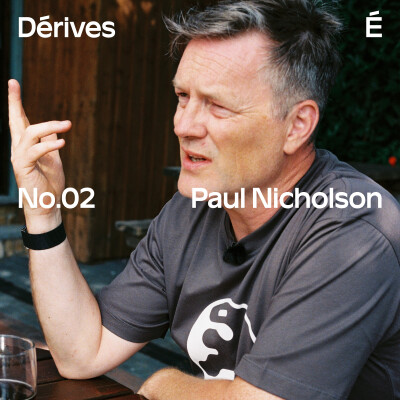
Paul Hi Paul Dérives, episode 2, with Paul Nicholson. We are at Paul's home, which is also his studio in West London, on Tuesday, June 30, 2026.
- Paul
So who's who?
- Chloé
I'm Chloe.
- Paul
Chloe. I'm Arnès. Arnès. I'm Javi. Javi. Javi. Yeah, well, come on in.
- Chloé
Thank you.
- Paul
Feel at home?
- Chloé
Nice to meet you. Paul Nicholson is a graphic designer. Over more than 30 years, he has established himself a strong reputation in music, working with artists including Skrillex and Pharrell Williams. His most iconic work remains the logo he created decades ago for Aphex Twin, which has become one of the most recognizable symbols in electronic music. For Etude Studio, Paul has designed graphics for a capsule collection launched alongside Résonances, presented at IRCAM in Paris, and bringing into dialogue John Cage experiments with the emergence of IDM in the early 90s.
- Paul
When I'm working, I don't actually need much space. I mean, that's all I need. I've got three monitors. So my setups, it's not even that expensive. I mean, everything I've got, possibly £5,000. So if you think about the amount of work I've created in the... Maybe 10 years I've had this equipment. I mean, my PC's 8 years old. I can't imagine there's many designers that have the luxury of being able to use quite old kit. But most of what I do is in Illustrator, a little bit in Photoshop. I'm not doing three-dimensional stuff, so I'm not using... fancy programs like Premiere or 3D Studio Max. I just don't need the power. So I'll work with this machine until it either dies or I start using some software that requires more power. I can show you the setup. This is a Wacom Cintiq. So when I need to create masks or I'm doing drawing, this is one of those ones where you can use a pen on the monitor. So I use that for sketching. This is my main monitor. So this is, I just bought a monitor that had the tightest pixel. So this is the sharpest. So this allows me to see with a lot of detail. And this is... a Japanese monitor that's very good for colours. So I can draw on here. This is where I do most of the work. And then light programmes like Photoshop and Illustrator, you have all of these fly-out toolboxes. Old man, need my glasses. Need my glasses for work. Oh look, here you go. I was Ricky Gervais. I have a lot of comedy playing on in the background when I'm working. Right, shut up. He just said shut up and I was going to say shut up. He beat me to it.
- Chloé
Alignment.
- Paul
I think I just always knew that I had this love and ability to draw. And as a kid, everything's just art. Everything was just grouped as art. So there wasn't any awareness of, say, design or that you might be a logo designer. It was just you could draw. So I think from there I just carried on drawing and then going through school. you know art design then foundation course then university but i think from i would say about 15 it wasn't so much that i wanted to do design i knew specifically it was going to be music related graphics so um this guy Vaughan Oliver he designed for a record label called 4ad And, I mean, these are all bands from my mid-teens. So the Pixies, Clan of Zymox, Cocteau Twins, who are still one of my favourite bands of all time. And got This Mortal Coil as well. So I'd have been, yeah, This Mortal Coil. So this is 1984. So I probably got into 4AD. Roundabout this time, 14. And Vaughan Oliver's just producing these absolutely beautiful pieces of artwork. And... Along with my obsession with music was this love of the design of around music, the packaging. So obviously I was getting into all of that. You also had the Designers Republic. Yeah, I've got too many books, I'll just cram them all in. And when I met Richard, we sat down chatting, so we'd be talking about music. I'd bring records that I had, so I know that I introduced him to certain bands like Cabaret Voltaire, Renegade Soundwave, Meet Beat Manifesto. Because Richard's background was more like Chicago and Detroit house, so he was more into acid and house. Whereas my background was a little bit more like industrial music. Especially, yeah, bands, I mean, funnily enough, I'm going to see Cabaret Voltaire. They're doing their last tour because, I mean, they've been going since the 70s. I think both guys in Cabaret Voltaire must be now mid to late 60s. So, yeah, I'd never seen them as a teenager. So it's like, well, if I don't see him now, I'm never going to see him. So it's kind of come full circle. So it was a really simple process. It's like... I get a girl who's Cornish, she introduces me to Richard, I show the sketchbooks, he needs a logo. And the crazy thing is, is that the two first logos in the book are the very first logos I did. And they're the only time I've submitted one logo and there's not been a change. So what you see there is exactly how I did it, how it was presented and how it was used. So, I don't even... I don't even have preliminary sketches for Aphex Twin logo. I can't remember how I came about coming to that design. But it's not like there's a series of drawings that lead up to it. It's almost like I just had this idea and drew it one time. And I know for a fact that... So round about, I'm guessing, October, November 91, R&S had heard Analog Bubble Bath, And they would desperate to get Richard on the books. So he signed a deal with R&S Records and Renard, he's very famous in techno, Renard van der Pielje or something, really long surname. So they're based in Ghent in Belgium. And he was like on and on at Richard, we've got to get stuff out. And every day he's ringing up, when am I going to get the master tapes? When am I going to get the LP. And it was the same with the artwork. It's like, we don't have time at all, get something to me, like end of the week kind of thing. So I know I had to create the logo in a really short space of time. And, you know, back when I started doing graphics, you sent the original artwork. So the hand-drawn stuff was seen as the thing that you reproduce from. So it was kind of crazy that once you'd given away hand-drawn stuff, it was like the last you saw of it. You very rarely got it back. So what would have happened is that the Aphex Twin logo would have gone to some printers in Belgium. They'd have gotten a copy of it, however they did it, and would have thrown it away. So the original drawing would have been in a bin somewhere in Belgium. So, yeah. So, Knowledge was the club to go to at the time because other clubs would be playing the more, kind of, not mainstream because it was, even rave music was underground but it wasn't the sound that Richard and I was into knowledge was playing the sort of labels we're into. So once knowledge started, so I did the logo for knowledge, did the logo for Aphex, then knowledge opened. So I'd already done the two logos before knowledge even... even started so rich and i would go there every week he had a tendency just to kind of chat with other musicians and and people about music and all i would do is once i'd done a few interviews with people i'd just be on the dance floor and then i'd be there until the lights came on and that i kind of got known for that just i was just the guy that would always be on the dance floor And when he got his first gig it was Tresor in Berlin 1992 and I put really simply I think Richard didn't feel comfortable being on stage on his own and being the focal point he was a little bit shy he didn't want that so it's just like look I'm going to Berlin you wanna come with me just do what you do at knowledge but I was basically just a distraction. He could focus on his music and not have to worry about people looking at him, and I'd just be... leaping about. But, yeah, I ended up doing, I think, about 50-odd gigs over about a two-year period. But, again, you know, for... you know, someone who... Pretty much just moved down to London a few years before. We didn't have a whole heap of overseas holidays as a kid and all of a sudden I'm going on flights here, there and everywhere, being put up in hotels, picked up in limos, the whole shebang. So it was just crazy. It was a really whirlwind period. And I think as well as it kind of tied in with me as well leaving university, Um... Taking portfolios around record companies, establishing relationships with a couple of labels. So just being busy working on graphics and when I wasn't working I'd be either at clubs or going to perform with Richard. So it was, oh man. I always felt and always believed that if you... have a passion for something and and you're 100% into it it's like things will gravitate your way so at the time and then bearing in mind that Richard was just one of many musicians at the time I don't think he'd quite cemented the reputation that he he has subsequently got he was obviously um a musician um at the top, as far as creativity goes. But, you know, you had Muzik, Mike Paradinis, you had Ortega, you had... ..so many good individuals creating music that it was more like... For me, it just felt you were part of this, like, new scene, this new way of thinking. And it did tie in with, kind of like... More like practical aspects as well, because London late 80s was run down, it was a shithole. So there was plenty of empty buildings. So there was plenty of spaces to put on raves. There were plenty of cheap, run-down, former... nightclubs. Like, Knowledge was in a building that had been obviously quite a fancy club in the 1930s or something, because it still had all the art deco fixtures and fittings, but it was shit. It was all crumbling and falling apart. But London was full of these spaces where for maybe a couple of hundred pounds, you could take it over, put on a night. So Thank you. You were also aware that you were part of an underground, because knowledge, even though it was attracting musicians from all over the world, it was a venue that had 400 people. You really felt like you were part of this like really solid and well connected underground scene. So it was kind of special, you felt like you were part of a very elite tribe of kind of techno obsessives.
- Chloé
Just to say something about the tattoos. The logo is getting big. It's getting really famous around the world. What's your take on the on people getting tattooed with the logo? How do you feel about that?
- Paul
Well, they should all send me £10. I could retire. You know, as a designer, you have to be humble.
- Chloé
It's flattering,
- Paul
isn't it? It's flattering, exactly. But, you know, something becomes iconic because for whatever reason, it just resonates with people. And that's all you... you can say and it's a combination of many things now obviously if Richard had never had a logo and he just had random artwork every time he did a release it wouldn't stop people liking his music but a logo plays a really important part in cementing in people's minds the aura of the music so for example you know the Rolling Stones Lolling Tongue or ACDC or Metallica I mean these bands have an impact far greater than the music would do solely on its own. So the logo does play an important part. How you quantify that is impossible. But it becomes symbiotic. You can't separate one from the other. So when people join the tribe of music, electronic music fans, they're looking for this signifier. If you join the church, you wear a cross. and if you follow the church of Aphex Twin you wear the logo and no other musician of his era or in his genre had a logo to speak of. Ortega, well, they just have their name written Helvetica. It's not a logo, it's just a name. Boards of Canada, not really. They don't have a logo. Orbital, again, it's just Orbital written in, I think, Futura. So the thing is, is that when looking for a symbol to show your allegiance, to this tribe. It's like that is the one that was picked. But obviously what's happened now is that the logo's grown bigger than the tribe it initially belonged to. So a lot of people now who just want to show that they're a little quirky or a little bit more artistically driven, it becomes a symbol to show, ah, look. I get it. And this is the thing is that this thing takes time. You know, the Rolling Stones lolling tongue or, you know, the Joy Division with the sound waves. It wasn't a... as important in 1980 as it is now so for i mean it what's his name um peter saville peter saville yes god the amount of times i've mentioned him in discussions and when i actually need to say it but no um pete saville i mean it is very interesting and As I say, you've got to be humble, and I'm genuinely very pleased and fortunate to have been someone that was involved in that process. Because the fact that you guys are here now is in part down to my involvement in that time. So had I maybe chosen a slightly different path, and to be my age and still designing is very rare. I would love to know out of the 30 other students on my course how many are still designing. I doubt there's many.
- Chloé
So that would be your definition of what makes a logo truly iconic? Time?
- Paul
Yeah, you need time. Something only becomes iconic over time. It's the same with the music. I bet Selected Ambient Works sells more on a week-to-week basis now than it... has done in any point in time leading up to now. It gathers momentum. It's now almost become a must-have part of any collection. But it's, like I say, it's... It's very complex because it's all cumulative. You know, because obviously there will be people who wrote about music 30 years ago. If somebody's going to write about Aphex Twin now, what are they going to do? The first thing they're going to do is type a search on all articles on Aphex Twin. So the sort of things that were said 30 years ago will be simply repeated. And once it's repeated a hundred times, it just becomes the mythology. So all the stories about Richard, for example, Oh, you know, He makes his own equipment, he does music in his sleep. I mean, it's just a myth that grew from nothing, or just an offer cut for a mark, and it's just grown and grown and grown. And, you know, how many people wear the Aphex Twin logo and might not even know it's to do some music? They've just seen it around. How many people wear CBGB shirts or the Joy Division shirt who really understands about the origin. So I just think once something gets elevated to an iconic status, it just, yeah, it takes a life of its own. It's, again, I think everyone's going to have different theories on it, but I don't think you can sit down and create something iconic. It just happens. I don't think any musician sat down and gone, oh, this is going to be sang for the next hundred years. You know, whether it's Sergeant Pepper's Lonely Hearts Band or, you know, Jimi Hendrix, I mean, you're just responding to how you feel. And then if you sum up a point in time, beautifully, then it will go on as being emblematic and iconic of that time.
- Chloé
Can we talk about the logo you did for Études? How did you do it?
- Paul
It was a whole thing of capturing that era. So that particular look with all the curves. that is somewhat Aphexian in its look. It was really just capturing that look, but trying to do something different with it. What's been quite good is that obviously when people have Aphex Twin logo as a reference point, what's quite good as a design exercise is to try and reinterpret essence of that look. but without it being too similar. So it's been quite good. I've been able to really push that particular aesthetic style. And then there was two elements for the project because there was the noise element as well. So again, I was looking at ways I was working in the early 90s. There was a whole thing with, during the 80s and the 90s, there was this whole obsession with the textures to do with deficiencies of technology. So the sort of things that you'd get using Xerox machines and photocopying. So this whole thing of the distressed image or glitch. So you've got artists like... April Griman, who in the late 80s was one of the first artists to really exploit the Macintosh, you know, the Apple machines. So what she was doing is in looking for aesthetic around computers, was looking at the things that it couldn't do or the things that it did badly. And the aesthetic became linked with technology because it was mostly glitch. In fact, I have her book over here. April Griman, here we go. So, you know, this is, I think, 1989, maybe. So I went to April Grime and show at the Design Museum, which would have been, well, I was still seeing Emma. So that was the girl who dumped me in 91. So I think I went to the April Grime and show in 1990. So if you look here, So I've had this book ages. So when I was looking at... There you go, look. I mean, when I was looking for reference points of what to do for Études, it was like, well, you know, the early pixels, the way that there were limitations to what computers could do. But those limitations became the aesthetic. So you can see she's really exploited basically the shit that a computer would produce. I mean, it's so frighteningly basic now, but at the time this looked completely future because it was all new textures. All of this kind of stuff in 1989 just looks so modern because it was purely down to what the technology would throw up. And it was a bit like, you know, when I was doing foundation course, it was when the canon... color photocopiers first came out and there were things that it would mess up so when you'd put things through the color copier it would fuck up colors or it would distort the image but that became the thing you wanted you were looking for where it went wrong the glitches the errors the faults the oversaturation of colors So as I say, working on Études, I was just looking at all of the things that got me excited all those years ago. So yeah, I mean, now you know my secret. That's where it was all from. When you wear something you really like and you've got swagger, you're walking down the street and you're like, I look good. It doesn't matter if anyone else gets it. And most of the time, I think the sort of things I wear, most people wouldn't attribute any value to it. So brands that I mentioned, like Maharishi, Nigel Caborn, maybe Buzz Rickson from Japan, I mean, those that know, know. But it's a bit like you're communicating to other nerds like yourself. It's a real niche thing. So, if I don't like what I'm wearing, I feel uncomfortable. So, if I go somewhere where everybody's really gone to trouble, like if I went to Paris Fashion Week, I know... I'm not in their league. I'll never be in their league. So I'm not going to compete. I'll just wear what I like and go, well, I look good.
- Chloé
You are listening to Dérives, a podcast by Études Studio.
- Paul
Here we are walking along the canal. So the part of London I live in, we're right by the canal that takes us down to Brentford and ultimately the River Thames. One of the things I do love about London is all of the layers of history and in particular during my time in London I spent a lot of time cycling along canals so I'm kind of connected to the canals. I think that I am drawn to decay. So there's something very appealing about canals because it's such old technology and a lot of the architecture around canals has ended its original usage. So like here you've got this chimney stack, so whatever reason that was built for no longer exists. So you've got all this dead tech that So that I just find fascinating. So this kind of architecture of warehousing, and you can imagine that there would have been a time when they were transferring goods to these warehouses off barges, and it's all gone. Right there Rory, you're fishing. Oh this guy's sticking a dead cat in my face. Now I'm doing an interview. This is my son's friend who goes fishing. Saw you after today. Well good luck my man.
- Chloé
More broadly, how do you think graphic design interacts with our daily lives?
- Paul
Well here's the thing is, whether people recognize infants of graphic design is the question. Because obviously everything we consume has been designed. you don't buy anything these days that hasn't been touched by a graphic designer. But whether people get it, I mean, obviously, someone who's maybe not into design at all, but they'll still be obsessed by Nike or Adidas. I think people are probably a lot more design literate now than they were, say, 10 or 20 years ago. People are very much into brands. Does that answer the question?
- Chloé
It's so nice, this draw. Yeah, really.
- Paul
Watch out. Oh, he's gone. Oh,
- Chloé
it's not a play. Thank you, Paul.
- Paul
My pleasure.
- Chloé
Cheers.
- Paul
I'm trying to... What's... I was thinking of De nada, but that's Spanish, isn't it? What's the French version? De rien. De rien.
- Chloé
See you. Dérives is a podcast by Études Studio, directed by Chloé Saramea. Recorded by Javier Carles, edited and sound design by Elias Magnin.