- Speaker #0
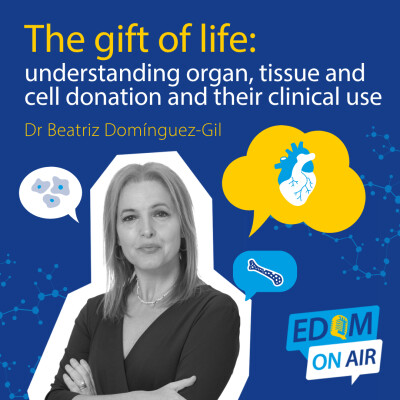
Hello and welcome to EDQM On Air. I'm your host, Sara Tseysir Ben-Sherif. This show is all about exploring the world of medicines and healthcare and giving you a chance to hear directly from the people who help shape it. Today we're focusing on transplantation and donation. Now when we hear the word transplant, I think most of us picture a heart or a kidney or perhaps even a liver. But donation is way more diverse than many people realize. Every day, donated organs save lives. Donated tissues like corneas and skin give people back their sight and help heal severe burns. Donated eggs, sperm, and embryo help people build their families. And other kinds of donations you might not even have heard of, like breast milk and stool, help some of our most vulnerable patients. Now, as different as these therapies are, they all have one thing in common. They depend on the generosity of donors and on systems that ensure donation is safe, ethical, and of the highest quality. And the impact of those donations is really extraordinary. In 2024 alone, more than 44,000 organ transplants were performed across Council of Europe countries. But the need remains far greater than the number of organs available. Nearly 95,000 people were waiting for a transplant. And more than 8,500 died while still on the waiting list. So today we're exploring this complex world with one of Europe's leading experts in donation and transplantation, Dr. Beatriz Dominguez-Gil. She's a medical doctor and chair of the EDQM European Committee on Organ Transplantation. Beatriz, thanks so much for joining us.
- Speaker #1
Thank you so much for having me here today.
- Speaker #0
So, because you've devoted your career to transplantation, and I want to hear from you, what first drew you to this field and what continues to inspire you today?
- Speaker #1
I came to the field of transplantation a little bit as a natural evolution of my specialty. So, I'm a medical doctor and a specialist in nephrology. And one of the important tools that we have in nephrology for renal replacement therapy is kidney transplantation. So as I was advancing in my training, I got to know first kidney transplantation and many other types of transplants. But what got my attention of this field is that not only is fascinating from a technical point of view, it is a highly innovative area of medicine, but it depends on something else. It has human issues, philosophical issues. anthropological issues that are very important for the field. So it's just not the technique, it's not just the capacity to perform the transplants, but all the elements that are required for the system to work, what really made me very attracted for this area of medicine. And that keeps me really inspired and pushing forward in this field.
- Speaker #0
Yeah, you're right that it's... more than just science. There's a lot of philosophical and ethical and human questions that are worth exploring. In the years since you've been working in this field, is there a donor or a recipient story that has stayed with you?
- Speaker #1
I would tell you that all the stories are important because every procedure, every donor, their family, the recipients are important stories. But if I had to choose one and I was trying to think of... One that really had an impact upon me was related to an occasion in which we were interviewing the father of a child who was a donor. The child had been born with a very important disability. So he was living for, I think he was eight years or 10 years old when he finally died. But he was disabled and unable to do many things during his short life. And for the family, it had been very important that his child could be an organ donor after he finally died. And the expression of his father was that he finally could see his child laugh through other children and that he could play. and that he could climb mountains, that he could do things that he was never able to do during his lifetime. So this is a very important story to me because in his sentence, my child is laughing through other children. he was capturing very well the meaning of donation. We always think about donation as something that, of course, is helping patients in need, because transplantation is the leitmotif for donation. But on the other hand, he was somehow highlighting other aspects of donation, which is how much this can help donors and the families. And he found some solace. in knowing that other children could be doing other things, but at the same time, he was somehow given an opportunity to his own child. And I think that was a very beautiful story.
- Speaker #0
Yeah, that's incredibly moving. Thank you for sharing that with us. And to our listeners, I just want to encourage you to tune in to a previous episode featuring transplant patient Liz Schick. She shares her story with us, and we really encourage you to tune in. So despite incredible advances in transplantation, as I mentioned in the intro, the need for organs still far exceeds the supply. And we frequently read or hear about waitlists. Can you tell us a bit more about why that is? Why is the supply-demand mismatch the way it is?
- Speaker #1
There is always a need, a demand, which is much larger than the organs that we have available for transplantation at a global level. We are performing more than 180,000 transplants. These are 2025 data in the world. However, the World Health Organization, and this is also stressed with data from the Council of Europe, estimates that we barely cover 10% of the needs. This means that we would need to perform about 2 million transplants every year to cover the need. Why is there a disbalance? Well, first we need to talk about the need. The need is not well represented by the waiting list. The waiting list is a surrogate of the true need because there are many patients who never make it to the waiting list for whatever reason, among others, because they may not have access to transplantation in the place where they live. So the waiting list is just a selection of those patients who could potentially be benefiting from transplantation. On the other hand, we know that the need is going to be increasing over time because of the aging of the population, because of the growing burden of non-communicable diseases that lead to the need for transplantation. So as we fortunately become older, longer survivors, at the same time, we are developing diseases that may lead to the need for organs. And then we have the donor side. We may have populations who are very much willing to donate. You will be surprised by the huge number of people who, just to the simple question, would you donate your organs, they would be willing to donate organs. But this is not enough. We need a system that identifies systematically those persons who die in conditions that are consistent with organ donation. And these are exceptional conditions. For example, in Spain, we estimate that barely 2% of persons who die in a hospital die in conditions of being organ donors. For tissue donation, this is easier, but for organ donation, these are exceptional circumstances of death. So you need to have very well-designed systems to identify routinely these exceptional circumstances of death, then make a very professional approach to a family and ensure that The rest of the phases of this complex process are developed in a unique manner, in a perfect manner. So the process is very complex and the circumstances of death are exceptional. And then we have also the donors getting older and with comorbidities. So we always have this disbalance and the message is that this disbalance is going to be kept over time.
- Speaker #0
Can you explain a little bit more the difference between living donation and deceased donation and how each works? You touched on it a little bit, but can you tell us more about that?
- Speaker #1
Yes. So in deceased donation, most of the organs that we transplant in the world and in Europe come from the individuals who have died. And this means that after the death of that person has been declared by professionals who are independent from. anything that has to do with donation, then the organ donation pathway will be initiating. We can donate many things after death, particularly not only organs, but tissues, as you were mentioning at the very beginning. And in the future, maybe groups of cells can be donated after death. This means that we have very robust standards to ensure that everything is performed to respect the death of the individual. the consent elements and how we get consent to recovering all those substances from the person after that individual has died, and of course the protection of the recipients. Now, a living donation is somehow restricted in terms of organs because we can donate during our lifetime a kidney, part of our liver, and in certain parts of the world, part of lungs can be donated. for example in Japan They perform living lung donation. But in the rest of the world, basically, it's kidneys and part of the liver. But you cannot donate a vital organ, evidently. You can also donate hematopoietic stem cells, bone marrow, which is very much needed in the world. And some tissues can be donated. We can donate also at the beginning of life, for example, through cart blood or placenta can be donated. The amniotic membrane can be donated as well. So during the lifetime, we can donate many things as well. The process is different because in this occasion, it's the donor themselves who, after receiving appropriate information, they make in first person the decision to be subject to an intervention or, I guess, to recover that organ or those. tissues, those cells to benefit a third individual. So here again, we need standards to ensure the protection of those involved. But the important element of a live donor transplantation is that it cannot exist without a proper framework to ensure the protection of the live individual.
- Speaker #0
It sounds like the willingness to donate is not enough because all these conditions have to be met for a living donation to happen as well as a... donation from a deceased individual to happen. I was quite surprised when you mentioned that so few patients who die in hospital actually pass away in the conditions that are, you know, acceptable for donation. That's really quite interesting. We touched on the wait list and, you know, the gap between the number of people who need an organ and the availability of the organs. And I know that sometimes people receive transplants. abroad through official international cooperation. How does that work exactly? And what safeguards exist when transplantation crosses borders the way it sometimes does?
- Speaker #1
Traveling for transplantation has very frequently been connected with the concept of transplanterism and inefficacy of travel for transplantation, which basically occurs when patients travel you to gain a transplant in the context of trafficking scenarios with the exploitation of the most vulnerable sectors of the population, or when they try to gain access to waiting lists in other countries because no country is self-sufficient in transplantation. But at the same time, we know that many patients may not gain access to transplantation locally because not all countries have all type of transplant programs or because of the complexity of the procedure. So what we have been promoting in the Council of Europe, and I think actually Europe is quite an example of that, is to create official ways of cooperation between network countries, which are based on solidarity, but also reciprocity. So we may have countries which do not have a specific transplant program, and I can give you the example between Portugal and Spain. So in Portugal, for example, they have not developed, and I'm not very sure they will develop, a program for the transplantation of the small bowel. Because the number of cases is very limited. It's a very complex surgery. So you really need to concentrate cases in certain locations and in certain centers. Yeah, centers of expertise. Right. So patients who need a small bowel transplantation in Portugal in the framework of official cooperation agreement established between the two governments, these patients are waitlisted for small bowel transplantation in Spain. But at the same time, Portugal cooperates with their donors in order to ensure that there is small bowel transplants. available, small bowel organs available to be used for transplantation in Spain. It is very important that we build up these sort of agreements that do not leave it for an individual patient or for professionals to be arranging, traveling for transplantation, but rather the states, the governments finding appropriate and ethical ways for the patients to be gaining access to transplantation. And this is an idea that has been very well built and implemented in many European countries.
- Speaker #0
Yeah, so what you're describing there is an official international cooperation and agreement based on reciprocity. But as you mentioned, unfortunately, some people do associate organ transplantation with organ trafficking or so-called transplant tourism. What safeguards are in place to protect both donors and recipients to prevent exploitation? in the context of organ trafficking or transplant tourism.
- Speaker #1
So we mentioned before the issue of life donation and how life donation needs to have specific safeguards that evidently intend to ensure that that donation is performed in a free manner without any form of coercion, be it economic coercion or other kind of coercion. And of course, with due information, so the donor can have an informed decision. So all European countries have built very harmonized standards regarding the protection of live donors in this regard. But evidently, additional measures are required. And for example, the Council of Europe has two important conventions. The Convention to Combat Human Trafficking, including for the purpose of organ removal. and trafficking in human organs. These are type of legal tools that include measures to prevent these practices, but also to prosecute them and to protect victims. So what we are promoting in Europe through these conventions is that all countries have legal measures that are very similar to help identify you these unethical circumstances and take measures to sanction and to prosecute them. But more importantly, I would say that what we have been working at and what it is essential is that healthcare professionals are engaged in the identification of these situations. So what we are promoting now is that when a professional identifies a situation that might be consistent with trafficking, for example, When a patient returns from transplantation in circumstances that are suspicious of trafficking, there is a reporting mechanism of these cases. And then we launch a cooperation between the countries involved in order to identify halves of trafficking and to detain these sort of activities. In the Council of Europe, we have established what we call NETA, which is a network of professionals working at different ministries of health that are promoting ways of professional codes of practices in this regard that we believe are going to be essential for really combating and preventing these trafficking cases from occurring.
- Speaker #0
Yeah, thank you for clarifying that and for really distinguishing this transplant tourism illegal pathway from the, you know, international cooperation official pathway where there are some people who do have to travel in the context of requiring an organ, but that this is through an official recognized pathway of cooperation between two countries. One of the things I find really interesting is that healthcare being organized at a national level in Europe, the legislation likely looks quite different from one country to another when it comes to transplantation. So can you tell us a little bit more about that? And. What does that mean for the number of donors and transplant recipients, the fact that the legislation varies so widely?
- Speaker #1
Well, there are many elements that I will tell you are quite harmonized across Europe because we do have the Convention on Human Rights and Biomedicine of the Council of Europe, its additional protocol in transplantation. So member states have quite harmonized legal frameworks. But one important difference is the model of consent. And this is very frequently discussed, whether you have an opt-in. doubt system, which is also called presumed consent, or an opt-in system, also called explicit consent. And this varies across Europe. So there are countries with opt-in systems, which means that a person will be considered a donor if they have specifically expressed their willingness to donate during lifetime. Of course, we're talking about this donation. And if this is not... registered or recorded in a registry, usually their relatives or their legal representatives will make a decision on behalf of them. In countries with presumed consent or opt-out, the legislation is phrased this way. If a person has not expressed the opposite during their lifetime, they will be considered donors. On many occasions, we have heard that countries with a knock-out system. will do better than countries with an opt-in system. And if you take a look to the literature, you will find all type of analyzers with different conclusions. Some conclude that their mode of consent makes a difference, and some conclude that there is no difference. But in fact, we have seen over the last few years, many countries changing to opt-out systems, believing that this will make a difference. And And it doesn't because in practice, we do not act in such a different way. We usually talk in countries with presumed consent policies. The willingness of the individual are taken into account. There are conversations with families. So in practice, the systems do not vary that much as we think in theory. And changes in legislation, what we have learned over the years. have not made a difference in the number of organ donors. But still, we keep talking about this discussion. Wilfred Trotter, who was a famous philosopher, talked about the mysterious viability of the false. So no matter how many times we say there is no point in changing the type of consent that you apply in your country, there is still people who think that that's the key for success. And donation is too complex. to be so easily to solve by a minor change in the legislation.
- Speaker #0
Yeah, that's really interesting because on the face value, one might think that an opt-out system would increase the number of donations, but it's interesting that the data doesn't bear that out. Can you give us some examples of a country or countries that have an opt-in versus opt-out system?
- Speaker #1
Well, if you allow me, because it's going to be difficult to say by heart, but... For example, I could point out as an opt-in system, Germany and some Scandinavian countries. But opt-out is now quite the norm in a number of countries because, as I was telling you before, many of them have been changing the legislation. So, for example, very recently in the UK, we have seen like Wales, Scotland, they have moved to opt-out versus opt-in. Or, for example, in the Netherlands, there has been quite recent change to the opt-out system. Spain has an opt-out legislation, Portugal. But the important message that I want to transfer is that when we have seen the before and after the change to opt-out or presumed consent, donation rates have not seen an increase. or if something... a transient increase, because when you are changing the legislation, then the topic goes, you know, into the public debate and everybody's talking about the issue of the legislation. But if we really want to make a change in the number of donors, what we need to go is into the organization of the process of this donation that I was explaining before. It is much more important to have a good system for identifying those. circumstances of death for making a very professional approach to the family, ensuring an appropriate evaluation of the person. Sometimes professionals believe there are contraindications to organ donation that are not. appropriate or having a good hemodynamic management of the person, ensuring that we have the super hospital organization of the issue well ready, well prepared for allocating organs, for the transfer of teams or the transfer of organs. So the organizational aspects are much more important than an opt-out or opt-in legislation. And we have seen many countries making great efforts in changing a law, which usually imposes a lot of time and discussions in the parliament, for example, to not see, you know, tangible results. So, well, to me, that's an important message.
- Speaker #0
So we've talked about organ donations, but if we move beyond that, we know that donations. other kinds exist. And we know that egg, sperm and embryo donations also exist and they make it possible for people to build families. Can you explain how those types of donation fit within this broader field of donation?
- Speaker #1
Well, as you said before, donation can be important even to support others to be able to have a child. So it's a very special form of donation. And although it shares a lot of ethical and professional standards with other forms of donation, here it is important to stress, and the Council of Europe has been working intensely in this regard, we need to think about the rights and the protection of a third party, which is that child or that future child. So many of the ethical standards that we share in donation, the protection of the child, dignity, the informed consent, the integrity, quality, safety aspects all are important. But here we have a third element, which is the protection of the child. So it's a very special form of donation and clinical use of something that is donated from the human being.
- Speaker #0
Yeah, you mentioned how these donations raise pretty unique ethical questions about consent, anonymity, access. to these types of donations and the interests of potential future children. What are the principles that guide these programs across Europe?
- Speaker #1
Well, what we are noticing is that there are substantial differences in key elements. I don't want to be here comprehensive, but for example, we are right now discussing whether that should be a maximum number of donations harmonized across countries. This is something that is not occurring. Or how can we control, for example, cross-border donation of eggs? So there are many elements that in the field of medical assisted reproduction and in the field of donation of gametes and embryos need to be harmonized in Europe. And this is actually an area in which we are working at the European Committee on Organ Transplantation. Many standards are harmonized, as I said before. But in the field of MAR, I would say that there are many elements that are still subject of discussion. Or, for example, anonymity is something that is being now under discussion. So it's a complex area because it has been indeed faced in a heterogeneous way across Europe.
- Speaker #0
And just for our listeners, MAR is medically assisted reproduction. But I would love to hear from you a little bit more about those discussions on anonymity.
- Speaker #1
walk us through those so for example there is currently a debate on whether we can agree on the possibility of a child be able at a given moment to get information about those who donated sperm or all sites and this is something where it is difficult to get an agreement uh there it is much easier to get an agreement in other contexts but in that particular context right now it's for example, very difficult to get an agreement, I would tell you that Europe is divided on whether this should be possible or not. And to what extent the details of that information should be disclosed or not.
- Speaker #0
And to what extent are technologies like DNA testing changing that conversation if someone can do a little swab at home and, you know, find out that they may have relatives who have the name of a biological parent. How does that change the conversation around anonymity? It will change it. At present, we are having these sort of discussions. But as you very well point out, there is going to be advances in this field in terms of genetic testing and in terms of other technologies that are going to be making the anonymity issue more difficult to keep. So definitely this is going to be a challenge for the near future. Even in many more simple aspects, there is no agreement in Europe. So definitely with the new challenges, let's see how we cope with them.
- Speaker #1
Yeah, I find this endlessly interesting how quickly that field is changing. But I do want to shift gears now towards tissue donations. So we've spoken about organ donation, the donation of egg, sperm and embryos. And now I want to talk about tissue donations because they do... receive less attention than organ donation, but they do change thousands of lives every year. So there's a lot to be said about them. So first question is pretty basic. What kind of tissues can be donated and how are they used?
- Speaker #0
So the tissue that is most frequently, the two types of tissues that are more frequently donated are bones, musculoskeletal tissue, which can be used for many different you applications and in different areas of medicine for example for rebuilding or reconstructing certain bone defects for example in oncological diseases so they have plenty applications and many of us might be might have received some form of bone tissue and we are not aware of it so it's it's very frequently used in medicine, eye donation is also... very frequent, particularly the donation of cornea. And as you said very well at the beginning, cornea donation can be so life-transforming because it can really return the sight to persons with specific forms of blindness. So it's a very important form of donation. We can also donate, for example, skin. And skin is particularly required for patients with very severe burns. So it can be life-saving because very frequently we think about tissue as tissue transplants as a type of transplant that improves quality of life but some tissue transplants are life-saving. This also occurs with for example heart valves. Sometimes the heart as a whole cannot be donated for whatever reason but the valves can be used for transplantation. And these biological valves, for example, avoid for the recipient to be subject to anticoagulation. That happens with artificial heart valves. So for children, this is very important because they can have a more normal life if they receive this biological, this human heart valve. For example, we have also vessels, arteries, veins are very useful for different types of surgeries. and I don't want to forget I was mentioning before the placenta, the amniotic membrane that covers the placenta is used, for example, for ulcers, for different types of lesions than it has also in the surface of the eye. It has regenerative capacity that it can be really critical for patients with severe conditions. And I don't want to forget about hematopoietic stem cells. So we can donate, as I said before, cord blood, which has not only applications for transplantation, and I want to discuss about that as well, but also we can donate bone marrow. Bone marrow is usually donated or is more frequently donated in the context of your family. But in many... Occasions, a recipient who needs a bone marrow transplantation, for example, for a malignant hematological disorder, a lymphoma or leukemia, they do not have a compatible donor in their family and they need an unrelated donor. So persons who want to donate bone marrow, usually what they do is they register in a national register, which is connected to registries all across the world. So when a recipient is in... that condition that they do not find a suitable donor within their family, which is very frequent as I said, we will make a search for an identical or almost identical donor, not only in our country, but in this network of registries throughout the world with more than 40 million people who have registered as donors for whatever person in whatever part of the world who may need that bone marrow. special form of donation because it is based on the principle of universal solidarity. You are there registered for whoever, whomever may need your bone marrow in whatever place of the world. And also about talking about tissue donation and donation of cells like the metaboletic stem cells and other forms of cells, we also need to be aware. Thanks to advancing technology, they can also help us to modify, by modifying them or treating them in certain ways, they can be transformed into certain types of medicines or devices that can be used for the treatment of many forms of diseases. So this is a very special form of donation indeed.
- Speaker #1
Yeah, it's pretty incredible that there's all of these. tissue donations that are available and that there's this world registry for hematopoietic stem cell transplants. And I would imagine that it's particularly important nowadays when people are so mobile and people are moving from one end of the world to the other. And so finding a genetic match within your new country might not be as easy as if you're in your country of origin where you might have closer genetic matches.
- Speaker #0
Yes, that's an important point, because in fact, for example, now talking about my country, we know that the population is changing because of the globalization and migration. And we we intend to have proper representation of those minority groups in our registries. But thanks to the international cooperation, as you outlined, we are more. prone to identify that much that patient needs, and we wouldn't be able to do that on our own.
- Speaker #1
That's pretty incredible. We hear more and more about regenerative medicine and advanced therapies using donated human cells and tissues, and you mentioned that certain cells can be used to make medicines, for example. So I'm wondering what exciting developments are you seeing, and how might they change medicine in the future?
- Speaker #0
We are seeing already those changes because, for example, the development of what we call ATMPs, advanced therapy medicines, medicinal products, they are now being used with good results to treat diseases that we never thought could be cured, like specific forms of leukemia or lymphomas. The CAR-T's, many people have heard about CAR-T's. are medicines, are called medicines, but in reality, they are substantially manipulated cells that are prepared. They are lymphocytes that are prepared to attack specific forms of malignant cells and are developed either from the same patient, using cells from the same patient, or can be allogenic. They can be prepared from cells donated by another individual. And they are... completely changing the reality, for example, of hematological diseases at present. What will we see in the future? Well, one of the most important advancements could be, for example, the development of bio-artificial organs. If we were able to properly organize cells and tissues in a manner that they can replicate what an organ does, that could be a great advance that we could see in the future.
- Speaker #1
It sounds so sci-fi.
- Speaker #0
It is. I think it is for the time being, but I think we will see it. But I think it's closer to see, for example, the ability to treat, for example, organs outside of the body. So we have, for example, all the development of machine perfusion that allows us to have organs outside of the body kept in almost physiological conditions. And at the same time, in the future, we will see how we are able to modify and treat this organ. For example, we could get this organ rid of a specific antigens, A and B antigens. So they are like from zero donors, like universal donors. And you don't have to see or don't require the ABO compatibility between donors and recipients. We can, for example... modify certain aspects of the organs to reduce the risk of acute rejection in the recipient, or we can, for example, remove certain infectious disease agents that are present in the organ. Otherwise, that organ would not be used for transplantation, but we can. you know, modified excite to that organ and allow that organ to be properly used. So I think we're going to see many advances in terms of replacing organs or tissues that need such replacement. But very importantly, we may also see that these donations are used to prevent, for example, transplantation to happen. So if we were able, for example, to heal inside to a heart, a kidney, a liver. before transplantation happens, that would make our life easy as well. I believe all these things are going to be happening in the next years for sure.
- Speaker #1
It's pretty exciting, all of these changes that are ahead, even the ones that sound a little bit science fiction for now. So I want to shift our attention once more to donations from unexpected places. So there are some forms of donation that many people don't even realize exist, things like donated... breast milk or donated stool. Could you tell us about some of these lesser-known donations, the story of how they came about, and why they're so valuable to patients?
- Speaker #0
Well, if we have to talk about breast milk, breast milk donation, I would say that even from a natural point of view, we can clearly understand its importance. But just focus on the premature or newborns. who, for whatever reason, cannot be breastfeeding by their mothers. So there has been a movement that is now being properly organized under the oversight of authorities of having the possibility of donating this breast milk from specific mothers that are able to produce more milk on occasions for different reasons they are not going to be breastfeeding their own children. for example, because they have lost their child, and they can donate that breast milk and it can be properly stored for these newborns, especially premature newborns who are going to be very much healthy in their development thanks to this donation, because there is nothing that can replace breast milk at present. That development is going to be completely different without breast milk that with breast milk. These tools are a particular form of donation because now we know that a microbiota can be related to many forms of diseases. Now, here we need to be very careful because a fecal microbiota is intended to be used in many different conditions, but the evidence of its efficacy and safety is still very limited. So right now we know that There is a specific form of infection, which is called the infection caused by Clostridioides difficile, usually in vulnerable patients, in which we know that stool or fecal microbiota can be useful. There is evidence there, and we know that it can be really very helpful in that specific setting. And I want to underline this because we are seeing such excitement about the future of fecal microbiota that we can enter into practices outside established healthcare circuits that can be dangerous for the population. So the population needs to understand that right now we are building the evidence about the utility of fecal microbiota, that there is a specific indication for it. And now we are building the evidence to know whether... in other conditions, it can be helpful as well.
- Speaker #1
Yeah, so you're saying that there are certain conditions for which we have good evidence for fecal transplantation, but that there are other conditions where we just don't have sufficient data to support its use. Is that right?
- Speaker #0
Absolutely. And this is very, very important for everybody to hear because we can identify practices in the internet that might be a risk for the population. So this needs to be. performed in well-established healthcare circuits under the indication of a physician and with a very specific prescription because the evidence is now being built, but we know that in a certain condition, it really works.
- Speaker #1
And are there any other types of transplants that are up and coming that we should stay tuned for, things that are emerging in the literature?
- Speaker #0
Well, we are. Talking broadly about transplantation, there are many... substances that can be of human origin that can be used for transplantation. For example, there are lab derivatives that cannot only be used for transfusion or even for producing medicines, but also for regenerative medicine. But again, we are moving in a field where the evidence is growing and we have a lot of work to do in growing the evidence where, for example, platelet-rich plasma. which is being used in many indications, where the evidence really says it can work. So this is something where we have a lot of work to do. And we haven't talked, for example, about the transplantation of composite vascularized tissue, because it's still considered experimental in many settings. And I'm talking about, for example, the transplantation of a face, of the limbs. or the uterus for example uterine transplantation is now being developed for women with specific types of infertility which is the lack of a uterus or a not appropriately developed uterus and this form of transplantation raised many debates not only from the technical point of view but also from the ethical and from the legal perspective
- Speaker #1
It's really a field that is rife with evolution and changes and debates. So it's been really wonderful speaking with you about it. Before we let you go, I just want to end with one last question. If there's one message that you hope listeners remember after today's conversation, what would it be?
- Speaker #0
My main message is that transplantation is a unique area of medicine. Because it does not only depend on the technology, the ability to perform transplants, all the science behind it. It cannot happen without the contribution of the population. It cannot happen without donation after we die or donation while we leave. And it's absolutely essential that everybody thinks about the importance of donation, that they speak with their families, regardless of whether we have registries. to live our will. It's important that our family knows that we want to be contributing to this form of medicine. It's important that we think that many people will need it. It's important that we also think that we may be the ones needing transplantation at certain point in our lifetime or some of our beloved ones. With donation, we do not only contribute to save lives, to change the quality of life, we contribute to the sustainability of healthcare systems. This is important. And also we make evident to the world the type of society that we are.
- Speaker #1
Thank you, Beatriz, for sharing your insights and experiences with us. It's been such a pleasure speaking with you.
- Speaker #0
It's been my pleasure. Thank you.
- Speaker #1
Today's conversation is a reminder that the world of donation and transplantation is far broader than many of us realize, whether it's an organ, a... a tissue, a cell, or another substance of human origin, every donation has the potential to change or to save a life. And behind every successful transplant is not only an act of generosity by a donor, but also a whole system working to ensure highest standards of safety, quality, and ethics. Now, if today's episode has sparked your curiosity, or it's inspired you to learn more about donation and transplantation, visit the EDQM website at EDQM for more information. And we encourage you to check your own national transplantation organization for more information about becoming a donor. That's it for this episode. A big thank you to our production team, to our guests, and to you for tuning in. As always, we welcome your questions and your ideas, so do reach out to us on X, Facebook, or LinkedIn. This has been EDQM On Air. I'm Sara Tsetsir Ben-Sherif. Thanks for listening, and until next time.