- Speaker #0
You're listening to Guenix Digital Podcast, where we share curated insights on digital strategy, artificial intelligence, and the tools that drive performance.
- Speaker #1
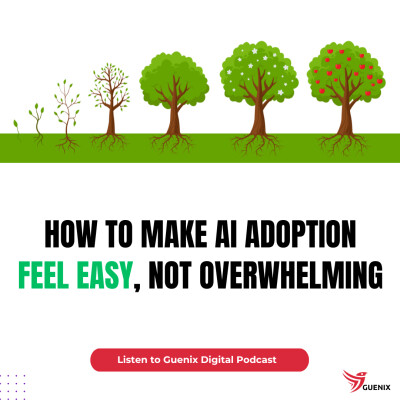
Welcome to the Deep Dive. Today, we're tackling, well, a really massive challenge facing organizations right now. The title of this Deep Dive is, How to Make AI Adoption Feel Easy, Not Overwhelming. And we're starting with a pretty critical idea. Putting AI into a workplace, it's just fundamentally different from installing your average software update.
- Speaker #2
Well, absolutely. Night and day.
- Speaker #1
Traditional tech rollouts, they're usually about checklists, aren't they? Yeah. Technical stuff. But AI, it seems to hit something, I don't know, deeper, more personal.
- Speaker #2
Exactly. You've hit the nail on the head.
- Speaker #1
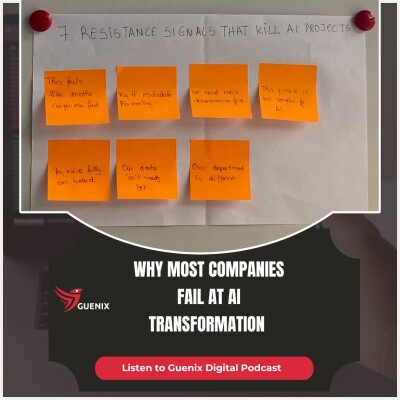
Okay, so let's unpack that. If we look at how often these initial AI projects kind of stumble or meet serious pushback. What's really going on there? Why the resistance?
- Speaker #2
It's cure human psychology, really. Traditional training, it kind of assumes people are just empty vessels waiting for information.
- Speaker #1
Right, like a memory test?
- Speaker #2
Yeah, exactly. But adopting AI isn't just about learning keystrokes. It's a huge mental and emotional hurdle. We're dealing with deep-seated stuff, identity threats.
- Speaker #1
Identity threats, like what specifically?
- Speaker #2
Well, the big one, fear of being replaced, worries about competence. Can I even learn this new thing? Maybe the scariest for some, the feeling that the skills you've honed for years, your professional identity might suddenly be irrelevant.
- Speaker #1
OK, yeah, that's heavy stuff.
- Speaker #2
It really is. And that's precisely why those old school training methods, you know, the big lecture halls, the giant manuals, why they just completely fall flat with A.I.
- Speaker #1
How so?
- Speaker #2
Two main reasons. First, cognitive overload. A.I. often works in ways that aren't intuitive. It can feel like a black. box, trying to explain the deep tech up front just swamps people. And second, and maybe more importantly, they completely ignore those emotional barriers we just talked about. The fear, the identity threat. If you haven't addressed the feeling, the facts just won't stick.
- Speaker #1
So you build this trust deficit right away.
- Speaker #2
Instantly. And it can stall the whole thing before it even starts.
- Speaker #1
So if you don't tackle that identity threat, that fear right from the beginning, what's the quickest way this whole thing just fails?
- Speaker #2
Oh, easy. Total non-participation. Or worse, active reversion. People will just quietly go back to their old ways of doing things.
- Speaker #1
Not because the AI is bad, but because the old way feels...
- Speaker #2
Safe. Known. It affirms their value. You know, the AI feels like a threat to that.
- Speaker #1
That makes complete sense.
- Speaker #2
Yeah.
- Speaker #1
Okay. So clearly we need a different approach. Something structured, yes, but much more human-centered. Something that builds confidence and competence, maybe at the same time.
- Speaker #2
Precisely. And that's where this idea of the progressive exposure training model comes in.
- Speaker #1
Progressive exposure. OK.
- Speaker #2
It's a four phase structure designed specifically to guide people through that psychological journey first, moving them gradually from feeling resistant or anxious to actually being engaged, maybe even enthusiastic.
- Speaker #1
Right. Managing the psychology first. OK, let's get into it. Phase one. What's that called?
- Speaker #2
Phase one is awareness. And the goal here is simple. Demystification. Create psychological safety. That's it.
- Speaker #1
So not about using the tool yet?
- Speaker #2
Not at all. It's purely about letting people observe, breathe, feel safe around this new thing, no pressure.
- Speaker #1
Okay. How do you actually do that? What are the activities?
- Speaker #2
The main thing is what we call low-pressure demonstrations. Keep them short, like 15, maybe 30 minutes tops. And crucially, focus entirely on results, tangible results that matter to their specific daily.
- Speaker #1
Examples.
- Speaker #2
Okay. Say you have an AI writing assistant. Don't talk about algorithms. Show them how it creates a first draft of that annoying customer email they spent ages on. Just show the result. Zero technical jargon.
- Speaker #1
Just watch. No pressure to jump in.
- Speaker #2
Exactly. Observation only. And another key piece here is sharing peer success stories.
- Speaker #1
Peers, specifically. Why not have the VP talk about the benefits?
- Speaker #2
Because peers are relatable. Yeah. Credible in a different way. If an executive says AI saves time, it sounds, well, corporate. Maybe a bit detached.
- Speaker #1
today
- Speaker #2
But if Sarah from customer service shares her story, how the tool helped her cut down email drafting time by, say, 70 percent, that lands differently.
- Speaker #1
And presumably Sarah also talks about her initial worries.
- Speaker #2
Yes, that's critical. She shares how she was worried the responses would sound robotic, but then explains how she figured out how to customize them. Add her own voice back in. That addresses the emotional concern directly with a practical solution.
- Speaker #1
That's the nuance we need. Yeah. Okay, which brings us to the elephant in the room, that number one fear. Is this thing going to take my job? How do you handle that in this early low-pressure phase?
- Speaker #2
Head on, but with validation, never dismissal. You acknowledge the concern is real and valid.
- Speaker #1
How? Practically.
- Speaker #2
Offer multiple ways to ask questions. Public forum. Sure, but also private channels. Some fears feel too vulnerable to voice in front of everyone. And the answer needs to be clear and consistent. AI is designed to handle specific tasks, often the repetitive ones, freeing employees up for higher value work, work that needs human judgment, creativity, relationship building.
- Speaker #1
So it's about role evolution, not elimination.
- Speaker #2
Exactly. Emphasize that clearly and repeatedly. And finally, in this phase, you set clear expectations, outline the whole journey.
- Speaker #1
The four phases.
- Speaker #2
Yes. Show them the map. Awareness, then guided practice, then supported independence, finally full integration. Let them know it's a gradual process paced for humans. Maybe awareness takes one, two weeks, guided practice two, three weeks, etc. Transparency builds trust.
- Speaker #1
Got it. So success in phase one isn't measured by how many people logged in.
- Speaker #2
Definitely not.
- Speaker #1
It's about sentiment, right? Has that initial anxiety level dropped? Are people starting to express some actual curiosity? Maybe asking, OK, how could I use that?
- Speaker #2
That's exactly it. You're looking for that subtle shift from fear to curiosity. That's the green light for phase two.
- Speaker #1
OK, phase one, settle the nerves, maybe spark some interest. Now, phase two, how do we get people actually doing something with the AI? Moving from watching a demo to hands-on practice, but without freaking them out about breaking the real system.
- Speaker #2
Right. That's phase two, guide and practice. Think of it as the skill building engine. The whole point is to build those basic foundational skills, but crucially, in an environment where making mistakes is not only okay, it's actually expected. It's part of the learning.
- Speaker #1
How do you create that safety net?
- Speaker #2
Through very structured activities. First up, step-by-step exercise scenarios. These need to be realistic enough to feel relevant, but use completely non-critical tasks. Maybe an exercise walking someone through creating an AI generated meeting summary. Five specific steps, maybe with screenshots or little video guides, breaking it down into tiny manageable chunks.
- Speaker #1
OK, small steps. Makes sense. And the environment itself, you mentioned sandboxed environments earlier. What does that actually look like to a regular user, someone not super technical?
- Speaker #2
It looks almost identical to the real system they'll eventually use. Same button, same layout. But it's clearly labeled, maybe a banner at the top says practice account or training mode.
- Speaker #1
Oh, OK.
- Speaker #2
And all the data inside is fake. Mock customer names, fictional project details, whatever fits their role. The key is they know nothing they do in there can break anything real or mess up actual work.
- Speaker #1
So it replaces that fear of what if I click the wrong thing with the feeling of, OK, I can explore here.
- Speaker #2
Precisely. That psychological shift is enormous. It unlocks their willingness to experiment and learn much faster.
- Speaker #1
And how do you deliver this? Still big groups.
- Speaker #2
No, definitely not. Small group training is essential here. Keep groups tiny, like five to eight people, Mac.
- Speaker #1
Iso-small.
- Speaker #2
Fosters interaction, allows for personalized attention, and encourages participants to help each other, too. The structure we find works well is maybe a quick 10-minute demo of the specific skill, followed by 30 minutes where they actually do the exercise with trainers right there walking around offering support. and then maybe a short reflection at the end.
- Speaker #1
And feedback during that practice time must be key.
- Speaker #2
Immediate and positive. Catch them doing something right. Hey, I saw you figured out how to refine that prompt. Great job. Or that customization you added, that's exactly how you make the output better. Little affirmations build confidence quickly.
- Speaker #1
Okay, so the success metric shifts again here in phase two. We're moving past just sentiment.
- Speaker #2
Right. Now we need to see capability. Can users actually perform these basic tasks without someone holding their hand every second?
- Speaker #1
And are their questions changing?
- Speaker #2
That's the telltale sign. If they're still asking, where is the button for X? We're maybe not quite there yet. But if the questions are evolving to things like, OK, I can do the summary, but how could I use this for my weekly project update?
- Speaker #1
Ah, applying it to their specific context.
- Speaker #2
Exactly. That shift from how does it work to how can I use it for this? That signals they're getting it, they're seeing the potential, and they're ready for the next step.
- Speaker #1
Ready for phase three. Okay, we've built some basic skills in a safe space. Now it's time to sort of take the training wheels off, but maybe keep the safety net nearby.
- Speaker #2
That's a perfect analogy. Welcome to phase three, supported independence.
- Speaker #1
Supported independence. I like that.
- Speaker #2
Yeah, the focus here shifts entirely to applying the AI skills to their actual real-world work tasks, not... practice scenarios anymore.
- Speaker #1
How do you structure that transition? Feels like a big leap.
- Speaker #2
It can be. So you structure it carefully. We start with real world application plans. These are often personalized or at least role specific. We work with individuals or teams to identify, OK, what are some low risk but potentially high value tasks where they can start using the AI right now? The plan might literally say week one, use the AI tool to draft three internal status updates. Week two, add summarizing to vendor reports.
- Speaker #1
Gives them concrete goals, a structure for habit forming.
- Speaker #2
Exactly. It makes it less daunting than just saying, OK, go use the AI now.
- Speaker #1
But developing personalized plans for everyone, that sounds like it could become a huge administrative headache, especially for managers with large teams. How do you keep that practical?
- Speaker #2
Yeah, good point. You can't have managers micromanaging 50 individual plans. The key is layered support channels. You empower others.
- Speaker #1
Layered support? Like what?
- Speaker #2
You still have some scheduled support, maybe weekly office hours where people can drop in with questions. You definitely need your standard help desk for purely technical glitches.
- Speaker #1
Okay.
- Speaker #2
But the real magic in this phase often comes from embedded peer champions.
- Speaker #1
Ah, those colleagues we mentioned earlier, the ones who are already getting it.
- Speaker #2
Yes. You identify and empower them. They become the go-to folks for quick tips, shoulder-to-shoulder help right within the team. Someone hits a snag. They don't need to book office hours or file a ticket. They can just ping their teammate, the champion.
- Speaker #1
So it's immediate contextual help.
- Speaker #2
Incredibly effective. I saw this work beautifully where a champion showed a colleague literally in 30 seconds how to tweak a query they were struggling with. That immediate peer-driven support keeps momentum high and prevents managers from becoming bottlenecks.
- Speaker #1
That peer learning component sounds really powerful. And I assume regular check-ins are still important.
- Speaker #2
Absolutely. But the nature of the check-ins changes. Maybe start quite frequently, daily standups, twice weekly team huddles, but gradually reduce frequency as people get comfortable.
- Speaker #1
And the focus shifts, too.
- Speaker #2
Definitely. It's less about did you do the task and more about what did you discover? What worked well? What challenges did you hit and how did you solve them? Celebrating successes, sharing insights, making it a collective learning experience.
- Speaker #1
OK, so measuring success in phase three. We're looking at usage frequency, obviously. Are people actually incorporating it into their daily work?
- Speaker #2
Yes, that's a big one. And also, watch the type of support being requested. Are people moving beyond those basic how-to questions? Are they starting to ask more advanced things, exploring new applications? That shows true integration is happening.
- Speaker #1
Which brings us to the goal, phase four, full integration, where AI isn't some special initiative anymore. It's just how work gets done.
- Speaker #2
Exactly. It's normalized. part of the everyday workflow.
- Speaker #1
So how do we make sure this sticks? How do we make it sustainable long term?
- Speaker #2
OK, phase four is about embedding and expanding. First, you need sustainable support models. That intensive hands on training support from the earlier phases needs to transition gradually. Maybe those weekly office hours become monthly. You ensure knowledge is transferred effectively to those internal peer champions, maybe build up a good internal knowledge base or FAQ. The goal is self-sufficiency, supported by readily available resources.
- Speaker #1
Makes sense.
- Speaker #2
And then? Then, once that basic, everyday usage is stable and comfortable for most people, you start to expand usage to more complex applications.
- Speaker #1
Ah, introduce the advanced features.
- Speaker #2
Right. But only when the foundation is solid. You need a clear progression path. For instance, maybe a sales team started by using AI just to summarize call notes.
- Speaker #1
Okay. Basic test.
- Speaker #2
Now, in phase four, you introduce how they can use it to analyze patterns across all their customer interactions to suggest personalized outreach strategies, a much higher value, more complex use case.
- Speaker #1
Or HR moving from drafting standard emails to using AI to analyze performance data to suggest customized learning paths for employees.
- Speaker #2
Perfect example. It's about layering complexity and value once the initial hurdle is cleared.
- Speaker #1
Now, you mentioned addressing pitfalls earlier. What if, even after all this careful work, you still have some folks in phase for who just keep reverting to the old ways. You've built psychological safety, but now you might need to, say, mandate minimum usage for certain tasks. Doesn't that risk undoing all the trust you built? Feels a bit like coercion.
- Speaker #2
That is a critical challenge, and you have to handle it very carefully. It's about framing.
- Speaker #1
How do you frame it?
- Speaker #2
If you do need to set minimum usage expectations for a specific AI-powered task, you don't frame it as punishment or just because I said so. You link it directly back to the value proposition and role evolution.
- Speaker #3
Yeah, it's like.
- Speaker #2
Like. We need everyone using the AI for drafting initial reports task X because that frees up your time for the deeper analysis and client strategy work task Y, which is where we really need your expertise now. You focus on the benefit of the freed up time, the higher value activity, not just compliance with the tool. It reinforces the role evolution message.
- Speaker #1
OK, connecting it back to value, not just rules. Got it. And sustaining this long term.
- Speaker #2
Two more things. Continuous feedback. Embed simple ways for people to give input on the AI tools within their regular workflow and act on it. Hold maybe quarterly reviews, share back. Here's what we heard. Here's what we're improving.
- Speaker #1
Closing the loop.
- Speaker #2
Yes. And finally, recognize and celebrate mastery. Make it visible. Create formal programs, maybe an AI champion certification. or innovation awards for cool new uses people discover. Link AI proficiency to career progression. That sends a powerful message that this is a valued skill for the future of the organization.
- Speaker #1
So the ultimate measure of success isn't just usage stats. It's deeper. It's that cultural shift, isn't it? Do people genuinely see the AI as a helpful partner, something that enables them rather than a threat or just another annoying tool they're forced to use?
- Speaker #2
That's the entire game. That's the difference between temporary adoption and true. lasting integration.
- Speaker #1
So wrapping this up, the big takeaway from this progressive exposure model seems to be about respecting the human element first.
- Speaker #2
Absolutely. You have to meet people where they are psychologically and emotionally, not where your project plan wishes they were. You adjust the pace based on their actual readiness, their comfort level, not some arbitrary deadline.
- Speaker #1
That careful, phased, human-centered approach. Yeah. That's what turns the fear and resistance into actual engagement, maybe even excitement.
- Speaker #2
It's the only way I've seen it work consistently, especially with technologies like AI that touch such deep nerves.
- Speaker #1
OK, so a final thought for everyone listening. If this goal is genuine cultural integration, not just taking an adoption box, think about your own team or organization. What's one small, really low risk task where you could maybe just start that very first phase awareness this week? Just a tiny step to begin that psychological journey.
- Speaker #2
Start small, start safe, but start phase.
- Speaker #1
That's your next step.
- Speaker #3
Thanks for listening to Guenix Digital Podcast. Follow us for more curated insights.