- Speaker #0
You're listening to Gueni Digital Podcast. We're bringing you insights on digital strategy, artificial intelligence, and the tools that drive performance.
- Speaker #1
Welcome back to the Deep Dive. Today, we're getting into something that honestly feels urgent for pretty much any small business owner out there.
- Speaker #0
It really is.
- Speaker #1
We're talking about why AI is the profit advantage small businesses are missing. And our goal here is to just... cut through all the noise, all the complexity.
- Speaker #2
Yeah, because this isn't some big, scary tech project.
- Speaker #1
Right.
- Speaker #2
Think about it like this. Right now, while you're maybe deciding if this is for you, your competition might have just, in effect, hired a team of 20.
- Speaker #1
A team of 20.
- Speaker #2
A team that costs next to nothing, never calls in sick, and works 24-7. That's what these AI tools are. It's not about trying to be Google. It's about solving those small, annoying, time-wasting problems that are dragging you down.
- Speaker #1
And. That's exactly our mission for this deep dive. We want to show you the practical, the affordable ways you can use these tools to get, you know, real results.
- Speaker #2
Tangible wins.
- Speaker #1
Tangible wins, exactly. Yeah. Like, we were looking at this plumbing company that set up a simple chatbot. It now captures 90% of their new leads by scheduling appointments while the owner is literally asleep.
- Speaker #2
And those were leads that just went to voicemail before. Lost money.
- Speaker #1
Lost money, now it's guaranteed revenue. Okay, let's unpack this. Where do we even begin?
- Speaker #2
The biggest mistake, and we see it all the time, is just overthinking it. People assume they need to, I don't know, hire some expensive consultant or understand complex algorithms.
- Speaker #1
And they get paralyzed.
- Speaker #2
They get paralyzed. Yeah. And they do nothing.
- Speaker #1
Right. It's like you don't need to know how the engine works to drive the car. But we should probably clarify the language a little. We hear AI, machine learning, automation. They all get thrown around.
- Speaker #2
They do.
- Speaker #1
For someone who just cares about their bottom line. What's the difference?
- Speaker #2
You can actually simplify it a lot. AI or artificial intelligence is just software that can, well, think and adapt. It's like an extra team member that can draft an email for you.
- Speaker #1
Okay, so that's the brain.
- Speaker #2
That's the brain. Then you have automation. That's the simplest place to start. It doesn't think. It just follows rules you give it. Like automatically sending a thank you email after someone buys something.
- Speaker #1
So automation is the grunt work, the simple repetitive stuff. Where does machine learning fit in?
- Speaker #2
Machine learning, or ML, is the part that connects the docs. It's AI that gets smarter. It learns from your data over time.
- Speaker #1
So it improves itself.
- Speaker #2
Exactly. Automation sends the email, but ML is what looks at the results and makes sure your next batch of emails has, say, a 10% better subject line. It's like an employee who gets better with experience.
- Speaker #1
That makes so much more sense. Yeah. Okay. Let's talk about reality versus the hype. What is AI not good at? Because the last thing a small business owner needs... is another headache?
- Speaker #2
That's a great question. It's fantastic for anything repetitive, anything that follows a pattern, but it really, really struggles with human judgment, emotional stuff.
- Speaker #1
Empathy.
- Speaker #2
Empathy, complex problem solving. AI can write a draft for your newsletter, but you, the human, should always be the one handling a really sensitive customer complaint.
- Speaker #1
And I've heard this over and over. The quality of your data matters a lot.
- Speaker #2
It's everything. Messy records are going to give you poor results. You know, garbage in, garbage out. The AI is a great engine, but you have to give it good fuel.
- Speaker #1
But hold on. That's a huge barrier, isn't it? If my records are a mess, which let's be honest, it's true for a lot of small businesses. Does that mean I'm just blocked? I have to spend six months cleaning up my CRM before I can even start?
- Speaker #2
Not at all. And that's the key. You start with automation. Automation just needs simple rules. It doesn't need perfect historical data. And you pick tools that create clean data from this point forward. A simple chatbot, for instance, creates a perfect, structured transcript of every customer chat. It's a clean data you can use later. Don't let perfection be the enemy of profit.
- Speaker #1
Let's talk about that profit. Give us a real-world example, a case study.
- Speaker #2
Okay, let's look at Café Lumiere. It's a small restaurant in San Francisco. Their problem wasn't the food. It was just managing tables and wait times. A total bottleneck.
- Speaker #1
I can picture it. The clipboard, the frustrated customers waiting outside.
- Speaker #2
Exactly that. So they got this AI tool called Hosti. It managed all their reservations, it optimized seating, and it would text people on the waitlist automatically when a table was ready. The tool cost them $199 a month.
- Speaker #1
So less than $200. What was the actual impact?
- Speaker #2
In three months, their monthly revenue went up by 23%.
- Speaker #1
23%?
- Speaker #2
Yeah. They were serving 13 more customers every single day, and they cut wait times in half. All told, it brought in an extra $28,900 a month. And what's fascinating here is this wasn't some super complex AI. It was a simple tool solving one critical problem they just didn't have the time to fix manually.
- Speaker #1
So $28,900 a month from $190 tool, the return on investment is just astronomical. How can someone listening apply that same ROI thinking?
- Speaker #2
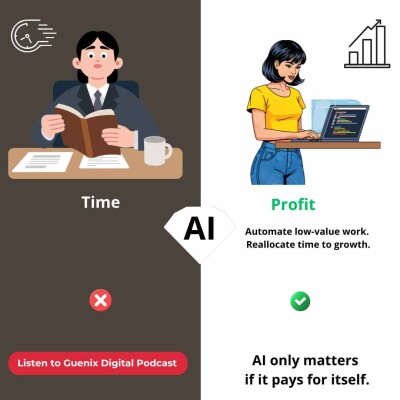
It's simple math, really. First, figure out what your time is worth. If you want to make $100,000 a year, your time is about $50 an hour. Now, if that $199 tool saves you, let's say, five hours a week, you're saving $1,000 a month in your own time for $199 cost. That's a 500% ROI. You're not buying software. You're buying back your own time.
- Speaker #1
And we know that time is just being squandered. I saw a stat that small business owners spend, what, something like 40% of their time on manual tasks?
- Speaker #2
40%. In a 50-hour week, that's 20 hours. 20 hours you're not spending on growing your business. It all starts with what we call the automation audit.
- Speaker #1
Okay, how do you do an audit without it becoming another time-wasting task?
- Speaker #2
You just look for the patterns. What are the things you do the exact same way every single time? The work that takes up time but doesn't require any, you know, deep thinking.
- Speaker #1
Like responding to the same customer questions over and over.
- Speaker #2
Exactly. Answering emails, moving data from a spreadsheet to your CRM, scheduling, creating invoices. Those are the prime candidates.
- Speaker #1
Let's get really tactical. What are some quick wins? Automation someone could set up like this week.
- Speaker #2
I'd say there are three easy layers to start with. First, email marketing. Set up a simple welcome series for new subscribers that's built into almost any platform.
- Speaker #1
Okay, that's one.
- Speaker #2
Second, social media. Stop posting in real time. Write all your posts for the week on a Monday and use a scheduling tool to push them out.
- Speaker #1
Set it and forget it.
- Speaker #2
Right. And third, invoices. If you use something like Stripe or Square, turn on the automatic invoicing and payment reminders. It's usually just a checkbox.
- Speaker #1
And once you have those little wins, you start connecting them, right? That seems to be where the real freedom comes from.
- Speaker #2
That's the next level. Workflow automation. You use tools like. Zapier is a common one that act like digital glue between your different apps.
- Speaker #1
Give me an example. How does that work in practice?
- Speaker #2
Okay, so a potential customer fills out the contact form on your website.
- Speaker #1
Right now I get an email, I have to copy their info, put in my CRM, then write a follow-up.
- Speaker #2
Stop. The automated workflow does all of that instantly. The form submission automatically creates a contact in your CRM. It can send you a text alert and it can trigger that welcome email sequence we just talked about.
- Speaker #1
All at once. No more manual data entry.
- Speaker #2
None. You just eliminated a whole chain of boring, repetitive tasks.
- Speaker #1
That's huge. Let's shift to marketing. You said earlier AI moves marketing from shooting arrows in the dark to laser sight precision. How?
- Speaker #2
Well, for one, content creation at a scale that's just impossible for a small team. AI can help write blog posts, ad copy, product descriptions, all in your specific brand voice.
- Speaker #1
And it learns from what works.
- Speaker #2
It learns from what works. It can analyze your... best performing email subject lines and apply those winning elements to all your future content. But it's really the targeting where it gets incredible.
- Speaker #1
You're talking about finding the right people to show that content to.
- Speaker #2
Precisely. Through something called lookalike audiences, AI can analyze, say, your top 100 customers and then go find 10,000 new people online with almost identical behaviors and buying patterns.
- Speaker #1
So you're not guessing anymore?
- Speaker #2
No more guessing. And it optimizes your ad spend in real time. If an ad is doing great with women h 25, 35 in the morning, but terribly at night, the AI just shifts the budget automatically. You don't have to do a thing.
- Speaker #1
That optimization happening at three in the morning, that's the 24-17 we mentioned. And that same idea applies to customer service, too.
- Speaker #2
It's a complete revolution for customer service. People expect instant answers now. An AI chatbot can handle all the routine stuff 24-7.
- Speaker #1
What's the routine stuff AI should handle?
- Speaker #2
Your hours, your location, pricing, your return policy. Where's my order? all the high volume factual questions that frees up your human team to focus on what humans are best at, which is judgment, empathy, solving complex problems, you know, handling the angry customer who needs a creative solution, not a link to the FAQ page. That's the human AI balance.
- Speaker #1
Let's talk data. There's that saying that most businesses are drowning in numbers, but spouting for answers.
- Speaker #2
And AI is the bridge. It gives you predictive power. It moves you from asking what happened last month to asking What's likely to happen next month if things keep going this way?
- Speaker #1
The inventory example is perfect for this. It has a direct impact on cash flow.
- Speaker #2
Totally. Normally, you reorder when you see you're running low, but AI predicts demand. It looks at your sales history, seasonality, even local events, and tells you what you'll need before you need it.
- Speaker #1
So no more costly stockouts, but also no more money tied up in stuff that's just sitting on a shelf.
- Speaker #2
Exactly. You carry the right amount of the right product at the right time.
- Speaker #1
And it reveals what customers actually do, not just what they say they'll do. Here's where it gets really interesting.
- Speaker #2
Oh, yeah. This data can change your whole strategy. AI might find that customers... who buy on a Saturday spend 40% more, or that people who open your newsletter are three times more likely to buy again.
- Speaker #1
So you can double down on what's working.
- Speaker #2
You can tailor your marketing spend directly to your most profitable customers.
- Speaker #1
Okay, this is a lot. It sounds like a fundamental shift. For anyone listening right now who's feeling a bit overwhelmed, let's end with a practical 90-day roadmap. Where do we start tomorrow?
- Speaker #2
It's a crawl, walk, run approach. Phase one, the first 30 days, is your foundation. Audit your time and pick one simple, low-cost tool. Set a budget of like $50 to $150 a month and just track the time it saves you.
- Speaker #1
Just one tool. That's manageable. Then phase two, days 31 to 60.
- Speaker #2
That's automation. You add a second tool that complements the first one, like a social media scheduler, and you focus on making them talk to each other.
- Speaker #1
Get that workflow going. And the final phase, days 61 to 90.
- Speaker #2
Optimization. Now you measure your total ROI time saved, revenue gained. and you start training your team. The key is to frame it as a partner that gets rid of boring work, not as a threat to their job.
- Speaker #1
So the big takeaway here is pretty clear. If you just adopt one of these tools, you are already way ahead of most other small business owners who are still guessing and doing everything manually.
- Speaker #2
You are. The tools are affordable. The knowledge is there. This raises an important question, really. Your competitors are hoping you'll wait for the perfect tool or the perfect time, but your future self is hoping you'll just take that first small step.
- Speaker #1
Because the businesses that win in the next few years won't be the ones with the most staff. They'll be the ones that make smarter decisions faster. And AI gives you that power today.
- Speaker #0
It's right there for the taking.
- Speaker #1
That's it for this deep dive. We'll catch you next time.
- Speaker #0
Thanks for listening to Guenix Digital Podcast. Follow us for more curated insights.