- Speaker #0
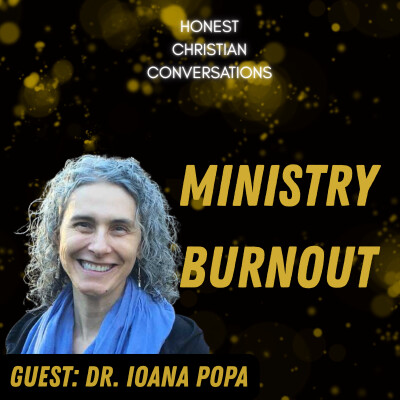
Your pastor is not superhuman. They have stresses. They have griefs of their own, not to mention the things that they help their congregations with. But who helps them when they are going through their struggles? What if your church isn't equipped to help your pastor through this burnout? Well, my guest today is Dr. Ioana Polpa, and she is a beautiful woman with an absolutely wonderful ministry. that started out of her own burnout. She learned how to work with her body, mind, and soul and get everything aligned and fully focused on Christ. This is going to be a very uplifting and encouraging message. And if you know anyone who is going through burnout, who is in some sort of ministry work, please have them listen to this episode. I'm Anna Murby. This is Honest Christian Conversations. If this is your first time listening to the podcast, thank you for spending your time with me today. For all returning listeners, I'm glad you're back. After the episode, please leave a review for the podcast if you haven't already done so. If you have, thanks so much. I appreciate reading your encouraging comments. They help me improve the content for you all. Thanks for your support. God bless and enjoy the show.
- Speaker #1
Hello, Ioana.
- Speaker #0
How are you today?
- Speaker #1
I'm doing great. How Ray, your owner.
- Speaker #0
I'm very good. Thank you for coming on the podcast. I read on your Podmatch profile about what it is that you do, and I thought that it was a beautiful ministry that is definitely needed. There's a lot of believers out there, especially pastors and leaders in the church who are feeling really burnt out, feeling exhausted, all the work that they do there. They've got a lot on their plate. that's putting it lightly. And they need people to come alongside them to minister to them. I think sometimes we forget that they're humans as well. We put them on this high pedestal that they don't even want to be put on, but we put them on such a high pedestal and somehow think that they're superhuman, that they can handle the job that they're in. But they're human too, and they have needs, and they go through struggles, and they need... people to come alongside them. And I love that that's what you do. So before we actually talk about what it is that you do, why don't you share with us how you got into your ministry work?
- Speaker #1
It has been a long and twisted journey. I started as a physician psychiatrist and I trained, I did my medical school in Romania and then my psychiatry residency here in the United States. And I worked in the trenches, you know, helping people with mental health. issues in all sorts of settings. And what I've discovered, there were some patterns. As a believer, I've noticed there were some patterns. Of course, as a psychiatrist, I could not impose my beliefs and talk about my faith way back then. It was not even cool to have a cross or whatever. But nonetheless, there was a sense of bringing God's presence. And what I was always struck by, the light that every person, every human being has inside. And people might use different languages in expressing their inner experiences, but the makeup in terms of the inner workings, the way the thoughts are working, the emotions and will and motivation and so on and so forth, they're very similar to how God created us. And out of that, though, my journey was initially working through, obviously, medical school, tending to the body, and then in a psychiatry residency and practice, tending to the mind and the emotions. And there was always something that was missing. And I wanted to bring more also the soul, the spirit into the conversations. In 2016, I was also trained as a life coach, life and leadership coach. And I was really drawn to study my faith as a Christian. I'm an Eastern Christian Orthodox. And my faith goes all the way back to Christ. It was interesting theological underpinnings. And I wanted to study that. So I did my master in theological studies. And I was so... touched by the convergence. God is truly everywhere if we think of things. And we can understand God's laws in this universe. The same way we understand physics and chemistry. We can understand how emotions are working in thoughts. And so I really worked through underlining and aligning for myself, you know, and what I'm doing, body, mind, heart, and soul. And lo and behold, I burn out because what I've noticed as a Christian, that's the kind of the ethos that you hear? Well, you just pray. You just pray and God takes care of you and just move forward, give like Christ, right, God? It sounds as if Christ just kept constantly giving. So he did pause. We kind of missed that. And there's another Bible verse that I'll reference that we miss. But nonetheless, I burn out because just by giving and giving and, you know, the better one becomes, the more people are going to seek you out. You're going to have more projects to do, more people to care. And eventually we reach a capacity. We forget that we're imperfect. And, you know, I burn out not because of a lack of... skills or knowledge because I'm in the field, but because it comes really in a hidden way with no bells and whistles. So when I've noticed one time, okay, one time there's one thing, but this happened the second time. Well, that was a really wake up call. It's really insidious. And I've really wanted to help others not to go in my footsteps. And when I needed help, I either found secular help or just virtual Christian help, but nothing. truly integrated to the degree that I knew, you know, including the medical knowledge, the psychological knowledge and whatever. So I like, okay, God, I'm going to start complaining. Just start helping others doing it. So that brought me to where I am today.
- Speaker #0
Burnout is a serious thing. And I don't think people understand just how serious it can be in every aspect of our life. Like you said, you... could only find help that would help in one area, but it never was cohesive enough to be every aspect that you needed. And that is important. We need to be whole beings. We need to be healthy, whole beings. And you can't be that if you have no idea how to find that help. And that's where some people get sucked into things that aren't good for them because they're trying to find a way to fill those spaces that they're missing. It seems like your ministry has unlocked the secrets, I guess, to understanding how to do it from all angles so people don't have to strive for things that aren't healthy to take care of the burnout, the stress, anxieties that they're feeling. They can come to you and they can find that health, that whole health that they need. So what is it that Team for the Soul does?
- Speaker #1
We started with my husband. He's a chaplain. We started Team for the Soul in 2019, and we wanted to really help Christians and clients in all sorts of ways. And in time, the Holy Spirit really narrowed down. Initially, we're helping everyone, and then God really is not that we don't love all people. I mean, both my husband and I, we're just in, we've been in secular worlds when you really get to love everyone, no matter their beliefs, no matter where they're coming from. But he just felt a call that Christians in particular are prone to burnout because they do try to follow Christ. And many times it feels like self-care is something very selfish. So many Christians actually avoid that. So we felt the call to really narrow down to Christians. So at Team for the Soul, we really help at this point Christian professionals and servant leaders. And we're trying to help them in several ways, which might seem different, but they all actually are very congruent. Most of to achieve the highest potential in Christ, it's very important to remove the blocks. Many of these blocks are tucked in into subconscious, into our past and our memory. We think, oh, we've dealt with that. Let me move on. And actually burnout is one of the things that can block us in ministry. And also grief, it's another thing that if we don't address it, it can also pull the brakes, so to speak, in our ministry. And both my husband and I, when we did a training on grief recovery method, we were mind blown because it's a very short training and actually experience for everyone who wants to move through grief. It only takes six to seven to eight sessions or eight sessions, depending on the situation and actually complete communications. So overall at Team for the Soul, I've tried to pull all the different psychological methodologies that can help in the fastest way so that Christian professionals can actually fulfill their vocation and do what they're called and keep giving and keep serving. And through that, I've developed a couple of methodologies. One of them is the Renewal in Action. how to regenerate body, mind, heart, and soul throughout the day. So we don't have to actually wait for the weekend or for... or any vacation because by that time it's too late. The other thing that I do, I do a lot of speaking. I lead retreats. I just came out of a retreat recently where I have an organization actually to focus on their mission, how to really think of their godly mission and how to implement it into goals. You know, otherwise it feels almost like we're business-like, but where is God into all this and how to use. also personality assessments to understand the team members and how to think of renewal together as an organization. So I like to do all sorts of retreats and workshops and speak, but everything that we're doing, we're doing for God. I really consider Team for the Soul, it's God's business, not my business. And we're here to support in all different ways.
- Speaker #0
Do you have a hard time helping people in the sense that do you still feel any burnout while you're helping other people with their burnout? Have you ever felt that way? Like it just got out of hand, maybe like in the beginning stages while you were trying to figure out how I'm going to do this. Did you ever feel like maybe you were getting burnout? Perhaps God just saying, you know, let's try to fix this. Maybe you needed help. Did you... feel any sort of stress, anxiety while you were putting this together?
- Speaker #1
The burnout happened before. And I would say, I think your question has a few layers here. One, am I getting burnout as I'm listening to other people's burnout or suffering? And I would say I'm very blessed because in our training as a psychiatrist, we were taught how to not, how to allow that to be processed without taking it in. Okay. Yeah.
- Speaker #0
I've always wondered that about psychologists, how do you not internalize everything that everyone's telling you? Okay. Absolutely.
- Speaker #1
Yeah. No, there's trainings. It depends on the training, but there's a big, important step around that. And we had preceptors and supervisors. I was meeting with people like three, four times a week. They really supported us to make sure we metabolize this and do not take it in. So for me as a Christian, I almost felt like a conduit. I'm not taking it and I'm giving it to God. So once you're trained, but the other piece, important piece to this is actually so essential for any Christian, especially in ministries, is when we do our inner work. This is where any pain that someone else has doesn't stick because there's a difference between empathy and compassion. Psychological research is showing that empathy means I'm feeling the other person's feelings, which can trigger my own past. Right. So then I am consumed not just because of the other person, but I'm consumed because of myself. So this is why many people do burnout, because they don't have their own inner workings resolved, so to speak. They haven't done work either in coaching or counseling or therapy. And then it resonates, it vibrates inside, and all these hurts are still as if they're happening. And that's what brings burnout. Once you do the inner work and you release your own rocks, so to speak, from the backpack, then you really can be compassionate. So that compassion doesn't, how do I say this, doesn't burden oneself. It's almost like different brain centers is something completely different and you can be with without being in. I mean, you're in and with, but not taking the burdens. You can really release them to God. So it's the key here is to do the inner work. And the other layer of a question you had was, has this happened while I was doing the program? I think it's happened before. And once I developed the methodology, actually what prompted me was COVID. I had some friends and we're all, you know, it was so amazing and striking, amazing in like. wow, what just happened? Some people were frontline and some people were stuck at home. My husband was frontline and all of a sudden I'm home. I'm loving it home. You know, being home was not fun for me. I didn't miss anything. It was all good. You know, I have, I have place to walk. I have trees around. So it wasn't traumatic for me, but I realized that that's not the case for most people and especially for frontline. So I felt the call by God. Really, I must have been in May 2020 to like, God, how do I help? I know I can help. And one friend really encouraged me, please, please, we need something. He was a physician on the front line with a burnout. So when I started, I started the Renewal in Action program in 20, by the end of 2020, 2021. And then I've applied the principles for me. So now I don't burn out. I don't burn out for two things, reasons. One is that empathy that you mentioned or... picking up someone else's hurt, which I've explained. But the other reason I think ministry leaders are burning out because they just do too much. The better one becomes in ministry, the more you're going to be sought out, the more balls in the air you're going to have. And that's my reasons for burning out. So because I'm using the Reliant Action, which is this blueprint with flexible enough to adjust no matter the season, but it's also structured. Set it up in the first few weeks and then you train the subconscious and it happens automatically. So now if I get off the wagon, so to speak, from regenerating, I know quickly how and when to restart and how to do it because of this blueprint. So, you know, I feel, oh, I'm getting close, but I'm never get close because I'm implementing again. I'm fine tuning the renewal blueprint and then coming right back. So that's the. joy of using this blueprint and what I've noticed in my students and clients, it gives that resilience and is not another thing to do on the to-do list. Yes, initially when you set it up, but then once you got it down, it happens so quickly. You know what to shift to align between body, mind, heart, and soul, morning, midday, afternoon, and night.
- Speaker #0
Hey friends. I wanted to tell you about my personal experience with Exodus Strong. If you aren't sure what it's about, it's a biblical and holistic supplement that has seven herbs and that's it. This is an amazing product. Since I have been taking it, I have not felt anger towards my children or my husband nearly as much as I used to. The anger fits are practically gone. Hallelujah. I know my family is singing those praises. feel like a completely different woman. I feel more relaxed, more even-keeled. I'm sleeping better. I'm feeling more focused, which is great because I'm learning a second language. And I just overall feel like a better person than I did before when I was full of my anger. And I am so excited to share this with you. The prayer guide that comes along with it is also a blessing that keeps you close to God. I feel more close to God. since I have been more regulated in my emotional state. If you need help focusing, if you need help with your stress levels, if you need help with your blood sugar levels, this product is going to be great for you. I encourage you to check it out. The link will be in the show notes. And if you want to know more about the founder of Exodus Strong, go back and listen to the episode that I did for the podcast with Rob Rene. You are going to be so blessed. That's awesome. Our brains are very capable of doing so much more than we give it credit for. And I love that how you say you just you kind of train your brain just like you do with anything else. That's all it is, is retraining what we've learned. I'm sure there's a lot of people out there who have learned unhealthy coping mechanisms when they're feeling burnout. And then, like you said, you have to sometimes you have to go back. and fix what happened in the younger years, the childhood years. You've got to figure that out because that can aid in why you have burnout, why you have grief, why you're dealing with things. And maybe you thought you fixed it because you're just not thinking about it as much. But somewhere in your brain, you're thinking about it because our brains are so much more capable than we give it credit for that we may not actually be thinking about it. But somewhere in the back of our minds, Maybe a situation that a pastor or a leader is dealing with triggers that. And they didn't think that it was going to do anything to them, but it is. And this is so important work that you were doing. And you mentioned COVID, which seems to have done a lot of good despite all the bad that happened. I have heard many positive stories that have come out during that time. And this is just another one. This is, you have such a heart. for helping and that you saw that there was a need and you wanted to fill it. And I believe God has helped you fill it in a beautiful way because there are so many churches that are hurting. There are so many pastors that are struggling right now. And they need help. They just, they need help. They may not think they do, but they do. They have a lot of things going on. They're counseling. They're preparing sermons. They have their families. They have spiritual warfare if they're preaching the truth. And Satan's not going to be happy with that. So they're getting bombarded from all different angles. And where's the help for them? unfortunate that there's a lot of churches out there that can't provide this kind of help. But it is a godsend that you are able to do that, that they have an avenue that they can go to.
- Speaker #1
Yeah, amen to that. And glory to God. It is God. I totally believe that. And it starts with our intentions, intentions of our heart. And I am really touched by... by all Christians. Like, I don't want people to go through this. And mind you, as mentioned, I'm in the field. I'm in the field and it happened to me. How much more can happen? And listen, no one is going to post this on Facebook or Instagram. Oh yeah, I'm burned out, right? Everyone who's just the happy, all the happy fans are doing well, which makes us feel even more isolated. Oh my goodness, it's happening to me. That means I'm doing something wrong. Everyone else is happy and smiling. And one of the things that I've noticed with the Renewal in Action, some people are so busy, some Christians, that they don't even have time to put aside a few weeks to develop this renewal blueprint. And that became very clear. I work with a school and they did my program. And that was the feedback. I said, we want to do it. It's just impossible, you know, because there's so many demands. And by the time they are done, the only thing they want is just to sleep. And even that is not. fully a full night's sleep. So this happened last year and I realized that what they really need is just a daily inspiration that can bring them back to Christ. Not just at the mind level, because most of the times when we think of prayers or we read the scripture, we actually invite the mind. So the mind gets over busy, but the mind itself is not the awareness. We have beyond our thoughts, beyond our emotions. have awareness, which actually is a space in between where naturally we can rest in God. When the living waters are coming and overflowing, that peace that surpasses all understanding is there, is not in the mind. The mind is too busy and it needs to relax. So we're overusing our mind. And one other thing that it's so essential is that we also pause in silence. So if listening Get into the practice of staying in silence and trying to encounter God in that space, not just with your minds, not just with words, which are wonderful, but to really connect. Connect, of course, with your emotions as well. So based on that feedback, I actually developed a program. It's called Wake Up to Your Soul, where I have daily inspirations with a bit of science and psychology, Bible verse, a contemplative practice, and a journaling prompt all in 10 minutes. And every day, every day of the week has a theme. So we move through that so we can start with intention and we rewire our mind in terms of our mindsets and take care of our emotions and our body and relationships. And I found that that is, for some people, that is what they need and they only have time for. Just 10 minutes in the morning. I cannot do anything more because just go downhill. And even if you don't have time to enroll in the program, just spend some time in silence. Think about that. So the questions they ask. Obviously, for your regeneration mind, think about prayer and scripture, conversing with God with words. Think about emotions. How is my heart doing? What are my emotions? Can I connect with God? Think of your body. Obviously, your body needs. We many times think about that, but also spiritual connection in that silence. Spend a few minutes. Put a timer to stay in silence. It can do wonders in time. You know, small steps every day.
- Speaker #0
Yeah, these are important. things. And you mentioned silence, which is so difficult to do for anybody. And it is very important, though. And I think we need to try harder to make time for silence. I know I do. It is not easy, but it is a necessity. Like you said, we're overworking our brains. We need to relax them now and then. They're not going to be as healthy as they will be. If you don't, it would be the same as a car. If you never put oil in it, eventually it's going to stop working. And that's what we have to do. Yeah.
- Speaker #1
I'm curious when you said that it's hard to do and stay in silence. What has been your experience or other people that you encounter? Like what makes it so hard to sit in silence?
- Speaker #0
Well, as a mom of five, my brain's constantly moving around thinking of my children, the things I got to do, the things I'm not doing, the things I could have done better and just focused on things that probably don't need as much attention at that moment. I don't know if it's just my personality, but some things I just can't stop thinking about. And sometimes, not always, but every once in a while, I'll be awake at night thinking of things. And then I'll have to leave myself a note so that I can finally go to bed. But I just, it doesn't happen all the time, but every once in a while, it'll happen at night. And yes, sometimes, especially moms, I think we're focused too much on things that. I guess we think are necessary, but if you actually took a step back, maybe were silent about it, would it really be something that needs to be thought of at that moment? Probably not.
- Speaker #1
Yeah. Thank you for that. Yeah. It makes sense to me, the thinking, right? And what are people that are dear to us and we want to do the best for them. And yeah, it makes a lot of sense.
- Speaker #0
So when you do these retreats, where do you do them? And are they usually like a weekend type of retreat, a week retreat? How do you do them?
- Speaker #1
I'm usually invited. So I go to whatever it is, the parish or the organization that is wanted to organize that. Sometimes it's in a retreat center, sometimes it's in a church or whatever other settings. I would say usually weekends are working for people. I've noticed Saturdays, sometimes Fridays are a good day for retreats. And I usually do them for one day. Definitely, I could do them for longer, but I've noticed the bandwidth usually is for about a day. Yeah. Okay, we're done.
- Speaker #0
Yep, yep. That makes sense.
- Speaker #1
We do three or four sessions in a day, and that feels full.
- Speaker #0
Yeah. Okay.
- Speaker #1
But I've done retreats. in sequence for in the same place, you know, we do some series and that's also possible. Yeah.
- Speaker #0
Okay. What is your podcast about?
- Speaker #1
Yes. Thriving in Christ show. It's on YouTube and podcast. So I, it's for Christian women professionals and servant leaders. And I help, the idea is how to develop holistic habits. that will propel us in the future, how to regenerate on the go about alignment, body, mind, heart, and soul. And I have now an episode where I invite someone for renewal conversations. Usually it might be someone that is in a ministry and wants to give or maybe talk about their regeneration or someone who is in a professional field and can bring some tips around renewal and care in a Christian way. And I also do a lot of teaching there. So I talk about regeneration, as I said, body, mind, heart, and soul habits. I have different series. Right now I'm in the middle of a series on internal family systems, bringing that in Christianity. So different topics, how to regenerate on the go. I have a series for... Christian professionals. So all sorts of combinations, but the idea is to serve the Christian women professionals, servant leaders. Although there are men who told me, oh, I'm listening to your podcast. It's not necessarily excluded, obviously, but it's all around these topics of how do we regenerate? How do we stay aligned, body, mind, heart, and soul? How do we... really achieve our highest potential? How do we understand our mind, our thoughts, our emotions? And I like to bridge science psychology with our Christian faith and good practices that people can take away and try as they go about their day.
- Speaker #0
So it would be like a trial run of what you do with your ministry work, I guess, like to give an example of what you would do if they were a client of yours, I guess. Yes and no, in a certain sense. I talk about my programs there as well. That in itself, it's a ministry, the YouTube and the podcast. So trying to bring practical tips for how to regenerate, how to stay. Yes, it is in a certain sense, a little bit of a sample. Of course, I go much more deeper in a different way, but also to answer questions that people might have.
- Speaker #1
Yeah. No, I was just thinking, because if someone wanted to. like a pastor or someone wanted to get an idea of what it is that you do, maybe listening to the podcast might give them a slight idea of this is what you can expect. That's pretty much where I was going with that, wondering if that's how it would be.
- Speaker #0
Absolutely. Absolutely. Yes. You'll get me. And especially some people say, no, I love to see you on YouTube because they get to see me, they get to see my personality. Absolutely. And the podcast as well. It's on Spotify and Apple and many other places that I don't even know.
- Speaker #1
That's awesome. Well, this has been a very encouraging conversation. And I love what you do. I think it's beautiful. It's heartfelt. It's definitely necessary. And I know there's people listening who... could benefit from listening to your podcast, whether they're a professional or not. I'm sure there's something there that God has for them. But if they want to get involved and become one of your students, they want to learn these skills, where would they go to get that information?
- Speaker #0
Great question. So teamforthesoul.com is our website. And on the website, you can see some of the programs that we offer. You can sign up for the Wake Up to Your Soul on the spot. You can try it for a week for a few dollars to see if that is something that you would like and you can continue. And for the Renewal in Action, there is a wait list right now. And you can sign up for that. There is a place to set up an inquiry call, like if you want to learn more about what I do. I do also one-to-one coaching. I do executive coaching. So there's... I'm also on social media, on LinkedIn, Facebook, and Instagram, but the website, teamforthesoul.com.
- Speaker #1
All right. Sounds wonderful. Thank you again so much for coming on, for doing this work and being obedient to the call that God has for your life. And everyone who's listening, if you feel this is necessary for your pastor, maybe you are a pastor listening and you feel like you could use this. Maybe you're... just someone who's serving in the church somehow, serving in some capacity, and you feel you need this kind of help, reach out. You aren't alone. There's no reason for you to feel alone and feel ashamed about this. We all get burnt out. I'm a mom. I get burnt out. Everyone gets burnt out at some point. We aren't superhuman. So get the help you need so that you can be the best version of yourself that God has created you to be. Thank you again for coming on.
- Speaker #0
Thank you so much, Anna. And thank you as a listener, sending you many blessings, many prayers. Know indeed you are not alone. And do seek help and seek guidance from God first and foremost. God is with you. God loves you. And in time, things will unfold for the best. So God bless you.
- Speaker #1
Yep. Amen.
- Speaker #0
Amen.
- Speaker #1
Friends. Did you enjoy the episode? I'm so glad to hear it. Leave a five-star review on Apple Podcasts, Spotify, or my website, honestchristianconversations.com. Your reviews help boost the podcast in the ratings. So let's make these honest conversations more accessible to those who need them. Be sure to follow the show so you never miss another episode. And while you're doing that, why not share the podcast with someone? Thank you for spending time with me today. I look forward to our next conversation.