- Speaker #0
As long as you have a strong vision and the courage and passion to move on it, you can be the change, you can be the future, you can impact system change in whatever community, everywhere in the world. And what we have done in Egypt is obviously also doable everywhere else.
- Speaker #1
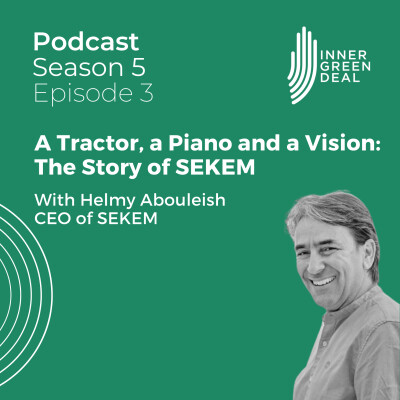
Welcome back to the In a Green Deal podcast with me, Tamsin Walker. As you likely now know, in this season, we're looking more closely at the role of inner development in the work of NGOs and impact organizations. And that at a time when many are facing deep uncertainty. And while there might be an instinct at such times to do more, could it also be an opportunity to invest in inner development as a way of staying grounded and building the trust and collaboration needed for deeper systemic change? Last month, I spoke to Davin Hutchins of Greenpeace International, who gave us an insight into how inner development can help activists to remain resilient. This time, we're exploring how inner development shapes systemic impact. And joining me to talk about this is Helmi Aboulaesh. He's CEO of Sekem, an Egyptian organization that translates to Vitality from the Sun. Set up by his father, who moved the family from Austria to Egypt in the 1970s to launch his visionary project, Sekem promotes sustainable development in ecology, economy, societal and cultural life. What started as a dream in a desert is now a vibrant community that employs more than 2,000 people and supports over 40,000 farmers. It also runs educational. medical and arts facilities and has received numerous international prizes, including the Right Livelihood Award. Welcome Helmi, it's a pleasure to have you on the podcast.
- Speaker #0
I'm very happy to be here at this time.
- Speaker #1
Yeah, let's get started. So the first question, this is the Inner Green Deal podcast, so I'd like to begin by asking something that everybody in this season is being asked, which is how you define inner development. and what it means to you personally?
- Speaker #0
Inner development is this strive to continuously develop our consciousness and our capacity. As human beings, we need to work on ourselves, our inner capacity, whether it's thinking, feeling, or our ability to do and really implement what we are convinced with.
- Speaker #1
Okay, well, thank you for that to get us going. So Sekem was started by your father in 1977, who moved to Egypt to green the desert, which is quite a big ambition. And again, if I have understood correctly, he was starting with a real kind of blank canvas of what looked to be pretty barren land.
- Speaker #0
Exactly right. So he started by intention in the desert to create this model for... system change, Sekem, as he called it, out of nothing so that he could have more freedom to design it and to shape it in the way which then would be what Sekem is today. And the starting in the desert gives you all this freedom and opportunity because there is barely nothing. And I can tell you that when he started in 1977, 48 years ago, it seemed really a mission impossible and I had seen a crazy idea to go for organic and biodynamic farming in the desert and to go for economy of love in the economic sphere and to go for a focus on human development and capacity building in regards to building an intentional community. The reason why we are talking today is that this miracle of SACIM unfolded over the last 48 years. You could prove that it's a concept which is very resilient and very sustainable and can work on a big scale.
- Speaker #1
He must have been quite a visionary. What do you remember about the beginnings and how he embraced what you just described? There was a very challenging endeavor. And I can only imagine also with a certain degree of outside skepticism.
- Speaker #0
If I remember something from these early days, besides at the age of 16, of course, loving to see adventure happening and going into the desert. I also have this inner feeling that this is going to be a great endeavor, but it was also obvious that my father was really inspired by this idea and had the kind of leadership it needed. to go for a mission impossible. So some of the pictures, some of the things which happened in these early days when there was no infrastructure, no tree, no water, are still alive in my memory. For example, investing at the very early stage into a tractor, which seemed to be logic when you want to go into wildland farming, but then into also a piano, which didn't seem very logic. This picture, I think, is a good... picture for what he wanted to say. He wanted to say the tractor is important, but the piano is as important. It's about people's development and nourishment of their souls as much as about the nourishment of their stomachs.
- Speaker #1
You said there how it's changed so much over the years, but do you sometimes, if you're walking down a particular pathway or something, have a memory of what it once looked like compared to what it's like now?
- Speaker #0
Actually, I need to see old pictures to remember. Otherwise, It's very difficult. It's such a beautiful place now. And in these oases of Sekem today, we never believed that it was pure sand and stones 48 years ago.
- Speaker #1
So you were a teenager. You said you were 16 and you're moving from Austria. Do you recall what it was like to be suddenly living in this new life, new land, different culture?
- Speaker #0
Oh, yeah, it was a big adventure, of course, and very interesting. exciting. I didn't speak Arabic so I had to learn it very quickly and I had the opportunity to tour the country on a motorbike and learn everything about the country, the people and the language. So for me it was a fantastic experience which inspired me tremendously. So it was very clear for me from the very beginning that this is where I want to continue and I want to serve side by side with my father and this is what I did.
- Speaker #1
It's what you did and you're still doing it.
- Speaker #0
I'm having a lot of fun and I'm very happy and excited every day to be able to do what I'm doing.
- Speaker #1
How did North African culture and the ecological context shape Sikkim's founding vision and also your own sense of purpose?
- Speaker #0
I mean, I can tell you from the perspective of the Egyptian culture, which is totally different to the European culture, with a lot more social connections between people. a lot more passion in all directions in the interaction, social interactions of people. And with a different consciousness, just an opportunity for anyone who comes from Europe to Egypt to see that there is not one picture for the world. And every time I go back now to Europe, it's interesting for me to see how people can see the same things I see in a totally different way. And so it was for... Me, in this stage of my life, I'm very willing to see that the world is not what we see with our eyes, but what we think with our perceptions and with our feelings. And it can change, and it teaches you that there are many possible worldviews, and it's not about right or wrong, it's about listening to each other and accepting that there are different worldviews.
- Speaker #1
Well, maybe you could just, for people who are not familiar with Seachem, give a little overview of exactly what you do.
- Speaker #0
It's quite a lot. But today, after these 48 years of the initiative, we are proving that biodynamic farming really works in the desert. It's capable of reclaiming deserts, creating living soils. At the same time, it's able to help. smallholding farmers along the line, not in the desert, on very bad soil to re-grive. And so at the moment, we are helping nearly 40,000 farmers in Egypt to go from conventional to biodynamic farming and out of the raw materials, which come from these 40,000 farmers and our own farms all over Egypt. We produce food and garments mainly for the local market and also for exports, of course. in 2000 people are busy working in all of our different factories and workshops. So proving that an economy of love not only can work, but is pretty much able to also compete in a global economy where we have to prove every day that we are able to be very productive and efficient with organic and biodynamic raw materials and using our margin to invest. into human development. We have 2,000 partners and co-workers who all have 10% of their working time dedicated for their own... inner development, not linked to the job development. And so really caring that everyone can unfold his potential. And in the end, creating and shaping an intentional community where one and one equals 10 and not two and not zero, but really where we prove every day that together we can achieve much more than each one of us could alone. This is what SACIM is all about. And this is where... We are nowadays busy to upskill and having our own school, having our own hospital, having our own university with 3,500 students, obviously are all catalysts for this contribution to system change.
- Speaker #1
Okay, I have many follow-on questions from what you just said there, but I think we should start with how would you define biodynamic farming?
- Speaker #0
It does not only care for... no pesticides and no chemicals, but really cares for living soils, supporting the microbiome of soils. And of course, extending the understanding of agriculture to an understanding where culture is applied on nature, creates this agriculture, and cares for human development, community development, and economic development at the same time.
- Speaker #1
So you've mentioned it a couple of times, the economy of love. Can you explain the economy of love to me?
- Speaker #0
I mean, the economy of love is, again, quite a holistic concept of a new economy, not built on this idea that the economy can only work out of my own interest and my own linguistic needs, but it can also work to serve the community and to serve the world and to serve consumers. So out of this, we have developed here in Egypt, in SACAM, kind of a standard. And it's about four questions, basically, which we want consumers to answer themselves before they buy a product from a shelf. And this is what is the impact of this product, which I'm going to buy now, whether it's a teabag versus another one. What's the impact on nature and the ecosystem? What's the impact on the community, society? What's the impact on the individual human development of the persons involved in producing this product? And last but not least, what is the true cost? As we know today, the hidden and externalized costs of our food system and agricultural system are huge. If we can give these four pieces of information to a consumer, then he will make a more educated decision what to buy. As long as he doesn't know anything, it's easy to mess up.
- Speaker #1
That's very interesting as well. I've seen some campaigns here in Germany where certain supermarkets have put the real price tags on food and seen the shocked responses of consumers. Another thing that I would like to ask off the back of your previous answer, this 10% of time for inner development. So what form does that take?
- Speaker #0
We have what we call the core program. And this works, by the way, in the school, in the university, but also for our staff members, whether they are academic staff at the university or our workers in the factories. And it's really a holistic capacity building in education because we try to support all of our workers by giving them an opportunity to find the artist in themselves. each one of us is an artist of course but many of us do not recognize it so only when you start to paint or sing or move or perform or speak you can feel it and I think it's really key to our hearts in this century but it's then also philosophical discussions about sustainable development or just to planting a tree and planting seeds and really actively getting involved into agriculture with your own hands. These are all different programs we have and they are offered to our co-workers all over the year, every day, every week. And it's great to see how many of them enjoy and how many of them are really happy to learn so many different sides of the world and learn to know themselves much better.
- Speaker #1
And also to have that time and to be told this is important, which is not. necessarily a message that is everywhere. Take time for yourself to develop from the inside out.
- Speaker #0
It is interesting to watch the people, and I will not say everyone 100%, but many, many of them, you can see that over time, at the beginning, they are a little bit annoyed what is painting when you are a student wanting to learn something about engineering or pharmacy. Or you are a co-worker on a packaging machine, tea packaging machine or something. What is this all about? But very soon they get a feeling that this is an important part of their lives. And in their interviews when they leave this university, most of the students think that this was the most important part to explore their own capacity.
- Speaker #1
And what about the farmers who have... joined Seachem, are they also actively practicing inner development? Is that part of the package for them too?
- Speaker #0
The idea I said at the beginning of our discussion that it's all about unfolding your potential. It goes for everyone and in particular for farmers who for me are a very important part of the community, feeding us. And so we care for their inner development as much as we care for the inner development of our co-workers. And we give them all the different possibilities to re-engage. And we are doing impact assessments. What is the reason that the people in the second community or around the second community are with us? And I would have expected that most of the smallholder farmers, the 40,000 farmers working with us, would raise first and foremost, better income as a reason to be part of the community. And this would be okay for me because I know that they are really under stress. But when we asked them the last two years, we are seen, we are part of a community, we see a future for our kids and we have a better income.
- Speaker #1
In that order.
- Speaker #0
Yeah. And this is something which I think is reflecting this inner development moment.
- Speaker #1
So how might a farmer who is out in the fields for more time than, say, someone who works in an office might be behind a computer. How do they find the time or how is it integrated into the farming life in a development?
- Speaker #0
Now, we have currently many hundred advisors, which are our agricultural engineers. Many of them are graduates of our university's organic agricultural faculty, whether it's from there or from any other place in Egypt, whether it's an experienced farmer and agricultural engineer. Advisors are living in the villages in the different locations where our 40,000 farmers are located. And they care for the training and capacity building program of the farmers. Every month, thousands and thousands of these farmers are in development programs. And then it's about being exposed to music, movement or whatever. As much as they learn about biodynamic farming and seeds and compost making and so on.
- Speaker #1
So really time also to connect with themselves and to explore themselves as human beings beyond the job.
- Speaker #0
Yeah.
- Speaker #1
So is it a big aspect as well, like acknowledging the climate crisis and feeling that A, as farmers, they're really on the front line and B, that there is something that they can constructively do to increase their own yield?
- Speaker #0
I mean, it's the biggest lever we have at the moment, climate. I don't think it's the only one. You know that what farmers do for biodiversity, for health, for beauty and landscape is important, but there is not yet an economic value attached to all these other ecosystem services. So we focus on this climate part because it's considered to be the biggest challenge and it has a price and we can hence honor their services. monetary benefits.
- Speaker #1
So you grew up then within Sekem's vision or like from the age of 16 onwards. How do you think that contributed to shaping you as a leader today?
- Speaker #0
I was never really second generation. I was there from the very beginning. So I'm very lucky that I could combine this with my personal life and my wife and kids and now grandchildren. So for me, having this opportunity to be there from early on, seeing every evolution stage. learning everything there at this university of life and also being exposed to Egyptian and other universities, of course. I think all this gave me a lot of passion to work on what I'm doing every day and what I do not really consider work, but I consider my joy and source of happiness every day.
- Speaker #1
Do you have a concrete example, just to go back to the economy of love for a moment, of how that model could also help to shift larger systems?
- Speaker #0
by calculating the true cost And recognizing that we are already cheaper than our conventional competitors, but also recognizing that our current economic system is not giving the opportunity to see this, for most of us at least. I started very early on, together with my colleagues here, to ask ourselves, what does it need to make organic mainstream? And because the true cost is a reality, but not seen on the shelf. We decided we will try to get it more obvious through calculating our true price, finding out that there are ecosystem services provided by biodynamic and organic farmers when they care for their soils, when they plant trees, when they make compost and so on. And actually the breakthrough for our organic movement and biodynamic movement in Egypt came when we were able to prove that we are sequestering. substantial amounts of CO2 in our biodynamic farms. And by calculating the amounts, it was then also very obvious that this, if compensated at the voluntary carbon market price to our farmers, would enable them to sell their biodynamic and organic raw materials at conventional price and still have a higher income. And this is the model we are upscaling since. And as I said, we are reaching now to 40,000 farmers this year. have then in mind to go to 250,000 in the next three, four years. So on the path to reach critical mass.
- Speaker #1
That's ambitious, no? It sounds ambitious to me. Do you think that's achievable?
- Speaker #0
Yeah, we started only 2019 and we are achieving every year the targets. And this year alone, we will have 25,000 new farmers joining us, which means 100 every day. If we go on like this, we can reach 200,000.
- Speaker #1
And so Sikkim, obviously, is also a real community. Does being in a community help you to stay grounded when you're facing challenges? And how important is a community in which values like love and trust can become real everyday practices?
- Speaker #0
There is a huge synergy possible if this community is an intentional community. where everyone is listening to each other, where the people respect each other, where they support each other, where they work, learn and live together. And reinvent themselves every day. And all this is possible, but it's not very common. So this needs everyday efforts to make it happen. And when it works, it's fantastic.
- Speaker #1
And are there any practices that you think other NGOs in the region could easily adapt? regardless of how big they are. Because a lot of NGOs perhaps struggle to balance urgent impact and inner culture.
- Speaker #0
I mean, a long-term vision and confidence and courage to do and move on this vision because you cannot think your vision to the end. You have to walk it. And by walking, you will find out that your feet and arms and hands can be much... more intelligent than your brain. And so you will learn by going. And you just have the courage to make the first step. But let no one tell you it's impossible. There is nothing impossible. As long as you have a strong vision and the courage and passion to move on it, you can be the change. You can be the future. You can impact system change in whatever community, everywhere in the world. And what we have done in Egypt is obviously... also doable everywhere else.
- Speaker #1
What value do you see in connecting Sekem's work with global ecosystems like the Conscious Food Systems Alliance?
- Speaker #0
I mean, hopefully we will be able to inspire some with these ideas and models. And as I said at the very beginning, nobody can do it alone, so we need to stand together, we need to learn from each other, we need to move together. get some inspiration from the one side and some sources for our courage. And this is what I feel is happening there.
- Speaker #1
So more community, different scale of community.
- Speaker #0
Yeah.
- Speaker #1
Thinking about inner development is something that can be a nice add-on if there's time and money for it, but it's not necessarily seen as integral to moving the dial and to nourishing people and organizations and building communities and all of the things that we've been talking about. Do you think that there's anything that... funders could maybe better understand about how inner development can play a role in systems change?
- Speaker #0
From the one side, I would say, from my example, our experience here at Sekem, Sekem would not be there without a continuous drive for inner development. For funders, I would advise them, of course, to make sure that There is this source of inspiration in whatever project they are funding. It's not about only numbers and areas and kilos or dollars. It's also to have the human equity part in their minds. It's all about human development. And if this is the focus of their attention and the attention of whatever project, I think it can only go in the right direction.
- Speaker #1
One final question for you. And I'm very curious to see what your answer is going to be here, given all the things that you've already said. But if you could choose a quality, one quality for everybody in the world to have and to demonstrate, what would you choose it to be?
- Speaker #0
Love and compassion.
- Speaker #1
Just straight there. I was waiting to come out that answer.
- Speaker #0
Yes, absolutely. This is why it's the economy of love.
- Speaker #1
Well, that's a good note on which to leave this conversation. And I thank you very much for taking the time to speak to me.
- Speaker #0
Very welcome.
- Speaker #1
If you enjoyed this episode and want to learn more about Helmi, the relevant links are in the show notes. You'll find an additional link to the upcoming Inner Development Goals Summit, including discount codes for both in-person and digital tickets. And if you're curious to hear more inspiring stories from the field of sustainability and inner development, there's a rich archive of past episodes waiting for you. And as always, if this conversation captured your imagination, we'd be grateful if you were to share it and subscribe to the podcast. That's all for this time. Thank you so much for listening. Bye-bye.