- Speaker #0
It's much easier to show pictures or videos on television about people dying in massive violence and getting support for that, rather than investing in more, if you will, discrete ways to help build resilience in societies, to help strengthen institutions, to help broker peaceful dialogue, and so on. We're running up against what I would call the political economy of decision-making.
- Speaker #1
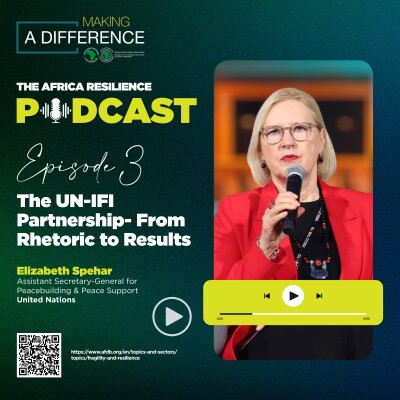
Welcome back to the Africa Resilience podcast series, part of the African Development Bank Group's Making a Difference podcast on the ideas and innovations shaping Africa's future. I'm Delphine Vukunta. Prevention only works if the institutions designed to deliver it actually work together. The United Nations and development banks are the two pillars of that architecture, and the distance between them has real consequences for the people. living in fragile and conflict-affected contexts. Today, we're speaking with Elisabeth Spehar, UN Assistant Secretary General for Peacebuilding and Peace Support. Elisabeth, a very warm welcome to you.
- Speaker #0
Thank you so much, Delphine.
- Speaker #1
Elisabeth, you've spent decades at the intersection of conflict, diplomacy, and institutional politics. What has anchored you in this work and... What's the moment you go back to when the system feels most intractable?
- Speaker #0
I would say that what has really anchored me to this work, which you're right, can be quite challenging, is a very strong conviction that if we're looking for true, sustainable peace, the only way forward is going to be through political dialogue and also through investing in building peaceful and resilient societies over time. Right now, we are seeing a record number of protracted conflicts, extremely violent conflicts around the world. I also believe firmly that if we want to get to the sustainable peace that I'm talking about, people's inclusive participation in our societies at all levels is absolutely essential. I don't see it happening just from the top. I think it has to happen very much from the ground up as well. And if I can give you a quick little example from the African continent, a couple of years ago, I was in Wao County in South Sudan, where I was meeting a group of young people. These were young people that were either gang related or at risk youth. And we had been helping them through a quite a comprehensive initiative to really get their lives in order and to become actually much better family members and members of their community. They said two things that really struck me they said We want to work for a better South Sudan. And they also said, we want to help other South Sudanese to have the same opportunities that we have.
- Speaker #1
Thank you so much for that. Now, that's prevention from the ground up. Let's talk about the institutional side. The UN's new agenda for peace names development banks as prevention actors, not just funders. What has actually changed since then, especially at country level?
- Speaker #0
First of all, I do want to refer also to the Secretary General's A New Agenda for Peace, which, as you know, came out around July of 2023. One of the things that the SG really wanted to do was to set out a significant shift in the way that we understand peace and prevention. So one of the things that our SG made a strong case for, I think, is the universal relevance of prevention. is something that not just countries that have known conflict or countries that are very fragile need to invest in. Every country is at risk of instability and systemic violence if they're not investing in preventive approaches. He also made the case that prevention is an investment in development. And so this should be a priority for all of us. I can say that one positive development that I've seen is that there's a growing number of our African member states that have started to put together what. they're calling or we're calling national prevention strategies. And through our UN Peacebuilding Fund and through the support of the Intergovernmental Peacebuilding Commission here, about eight new prevention strategies have been supported in the last two years from countries across the globe. African governments have actually been leading the way. We've seen that from Saint-Domingue-in-Princepe. We've seen it recently from Mauritania. We're even seeing strategies that are being developed by middle-income countries like Côte d'Ivoire. And there is that understanding in Côte d'Ivoire that they continue to invest in strong and inclusive institutions and in social cohesion because peace... cannot be taken for granted. What are the other changes that we're seeing? Well, the less positive changes is what's happening to development aid. We've seen military expenditures rising and military spending. And in terms of the OECD countries that tend to put quite a bit of resources into official development assistance, a recent report found that for every $1 that the top 10 OECD military spenders are investing in development and diplomacy. Together, they're spending $7 on defense, and we need to do better to invest in actually actions that strengthen societies, build resilience, build social cohesion.
- Speaker #1
You're listening to the African Development Bank Group's Africa Resilience Podcast with Elizabeth Spehar, UN Assistant Secretary General for Peacebuilding and Peace Support. You've touched on political will and financial clout. Let's talk about the partnership side of that. What is the UN actually doing differently with regional development banks and IFIs?
- Speaker #0
Since about 2019, my office here, the Peacebuilding and Peace Support Office of the UN Secretariat, has been developing and also housing a dedicated capacity to really work much more effectively with the IFIs. So one of the things that we very much value is, for example, your institution, the African Development Bank. having really been a pioneer in tailoring approaches, specific approaches or strategies for fragile or crisis contexts. And in terms of the African Development Bank in particular, we very much appreciated how you've crystallized this more tailored approach in your 2024-2033 strategy, where you emphasize the need for investment in peace and resilience as critical regional public goods. We very, very much are with you on that. So in more concrete terms, We are working together increasingly on the ground. And what we're trying to do is really bring our complementary tools to bear with the idea that we can have much more deliberate, what we would call peace positive development action, particularly in fragile and conflict affected contexts. Something else we've been doing with the African Development Bank, we've started it with the Asian Development Bank and some of the other MDBs, is we're trying to jointly map good practices. of this type of cooperation between us. And we're also investing a lot more in doing joint analysis, even joint planning, and also policy dialogue with governments so that we can support them together, again, based on our relative comparative advantages or respective comparative advantages. I should say we're working to try and align our investments through instruments we have, like the UN Peacebuilding Fund. or the PBF with the investments of the transition states facility, for example. So we have a recent example in the Central African Republic. So the African Development Bank is running a $32 million agricultural investment there. Our smaller fund, the PBF, the Secretary General's Peacebuilding Fund, has added to that tally with $2 million that is more targeted on responding to possible conflict triggers and bringing a conflict sensitivity to the project. particularly by ensuring that the displaced people in the region where this initiative is being financed, returnees and vulnerable communities are included in this project. Our small contribution is bringing a kind of peace-building lens to a much larger investment of the African Development Bank, and it's specifically targeted to make the investment more inclusive, more conflict-sensitive, and hopefully through that, more sustainable. We know that the African Development Bank has a lot more money. You are helping to bring the scale to this initiative. And we are trying to ensure that this particular investment is anchored in inclusive collaboration.
- Speaker #1
That's a small contribution shaping a much larger investment. What's standing in the way of that kind of alignment becoming the norm?
- Speaker #0
One of the challenges we found is that the cooperation on the ground often is a kind of one-off and we haven't been learning enough the lessons of what works well and what doesn't. We feel that if we could really work more closely on sharing information early on in these fragile and conflict-affected contexts based on the information that each of us gleaned from those contexts, if we work more on joint assessments and if we work more in strategically aligning our instruments on the ground, we can provide much more effective support to governments. in fragile and conflicted contexts, and particularly for them to be more prevention and peace intentional.
- Speaker #1
I must say, it's quite encouraging to hear you talk about all the positive things that are being put in place and the instruments that are working. These are imperatives that you have been an advocate for and a real champion for. Which one do you think the international community is genuinely failing at?
- Speaker #0
All three are important, right? Investing earlier, acting smarter, and working together in a more joined-up approach. So on the first issue of investing early enough, I think the way our systems are set up, it's not easy to shift resources upstream before crises escalate. So most of our sources of funding are from the member states, our UN member states in our case, and they've made it very clear that they think this is a priority. But when it comes to actually putting money aside for prevention, it's just a harder case to make. So we have perception issue. It's a lot easier to sell the idea of giving money to respond to a crisis. But giving money much further upstream to anticipate what might happen and try to forestall it somehow, it's a tougher case to make. But I think we would really reap the benefits if we can work earlier and better. And if we can help. a government or a society at a particular moment early on when things have not yet gone into full-blown conflict, it will be better for all concerned. I can say that the UN system itself internally is still working to square that circle to improve. I think we've made a lot of progress, but there's still more to be done. And then between us and the MDBs, there's again more to be done. I'm really pleased to say that with the African Development Bank, we're currently working towards what we call a sort of joint strategic framework for collaboration on peace and resilience that I think could really nicely frame how we should work going forward.
- Speaker #1
You're listening to the African Development Bank Group's Africa Resilience Podcast with Elizabeth Spehar, UN Assistant Secretary General for Peacebuilding and Peace Support. Coming up, Elizabeth and I talk about some of the initiatives the UN and the African Development Bank are working on to bring in private capital. You mentioned early in this conversation that less than 2% of development funds go to prevention, despite decades of advocacy. What is the barrier to the development community doing more around this fact?
- Speaker #0
I mean, we know, and we've known for a long time, frankly, that an ounce of prevention, as the saying goes, is worth a pound of cure. The IMF came out with a study called the Urgency of Prevention. I think it was just last year or the year before. And the study showed that returns on average investing in preventive action can be between $75 to over $100 for every dollar invested, and in some cases as much as $200. But we haven't really consolidated the incentives for these preventive investments. And again, it's much easier to show. videos on television about people dying in massive violence and getting support for that, rather than investing in more, if you will, discrete ways to help build resilience in societies, to help strengthen institutions, to help broker peaceful dialogue. So we're running up against what I would call the political economy of decision making, right? So prevention takes time to show results. So part of what I think we need to do is we need to invest. a lot more capturing and effectively communicating evidence that these preventive approaches work and that they do have a very clear impact. And that hopefully will help the decision makers to translate our evidence into political decisions and financial decisions. Because I think in terms of prevention, you need the political will and then the financial clout as well.
- Speaker #1
The Political Economy of Decision Making Thank you. I think that's a really profound way of highlighting that. And it's clear that the case for prevention, obviously, is both fiscal and economic. And we also know, of course, that this is the case for private capital. We hear that your office has been working with the German government and others on an initiative called Investing for Peace, I4P. Can you tell us what it is? how it meets the moment.
- Speaker #0
Thank you so much for mentioning the Investing for Peace initiative, which is an initiative that we are supporting that was spearheaded by Germany, but also has had very good input from African countries such as South Africa, and that we are building with DFIs and various other partners. This I4P initiative has a core idea behind it, and we think it's pretty intuitive. If economic exclusion Thank you. an instability fuel conflict, and we are definitely seeing that on the African continent, then we need to invest in businesses that address these specific conflict drivers. So it's a question of... Yes, creating jobs, building inclusive value chains and connecting communities. That should help build peace. It's not just what you're investing in. It's also how you're investing in it. The challenges, as you say, come when this type of idea hits the reality of fragile market, because in fragile contexts, these investors are going to have to deal with high political risk. So, you know, even if you find investors who would invest meaningful capital. the opportunities for them to do this investment are often pretty scattered and they're often quite small. A second challenge that we see in these fragile contexts is the issue of risk tolerance, right? Most investors that we've talked to, and even most development finance institutions, simply are not ready to absorb the level of risk that comes with operating in places like the Sahel, for example, or the Horn of Africa without some serious de-risking. And so, So I4P is looking at using blended finance, using first law structures, and also providing technical assistance. And often the commercial math doesn't work unless in these very fragile conflicts, context, pardon me, you have some sort of a cushion. So we're going to be trying to help build a market at the same time as it is being invested into. And if we don't start today, you know, a decade from now, there will be... even less opportunities for institutional investors to find viable opportunities. And that means that the countries remain stuck. We're trying to promote the idea and show it in practice that peace can be investable. So what we think it requires is helping to create the conditions for what we're calling a peace-intentional allocation of capital. One of our partners said it, I think, very well, that their objective would be to allocate for peace, but... At the same time, of course, invest for profit. So in fragile markets, we're trying to help build the businesses, develop the businesses that later can attract DFIs and commercial investors and businesses that also have some aspect of peace intentionality, if you will. And what our model is acknowledging basically is that early capital has to be concessional or it has to be catalytic. And that's why we've built in an up to 50% first loss structure. This is what we think will be helping to unlock follow-on DFI capital and private investors down the line. And then the issue of scaling through time. It's a question of, again, meeting fragile markets where they're at. And the role of I4P, I hope, will be as a market preparer and a DFI enabler. So our first wave of investments would be mostly about stabilizing enterprises, proving peace intentionality, and setting standards, right? So what we're hoping to do with I4P in summary is to prepare the ground for this type of investment, reduce the risk for peace positive investments in fragile and conflict affected contexts, and to create a pipeline that will eventually allow larger pools of private capital to follow.
- Speaker #1
Before we bring this conversation to a close, I like to end by asking all our guests this question. What? Do you want decision makers who hear this conversation to hold in their minds, especially about the people whose lives depend on whether the system gets the case for prevention right or not?
- Speaker #0
Well, what I want to close with in that sense is that it is truly all about the people. If we're serious about development that actually helps to anchor and consolidate peace in a country over time. so that indeed these countries can enjoy sustainable development, we have to have people-centered approaches. Critical, but also how people themselves are agents of their own peace and agents of development. We need to make sure that we're investing in civil society, helping to open up more civic space. We need to invest in youth, most certainly on the African continent. Most of the countries where we're working have huge youth populations. They are feeling disaffected. They are feeling that they do not have either socioeconomic opportunities or political opportunities. And what we are doing by not addressing this sufficiently, we are basically squandering some incredible capital. So we have been, for example, through our peace building fund here that we managed on the secretary general's behalf, we've been investing a great deal on women's empowerment. Gender equality, also extremely important. And when we're looking at youth, it's a question, of course, of generating more opportunities, socioeconomic opportunities for them. But what we've also heard from the young people themselves is that they need more. They have to have agency. They need to have a voice and they need to have real avenues to engage in decision making. And I think if we get this right, the impact will be significant. We will be able to help protect lives and we will be giving an incredible boost to this generation and the next generations. And that will make a real stake in peace and prosperity.
- Speaker #1
Elizabeth, thank you very much.
- Speaker #0
Thank you so much, Delphine. It was a real pleasure.
- Speaker #1
The Africa Resilience Series is a production of the African Development Bank Group. I'm Delphine Bakunta. Thank you for listening.