- Speaker #0
The MDBs have to be culturally, process-wise, governance-wise, financially rewired to take more risk.
- Speaker #1
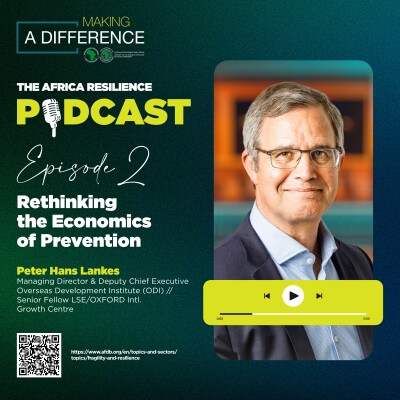
Welcome back to the Africa Resilience Series, part of the Making a Difference podcast. I'm Delphine Bakunta. Last episode, we looked at how the African Development Bank operationalizes prevention. This episode asks a harder question. Why does the global development financial system make prevention so difficult? My guest is Peter Hans Lankes, Managing Director at Overseas Development Institute Global, ODI, one of the world's leading development think tanks. He spent two decades inside the World Bank and the European Bank for Reconstruction and Development, EBRD, before moving to ODI. Peter, welcome.
- Speaker #0
Pleasure to be with you.
- Speaker #1
I want to start with a personal question. Peter, you've spent your career moving between generating evidence and then... trying to get institutions to actually put that evidence to use. Why the pivot?
- Speaker #0
Thank you, Delphine, for that question. One thing on the demand side is that there are things that client countries or private companies systematically underinvest in, and they do so despite the evidence. There are lots of examples of that in the climate area, flood or drought protection, or in skills training. And also when it comes to long-term, such as pension reform or low-probability, high-impact events. diversification, for instance, away from resource dependency. Then on the organizational side, there are things that institutions just fail to do, even though we know that things have high economic or social benefits. There is very little investment in project preparation, even less in upstream sector readiness or in investment climates. There's far too little investment among MDBs and DFIs. But we have to keep trying because closing that gap is, or it should be the mandate of. of these institutions, and in fact, of government. And it's good for development across generations, and it's good for the bottom line.
- Speaker #1
Help me understand IMF's claim that every dollar invested in prevention returns between $26 and $103. The numbers are well known. Everybody cites them. So why has the development ecosystem not changed?
- Speaker #0
Yes, you're right. Prevention is a case in point. And in fact, it's one of the most stunning examples of the evidence gap. We know about that gap, we and the governments and MDBs, but we don't act on it since the incentives are wrong. So politics has the wrong incentives because if we're talking about a democracy, the payoffs are often too far in the future, or they accrue to others, such as future generations, such as local government, such as neighboring countries. And then MDBs have the wrong incentives because prevention projects can be small and they can be messy. You need to interact and to coordinate with all sorts of parties, including civil society or other non-state actors. Then the politics can be complicated, including with your own board. Now, changing these incentives is easier said than done, of course. For the MDBs, it means being willing to bite the bullet, to take greater risks, to allow projects to be locally led. And that in turn means that shareholders have to do the same. They have to change their understanding of accountability.
- Speaker #1
So what I'm hearing is that The incentives are wrong on both sides. And now, to complicate things even more, overseas direct assistance is declining. Major donors are pulling from multilateral commitments. For the most fragile countries in Africa, what will this actually mean in the next five years?
- Speaker #0
Well, at one level, there will be less highly concessional and less grant funding available in the coming years. The biggest impact of that is on humanitarian emergencies and on social sectors where much of ODA has been concentrated. And unless there's drastic action and unless alternatives are found, many people will die. They will be stunted, will suffer preventable shocks.
- Speaker #1
Wow, that's a stark picture. Is there a silver lining? And where, in your view, does the African Development Bank, for example, fit into that picture?
- Speaker #0
But I think it's also important to draw a larger frame here. So while on the one hand, grant funds will almost certainly decline, the financial capacity of the MDPs and of the development finance institutions is actually growing and is growing fast. And it is growing, if you look at the last two, three years, by a very similar amount by which grant ODI funding has declined. There's also progress with initiatives and with mechanisms to channel more private funds into long-term development purposes. Ideally, The smaller amounts of grant finance would be directed to enabling countries to strengthen their domestic finance and their domestic capacity and to deliver services, those services that foreign humanitarian or other ODA funding had been providing. and which had in fact created very unhealthy dependencies because it had been substituting for domestic capacity, even indirectly destroying domestic capacity in some cases. The development funding would replace much of that protracted, unending humanitarian support that we are seeing today. But I have to say that the African Development Bank is taking just the right measures as far as I can see. It is setting the right principles for its support. It is aiming to help countries make that shift from aid to investment and from foreign dependence to local capacity.
- Speaker #1
This is the Making a Difference podcast from the African Development Bank. I'm Delphine Bakunta and I'm speaking to Peter Hans Lenz, Managing Director at ODI Global. Peter, Hans, you've worked for three of the world's leading multilateral development institutions. From that vantage point, what would you pinpoint as needing to change institutionally? and structurally for emerging economies to get where they need to be.
- Speaker #0
I could highlight three big changes that the MDBs will have to go through. And those are, in fact, consistent with the so-called MDB reform roadmap that was adopted by the G20 under the Brazilian presidency in 2024. But I would push even a little further than that. So the first and most important change from my perspective is that the MDBs have to be culturally, process-wise, governance-wise, financially rewired to take more risk. And that is because in a world in which financial markets have been deepening and have been deepening enormously over the past decades, the role of the MDBs is not to provide what financial markets can provide themselves, but to push at the frontier where those markets don't yet work. And that is risky. And that includes fragile and conflict situations. But it also includes supporting and spreading new technologies. It includes high-risk financial troshes, early-stage project finance, business models such as adaptation or disaster risk finance. And it is about taking operational risks, for instance, on the environment, on politics. Now, the second change that I see is to go and create project pipelines. Building project pipelines should be seen as a global public. good, especially in the more fragile environments. Projects don't come about by themselves, at least not in sufficient amounts. And that's a role the MDBs should have. And the third point is the need to harmonize and eventually to hand over or localize and to trust country systems for procurement, for environmental and social standards, etc. And that means putting countries truly in the driver's and get away from that. imperial supervision and determination that we continue to have in the name of good governance. For that, we must help and MDPs must help countries to get there, to establish their own functional and legitimate policies.
- Speaker #1
Now, ODI produces evidence and the African Development Bank and other partners try to act on that evidence. But again, there seems to be a breakdown somewhere in that process. Where does that breakdown happen? Is there a case where perhaps you've watched evidence genuinely change what an institution did?
- Speaker #0
The translation from evidence to action breaks down most reliably where following through on the evidence would be complex, where it would be time consuming, where it would be risky, involve lots of parties, etc., etc. But there are positive examples of change. For instance, you can look at the market for guarantees, which was more or less dead in the early 2000s. There was evidence from institutions like ODI that had long said that guarantees can be a very valuable instrument to bring risk-averse funds into development from the private sector and from various sources. Now, the incentives were wrong because guarantees involve many parties or multiple parties. They involve a different skill set from the traditional economist and engineer profile that we had in the MDBs. Now today the... The African Development Bank, for instance, is investing in guarantee companies and it is planning to create a pan-African guarantee platform. So, for instance, with blue bonds for water scarce regions that were pioneered in Southern Africa, or you look at the sovereign bonds with disaster risk clauses that the African Development Bank and others are now offering. These instruments weren't obvious products for the MDBs, but they're now having good. momentum. Let me give another example, perhaps the most prominent example for me is Mission 300. Mission 300 is about connecting 300 million more Africans to power by 2030. The African Development Bank and the World Bank. They have truly understood that for systems change and for a big lift, you need to gather many players around a common goal. You need to coordinate sector reform as well as investment. And most importantly, you have to have the country in the driver's seat. It's early days for Mission 300, but those compacts, for me, those kinds of compacts, are a very promising way forward for many development challenges.
- Speaker #1
You keep coming back to the need to rewire institutions to take risks. So what, in your view, is the biggest obstacle to actually making that happen?
- Speaker #0
The honest obstacles to that are a risk-averse culture that's going to be incredibly hard to dislodge and shareholder political accountability back home that lives in what I would call a dream world, that the possibilities you have there, designed things, are to superlative standards. The risks you might legitimately take there and the norms you might apply there, that those are different and that needs to be accepted. That needs to be factored into the kind of accountability that shareholders expect from these institutions.
- Speaker #1
Final question, and this is a personal one. We've been talking about institutional architecture, risk frameworks, shareholder accountability. But behind all of these are real people, young people. Women heading up households, communities in fragile contexts whose lives and livelihoods depend on systems getting this right. So what do you want policymakers and investors who hear this conversation to hold in their minds?
- Speaker #0
I want them to bear in mind that these countries and the people who live there are an important part of humanity, that they are a part of humanity that hasn't yet benefited at all from the progress that... mankind has made over these past decades, that there is opportunity in these countries and not just threat. The fact that mindset has to be one that progress is possible. There is opportunity that we can do something about it. In the early 1990s, there were around 65 countries classified as low-income countries by the World Bank. And those held about 60% of the global population. 1990, 65 countries, 60% of the global population. By 2019, there were only 31 low-income countries, according to that classification, and those countries held less than 10% of the global population, but they held almost half of the world's absolute poor. There's a large overlap between these countries and the fragile in-conflict situations. You see the enormous progress that's been made in the past decades, and it's possible to continue to push there if we bear in mind that this is a part of humanity. that we need to enable to benefit from that progress that the rest of humanity has been making.
- Speaker #1
Progress is possible. That's the frame. Peter Hans Lange, thank you very much. What this conversation surfaces is a system caught between what it knows and what it does. The evidence for prevention is not in dispute. The political economy that keeps resources flowing toward crisis response rather than early action. That's harder to shift than any financial instrument. In our next episode, I'll be tackling the partnership question with Elizabeth Spehar of the UN as we discuss whether the UN and multilateral development banks have gotten any better at working together on prevention. I'm Delphine Vakunta, and the Africa Resilience Podcast is a production of the African Development Bank Group. Thank you for listening.