- Speaker #0
The great interviews of the SACEM museum with Stéphane Lerouge.
- Speaker #1
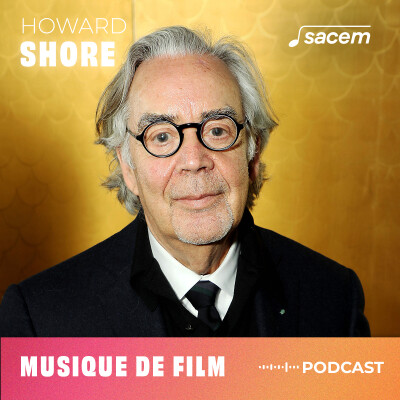
Hello everyone. At the 2023 Cannes Festival, the SACEM music lesson celebrates a living legend of film music, the Canadian Howard Shore. Martin Scorsese's accomplice, David Fincher, Arnaud Desplechin, and Peter Jackson's, of course, the time of two out-of-proportion triptychs, The Lord of the Rings and The Hobbit. For more than 40 years, Shore has been one of the most innovative composers in contemporary cinema. In the Toronto of the 50s and 60s, his vocation is shaped by several successive revelations, that of modern jazz, of the Second School of Vienna, not to mention the founding shock against the writing of John Cage and Takemitsu. He tells us about this founding period and its singular connection with a high school comrade, a certain David Cronenberg, who was going to put him on the rails of his destiny.
- Speaker #0
Well, I didn't plan on being a composer. You have to go back with me to the early 50s. I grew up in Canada, in Toronto, and in Canada they did a test in the 1950s. where they tested every student from coast to coast. Every student was given this kind of a computer electronic test to study their hearing, to see who were the possible musicians. who were the artists in the country, and scoring high on the test. The schools that I was in, the public school, offered you an instrument, and they offered a violin. I was only about nine years old. I didn't want to play the violin. I thought I'd get beat up probably after school carrying it around, so I didn't want the flute either, but the clarinet I liked because it meant jazz, and I liked Benny Goodman and Glenn Miller. and my parents had those records. So I studied the clarinet with a man named Morris Weinsweig, taught his young student, Howard, the clarinet, and gave him counterpoint and harmony exercises to write every week. So he got me writing with a pencil at about nine, ten years old. And frankly, I've just been carrying on that pencil for 40, 50 years. now. It's been just a stream of writing. So it wasn't a goal to become a composer. It was something that happened kind of organically. I didn't have the desire. I liked music, but I did some acting. I did some directing and I could have gone different ways, but music sort of became the thing that I studied. Well, David Cronenberg grew up in the same neighborhood that I did in Toronto. And if you lived in Toronto during that period of the 60s, his films were important. Everybody knew about David. And he had a beautiful... beautiful motorcycle. And he, well, you know, when you're 14 years old and he's a little older than I am, he would be 17. And you'd see him in the neighborhood in that beautiful motorcycle. And he had leather jacket and stuff, you know? So, I mean, he was well-known and I had seen his films, you know, in late night. midnight showings and underground film festivals, which they had in the 60s. And I knew his films, but I didn't approach him to work on any of his films for a long time. David made 8mm, 16mm films before he made 35mm films. Cronenberg took me on to do the film The Brood, and that's how we started our collaboration. I've worked now with David for... a long time over 30 years and we've done 16 films together now working on the 17th. You know, I think since the beginning of working on the Cronenberg films, one has led to another. The brood led to scanners, which was actually all analog. technology and the electronics were all analog. It was all using tape loops, an older form of editing electronic music which led to Videodrome. which was the first digital electronic score I did, which then led to The Fly, which was a completely symphonic score, and then did ringers, and they became more symphonic, and I used orchestras more extensively. If we didn't have the budget, we would do scores like Crash or Spider, more guerrilla filmmaking, as David would call it. Previously to M. Butterfly, I'd use one harp in the orchestra. I'd place it left of the podium. And M. Butterfly used two harps. I placed them left and right and created a stereo. image with the harps. And then I wrote a two-part counterpoint for the harps. And then I wanted to, between the films, extend the use of the counterpoint. So I wrote a piece for three. three-part counterpoint and I thought it'd be interesting to use that with three harps. So here was my interest in music kind of driving the film that I hadn't even scored yet. I was just writing this piece for three-part counterpoint and then I applied the three parts to the music of Crash. and it became six electric guitars two playing each harp part and then i added uh all metal percussion as you would say for the machine part of it and then the uh then for the warm there's three woodwinds you know that play solos with that combination so it's like similar combination to this years you know i mean using The electronics and the warmth of the acoustic instrument was something I had been doing years before this. So really, it's been a very linear process of writing that became, you know, this whole thread of Cronenberg. He gave me so much room to experiment that it went off in tangents into films like Silence of the Lambs and Seven. And, you know, it took me into other areas.
- Speaker #1
Howard tells us how, for a composer for the image, everything is a question of interpretation, subjectivity, in a word, of point of view.
- Speaker #0
Film music is a lot about point of view and how you use it is really has to do with um you know what you're trying to express in the film i know with uh with marty with martin's chris says he will see in it soon i i hope and um when we were looking at the departed he said to me these characters are all duplicitous they're all dancing around each other and he said maybe it's a tango and it was just the word tango and i went off and wrote a tango and started working with those rhythms in the film Thank you. And I know with Jonathan Demme on Silence of the Lambs, he said, take the point of view of Clarice Starling, which was unusual at the time for a thriller, because usually we take the Hannibal Lecter, the bigger character on screen. And by taking the point of view of Clarice Starling, Cody Foster's character, I brought out some more of the humanity of that character. And I think that broadened the scope of the narrative of the film. So it can just be a word or a gesture, really, that takes you off on a certain way. And what you want to do with the first playing of your music is just think thematically. Don't look at the film. I don't look at the film too much in the beginning. I like to read. So I studied the screenplay. And I think this is maybe something that I've... developed over the years, but I like to work with the words for quite a while. And if the screenplay is based on a novel, like J.G. Ballard's Crash, or that we just saw, or William Burroughs' Naked Lunch. So I study the period and I research the period and try to delve into the world that the film's going to be based on, but not looking at the film, just thinking about the authorship of the story. and the heart of the story. And that's really what you want to present when you first play some music for your director collaborator, is the, you know, is that heart, is what you feel in your heart that expresses your music to the story. And it could be eight bars or 16 bars, 24 bars. It doesn't have to be connected to the film. But once I, you want to write something from your heart about the subject and then collect. pieces every day, like I do, like a journal of music. And it could just be a few bars every day you're writing or recording little pieces. And then they add up. And then once you have a catalog really of themes and motifs, then you should approach the film. Sometimes you can watch the film once as a narrative, as an audience member, and you have a certain emotion. when you see the film so you're writing to those feelings you're not looking at the film you're just remembering recalling what you felt when you sat in the cinema and saw the film for the first time because you want to capture that feeling and then of course as the film is edited and you see the whole film uh and you're into scoring it it becomes more technical you're trying to apply your themes and motifs based on your dreaming part of it into the actual reality of scoring the film. So think of it as a linear process. It's not a one-step process, scoring films. It's like composition and then editing into the film, and then it's recording, orchestration, recording, producing, conducting. I mean, they're all separate functions.
- Speaker #1
Compared to melody, harmony, rhythm, Howard tells us how inspiration comes to him.
- Speaker #0
To me, it's a feeling. I think music is an emotional language, so I'm trying to express a feeling that I have about the subject. My scores are written in pencil and sketches in pencil, and then I do the orchestrations, the 30s. stave in ink and it's a visual uh process to me for quite a while i'm not thinking so much about colors or orchestration or anything but i'm thinking more in terms of tempo meter uh counterpoint, harmonic progression. You know, so it's, again, a step-by-step process of creating the counterpoint and the harmony for the piece you want to write. And what you're doing is expressing the ideas emotionally. of what you feel and trying to put that on paper and then you're trying to get a performance of it as to who's going to play it and where will the recording take place and what are the physics of the room the placement of the microphones all of those things that leads to a great recording You know, the need is always to serve the film, to do what the film needs. But I think I was trying to bring my music ideas into the film. So I was combining what I was interested in musically with the needs of the film and I was trying to make these two things function well together.
- Speaker #1
In 1995, Howard Shore was lucky enough to meet with the genius Tim Burton on Ed Wood, with an off-nese score for Térémyne Soliste on Afro-Cuban rhythm.
- Speaker #0
The thing that was great about working with Ed Wood was... you couldn't do anything wrong because every mistake was golden. It was like, you know, he was considered one of the worst. The worst. Yeah, so. But it was a fantastic project. I love that period, that late 50s. period and Naked Lunch also sat in that same period. It was just, you know, Tim Burton has a great heart and he brought out the humanity of the man of the story. No, Lydia Kavina played the theremin. She's a virtuoso. She was related to the inventor. She lives in Oxford, England. She's the great thereminist. But I used that instrument. It was developed in the 1920 period. And it's one of the first electronic instruments. It has a relationship to science fiction films, but really it was designed as a concert instrument. The influence of Cuban music into America, like Desi Arnaz and I Love Blue City Show, brought in those elements. And it was around the same period. So I'm combining the Afro-Cuban rhythm.
- Speaker #2
I'm so happy to be here with you all. I'm so grateful to be here with you all. I'm so happy to be here with you all. I'm so happy to be here with you all. I'm so happy to be here with you all. I'm so happy to be here with you all. I'm so happy to be here with you all. I'm so happy to be here with you all. Thank you. I love you, Michelle.