- Speaker #0
Musique
- Speaker #1
The great interviews of the Sacem museum with Stéphane Lerouge.
- Speaker #2
Les grands entretiens du musée de la Sacem avec Stéphane Lerouge Musique
- Speaker #3
At the Cannes Festival 2025,
- Speaker #4
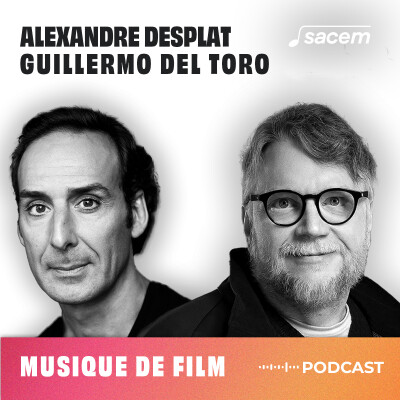
At the Cannes Festival 2025, the Leçon de Musique SACEM celebrated a emblematic composer-cinema composer duo,
- Speaker #3
the SACEM music lesson celebrated a emblematic composer-cinema composer, the French Alexandre Desplat and the Mexican Guillermo del Toro.
- Speaker #4
the French Alexandre Desplat and the Mexican Guillermo del Toro.
- Speaker #3
Their meeting in 2017 is a friendly touch.
- Speaker #4
Their meeting in 2017 is a friendly and professional blow,
- Speaker #3
and professional, welded by the striking success of the form of the humanist fable water which is worth to the composer his second oscar.
- Speaker #4
welded by the striking success of La Forme de l'eau, a humanist fable that deserves the composer his second Oscar. It will then be an original rereading of Pinocchio,
- Speaker #3
It will then be an original rereading of Pinocchio,
- Speaker #4
treated as a musical tale,
- Speaker #3
treated as a musical tale and in 2021,
- Speaker #4
and in 2025,
- Speaker #3
a very lyrical Frankenstein where the monster is less the creature than its creator.
- Speaker #4
a very lyrical Frankenstein, where the monster is less the creature than its creator.
- Speaker #3
In parallel with the collaborations with Wes Anderson,
- Speaker #4
In parallel with the collaborations with Wes Anderson, Stephen Frears,
- Speaker #3
Stephen Frears, George Clooney or Roman Polanski,
- Speaker #4
George Clooney or Roman Polanski, the axis of El Toro holds a singular place in Alexandre Desplat's career,
- Speaker #3
the axis of El Toro holds a singular place in Alexandre Desplat's career, which often emphasizes that each filmmaker has his own functioning,
- Speaker #4
which often emphasizes that each filmmaker has his own functioning,
- Speaker #3
his own relationship to music.
- Speaker #4
his own relationship to music. So,
- Speaker #3
So precisely,
- Speaker #4
precisely,
- Speaker #3
what is Guillermo del Toro's way of working?
- Speaker #5
what is Guillermo del Toro's way of working?
- Speaker #3
Del Toro.
- Speaker #6
I've learned his passion for music and for film music,
- Speaker #5
and for film music.
- Speaker #6
so it's a great help,
- Speaker #5
So it's a great help because when we exchange we have references that we can you know go to.
- Speaker #6
because when we exchange, we have references that we can, you know, go to. But
- Speaker #5
But
- Speaker #6
I think it's his open mind,
- Speaker #5
I think it's his open mind as you know he's just open to whatever I would suggest.
- Speaker #6
you know, he's just open to whatever I would suggest. If it's right,
- Speaker #5
If it's right it's fine,
- Speaker #6
it's fine.
- Speaker #5
it has to be right.
- Speaker #6
It has to be right. Of course,
- Speaker #5
Of course if I say shit then it's not good but if I bring a good idea it works and he's always open to.
- Speaker #6
if I say shit, it's not good. But if I bring a good idea, it works. and he's always open to change routes.
- Speaker #5
to change routes, you know, sometimes he had an idea,
- Speaker #6
Sometimes he had an idea,
- Speaker #5
oh,
- Speaker #6
oh,
- Speaker #5
we should do this,
- Speaker #6
we should do this,
- Speaker #5
that,
- Speaker #6
that, and I suggest,
- Speaker #5
and I suggest,
- Speaker #6
maybe,
- Speaker #5
maybe,
- Speaker #6
how about we do this,
- Speaker #5
how about we do this,
- Speaker #6
we do that.
- Speaker #5
we do that, and he's always open to,
- Speaker #6
And he's always open to... And that's a great,
- Speaker #5
and that's a great, great quality,
- Speaker #6
great quality because
- Speaker #5
because I need to feel that the director has confidence in me,
- Speaker #6
I need to feel that the director has confidence in me.
- Speaker #5
otherwise it's painful.
- Speaker #6
Otherwise, it's painful.
- Speaker #7
So,
- Speaker #8
So, Guillermo,
- Speaker #7
Guillermo, the second act of your collaboration was your adaptation of Carlo Collodi's
- Speaker #8
the second act of your collaboration was your adaptation of Carlo Collodi's
- Speaker #7
Pinocchio, which is a very original version,
- Speaker #8
Pinocchio, which is... A very original version because it's really a film about loss and grief.
- Speaker #7
because it's really a film about... Loss and Grief. How did you get the idea of treating it as a musical tale?
- Speaker #8
How did you get the idea of treating it as a musical tale?
- Speaker #9
It was from the beginning.
- Speaker #10
It was from the beginning.
- Speaker #9
It started very different and it got mutated when I finally decided on this form.
- Speaker #10
It started very different and it got mutated when I finally decided on this form. I knew I wanted
- Speaker #9
I knew I wanted Pinocchio to sing to Mussolini,
- Speaker #10
Pinocchio to sing to Mussolini.
- Speaker #9
you know,
- Speaker #10
And
- Speaker #9
and I think that the clarity of a musical where you can declare...
- Speaker #10
I think that the clarity of a musical where you can declare
- Speaker #9
The personality or the intentions or the dreams of a character is very,
- Speaker #10
The personality or the intentions or the dreams of a character is very,
- Speaker #9
very clean.
- Speaker #10
very clean.
- Speaker #9
It can get you not only through the story,
- Speaker #10
It can get you not only through the story,
- Speaker #9
but through a lot of unnecessary sort of signification.
- Speaker #10
but through a lot of unnecessary sort of signification.
- Speaker #9
With the puppet being stop-motion and the actors being stop-motion,
- Speaker #10
With the puppet being stop-motion and the actors being stop-motion,
- Speaker #9
the way to bring the humanity in all of them was through the singing.
- Speaker #10
the way to bring the humanity in all of them was through the singing. And it was constructed very much like a musical.
- Speaker #9
And it was constructed very much like a musical. If you see,
- Speaker #10
If you see,
- Speaker #9
it has a touch of grace at the end when the pine cone falls.
- Speaker #10
it has a touch of grace at the end when the pine cone falls.
- Speaker #9
It's like a...
- Speaker #10
It's like a...
- Speaker #9
It's like a punctuation at the end of a symphony.
- Speaker #10
It's like a punctuation at the end of a symphony. Same in Pan's Labyrinth,
- Speaker #9
Same in Pan's Labyrinth,
- Speaker #10
the flower blooming at the end.
- Speaker #9
the flower blooming at the end. These are punctuation marks,
- Speaker #10
These are punctuation marks, and that,
- Speaker #9
and that,
- Speaker #10
like Shape of Water,
- Speaker #9
like Shape of Water, it declared itself to be a musical.
- Speaker #10
it declared itself to be a musical. For example,
- Speaker #9
For example, Frankenstein,
- Speaker #10
Frankenstein, I never thought.
- Speaker #9
I never thought. The movie tells you what it wants to be.
- Speaker #10
The movie tells you what it wants to be.
- Speaker #9
It really does.
- Speaker #10
It really does.
- Speaker #9
And I think people think a director's job is to talk.
- Speaker #10
And I think people think a director's job is to talk.
- Speaker #9
A director's job is to listen a lot also.
- Speaker #10
A director's job is to listen a lot also,
- Speaker #9
And to collaborators,
- Speaker #10
and to collaborators, to the movie itself,
- Speaker #9
to the movie itself, to actors.
- Speaker #10
to actors.
- Speaker #9
So
- Speaker #10
So Pinocchio wanted to be that because he's in the theater.
- Speaker #9
Pinocchio wanted to be that because he's in the theater. He's in the marionette theater.
- Speaker #10
He's in the marionette theater.
- Speaker #5
In many movies I try to not be too...
- Speaker #6
In many movies I try to not be too close to the period of the film,
- Speaker #5
close to the period of the film. But for this one,
- Speaker #6
but for this one it seemed just not right to go too far away and write pop songs that would be completely...
- Speaker #5
it seemed just not right to go too far away and write pop songs that would be completely disconnected to the time.
- Speaker #6
disconnected to the time.
- Speaker #5
So I think we decided very early on that it would fit a more
- Speaker #6
So I think we decided very early on that it would fit a more
- Speaker #5
1920s, 30s kind of orchestration type of melodies.
- Speaker #6
1920s, 30s kind of orchestration type of melodies.
- Speaker #5
And the challenge was that there were many songs to write.
- Speaker #6
And the challenge was that there were many songs to write ahead of time,
- Speaker #5
ahead of time many many many many many months or a year before it was covet time we had to sometimes
- Speaker #6
many, many, many, many, many months or a year before. It was COVID time, we had to sometimes
- Speaker #5
I record from abroad.
- Speaker #6
...record from abroad. I remember the little boy who was recording Pinocchio.
- Speaker #5
I remember the little boy who was recording Pinocchio.
- Speaker #6
He was in his bedroom in London and I was coaching him.
- Speaker #5
He was in his bedroom in London and I was coaching him. Christoph Watz was somewhere in Los Angeles.
- Speaker #6
Christoph Watz was somewhere in Los Angeles.
- Speaker #5
Ewan McGregor was in his garage.
- Speaker #6
Ewan McGregor was in his garage.
- Speaker #5
But the challenge was mostly artistic,
- Speaker #6
But the challenge was... mostly artistic,
- Speaker #5
you know,
- Speaker #6
to try and have a continuity with all the songs and make the score marry with all these songs and use some of the themes or not.
- Speaker #5
to try and have a continuity with all the songs and make the score. marry with all these songs and use some of the themes or not. It was a complex,
- Speaker #6
It was a complex, complicated machine.
- Speaker #5
complicated machine.
- Speaker #11
And you make it right And your heart is bright So let the world know how it goes
- Speaker #12
And you make it right, and your heart is right, so let the world know how it goes, open your arms to better tomorrow.
- Speaker #11
Open your arms to better Open your arms Open your arms to better
- Speaker #12
Open your arms to better tomorrow. To better
- Speaker #6
When we started talking about the songs,
- Speaker #5
When we started talking about the songs, Guillermo had written some lyrics on the page,
- Speaker #6
Guillermo had written some lyrics on the page,
- Speaker #5
on the script,
- Speaker #6
on the script,
- Speaker #5
and it became the kind of blueprint,
- Speaker #6
and it became the kind of blueprint,
- Speaker #5
the beginning of the writing of the songs,
- Speaker #6
the beginning of the writing of the songs,
- Speaker #5
and I brought in my old friend,
- Speaker #6
and I brought in my old friend.
- Speaker #5
yeah,
- Speaker #10
cats who I'd written songs with in the past we were talking to Beck the rock star and he was really hard to schedule and I said you know who's always around?
- Speaker #5
Katz. who I'd written songs with in the past.
- Speaker #9
We were talking to Beck, the rock star, and he was really hard to schedule. And I said, you know who's always around? Me.
- Speaker #10
Me So we went at it with the song My Son,
- Speaker #9
So we went at it with the song My Son,
- Speaker #10
and that was successful,
- Speaker #9
and that was successful, and I thought,
- Speaker #10
and I thought, oh,
- Speaker #9
oh,
- Speaker #10
I'm a lyricist.
- Speaker #9
I'm a lyricist.
- Speaker #10
You are a lyricist.
- Speaker #9
You're a lyricist. I'm not.
- Speaker #10
I'm not. So,
- Speaker #9
So,
- Speaker #10
you know,
- Speaker #9
you know,
- Speaker #10
Alexander and Katz,
- Speaker #9
Alexander and Katz,
- Speaker #10
we would discuss the main ideas,
- Speaker #9
we would discuss the main ideas, and then they would go away and work on the rest of the songs.
- Speaker #10
and then they would go away and work on the rest of the song.
- Speaker #8
Ciao,
- Speaker #7
Ciao Papa!
- Speaker #8
Papa. Could you sing it,
- Speaker #7
Could you sing it, the first verse?
- Speaker #8
the first verse? No.
- Speaker #7
No.
- Speaker #8
But you said,
- Speaker #7
You said, you accepted.
- Speaker #8
you accepted.
- Speaker #7
Yeah,
- Speaker #8
Yeah,
- Speaker #10
but you were serving me ice cream.
- Speaker #9
but you were serving me ice cream. I lied.
- Speaker #10
I lied.
- Speaker #9
I'm not doing it.
- Speaker #10
I'm not doing it.
- Speaker #7
You're not a real singer.
- Speaker #8
You're not a real singer.
- Speaker #7
No,
- Speaker #9
no.
- Speaker #10
No.
- Speaker #7
Are you disappointed?
- Speaker #8
Are you disappointed?
- Speaker #9
Ciao,
- Speaker #10
Ciao,
- Speaker #9
Papa.
- Speaker #10
Papa.
- Speaker #9
Mi
- Speaker #5
Papa. Voilà.
- Speaker #9
Très bien.
- Speaker #10
No,
- Speaker #9
No, no. Basta. That's it.
- Speaker #10
that's it. It's opening.
- Speaker #9
It's opening. No, but the spirit of that song was so important because,
- Speaker #10
But the spirit of that song was so important because like Frankenstein,
- Speaker #9
like Frankenstein,
- Speaker #10
for me,
- Speaker #9
for me,
- Speaker #10
it's a story of fathers and sons.
- Speaker #9
it's a story of fathers and sons. And to say farewell was...
- Speaker #10
And to say farewell was such a beautiful feeling.
- Speaker #9
Such a beautiful feeling and
- Speaker #10
And
- Speaker #9
I think the song captured it.
- Speaker #10
I think the song captured it.
- Speaker #8
And father and son is the spine of all your movies.
- Speaker #7
And father and son is the spine of all your movies.
- Speaker #9
Yes,
- Speaker #10
Yes, unfortunately so.
- Speaker #9
unfortunately so.
- Speaker #0
Ciao Papa,
- Speaker #13
Ciao papa,
- Speaker #0
mio Papa,
- Speaker #13
mio papa
- Speaker #0
time has come to say farewell.
- Speaker #13
Time has come to say farewell For how long will I go,
- Speaker #0
For how long will I go,
- Speaker #13
is it far?
- Speaker #0
is it far? No one knows,
- Speaker #13
No one knows,
- Speaker #0
no one can tell.
- Speaker #13
no one can tell If I am gone for a long,
- Speaker #0
If I am gone for a long, long time,
- Speaker #13
long time,
- Speaker #0
I'll pack a...
- Speaker #13
I'll pack away a fine piece of shine.
- Speaker #0
away a fine piece of shine, the sounds of birds jumping with bells,
- Speaker #13
The sounds of birds jumping with bells,
- Speaker #0
your rings of plums,
- Speaker #13
draw rings of plums to bags of shells.
- Speaker #0
your bags of shells, the smell of bread,
- Speaker #13
The smell of bread,
- Speaker #0
a drum of wine,
- Speaker #13
a drop of wine,
- Speaker #0
your memory,
- Speaker #13
your memory,
- Speaker #0
father of mine.
- Speaker #13
father of mine.
- Speaker #0
Farewell, my papa.
- Speaker #3
In a stop motion animation film,
- Speaker #4
Papa In a stop-motion animation film,
- Speaker #3
with songs, these are obviously recorded before the animation.
- Speaker #4
with songs, these are obviously recorded before the animation.
- Speaker #3
To what extent does having music at the time of shooting influence the staging?
- Speaker #9
To what extent does having music at the time of the shooting influence the staging?
- Speaker #10
Yeah, the animation is based on the soundtrack first. We record the actors on what is called a scratch track, and the songs,
- Speaker #9
Songs, of course,
- Speaker #10
of course,
- Speaker #9
need to have that emotion.
- Speaker #10
need to have that emotion. And I think that's what I value in Alexander,
- Speaker #9
And I think that's what I value in Alexander and I have in common with him.
- Speaker #10
and I have in common with him.
- Speaker #9
There is a thing,
- Speaker #10
There is a thing in...
- Speaker #9
when I was raised Catholic,
- Speaker #10
When I was raised Catholic, it was called a state of grace.
- Speaker #9
it was called a state of grace. What it means is,
- Speaker #10
What it means is,
- Speaker #9
for me,
- Speaker #10
for me,
- Speaker #9
emotionally,
- Speaker #10
emotionally, we have an innocence that allows us to get emotional.
- Speaker #9
we have an innocence that allows us to get emotional. I think that a lot of art is meant to be objective and distant,
- Speaker #10
I think that a lot of art is meant to be objective and distant, and we share the knowledge that art is emotion.
- Speaker #9
and we share the knowledge that art is emotion.
- Speaker #10
I'm Mexican,
- Speaker #9
I'm Mexican, so I'm extremely emotional,
- Speaker #10
so I'm extremely emotional, but Alexander and I share that bond where the meter we use for the final themes and all that is,
- Speaker #9
but Alexander and I share that bond where we, the meter we use for the final themes and all that is, I say,
- Speaker #10
I say,
- Speaker #9
I haven't cried.
- Speaker #10
I haven't cried.
- Speaker #9
Until I cry in his studio,
- Speaker #10
Until I cry in his studio,
- Speaker #9
we don't rest.
- Speaker #10
we don't rest.
- Speaker #9
And I think that's a very open,
- Speaker #10
And I think that's a very open, sincere and risky thing to do these days,
- Speaker #9
sincere, and risky thing to do these days,
- Speaker #10
because I think emotion is the new punk.
- Speaker #9
because I think emotion is the new punk. It's something people don't risk,
- Speaker #10
It's something people don't risk,
- Speaker #9
and we risk it.
- Speaker #10
and we risk it.
- Speaker #4
For the son of Gepetto,
- Speaker #3
For the son of Gepetto, Carlo,
- Speaker #4
Carlo, Alexandre wrote a deep and naive theme at the same time,
- Speaker #3
Alexandre wrote a deep and naive theme at the same time,
- Speaker #4
which already seems to belong to the collective memory,
- Speaker #3
which seems to already belong to the collective memory,
- Speaker #4
a theme that he will play for us the first measures on the piano.
- Speaker #3
a theme he will play for us the first time on the piano.
- Speaker #6
The
- Speaker #5
The
- Speaker #6
theme is original but it seems to be part of the collective memory.
- Speaker #5
theme is original but it seems to be part of the collective memory.
- Speaker #6
I don't know,
- Speaker #5
I don't know,
- Speaker #6
I just try to make it accessible I guess.
- Speaker #5
I just try to make it accessible I guess and without being
- Speaker #6
Without being simplistic and simple,
- Speaker #5
simplistic and simple is not the same.
- Speaker #6
it's not the same. So simple means that I spend many,
- Speaker #5
So simple means that I spend many,
- Speaker #6
many hours trying.
- Speaker #5
many hours trying.
- Speaker #6
Sometimes some themes just come very quickly,
- Speaker #5
Sometimes some themes just come very quickly,
- Speaker #6
but most of the time,
- Speaker #5
but most of the time, it's hard to write a good melody.
- Speaker #6
it's hard to write a good melody. It's a lot of work,
- Speaker #5
It's a lot of work,
- Speaker #6
a lot of tries and tries and tries again and again until you find the right shape,
- Speaker #5
a lot of tries and tries and tries again and again until you find the right shape,
- Speaker #6
the right chord changes.
- Speaker #5
the right chord changes. You sleep with it,
- Speaker #6
You sleep with it,
- Speaker #5
you wake up with it until you find the right thing.
- Speaker #6
you wake up with it, until you find the right thing.
- Speaker #5
But when you write a melody,
- Speaker #6
But when you write a melody, you want everybody to be able to sing it.
- Speaker #5
you want everybody to be able to sing it.
- Speaker #6
So it...
- Speaker #5
and at the same time it has to fit the character that you're writing a theme for.
- Speaker #6
and at the same time it has to fit the character that you're writing a theme for. I remember,
- Speaker #5
I don't know if you remember that,
- Speaker #6
I don't know if you remember that,
- Speaker #5
I wrote the score of a movie called Philomena for Stephen Frears,
- Speaker #6
I wrote the score of a movie called Philomena for Stephen Frears, and it's the story of a nurse,
- Speaker #5
and it's the story of a nurse,
- Speaker #6
the woman was a nurse.
- Speaker #5
the woman was a nurse. So a woman who was quite simple and worked with her hands all her life.
- Speaker #6
So a woman who was quite simple and who worked with her hands all her life. And so I started writing a theme,
- Speaker #5
So I started writing a theme,
- Speaker #6
and it couldn't be too sophisticated or too elaborate,
- Speaker #5
and it couldn't be too sophisticated or too elaborate, too complex.
- Speaker #6
too complex.
- Speaker #5
It just didn't work.
- Speaker #6
It just didn't work and I thought about her hands,
- Speaker #5
And I thought about her hands, that she was working with her hands.
- Speaker #6
that she was working with her hands.
- Speaker #5
So I tried to find a melody that could just fit in one hand.
- Speaker #6
So I tried to find a melody that could just fit in one hand.
- Speaker #5
So the fingers are like this on the piano,
- Speaker #6
So the fingers are like this on the piano and they don't move,
- Speaker #5
and they don't move, it's just this.
- Speaker #6
it's just this. And that's a way of being in tune with what is on the screen.
- Speaker #5
And that's a way of being in tune with what is on the screen. It's just trying to understand what the character is revealing and what your music can reveal of the character.
- Speaker #6
It's just trying to understand what the character is revealing and what your music can reveal of the character.
- Speaker #7
You use the word revealing.
- Speaker #8
You use the word revealing.
- Speaker #7
Guillermo,
- Speaker #8
Guillermo,
- Speaker #7
you always say that a good composer does not underline,
- Speaker #8
you always... say that a good composer does not underline,
- Speaker #7
he reveals.
- Speaker #8
he reveals.
- Speaker #10
Yeah,
- Speaker #9
Yeah, I believe that.
- Speaker #10
I believe that. I think that,
- Speaker #9
I think that,
- Speaker #10
I mean,
- Speaker #9
I mean,
- Speaker #10
it's what in the old days they called Mickey Mouse-ing.
- Speaker #9
it's what in the old days they called Mickey Mousing. You don't Mickey Mouse.
- Speaker #10
You don't Mickey Mouse.
- Speaker #9
You don't pop, you know it is you supplement you propel you de-accelerate when we are working together oftentimes i say i'm gonna give you another an extra beat on this shot and i call the editor right there and this shot at 36 frames or you know 12 or 24 but i also learned to breathe with his music the editing is
- Speaker #10
You supplement, you propel, you deaccelerate. When we are working together, oftentimes I say, I'm going to give you an extra beat on this shot. And I call the editor right there and say, this shot had 36 frames, or 12, or 24. But I also learned to breathe with his music. The editing is not only one-sided.
- Speaker #9
not only one-sided you know if if we feel that it needs
- Speaker #10
If we feel that it needs a moment more,
- Speaker #9
A moment more,
- Speaker #10
Are we...
- Speaker #9
we're going to extend the shot.
- Speaker #10
we can extend the shot.
- Speaker #9
So
- Speaker #10
So
- Speaker #9
I'm not underlining,
- Speaker #10
I'm not underlining,
- Speaker #9
he's not underlining,
- Speaker #10
he's not underlining, we're singing together.
- Speaker #9
we're singing together. That's the thing,
- Speaker #10
That's the thing.
- Speaker #9
it's a jazz,
- Speaker #10
It's a jazz,
- Speaker #9
we are riffing.
- Speaker #10
we are riffing.
- Speaker #9
As abstract as this sounds,
- Speaker #10
As abstract as this sounds,
- Speaker #9
I think a good color version is riffing.
- Speaker #10
I think a good color version is riffing. piano plays in bright rhythm
- Speaker #7
What could you tell us about the score for Frankenstein?
- Speaker #8
What could you tell us about the score for Frankenstein?
- Speaker #9
We're working on it.
- Speaker #10
We're working on it.
- Speaker #9
No,
- Speaker #10
No,
- Speaker #9
you know,
- Speaker #10
you know,
- Speaker #9
that is the same with Pinocchio.
- Speaker #10
that is the same with Pinocchio.
- Speaker #9
It's a thing that was taken by me at a very early age.
- Speaker #10
is a thing that I it was taken by me at a very early age so at this point is biography at this point is it's as ingested and part of me as it could be
- Speaker #9
So at this point is biography. At this point is... It's as ingested and part of me as it could be. And what I can tell you is when I sat down with Alexander,
- Speaker #10
And what I can tell you is when I sat down with Alexander, what we do is break it out in themes.
- Speaker #9
what we do is break it out in themes.
- Speaker #10
This is the theme for this character,
- Speaker #9
This is the theme for this character, this is for this.
- Speaker #10
this is for this. Not always sticking to that.
- Speaker #9
Not always sticking to that. And then we play with that.
- Speaker #10
And then we play with that. That's where we are right now.
- Speaker #9
That's where we are right now.
- Speaker #5
Yeah,
- Speaker #6
Yeah,
- Speaker #5
the only thing I could say is that
- Speaker #6
the only thing I could say is that
- Speaker #5
Guillermo's cinema is very lyrical.
- Speaker #6
Guillermo's cinema is very lyrical. and my music is rather lyrical too so
- Speaker #5
And my music is rather lyrical too. So
- Speaker #6
I think the music of Frankenstein will be something very lyrical and emotional
- Speaker #5
I think the music of Frankenstein will be something very lyrical. and you know and emotional. You know, I'm not trying to write horrific music or...
- Speaker #6
I'm not trying to write horrific music that's something we can do but we can try something else maybe somebody asked me the other day
- Speaker #5
That's something we can do, but we can try something else,
- Speaker #9
maybe. Somebody asked me the other day...
- Speaker #10
Does it have really scary scenes?
- Speaker #9
Does it have really scary scenes?
- Speaker #10
For the first time,
- Speaker #9
For the first time,
- Speaker #10
I consider that.
- Speaker #9
I consider that.
- Speaker #10
It's an emotional story for me.
- Speaker #9
It's an emotional story for me. It's as personal as anything.
- Speaker #10
It's as personal as anything.
- Speaker #9
I'm asking a question about being a father,
- Speaker #10
I'm asking a question about being a father,
- Speaker #9
being a son.
- Speaker #10
being a son.
- Speaker #9
Things that are...
- Speaker #10
Things that are...
- Speaker #9
I'm not doing a horror movie,
- Speaker #10
I'm not doing a horror movie,
- Speaker #9
ever.
- Speaker #10
ever. I'm not trying to do that.
- Speaker #9
I'm not trying to do that. So the same thing with the music.
- Speaker #10
So the same thing with the music. We're finding the emotion.
- Speaker #9
We're finding the emotion.
- Speaker #10
What I can say for me is it's an incredibly emotional movie.
- Speaker #9
What I can say for me is it's an incredibly emotional movie. Yeah,
- Speaker #10
Yeah,
- Speaker #9
I mean,
- Speaker #10
I mean,
- Speaker #9
I remember the first time I thought
- Speaker #10
I remember the first time I thought I was going to avenge the creature was when Marilyn Monroe is coming out on the seven-year itch with Tony Leung.
- Speaker #9
I was going to avenge the creature was when Marilyn Monroe is coming out on the seven-year itch with Tony Leung.
- Speaker #10
And she says,
- Speaker #9
And she says, the creature just needed somebody to like him.
- Speaker #10
the creature just needed somebody to like him.
- Speaker #9
I fell in love with Marilyn and I fell in love with the creature in that scene at a very early age.
- Speaker #10
I fell in love with Marilyn and I fell in love with the creature in that scene at a very early age.
- Speaker #9
And I thought,
- Speaker #10
And I thought... You know,
- Speaker #9
you know,
- Speaker #10
all we have is people that look at people the wrong way.
- Speaker #9
all we have is people that look at people the wrong way.
- Speaker #10
That's what we have in this world.
- Speaker #9
That's what we have in this world.
- Speaker #10
You know,
- Speaker #9
You know,
- Speaker #10
you consider something and you make it real.
- Speaker #9
you consider something and you make it real. Monsters,
- Speaker #10
Monsters,
- Speaker #9
you know,
- Speaker #10
you know,
- Speaker #9
to me are the perfect way to speak about this.
- Speaker #10
to me are the perfect way to speak about this.