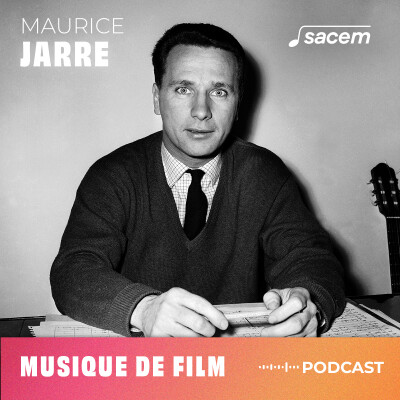
Speaker #1He came pretty close towards the end of the movie when we were in the process of cutting the movie. So the movie had been shot and he would watch the movie spool by spool. And we had in those days... People didn't use synthesizer. This was in the mid-'80s. And so everything was done by piano. And in many ways, when you work with a composer, it was an act of faith. I couldn't hear. Now when I work with a composer, he plays back the orchestrations and the whole piece with a temp. done on a synthesizer. Even though I don't hear a real violin or a real trumpet, and those instruments will be recorded later, I do get a very, very good idea of what the music's going to sound like. It's almost 90% of it I'm going to hear nowadays. But in the time I worked with Maurice, we had none of that. I simply had to listen to him. He would play on the piano very quietly some of the lines. He'd say that the brass are doing this, the woodwinds are doing that. Meantime, the percussion is doing this. Meantime, I have a choir doing this. And I had to sort of imagine. So working with Maurice in those days was very fragmented. He would suggest on the piano... what the various instruments would be doing. So he'd play something, he'd take a certain section of the film with the picture and he'd say, OK, right here now the woodwinds are going to be doing this, the brass are going to be doing this, the percussion will be doing this. He would often sing if he couldn't at the same time. He's not a very good singer. In fact, he's a very bad singer. but he would give me some idea of what another line of the orchestration would be doing. So I had to sort of put these bits together in my mind and really trust his ability to do it. And of course being such a master I had complete faith. I was never surprised somehow even though he's not a good singer and he I don't think he would even claim to be a great piano pianist he was able really convey to me by description, by feeling, by humming, by doodling on the piano, very much what the final orchestra would sound like. I found it quite a lovely experience, really. It was someone trying to describe to a blind man what they were seeing. Because I'm not musical, he was able to sort of whisper in my ear and play something. And somehow I would get an impression of what the sound... the final orchestral music would be like. But it wasn't until I got on the recording stage and actually saw him with the orchestra and saw what he was doing. The music for the film was recorded in London with the Royal Philharmonic. And it wasn't until I actually flew to London and actually heard what he was playing with a full orchestra against the picture that I had any idea of what it was going to be like. So It was very interesting, very different from working today. To my delight, of course, there was no doubt about what he was writing. I loved everything he did. It just seemed to work very well. So obviously any great composer like him works very, very intuitively. I remember a very bizarre incident. As I said earlier, Maurice, these are my offices and Maurice worked in an apartment building about a block away and he was like on the 17th floor of this very tall apartment building, very narrow, and he wanted to have a big piano but the elevator was very, very narrow. and they couldn't fit the piano. So they had to get this huge crane to lift this grand piano up 17 floors and then swing it across onto his balcony and put it in his living room in order for him to compose the film. And it took... It was a comedy of errors because, first of all, the people who came to measure the elevator... They brought the piano but it couldn't fit in the elevator. They had to take the piano away. So then someone came along to measure the crane and they brought a crane. They started to lift the piano but the crane wasn't big enough so the crane had to go away. It took about a week to get Maurice's piano. We lost a week by the incompetence of the people trying to bring the piano. It was too difficult to bring it. So Maurice laughed. He thought we Australians were too crazy. He thought we were nuts and very incompetent. I think he wanted to make a movie about the comedy of the piano and how it arrived, how it arrived. But he made up for the lost time and he quickly got into composing. Music is incredibly important to a film. We all know many, many examples of movies where, had you taken away the music, the movie would have been diminished significantly. And could you imagine, for instance... Um... Dr. Zhivago without the music of Dr. Zhivago. Could you imagine Psycho without the music from Psycho? So obviously the music is very significant, and in many ways it's the kind of internal narrator of the movie. It's the means by which the storytellers, and in this case the composer is one of the storytellers, can get into the subtext of the movie. Whereas the actors or the dialogue, the writers, the director, can't really... They can imply subtext, but they can't address it directly. In many ways, apart from mood, the composer can guide the audience through the subtext of the movie. So the composer is a very, very important part of the storyteller. What was so interesting back then... was to take someone you'd never worked with before, Murray Shaw, to listen to his doodles on the piano and with his voice and somehow have some really clear understanding of what it was going to sound like when you finally saw it. It wasn't until I got to London and there was the orchestra playing against the picture that I really understood what he was trying to do and I was never disappointed. I was often... more delighted. I was never surprised. Somehow he was able to convey to me what the music would be like. So by the time I got to mix the music against the sound effects and the dialogue, you know, I was able to get them working as well as possible. choosing a composer, because ultimately they have a big influence on a movie. And depending on their sensibilities, if the sensibility is going wrong, then you're in big trouble because they can skew the movie one way or the other. So it is a big risk, but given that I had a lot of encouragement, given the breadth of the scores he wrote. Given all those things, it's a little bit like working with an actor or any creative decision. You kind of go on your instinct and you say, my God, if he was able to create those feelings, that atmosphere on this film, say, and then this film and so on, you already know in their repertoire what they're able to do. You already sense that. And then I had that idea reinforced. by talking to Peter Weir. And thirdly, I met Maurice. And you meet Maurice and you get to understand very quickly the sort of person he is and you put that together with all the other information so it becomes less and less of a risk. I think it's more of a risk when you work with someone who's never composed before. I mean, you would have had to have heard some music before you decide. And usually something of the artist is embodied in the work, even if it's a fragment of music. But to work with someone like Maurice, someone who's had... had a lot of experience, a lot of wonderful experience, worked with some really fine, great filmmakers, you know that he's going to be able to deliver. It's a question of really being able to collaborate with him very well and to give to him, you know, to sort of load him up with as much information as I could about what I saw in the movie and what I thought the movie really wanted. But after a while it became a very easy collaboration. I would, you know, I remember leaving the editing room and going to work. You know, I had an appointment each day with Maurice and I couldn't wait. I'd run down the street and couldn't wait for the elevator to take me up to the 17th floor and work with him because it was always so exciting. It was like I didn't know what he had in store for me. It was going to be always exciting. When we got the call, I'm ready to show you something else, my heart used to... and I'd be very, very excited. It was always a great privilege. You know, it's like opening up a new gift.