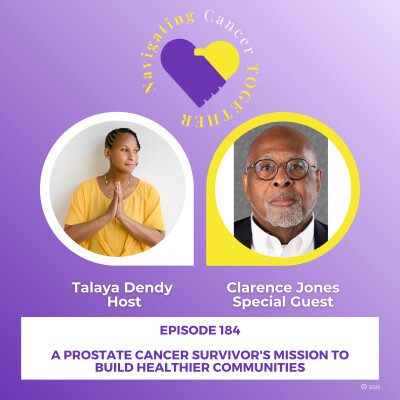
- Talaya Dendy_Host
Hello, welcome to another episode of Navigating Cancer Together. Navigating Cancer Together is the show that has something for everyone facing cancer. Why? Because everyone is different with different needs, beliefs, and perspectives. Thank you so much for joining us for this very special episode. I encourage you to open your minds and your hearts. Navigating Cancer Together is everywhere. Make sure to subscribe and follow the show to stay updated on our latest episodes. You can tune in on Apple Podcasts, Spotify, YouTube, or your preferred podcast app or platform. Today's episode is brought to you by On The Other Side. On The Other Side provides emotional support, health and wellness, communication tips, and so much more to individuals and families who are navigating cancer. Fill out an intake form at ontheotherside.life to get connected with an experienced cancer doula today. Today we have a very special guest joining us today, special for Prostate Cancer Awareness Month, which is September if you did not know. And this is a very important topic. Now, before James share his story, I want to tell you a little bit about prostate cancer. And James's story is really important, especially for all the men out there and women who love them. Here are a few numbers. About one in eight men will be diagnosed with prostate cancer in his lifetime. And it is the second leading cause of cancer death for men in this country. But here's the very important part. That really can change everything. When prostate cancer is caught early, the five-year survival rate is nearly 100%. When it's caught late, after it has spread, that number drops to about 38%. Early detection is literally the difference between those two numbers. And it isn't the same for everyone. Black men are about 70%, which is up. from 67% last year and a few years ago. They are 70% more likely to be diagnosed with prostate cancer and roughly twice as much as likely to die from it as white men. Those figures come from the American Cancer Society. I share those numbers because my guest today is living proof of what that first number, early detection, can do. James Waddington is a prostate cancer survivor, an educator, and an advocate for early prostate cancer detection. James was diagnosed in 2020 through a routine PSA test. For those who don't know, PSA is prostate-specific antigen. And James credits his early catch with giving him the chance to begin treatment and reach survivorship. Today, James shares his story to raise awareness, especially among Black men, and through his community work and his advocacy with the American Cancer Society Action Network. He pushes for open conversations about men's health and for affordable access to screening and treatment. So that cost never becomes the reason that someone doesn't get the care that they need and deserve that could save his life. James, welcome. I'm so glad you are here. And let's talk about this very important topic.
- James Waddington_Guest
Thank you. I'm super glad to be here. That introduction made me feel a little special.
- Talaya Dendy_Host
You are special, James. You are. And over at Navigating Cancer Together, that's the aim.
- James Waddington_Guest
You've achieved your aim so far.
- Talaya Dendy_Host
Thank you. So James, for our listeners out here, before we get into the really heavy stuff, I would like for the Navigating Cancer Together listeners to learn more about who you are, James. And what are some of the things that are unique about you that many people may not know?
- James Waddington_Guest
Again, I'm James Waddington. I am, yesterday started my 34th year in public school education. I have been married for 29 years. I have Two children, one who is a recent graduate of the University of Pittsburgh. Another who is a sophomore in college, teaching, being a dad, being a family man and doing my best to raise awareness about cancer is pretty much what I'm into right now. Do a lot of stuff that I say fit because I understand that once your body is healthy, once other things come, you can fight a little bit more readily. So just trying to stay active physically, mentally and spread the word to see how many lives we can save.
- Talaya Dendy_Host
Thank you so much, James, for all of your very important work. And I can tell you that you are truly helping to save lives. And we're going to get more into some of the challenges that men face just in terms of talking about their diagnosis and seeking help. So James, you've spent three decades, as you just said, teaching kids how the world works. What has surviving cancer taught you that you couldn't have taught? your students before, but you certainly can now.
- James Waddington_Guest
I think one of the biggest things is teaching my children and my students that being on top of your own physical health is so important, making sure you know what's going on with your body and giving that lifelong example. Another example, I talk to my students about my diagnosis and the work I do just to let them understand the importance of community activism and getting involved in your community. Just because this happened to me doesn't mean I should just let it happen and go in a corner somewhere. I'm using this to make lemonade, as we say, life gives you lemons, you make lemonade. So I've been trying to squeeze these lemons for the last couple of years and make some good lemonade and share it so others don't have to go through some of the experiences I've heard. Continually tell people my cancer story, in my opinion, has been an easy road compared to so many stories I've heard over the last few years of people who... had to go through the chemo and the radiation and the surgery and after a year or so come to find out they were in remission but it's come back so i'm just thankful to god that courted early got everything taken care of worked in conjunction with my doctors and when i went for my five-year appointment and they said james you've graduated i was kind of shocked and a little disappointed because it became part of my routine like i don't come back anymore They're like, no, James, this is a good thing. You don't have to come back. When you talk about that five year survival rate, it hits me because there's a good chance, a very good chance that I don't have to worry about this again. But I also understand that prostate cancer is not the only cancer out there. So you always have to be diligent because you never want to hear those words again. You have cancer.
- Talaya Dendy_Host
That's the truth. As a survivor myself of 15 years, that thought never goes away. And like you, James. I'm doing everything that I can to try to prevent that from happening. And again, thank you for taking your experience and using it to really help and educate other people. I want to talk about some preconceived notions that people have just about cancer in general, and then we can tie it to prostate cancer. So most people assume that a cancer diagnosis starts with you feel like something's wrong. And in some cases, no one gets that. They don't have a symptom or something. And yours didn't surface until you did a PSA check. And so take us back to that moment, James, when you decided to get a PSA check and then you got the news. What was going through your mind?
- James Waddington_Guest
My story is a weird one. So I'll start at the beginning. In December of 2019, I was at a Blue League. basketball draft. And my wife called me and said, Dr. Cavuto, who was my personal doctor, has been trying to get in touch with you. So this is a Thursday evening. I'm like, okay. So I stepped out of the meeting and I called him and he's like, James, I just got your glucose levels back. And it looks like you have diabetes and I want you in here tomorrow. And I'm like, diabetes. He was really diligent on staying on top of me, making sure my numbers were checked every three months. So in March, and he said, I don't like your PSA. And I'm like, my PSA, what is that? So he explained to me what the prostate specific antigen is. He said, I need you to see a urologist. And I was like, okay. So that was March of 2020. And as you know, March of 2020 is when the pandemic hit and everything was shut down. So my wife tried to make me an appointment for urologist and everything was closed. So I couldn't go. So I just, oh, well, the PSA looks funny to him, but it didn't mean much to me. I went back to him in July. He said, James, how did urologist visits go? And I said. I didn't go. I couldn't get an appointment. He said, I need you to go. So I made an appointment with a urologist just following up because he told me to. We had a 20 year relationship, so I trusted him. And I went to urologist, got the biopsy done, and I was set to go back on a Friday afternoon. I go back to the doctor's office. It was all closed. Some reason they had to shut the office down and I called the officer. Hey, I came from an appointment. Nobody was there. He called me back the following Monday and I was just on my cell phone walking in front of the house thinking it's routine. Hey, James, everything's fine. And he said, hi, James, I'm sorry to tell you this, but you have cancer. So, you know, right there walking past the front of my house, I just automatically thought I was going to die. So it was weird to hear it on the phone. It was definitely unexpected because I was just following what the doctor told me to do. I thought there was no problems because, like you said earlier, there was no symptoms. There was nothing going on where I thought something was going on with the prostate. So getting that news was a very big shock.
- Talaya Dendy_Host
I bet it's something you'll never forget.
- James Waddington_Guest
Never.
- Talaya Dendy_Host
And how did you share that information with your family?
- James Waddington_Guest
So I immediately called my wife who was at work and told her the news. Because it was the pandemic, everything was pretty much on the phone or on the computer. So trying to figure out how we were going to tell my kids who were teenagers at the time. And one night we were at dinner and after we finished eating dinner, I just told them and my wife didn't even know I was going to tell them. And it was a life stop for a second. Everybody just froze and we had to deal with it from there. Last thing I wanted to do is them hear me on the phone or see me on a Zoom call with a doctor and not know what was going on. And unfortunately, in 2006, I lost my dad to lung cancer. So my kids understood that cancer can easily take you out. So I didn't want them having that worry. So we talked about it and just got to understand that we were going to do next steps.
- Talaya Dendy_Host
Thank you for sharing that, James. It's so important to have those conversations. I know sometimes people try to shield their children from what's really going on, but kids are smart and they figure out when something's going wrong. So I love that you really talk to your children early and share that with them. James, you had shared before that you had decided to go the surgery route in terms of your treatment. Can you please walk us through how you landed on that choice? And what did recovery look like for you?
- James Waddington_Guest
Sure. So if I could just back up a little bit, I was, I consider myself blessed to have time from the time I was diagnosed to meet with multiple doctors. And it was a four month span for me to decide to have the surgery. And I find that so important because, like I said, I lost my dad to lung cancer. So my dad was diagnosed in November of 2005 with lung cancer. He was gone four months later. and died March 7th, 2006 from lung cancer. So for me to be diagnosed September and be able to meet with doctors and come up with a plan of action, I just find it a blessing because my four months was a whole different four months than him. And that's really what got me understanding the importance of early detection. That early detection allowed me to make some choices. And after meeting with doctors, from one doctor saying, hey, let's just observe it and see what happens, to the other doctors giving me a chemo, the radiation. But to be quite honest, one doctor told me once, he said, James, if we do radiation and chemo, we just have to do that biopsy every year and just to make sure everything's okay. And at that point, I said, no, you're never doing that again. So we're just going to take it out because I was not going to go through that experience of the biopsy again.
- Talaya Dendy_Host
Understood. And how did you feel when you made that decision? Do you feel like you had enough information to... come to the best decision for yourself. And for anyone out there who's listening, James, who is not really sure how to go about getting the information that they need, what tips do you have for them?
- James Waddington_Guest
When I finally made the decision, I felt super confident because first of all, I was at one hospital and got the diagnosis. When I was speaking with a colleague, he mentioned Sloan Kettering Hospital in New York. And I did my research on Sloan Kettering and saw that they were one of the best in the country with prostate cancer. So I looked to see if my benefits, my medical benefits would cover up there. And they did. So I got a second opinion from them. And just making sure I didn't just go on that first opinion, making sure I did my due diligence, went to the American Cancer Society's website and started doing all kinds of research. As an educator, I'm used to doing research and trying to make sure my lessons are sound with packed with information. So I did the same thing with my own medical care. So I became informed. I talked to those who've been through it. I talked to the doctors and tried to weigh everything. But I think the worst thing you can do is just try to make a decision based on one person's opinion, first of all, and not having information. One of the things I truly understood early on is... When the first doctor told me that I had the prostate cancer and I decided to get a second opinion, I felt I didn't want to offend him, but my life was more important than offending him. And I knew him through my doctor who diagnosed me. But other than that, I really didn't know him. So if he was not happy with me getting a second opinion and going to another doctor, I'm quite sure he's still living his life happily and I'm doing the same.
- Talaya Dendy_Host
I love that. Yes, you got to do what's right for you. That's for sure. And it's not about being rude or hurting anyone's feelings. You really have to take those personal things out of it, take the emotion out of it and get right to the facts of what is going to benefit you. And I love that you did that for yourself.
- James Waddington_Guest
It's also interesting you mentioned the recovery. I really believe my faith tells me that my steps were ordered. So, you know, finding, being diagnosed with the diabetes. And that was after my wife made me an appointment and sat there with me because I was ignoring the symptoms of the diabetes. And that scared me. So I really I lost about 35, 40 pounds. I was out running and getting in shape. And this was during COVID. So I was the only one out in the street running. People like, why are you out at midnight running? I said, if somebody comes up with me at midnight while I'm running, COVID is not our concern right there. I think that prepared my body for the deal with this because where I was heavy and out of shape, by the time surgery came around and when the diagnosis came around, I was up to running over 100 miles a month. and really getting there. So after the surgery, they have you walk. And they said, James, we want you to walk around the floor of the hospital and just to get yourself. And I was doing laps and like, James, you can slow down. This is not a race. But because I was prepared physically to deal with, I think that helped me a lot. So there's certain things I could not do for a few months. And I followed the doctor's advice, but I'm still able to within maybe three, four weeks, get back to working out and getting in shape. My surgery was a week before Christmas. I had to wait seven days before the catheter came out. And that meant either going to a doctor or going back to New York. But the hospital also provided a YouTube video. So I watched the YouTube video and took the catheter out myself as my Christmas morning present. And just I think, again, that was part of recovery because my body was prepared for it. That's why I still try my best to stay in shape and make sure my body is strong enough to handle whatever's coming.
- Talaya Dendy_Host
What I heard you say is take care of your health before something really serious happens, because it can really determine how you get through that thing if it shows up, if it's cancer or something else, how your health is before will really determine how you get through that thing, how you get through treatment, all of it, all of it matters. So if you are not exercising and eating right and things like that. And something like cancer or another disease shows up, it can make it that much harder for you.
- James Waddington_Guest
Amen. I couldn't say it any better. That's so true.
- Talaya Dendy_Host
Thank you, James. Now, James, I've had conversations with many men and Black men in particular, and Black men are just not having enough of these conversations or not at all. What do you think is actually underneath that silence? What is something that can help to bring more of these conversations to the forefront?
- James Waddington_Guest
I'm going to be quite honest, as smart as I think I am, I am not 100 percent sure. Unfortunately, I think it's pride, ego, ignorance. There's a lot going on where we as men don't talk about it. As you can see, I probably haven't been to a barbershop in a while. But when I take my son to the barbershop or took my son to the barbershop, the conversations you hear about all kinds of things. But this is a conversation you never hear. You never really hear a conversation about men's health and the things you have to deal with, especially prostate health. When I do resource tables and things like that, I ask men, hey, are you up on your PSAs? And they look at me like, what are you talking about? Or I talk about prostate. I get the funny looks. And a lot of the conversations I have with men are men who went through it. And I know at church, many men came up to me afterwards and said, hey, James, I've dealt with it. And I'm like, why am I finding this out now. If we would have had these conversations earlier in my life before this, I would have been able to be a little bit more cognizant of the screenings and things like that. Like I said, I didn't think about a pizza. My doctor was doing it as a part of my routine blood work. And the majority of conversations I have about prostate cancer, unfortunately, are with women who are getting information for the men they love. I've had numerous times where women have contacted me and say, hey, can I get my husband your number? So he can talk to you about it. And I gave him the number, but it's a good chance I know I'm not going to hear from that man. So it's unfortunately, I have a co-worker whose husband went through it and she said, Mr. Waddington, my husband said they took his manhood. after surgery. And I get in trouble sometimes when I'm doing these forms of panels. I'm like, brothers, if that's what determines your manhood, you have more trouble than cancer. So for me, manhood is raising my kids, going to work and doing the best I can as a teacher, doing what I can do at church to be a leader and just helping the community. That's where my manhood comes from, not just this prostate that I lost.
- Talaya Dendy_Host
I love that. So what I heard you say, James is that when you're focused on the wrong things. And it's so important. There's more to being a man than biology. It's how you treat your family, your work, your community, all of these things, the contributions you make in life. And I think that's such a great point because I'm sure that's not an easy thing to go through. And I'm sure it changes you in a lot of ways, not just physically, but mentally and emotionally. But I think that as we grow, it's so important to just realize that we're more than this body that we're in. We still have our soul. We still have our spirit. And we're still able to make an impact regardless if we choose to do that.
- James Waddington_Guest
Correct. And fortunately for me, when I was going through the consultations and things like that, Sloan Kettering kept pushing that they have psychological support available. And I'm like, for what? It really didn't hit me. But now that I look back at it, the work that I do has been that therapy for me. So I don't have to go sit and talk to a therapist, but I'm out there talking to people. People walking up to me and saying, hey, I thank you for sharing because I talked to my husband, made him go get testing. I did a panel a few years ago with the American Cancer Society and a running club co-sponsored it with us. And the leader of the running club contacted the woman from the American Cancer Society, who coordinated it, and said, James may have saved my life. Listening to him, I went and got a checkup, and we found A, B, or C. And, you know, just little things like that. Being out there, talking to people about it, because as much as the cancer work is important, the overall health and taking care of yourself and those going with you is just as important. I've done 5Ks. I've done 10Ks. I've done half marathons. I've done a couple of 66-mile bike events. with the American Cancer Society to raise awareness and raise money. And that's what's pushing me to say, hey, God didn't get this to you as a punishment. He gave it to you as a vehicle to do some good work. And that's the way I look at it.
- Talaya Dendy_Host
Wonderful. James, as you've shared throughout our conversation so far, you tell your story over and over. And sometimes that can come with a cost. We just touched on mental health a little bit. So you What does it take out of you to keep reliving your story and putting it out there in public? But what keeps you saying yes, despite the cost that it may have?
- James Waddington_Guest
I agree with you. It becomes work sometime because unfortunately, I am now that person in my circle. When someone is diagnosed, they're like, hey, you know, so-and-so is diagnosed. Or when somebody dies from cancer, it really hits me a little bit harder. I'm like, oh, wow, another person. And it makes me realize. how devastating this disease is. But what keeps me going is I'm still here. And I have the faith that the reason why God allowed me to go through this and it has not been as rough as I've heard other people is because he didn't want to take me under. He wanted to push me out there to do more work. And scripture says this disease is not into death. It's to glorify God. And that's what my motivation is. to continually glorify God and do his work. And he said in me and realized that the cancer wasn't a curse. It was a mission. And I'm one of the weirdos who tell people all the time, I thank God for this cancer experience. I hate the disease, but the experience, you know, kid from the projects of South Shirley, if you're on the news, it's normally something negative, but I've been on all the local news. In Philadelphia, except one, I've done a YouTube for the American Cancer Society, one of their campaigns. British Broadcast did a documentary, a five-minute thing for an international cancer thing that was going on. Those opportunities, the people I've met and the experiences I've had have made me as a better person and helps me deal with it even more.
- Talaya Dendy_Host
Wonderful. Thank you for sharing that. And I'm so glad that you've been given the opportunity to get on different platforms and reach. more men. That's wonderful.
- James Waddington_Guest
Thank you. And like I said, to me, it's God's work. So as long as he wants to use me, I'm glad to be on this earth to be used.
- Talaya Dendy_Host
At one point, James, you were the person who needed support. Was there any kind of support that you needed that didn't exist? So was there something that looking back that you really needed, but it just wasn't available to you at that time?
- James Waddington_Guest
Looking back, I didn't realize it back then, but I think the biggest support was the ability to be in contact with other people. So my support system, my physical support system was my wife and two kids, because, again, we were in the pandemic. We were in the house. I only told a few people what was going on. I'm part of a huge church family, and I know if we would have been in person during church and I was able to be around those folks, that support would have been there just through prayer, the laying of hands, things like that. It was just missing. I'm active at work and I do a lot of work talking about cancer awareness at work. And I love the fact that at my job, especially my current school, there are a bunch of cancer survivors there and we lift each other up. Quick story, I have a coworker who came last year and she had something wrong with her hand. And I asked her, what's going on with your hand? And she gave me a real funny look. And I said, hey, you can tell me about my business if you want. And she said, yeah, let's go with that. I was like, okay. So the next day she came up to me, she said, Mr. Waddington, is that you on that poster about cancer in the staff lounge? I said, yes. She said, that's what's going on with me. I'm a cancer survivor and this is one of the after effects. So we started to get closer and talk about it. I introduced her to my lead educator who was going through a second bout of cancer and they've gotten real close. And when other staff members who dealt with cancer heard about her, they brought her in and supported her. And just that that support is so important. So now she's one of the cancer crew at school and we just lift each other up and understand that, hey, everybody's battle is different, but it's a battle that we're going to support each other through.
- Talaya Dendy_Host
And Thank you so much for sharing that story because it is a real life example of how important community is when you are going through cancer and even into survivorship. Because it's one of those things where you can feel like it's just you. You're the only one or what you're feeling or thinking is strange or weird. And if you're able to open up and talk to other people, you'll find that it's not.
- James Waddington_Guest
Yes, I agree 100 percent.
- Talaya Dendy_Host
James, if you could sit across from your father today, knowing what you know about early detection, what would you say to him? And what do you think he'd say about the amazing work that you're doing?
- James Waddington_Guest
The second part of your question is the easiest. My father would be super proud. My father probably would be telling everybody that he prepped me for being able to speak and do all kinds of things. So, yeah, the work I'm doing, he would be excited about and proud of. The other part is the harder part because my father is one of those black men. So he probably wouldn't want to talk about it. I know he wouldn't want to talk about it because when he was getting sick, my aunt called me and said, Hey, you need to go talk to your dad because he's not doing well. He's losing a lot of weight and he's not looking good. So I go to his house. I'm like, Pop, what's going on? You're losing weight. He said, Oh, no, nothing's wrong. He said, I just stopped eating ice cream. So I'm like, you're going to lose all this weight from stopping eating ice cream. And. My brother had died 2004 from a stroke at age 35. So I'm like, pop, you need to go get checked out. I said, do you want to be like your son? And he got super mad at me. And as an adult, that's probably the maddest I've seen him with me. A few weeks later, we're in a doctor's office. And my father, who was a nice size man, we're in the doctor's office. And he says, Mr. Waddington, you have lung cancer. Seeing my dad's head drop. that's the The first time I've ever seen my dad in a position where he just looks so vulnerable and beaten. So, you know, to the end, he tried to deny it and didn't want to deal with it. So, you know, pop early screen to save his lives and all this stuff. I'm fine. Don't worry about it. Probably would have been his answer, unfortunately.
- Talaya Dendy_Host
When you are able to advocate for yourself and you're able to reach so many other men, How does that feel when someone so... close, like your father or any other family member who just doesn't want to hear it, what do you do in those cases? How does, how would, what would you recommend? Because that's happening everywhere.
- James Waddington_Guest
Yeah. For me, I'm stubborn, so I would keep going at it. As an educator, we have something called differentiated instruction. So if a student doesn't get a lesson one way, I try to show them another way and show them another way. And that's what, you know, Until... there's no more options i'm gonna keep trying to give you options and try to motivate you. And I think sometimes my experience is not the one. So you try to introduce the folks to other people's stories. We had a gentleman at church who I was talking to. He was dealing with prostate cancer. And I felt that my story wasn't moving him as much. So I showed him a video of our former mayor, Michael Nutter, who was going through prostate cancer at the same time. And the funny thing is his wife had worked for Nutter. So his wife saw the video of Nutter. reached out to Amir Nutter. He called him and they had a conversation because he's about 15 years older than me. And they had a conversation as older men, how to tell your older children how to deal with it. And that really helped him a lot. So, you know, the resources, if you're not the resource to help somebody find a resource that's going to be suitable for them.
- Talaya Dendy_Host
Wise words. Thank you for sharing that tip. James, when you hear the phrase navigating cancer together, what does that mean to you?
- James Waddington_Guest
The navigation part is easy. There's many pathways to deal with this cancer and you just can't go about it willy-nilly. Sometimes you need some support to get you from A to B, sometimes from A to B to C back to B, and then together you can't do it alone. You even need a support system, you need a medical support system, you need a family support system to help you look at things and make decisions. One of the things that for me that was advised and I see it worked out Bye. is my wife sat in on a lot of my Zoom calls because you're hearing you have cancer, you have to do this, these are the things, but you don't hear the details of some of the options you have and some of the things you can do. So, hey, did you hear when they said this? Hey, how about thinking about when they said this? So having somebody to navigate this thing with you, I think is so important, whether it's just making decisions or just that support system and to get you from one point to the other.
- Talaya Dendy_Host
Throughout our conversation, James, I've heard one person come up continuously, and that is your wife. So I just want to give your wife props for being that person to say, hey, you need to do this. You need to get these checkups. You need to do this, that, and the other. Stay on top of your health. I just want to applaud your wife. But there is a message there as well. For any woman out there listening, you may be the person who saved you your husband or your partner's life. You hear James's story here about how his wife encouraged him early on to go in and have those checkups, have those appointments, stay on top of the men in your lives because you might just save it.
- James Waddington_Guest
Yeah, it's funny. I do vocabulary and I understand through this journey, love can also be synonymous with nagging. So we see it as nagging, but it's just an act of love.
- Talaya Dendy_Host
That's right. That's right. I like that. James, there is a man listening right now, and he has been recently diagnosed with prostate cancer, and he's scared. He probably feels ashamed. What is one thing that you would advise him to do before he does anything else?
- James Waddington_Guest
I'm a give. the James answer. And this is not necessarily universal because this is particularly for men of faith. First, stop and pray. Stop and pray. Get yourself centered. Make sure your faith is strengthened to understand that just because you have a diagnosis doesn't mean you have a death sentence. So start planning on how you're going to move on with life, how you're going to deal with this and continue to live. There are going to be some ups, some downs. It's not going to be easy. But strengthen your faith, strengthen your courage and solitude that you know you can get through this. Until the end is here, you always have a chance to get through this.
- Talaya Dendy_Host
Thank you for sharing that, James. Before we end, is there anything else that you'd like to share that you haven't had an opportunity to share?
- James Waddington_Guest
I think I just want to reemphasize that early detection can save your life. Early detection can save your life. And if you have to go through this, don't go through it alone. And once you get through it, make sure you went through it for a purpose. Reach out and help others, because if we just sit back in our corners and allow others to go through these things without the guidance that we can provide, I think you're cheating yourself and you're cheating others and you're missing a wonderful opportunity to touch mankind in a positive way.
- Talaya Dendy_Host
That is a great way to end, James. Thank you so much. It's been such an honor and a pleasure to talk with you. And thank you for being one of those. fearless men who says, hey, my story and what I have to share to help other men and really anyone is more important than shame or fear or. whatever guilt, whatever else people may be feeling. So thank you so much, James, for sharing your story here and all the wisdom that you've gained along the way.
- James Waddington_Guest
You're super welcome. I really thank you for the work you're doing in this platform. When you reached out to me, I was like, hey, what's going on? And I started doing the research and I'm like, wow, this is important work. So I thank you for the opportunity and definitely appreciate the work that you're doing to help folks navigate through this thing, because without people like you, we... we stuck. It's a good thing to have everybody pushing towards the same goal.
- Talaya Dendy_Host
Thank you, James, so much. And, you know, no one wants to be in this club for sure. We didn't ask for this, but it's such an honor to be in this club with people like you, James. Thank you so much.
- James Waddington_Guest
Thank you. I truly appreciate you.
- Talaya Dendy_Host
Before we end, I would like to give a shout out to the Navigating Cancer Together community and valued listeners. Today's episode, again, was brought to you by On the Other Side. Thank you so much for joining us. That is it for this Wednesday. And until next time, let's keep navigating cancer together. Take care.