- Speaker #0
Welcome to the Plant-Based Coaches Podcast, where you'll learn about the latest in health and nutrition with your hosts, Plant-Based Rich, Richard Hubbard, and Physical Therapist and Wellness Coach, Dr. Suzanne Fox.
- Speaker #1
Hey everyone, this is Rich, Plant-Based Coaches Podcast. Joining me here today is Dr. Suzanne Fox.
- Speaker #2
Hi everybody, it's good to see you.
- Speaker #1
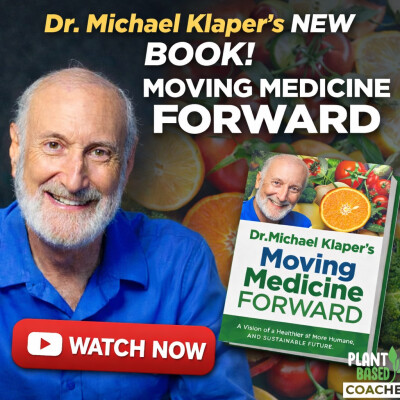
And we're honored to have an advocate and... a friend of the podcast, Dr. Michael Clapper. I've followed his work for years. His work means so much to me, and I'm excited to talk about his new book. The book is called Moving Medicine Forward, What More Doctors Should Know About Nutrition and How It Could Save Your Life. I love that title, Dr. Clapper.
- Speaker #2
It's a great title.
- Speaker #1
Yeah.
- Speaker #3
Well, Todd, we've got to move it forward. We're still stuck in the 1950s. Yes.
- Speaker #1
We are. We are. Are we getting closer, do you think?
- Speaker #3
We're making progress. We're getting closer. Doctors are waking up all over, and the public's demanding it as well. How many times do I have to hear, why doesn't my doctor know anything about nutrition? Yes. And that we can't let that stand. We've got to knock that wall down. And we're doing that with podcasts like this, and just the truth of it. most people are in those bodies in the doctor's waiting room overweight diabetic hypertensive atherosclerotic from what they're freaking eating every four hours and unless the doctor realizes that then they're just treating symptoms and so it's time to uh
- Speaker #1
shine a little light on that reality yeah i was fortunate because um my doctor um i'd say about 10 years ago he wasn't plant-based and um I mean, he was impressed with my weight loss and everything, but he says, you don't even eat fish or eggs. So I knew it was time to find a plant-based doctor. And I'm lucky I have one in my home state. And I've had no issues ever since because it's really important to have somebody who's in your corner.
- Speaker #3
Absolutely. Absolutely. Fortunately, there's going to be more and more doctors around, and in our book we have resources where people can find a plant-based doctor. But now in the age of telemedicine, there's lots of good plant-based physicians who can give you counseling even over your computer there. So things are looking brighter on that score.
- Speaker #2
Yeah.
- Speaker #1
What was it like when you were in medical school? Nabi Abu Salman I mean, how bad was it with nutrition? Did they not teach you anything at all? Oh,
- Speaker #3
it was nonexistent. We just blew right past that, what the patients eat. It never really entered the conversation. Any issue regarding nutrition was covered in biochemistry. What happens if you don't get enough vitamin C? You get scurvy. What happens if you don't get enough niacin? You get pellagra. And that was about it. It was just useless information as far as really helping the doctor understand the role of the patient's daily diet and the diseases that we're treating. And so... The first, second year of medical school is so packed with basic sciences, biochemistry, histology, physiology, anatomy, that there's no time to talk about nutrition. And besides, it's all cultural. You can't tell a Hispanic patient what to eat and an East Indian patient what to eat. This is really none of your business, doctor. Just look to make sure they don't have any obvious diseases and you've done your job. And that's, you know, appallingly inadequate. And one of the main emotions I feel these days is embarrassment. It's embarrassing that doctors don't know anything about nutrition. And that's where the seeds of ignorance are sown. In medical school, you go through the basic science years, and then the clinical science years, rotating to the various specialties. And you pronounced a doctor fit to be unleashed upon the public without knowing the effects of food. The truth is that when the designers of medical education said, well, if we put in a nutrition course, what do you want us to drop out? Biochemistry? Physiology? No, that's a cynical proposition. The truth is nutrition should be woven into every subject that the medical student in CAR, the anatomy of the digestive system, the physiology of the digestive system, when you're studying biochemistry, the biochemistry of energy production, and certainly pathology. These are all basically nutrition-based diseases, the heart attacks and strokes and cancers. Pharmacology, how food affects the drugs people are taking. On every level, in the basic sciences, nutrition should be woven in. And in the clinical rotations, in obstetrics, these women are eating so much. Empty calories, they're getting obese, and the babies are getting big. You've got to do more cesarean sections. They get gestational diabetes. from the food. Pediatrics. Atherosclerosis is a pediatric disease. It starts in childhood. You see, they do autopsies on kids killed in car accidents. At age 10, 11, they already have atherosclerotic streaks in their artery walls from all the peaches and burgers they're eating. Certainly, internal medicine, you ought to be talking about nutrition with every patient. Surgery. Why are they taking out all those gallbladders and doing all those amputations? Again, they're all dealing with nutrition-based diseases. So nutrition be woven into every aspect of medical education, and that's what we're advocating in our book, Moving Medicine Forward. So it's a false dichotomy that you've got to teach nutrition or nothing. No, you should teach nutrition in every subject that the young doctor encounters.
- Speaker #1
I think we're slowly getting there. My mom, she actually fell and she had to go to the ER. To make a long story short, she didn't break any bones. But the doctor was impressed because she reversed her diabetes. He says he almost never sees that in a patient, and he knew about plant-based diets. But he was like so many other doctors, he doesn't recommend it to people because he thinks it's going to be too hard to follow. And now that they see examples, maybe they'll...
- Speaker #3
Give it a second. It's an old clinical adage that we learn the most from our patients. That's where we do the most learning. They teach us the reality. And your mother was a good professor for that ER diet. Good for both of them, but he was humble enough to admit it. So yes, our signs of progress is happening. They say you can't keep a hat pin in a cloth bag for very long. You know the point. comes out. And that's what's happening with the reality of food and medical care. I'm encouraged in that way.
- Speaker #2
Yeah, we have a local doctor here who does colonoscopies and colorectal cancer diagnosis, and I think the surgeries as well. And he says that he advises all of his patients to go on a vegan diet as soon as they have any polyps whatsoever. And especially if they have cancer, he says, no, if you have colon cancer, he said, when I come, When you come back in three months or six months or whatever it is for your screening, I'm going to be able to tell by the condition of your colon whether you've been following my advice or not.
- Speaker #3
Bravo. Good on him. That's exactly what should be told to the patient. And the V word would never have escaped his lips five years ago. Now he's using this. So that's signs of great progress. I'm very encouraged.
- Speaker #2
You have to use that word. I know a lot of people get really uncomfortable, but the plant, you use plant-based and a lot of plant-based products have eggs and dairy in them or pieces of fish or whatever. So you can't, you have to use the vegan word because that's. the only thing that truly people, you know, that's the one, whoa, you want me to give up everything? It's not, you know, they don't realize they're actually not giving up anything except disease and heartache, but it is what it is. Yeah, it is. I always use the word vegan. I said, yes, do a vegan diet. That means no animals in your food. You know, that's amazing.
- Speaker #3
That's the ticket. Absolutely. And it's delicious. And to choose the bean chili over the beef chili, you know, it's not that great a sacrifice, you know, but it makes all the difference in the world, literally. Huge difference. Yes, indeed.
- Speaker #2
I know whenever I go to the doctor, I had the same experience as Rich, where I go in there and they're like, oh, my gosh, your blood work is perfect. Everything is perfect. Like, what do you do? And I said, oh, I just do a plant-based diet. And they're like, no eggs, no dairy, no fish. Where do you get your protein? And then they just go on and on and on about that, you know. And then they just, oh, well, and they get sick of it and go to the next patient and start counseling through the door. You can hear them talking about, you know, this is, you're going to cut your lunch in half, and that's how you're going to lose half your weight, you know. It's not going to work.
- Speaker #3
Yeah, and that's embarrassing, you know. The doctors are saying that at this point. All they really need to say is go. Sweet potatoes and blood,
- Speaker #2
we will save you. Yes.
- Speaker #3
That's the truth of it, absolutely and all of that implies,
- Speaker #1
sure Dr. Clapper, how long have you been practicing as a vegan doctor, you know, promoting veganism?
- Speaker #3
Well, I got my MD 54 years ago I can't believe how fast time goes and for the first 10 years of um of my career. I practiced regular blood and guts medicine in emergency rooms, operating rooms, urgent care clinics, and I thought I'd be doing that all my career until partway through the career. I wound up on the attending staff at True North Health Center in Santa Rosa, California. And it's an inpatient facility where people come and stay for a few weeks. And they're served a whole food plant-based diet, a completely vegan diet without extra oils and salt and sugar. And the changes we saw in these people were nothing short of spectacular. I mean, overweight and diabetic, hypertensive within days. They're losing weight. Their arteries are relaxing and opening up. The blood pressures are coming down. The joints stop hurting. It's an anti-inflammatory diet. So the asthmatic lungs stop wheezing. The migraine headaches go away. And they turn into normal, healthy people right before our eyes. It's the most stunning and miraculous transformation in all of medicine. And once you see that, you can't unring the bell. You know, there's no going back when you see the power. of a plant-based diet.
- Speaker #2
And from there you end up at True North.
- Speaker #3
I had been practicing in New Zealand for several years running a large urgent care clinic down there and I got homesick and wanted to come back to the States and so I interviewed with several different health relatives. So I I had been vegan and that's why I had to find a vegan-friendly clinic. And the director of the clinic, Alan Goldhammer, and I have been friends for years. And he said, someday, Michael, you're going to come and work for us. Well, in 2009, it was that time. And so I joined the staff there, stayed there until 2018 and changed my career and provided the most dramatic evidence that it's the food, You know, you got to take a walk every day. You got enough love in your life. Get enough sleep. Yes, yes. Those other pillars of lifestyle medicine are important. But a plant-based diet is the key to making you remarkable.
- Speaker #2
I go to the gym all the time and I work on patients who are constantly at the gym and hurting themselves, you know, just things like that. The gym is full of overweight, unhealthy people. It's not. It's so sad because they're there doing what society says. This is 80, 90% of it. And I'm like, you got to walk to your kitchen. That's how you're going to fix this. This is not, the gym is 20% of it. The kitchen is 80% of it. This is honestly, it is the big wheel on the front of the tricycle.
- Speaker #3
You can't out-exercise your mouth. A friend of mine was a former NASA scientist. and he's really into body physiology. And so he sent me some slides. You see him in the... down in a basement somewhere, putting on a scientific mask. Well, this is the basement of the Hyatt Hotel in Atlanta, Georgia, 73 stories high. And he was putting on a mask that measures how much carbon dioxide he's breathing out, so you can determine how many calories he's burning. And so he was in his 50s at that time. He's down at the bottom basement of the Hyatt. and puts on his Nikes and proceeds to run up all 73 floors of the Hyatt Hotel in Atlanta, gets up top and looks at the reading on his mask, how much carbon dioxide would be that, how many calories he burned. And he translated those calories into Oreo cookies. You know, how many Oreo cookies worth of energy do you think he burned?
- Speaker #2
I'm going to guess 10. I'm going to guess 10.
- Speaker #3
Three.
- Speaker #2
No, that's way worse.
- Speaker #3
Exactly. There's so much energy in these sugary foods, and our muscles are so efficient that you have to, you know, there's one pound of fat has 3,600 calories. You've got to run 36 miles to run off one pound of fat. You can't out-exercise your mouth. It's the food, Because the glories of vegan food, whole plant foods, are mostly fiber and water. When you eat the broccoli and the rice and the soups and the salad, you're filling your tummy up with the fiber and water. And you pee out the water and you poop out the fiber. It doesn't stick to you. If you go back for a third bowl of vegetable soup, who cares? It really doesn't matter. It's guilt-free. And that's the truth of it. Yeah. The calorie density is so low. So it's joyous eating. No carb counting, no calorie counting. Just eat until your tummy is...
- Speaker #2
Giant plates. Giant plates of spaghetti. And people just get horrified. They're like, oh my God, how can she eat that?
- Speaker #1
You can see my salad. It's huge.
- Speaker #2
Just watch me. I'm going to eat it all.
- Speaker #1
And the thing is, I have a big appetite. And that's why I love this way of eating. Oh,
- Speaker #2
yeah.
- Speaker #3
Oh, sure. That's a great idea. And you push your head down the pillow, but you know, you haven't had any animals have their throat cut because of your food choice that night. It helps the ones being on many levels, no doubt.
- Speaker #2
Yeah. It's your protein, you know, and I always say, I don't even worry about it. I don't even worry about where my dogs get their protein. My dog's plant-based too.
- Speaker #3
Indeed. Ask any elephant, ask any gorilla or giraffe or buffalo where they get their protein. It's all in the plants. Exactly. That's where all the protein comes from.
- Speaker #1
I wanted to ask you about your books. I know Glenn Mercer was involved, a good friend of ours, on the animal podcast as well.
- Speaker #3
Yeah, oh, it was a, what a blessing to be able to have Glenn Mercer as my co-author. Glenn is an experienced writer. He's had plays on Broadway, and he's a true blue vegan in his heart. And he is a very witty writer. And so I would lay down some scientific track about blood pressure, whatever, and he would be there and putting in the human aspects. phrasing into it. This really helped the flow of the book. And I have to credit Glenn after we go through all the chapters of the book. One that I'm most proud of is chapter 5, A Day in the Disease Reversal Clinic. And I assume the voice of the chief resident of Lifestyle Medicine welcoming the new doctors into the disease reversal clinic. And, of course, all doctor's offices should be a disease reversal clinic. And we want to tell the reader and doctors that, one, the majority of diseases they're spending their careers treating are reversible diseases. I wish someone had told me that high blood pressure is reversible. I wish someone had told me. the type 2 diabetes reversible we get the opposite message high blood pressure they'll take these pills the rest of their lives diabetes one's on insulin always on insulin nonsense not only can you get these patients off these medicines you have to get them off once they get leaner and their blood pressure goes down you've got to get them off those blood pressure pills not insulin so um it's an exciting chapter where i want to put a model in the doctor's young doctor's head on the idea that these reversible diseases on a plant-based diet is the key to reversing them. And so it's a pretty science-heavy chapter, and we're giving the doctor clues on how to do this. But the last chapter Glenn largely wrote, and the last chapter of the book puts a lovely cast on it. The title of the chapter is It Just So Happens. And mostly Glenn wrote, you know, it just so happens that the very same diet that Dr. Klapper has been proposing here is the very same one that will help the forest grow back in the Amazon. It's the very same, it just so happens that it's this very same diet that will stop all this animal suffering. It just so happens. that it's the very same diet that will allow the ocean to seal. And he goes back down. It's a beautiful chapter. I can't wait to read it. And the book. Yes, lovely. Put a lovely touch on it. I'm very appreciative for that.
- Speaker #1
What are your thoughts on the new food pyramid? I mean, I'm so aghast by it and just want to hear your thoughts on it.
- Speaker #3
Oh, I hope my facial expression is conveyed by my thought. It's stunning, you know. we should George Orwell, truth is white is black, black is white world that we're entering. And the government is giving us all these opposite messages. Because you see, it's a shameful example of how industry and money interests will subvert and pervert the conveyance of truth. And that's exactly what we're seeing now. and all the resentment I can imagine among the purveyors of animal-based diet over the years, as they've seen the plant-based nutrition programs gain ascendancy. And you can see, oh, well, no one's going to take my burger away from me. No one's going to take my fried chicken away from me. And now they're in the driver's seat. Now they're in the control room. And now they can throw the levers how they want. And you see this happening. and you see there's RFK fires all the legitimate nutrition experts and brings in all these cronies with ties to the meat industry and the dairy industry and the egg industry. Well, what do you think they're going to say as far as dietary guidelines?
- Speaker #2
Like Dr. McDougall said, people love to hear good news about that.
- Speaker #3
Absolutely. That's what we're seeing here. So we're pandering to that.
- Speaker #1
How do you get past that? I'm sure that's in your book too, but how do you get past all the lobbying and everything?
- Speaker #3
Sure. One, like the desiderata says, state your truth quietly and clearly. The truth is the truth. We are plant-eating hominids that thrive on a whole plant diet and you pack the human intestine three times a day with animal flesh and you're going to be spawning an epidemic of diseases. And seriously, this is, yes, how do I get past it? One, certainly by conveying the truth that we are plant-eating creatures. But I know as not only a physician, as an experienced physician, has seen 50 years of fads and fashions go through medicine, that, again... You pack the human intestine full of meat three times a day. This is a recipe for an epidemic of colon cancer. Heart attacks and strokes, all the TMAO stuff that's going to be generated will damage people's arteries. It's an epidemic. All the meat that people are eating is full of endotoxin. It makes the gut leaky. And so it's going to open the door to an epidemic of autoimmune diseases, of lupus, of ankylosing spondylitis. The bacteria that a meat-based diet summons up are nasty pathogens and inflames the gut wall. They're going to have an epidemic of Crohn's disease and also colitis. When you cook meat, you create these advanced glycation end products teeming with free radicals that damage the arteries in the brain. It will lead to vascular dementia. That steak may taste good in the mouth, you know, and these are mostly young doctors and middle-aged guys who are promoting this. Oh, you can eat all the steak you want. But Mother Nature, she's got the last word there. My left eyebrow will not go up that much when the medical journals start publishing the article carnivore diet associated with increased colon cancer risk, paleo diet associated with increased dementia risk, meat-based diets and more autoimmune disease. And we'll say, yep, that's right. That's exactly what you're going to get if you violate natural law like these guidelines currently do. And at that point, the pendulum is going to start swinging back. You'll see it on the 6 o'clock news. Those veggie burgers are going to start looking better and better. You're going to see more people coming on and demonstrating vegetables, curries and chilies and stews, et cetera. So that pendulum is going to swing back. But right now it's swinging in the carnivore direction. Wait. tincture of time is a potent medicine and it's working in our favor on this one. So hang in there. Hold on to it.
- Speaker #1
All this talk about keto too drives me crazy. You just know it's bad.
- Speaker #3
That's an important issue. It gets a little weedy here as far as the science behind it. At True North, we use water fasting as a powerful therapeutic tool. And someone comes in with intractable high blood pressure or flare-up with lupus arthritis, put that person on 10 days of water or 14, 21 days of water, and it's stunning what you see. That blood pressure comes down, the joints cool off. It's a powerful anti-inflammatory effect. and When you are in this state, when you stop burning carbohydrate fuel for more than 72 hours, your body starts burning stored fats. And as you should be, it's a survival mechanism that we developed over the millions of years. And if the body burns fats, these fragments of the fat molecules come into the bloodstream called ketones. They're slightly acidic, and they send a powerful message to the body's cells. and uh It says to the body, hey, there's no more sugars coming in, which is our primary fuel. Start conserving. So now we're burning fat here, our emergency fuel. To all you cells out there, stop doing unnecessary metabolic tasks. If you are running in an inflammatory reaction, stop. And we see the joints cool off and the lungs stop wheezing because of the anti-inflammatory effects that the ketones induce. And, um... If there's cancer growth, well, you're starving to death. What a waste of energy to run a cancer. So cancer growth typically during a fast stop. And now the other benefits, the cells start looking inside for fuel to burn. They start cleaning out cellular debris, old oxidized starches and proteins. This is called autophagy. and it It's the bodies, it's like taking the cell to the car wash and cleaning out the old debris there. So there's some beneficial changes that happen during the first three, five, seven days, ten days. And if everybody in America did a five-day or seven-day water fast once or twice a year, I think it would really help us. But we're Americans, right? And if a little is good, more must be better. Well, how about staying in this ketosis state all the time? Okay, keep on burning all this stuff. Well, this is like driving your car from L.A. to Seattle in passing gear. You know, it's great to pull out and pass a semi in passing gear, but you don't want to stay in that gear mile after mile after mile. And that's what ketosis is. It's a stressful state. It's a state of acidosis. It's a state of generating acids that the bones have to neutralize, the kidneys have to neutralize. It's a stressful state. And I have concerns about people who are advocating a diet that keeps you in ketosis week after week after week. I think they're going to start seeing problems with kidneys and livers and bones, et cetera. It's not a healthy thing. So I don't want to disparage the ketotic state completely. It has benefits in small doses there for a few days. But the ketogenic diet, I think, is problematic, and I would advise people not to stay on that long term. Okay,
- Speaker #0
that's good to know.
- Speaker #1
And even so,
- Speaker #3
you can do a vegan keto diet. If you are going to be cutting out carbohydrates, which is not a great idea. You can do it all with soups and salads and steamed veggies.
- Speaker #0
of the low sugar vegetable foods. You don't have to be eating all sorts of meat and dairy to stay in a ketotic state. So I'd throw that in.
- Speaker #1
What were your thoughts on the GLP-1s? I know they have a juice, but I'd be afraid of them.
- Speaker #0
Yeah, exactly. These are remarkable drugs. They were inevitable, I suppose. and in our American quest for give me that pill that I can take so I can keep eating my cheeseburgers and my buffalo wings and my pepperoni pieces, but I'm taking my pill so I'm going to lose weight. This is problematic. Not that these drugs couldn't have a possible use, which I will outline in a minute. But again, these people put on these drugs, both the doctor and the patient, think it's lifetime medication. I'm just going to stand on this forever, and I'll keep this weight down. Because when you stop the drug, the weight comes back, you know, that everybody's afraid of. well duh if you start eating your cheeseburgers and buffalo wings and pepperoni pizza what do you think the weight's going to happen of course it's going to come back but which gets me around to I think the responsible use of these agents because it's a powerful force that's been unleashed on the American public and you can't put that genie back in the bottle everybody knows about these drugs and I and the doctors at our clinic get asked for it all the time but Thank you. because it's the food is the food, the reality is that the responsible way to use this medication would be to write out a prescription for a six-month supply and hand it to the patient with this admonition. I'll give you a six-month supply of this, and you will feel the results of it, you'll lose the weight, the people will compliment you, etc. But realize that if you continue your old diet, at the end of six months, that weight's going to come back. Unless you do what you should do, and that is use these six months to learn how to eat a whole food, plant-based diet. So when you do come off this medication, you're filling your belly with all the soups and salads and steamed veggies and chilies and things that don't put the weight back on you. And so I think, yes, there is a place for these drugs, but it's as the bridge. to a whole food plant-based diet. But 21st century, let's do a little high-techy magic here and help the patient lose those initial 20 pounds. But what happens after that is the issue. And there's no substituting a healthy whole food vegan diet. That's the ticket. Yeah,
- Speaker #1
that's true.
- Speaker #0
So they can be less expensive.
- Speaker #2
What I've noticed about the GLP-1s is that people lose a lot of muscle mass with those.
- Speaker #0
That's what I'm noticing.
- Speaker #2
And then as soon as they stop taking them, now they have even less muscle mass, so it's even easier to gain weight, and they get even bigger. That's what I've noticed.
- Speaker #0
Your doctor, what a valid observation. Yes, and you don't see that on the Wagobe commercials. Absolutely. About 40% of those 20 pounds of weight you just lost. Eight of them has been your muscle mass and that precious muscle, especially as you get older, then you need all the muscle fiber you can to prevent osteoporosis and to keep you moving, which is the name of the game here. What a deal with the devil. Well, lose weight, but it's going to cost you muscle too. Who wants that? There's no need for that. The truth is all they need to do is to add on to whole food and plant-based diet and the weight melts off. You can't hold weight. on a vegan diet. Now once you start putting a lot of oil and nut butters in the processor, that's something else. But if it's really whole plant foods, you're going to wind up lean and there's no need for any of these high-tech expensive and side effect driven drugs.
- Speaker #1
Yeah, Dr. Glapra, I think you'd appreciate this. We did a podcast with Dr. Fuhrman a few months ago and we used AI to ask questions, different medical questions and It would point to plant-based diets each time. I forget the questions we asked right now, but there are certain questions Dr. Fuhrman is wondering about. We had him compare the answers with CHAT-GBT. They were promoting a plant-based diet the way we asked the questions.
- Speaker #0
Indeed. When I use CHET-GPT and I ask, what should I tell a patient with such and such a disease? CHET-GPT is remarkably plant-based friendly. I was impressed with that. Really. But right up top of the initial recommendations, it knows the power of a plant-based diet. And when I ask, what are the hazards of a carnivore diet? It lists them big time. So, um... The truth is the truth, even coming through artificial intelligence. It's pretty beneficial.
- Speaker #1
What role do you think it will play in the future of medicine?
- Speaker #0
AI?
- Speaker #1
Yeah.
- Speaker #0
Oh, boy. After your seatbelts. It's going to change everything. But I, so far, I welcome it to have this entity, it's an intelligence, listening in to my interview with the patient. And when I'm through, I don't have to spend 25 minutes writing up the record of the appointment. It's been listening. It does a beautiful job of summarizing what went on between us as well as the recommendations. And then talks doctor speak to me. And, doctor, here are the other diagnostic possibilities you might want to consider in this particular patient. And list 20 rare diseases I've never even heard of. small, but it went... Professor AI knows him. And I welcome that. Yeah, all right. That's right. It could be that. And it makes me see the patient differently. What you know about you see. And so it's never going to you know, no AI agent is going to reach out and hold my patient's hand as they're describing there her husband's dying of cancer and there's no um no one The AI doctor is not going to really help the patient, you know, make up, you know, connect with patients when they're going shopping to help them decide what to put in their shopping cart. There's no substitution for, you know, the human physician or the human healer in the room with the patient. But it's a powerful tool. There's no stopping it. And I welcome it. But, yeah. We got to keep our eyes on it. We do. Yeah. It's going to take over a lot of functions that we now rely on other people for. And there's going to be a lot of people from Uber drivers to truck drivers that are going to be out of work as we become more automated. So we're going to have to help everybody adjust to this new world.
- Speaker #1
For sure.
- Speaker #0
For sure.
- Speaker #1
And your book, that doesn't come out until April, but I guess everybody can pre-order now, right?
- Speaker #0
Yes, right. It's available on Amazon. The books will be out in the stores in April. But, yes, if you go to Amazon.com and you type in either my name or Moving Medicine Forward, you'll be able to pre-order your copies. It would really help us be able to sell this at a lower price, by the way. Thank you. And everyone who pre-orders will have that lovely package show up in their box sometime in mid-March, I suspect. So, yes, I welcome people to go to the website.
- Speaker #1
How many books have you written so far?
- Speaker #0
Three. One on vegan nutrition, pure and simple. One on pregnancy, children, the vegan diet. And Moving Medicine 4 is my third.
- Speaker #1
Nice.
- Speaker #0
Right. The, um. It's another long story about the NASTA program I got involved with. In 1986, I wrote my little book, Vegan Nutrition, Pure and Simple. Because so many of my new patients had questions about it. It was a little skinny little paperback book. I know at that time that NASA was planning, and still is, a program to put space colonists on the moon and on Mars. And they realized, they ran into the physics, that to put anything in low Earth orbit, it costs $16,000 a pound of anything, rocket fuel, etc. Well, they realize with their horror that... 16,000 pounds, they're not going to be rocketing 800-pound dairy cows up to the moon with 80-pound bales of hay. That's very expensive yogurt. And so they realize, much to their horror, that their space colonists are going to have to be vegan. And they have no idea if that's even possible. Well, it turned out that one of the engineers at NASA, her daughter, had somehow come into possession of my little green book on vegan nutrition. I gave it to her dad. And the next thing, my phone rings, and it's the Johnson Space Center. And we start to clap. We hear you know something about feeding humans and vegan diet. Would you like to come on down to the Space Center and help us get started here? So what have I said? No, I don't. My country falls. No, I don't have time. So I'm on a plane to Houston, and I wind up spending all three weeks down in Houston working with the engineers and the soil scientists and the dietitians. We're calculating out the nutrient density of potatoes and all that. And finally, if you grow enough starchy vegetables and greens, you can survive. Beans and greens and starches will do it for you. And after three weeks, we got it. We understand you. We can do this. know So this is my contribution to every time the International Space Station goes over, I wave, you're welcome, guys. That's so awesome. I love that. But anyway, we left my three books. The only one that really had an impact, I think, was my little green book. We've got vegan nutrition. Awesome.
- Speaker #1
This book has been having a huge impact, though.
- Speaker #0
But this one, we're hoping, and it would be a good one to give your doctors, if you know a medical student. I'm really talking to the medical community in this book. It's the food guys, but it's helpful. It would help the lay public. Any lay reader would help be benefited by reading this book to understand what their doctor ought to be asking them. It will help them the next doctor's visit.
- Speaker #1
I'd love to give it to my former doctor who said, you don't even eat eggs.
- Speaker #0
Indeed, indeed.
- Speaker #1
Yeah, yeah. Well,
- Speaker #0
thank you.
- Speaker #1
Yeah, I'm really looking forward to the book. And again, I did pre-order. I want my audience to order as well because it's going to make a huge impact. I really believe that.
- Speaker #0
We sure hope so.
- Speaker #1
Thank you again for all the work you do. Honestly, I've been following you for years, and I'm really impressed with the work you do.
- Speaker #2
Well,
- Speaker #0
thank you. And, you know, I'm a doctor and a lot of science and all that stuff, but at this point, we know we don't need another study showing that plant-based diets lower blood pressure. We know that. What we need is what you folks are providing. It's education of the public at this point. It's the podcasters and the educators. to get this word out so it becomes commonplace. So people say, of course, we know the plant-based diet is lower blood pressure. So the public, I'm turning an ocean lighter, but slowly, slowly, podcast by podcast, it becomes people accept it. And so you folks are playing a key role here. And so I'm so appreciative for the work that you guys are doing and helping to get this word out. the truth of plant-based eating and plant-based living. It helps us all.
- Speaker #1
Definitely. Oh, it's great catching up with you. Great. Same here. Yes, it was great. Our first one, and I appreciate you.
- Speaker #2
Thank you very much. It was a pleasure meeting you.
- Speaker #0
You're so welcome. Pleasure meeting you. All the best of health and happiness and success to you and to all of us. All the best. Bye-bye.
- Speaker #2
Thank you. Bye-bye.