- Speaker #0
you're listening to raw talks your front row seat to the future of raw materials and metals in europe and beyond produced by EUMICON
- Speaker #1
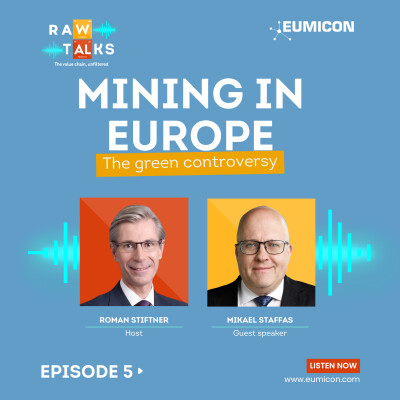
We talk a lot how we can secure Europe's supply of raw materials, about supply chains, trading partners, strategic autonomy. But there is a question that often goes unasked. What about the materials? beneath our feet. Europe has geology. It has copper deposits in Scandinavia, zinc and lead in Ireland, nickel and cobalt in Finland, lithium in Portugal and Czechia, magnesium in Austria, and many, many more. The question is not only whether these resources exist. The question is whether we are willing and able to mine them responsibly. Today, we explore this challenge with Mikael Staffas, President and CEO of Boliden, one of Europe's leading mining and smelting companies operating across Sweden, Finland, Norway, and Ireland. Mikael, welcome to Raw Talks.
- Speaker #2
Thank you. And don't forget Portugal. Don't forget Portugal.
- Speaker #1
Mikael, let me start with a fundamental point. There is often a perception that Europe is resource poor, that we must look outward. for the materials and metals we need. Is that actually true? What does Europe's geological potential look like? And is it underestimated?
- Speaker #2
Yeah, it's difficult to answer that question with a clear yes or no, because it depends on what you're looking for. But I would argue that Europe has much more resources than we think. We have been under exploring for a long time. The other thing, of course, with the mining industry, it has very long cycles. So even if you now start investing into exploration, will take 10, 20 years until we get into production. I can give you later some examples of what's happening in Sweden, where we've been at projects for 15 years and we're not really close to production yet anyway. So it takes a long time from technical reasons, geological reasons to get to real projects. So Europe will need to have a combined approach with both working to get more self-sufficient, which is clearly possible to increase it. But of course, we cannot be... naive and think that we can very quickly replace all the import that's happening today.
- Speaker #1
Boliden has operated mines in Europe for nearly a century. Given what we know about critical materials demand, when you look at Europe's geological potential today, do you see any untapped opportunity or are the easy deposits already gone?
- Speaker #2
Well, it's always like that. The most easy deposits are always gone. You always find them first. So to some extent, what I usually say in Sweden is that anything more or less that is more shallow than 500 meters has probably been explored or mined. And what we're looking very much now is for new deposits below 500 meters down to 1000 meters. But there's clearly more potential, but it is also so that we have taken the easy ones. That's always the way that life works.
- Speaker #1
Mikael, let's talk about the other side of the equation, even. Where resources exist, mining projects in Europe often face serious opposition from local communities, environmental groups, regulators. What is driving this opposition and how does Boliden navigate it?
- Speaker #2
Well, number one, you know, you can argue how serious it is. It's clear that there's always some opposition, but in general, we tend to be able to find ways forward where we have most people standing behind. But there are, of course, lots of different reasons why people do not like. what we're doing. There's some of this non-in-my-backyard activism. There is also people who feel that in some way we should leave the world unscored and who maybe do not see the direct connection that if you don't mine, you actually will not get the material. So there's some of these links that are not really clear and then other people have other priorities, which is important and what should have priority. But as I said, typically in Scandinavia and in Sweden. we tend to have a relatively strong support for what we're doing locally.
- Speaker #1
So we face a paradox. European society wants clean energy, but is deeply ambivalent about mining that clean energy requires. Can that contradiction be resolved? Or is it structurally embedded in how we perceive industry today?
- Speaker #2
I don't think they will ever be resolved in the sense that it's solved once and for all. And it's not just mining in that sense. You know, if you look at somebody's going to build a new road somewhere, there will be somebody against that or a new railroad. So any kind of infrastructure will face some kind of opposition. I think that there are roads going forward how to handle this. And I think that... The other thing that is linked to this is that also the more close you are to an active mining district, the less problem you have because you have people who actually seen mines themselves. They know what they look like. They know that in general speaking, mines have a very limited impact on the environment, maybe apart from exactly where it is. But if you move a couple of kilometers away, it might almost be impossible to know that there's mining going on in the area.
- Speaker #1
And Boliden is making significant investments in reducing the emissions, water use, waste. Can you, Mikael, walk us through what responsible mining actually looks like in practice from an operational point of view?
- Speaker #2
Yeah, this is an interesting one. And I think it's also interesting to a little bit talk about the development. And I usually take an example, which is a little bit morbid, but it's still important. In the 1960s, Boliden, the company that I'm running, had about 40 fatalities during those 10 years. So four people per year that got killed in different accidents. In the 1980s, so 20 years later, that number was down to about 20. In the 1990s, the number was about, or it was eight. In the 20s, so the first years of the 20th century, those 10 years, it was two. And for the last 18 years, it has been zero. So the 2000s and the 2020s so far. And I think you can make this comparison for almost anything, that mining today is in a way totally different than it was if you go back 60 years when I was born. It has to do with safety, as I just mentioned, but you can do the same kind of mapping out of emissions to water, emissions to air, noise. You can also do it about health of the general miner and so on. There's been an enormous development over these years. And most people don't live close to mine. Most people don't know a miner. They don't have a friend that they can call. So they have some kind of image in their head, which is usually linked to mining operations quite back in history and not in recent times. And that is part of the challenge. We need to show and we need to tell to people that mining today is very much different compared to how mining was just 20, 30 years ago and even more 60 years ago.
- Speaker #1
Let's focus to the people. Many people still picture mining as something out of the museum. Mine working underground is under very traditional conditions, often perceived. Could you give us a clear picture today of modern mining, how it looks like today, who is working on the site, in which roles and under which conditions?
- Speaker #2
Yeah, you can talk a lot about this, but just to give a few kind of snapshots around it. Number one, mining is a high-skilled work. I mean, the people... that we kind of employ in a mine for their muscles is very few, if any. It's a high-skilled work. It's a high-skilled blue-collar job around how to manage all the automation, electrification, everything that goes on. And it's also high-qualified from a white-collar point of view, mining engineers and so on. So it's probably one of the industries that has one of the highest degrees of skill that is needed to work in this. Even though some people, especially those who work, for example, in maintenance, do physical work and, you know, they will have to shower at the end of their shift and so on. The chances that they will get hurt are extremely small. The chances that they, even if they don't get hurt, that they will have some kind of physical sense of, you know, having worked a lifetime in a mine, it's almost zero. We don't really see any kind of health things that are different. Many people will work on sitting with control centers. working with remote control of certain operations, even though they will be underground because we want to have them close to the action to be able to, because it is part of a miner's job to also fix things when they don't work and they have to be close. And we want the same operator to both operate things when everything goes fine and also when it doesn't go fine, because in that sense, you take better care of the equipment. So we have them underground, but... Most people might sit the whole day in a control room underground and might not ever go into the mine, or they might go out into the mine for a couple of hours to do certain things that are not so easy to do from a control center, then go back to the control center.
- Speaker #1
So it's a fascinating world to work in the mining sector.
- Speaker #2
I think it's a fascinating world. We also have a very low turnout. So people that join us tend to work for a long time. People tend to be happy where they are. As I said, we have a low churn of people around that, which I think is linked to the fact that this is a fascinating industry. And once you get into it, you get more and more fascinated.
- Speaker #1
And it's a safe job as we need more and more rheumatoid in the future, isn't it?
- Speaker #2
I would argue that it's very safe. I would argue that it is safe both in what I talked about. The chances that you will get hurt on your work is very low, but it's also in terms of job security, it's a good place to work. I think that however Europe turns and whatever Europe does, Europe will need to have some kind of larger self-sufficiency in terms of mine output, which means that mining will grow. going forward. Exactly how fast, we'll have to see, but I think it's going to grow.
- Speaker #1
So maybe the real question isn't whether to mine in Europe, but whether we are willing to make it aligned with our values, because that's a political and a cultural choice, and it's not really a technical one. So that I would like to ground this conversation on very specific examples. And you're an expert and you're running several mines, several advanced mines. Boliden is developing what is called ESCM. a supplementary cement use material, which basically means replacing part of traditional cement in concrete with a much lower carbon alternative. This could reduce emissions by up to around 95% per replaced share. What excites you most about this? The impact on the construction sector, the additional materials you can recover, or the idea that the former waste stream becomes the high value. product? And what could such project teach policymakers who are now trying to speed up and simplifying permitting under the Critical Role Materials Act and other EU regulations?
- Speaker #2
Maybe we should still point out that it's a little bit early days because we were doing the first demonstration plan. But apart from that, I would say that this project ticks all the boxes you talked about. It is taking... a waste stream that otherwise would have to be stored as waste, which is, we still have, you know, issues with environmental thing and waste streams is one. So we take something that is waste. This waste contains still some valuable metals, so copper and zinc and so on. We managed to get out about one third of that metal that is still left. So we get more revenue from what we have already mined. But then we take the rest and we, through a process that we have developed, we turn it into a cementitious. We're not allowed to say cement because it's not pure cement, but it's basically replacing cement in concrete. And this product has about 95% less CO2 footprint than classical cement. And you know that the cement industry is one of the largest CO2 emitters around. I think somewhere 7% to 10% of total CO2 comes from the cement industry. So doing something to abate the CO2 footprint in cement is, of course, very good. So this one kind of ticks all those boxes around taking care of waste, taking out valuable metals, turning it into a product that can be used that has a much better CO2 footprint. So we're very excited about it. We will have announced it to the markets about six weeks ago. We're going to go ahead now. We have the permit to build it. So that's not a challenge in this particular case. But we need building it. It is a new technology. We have developed this all ourselves. So there is, of course, some... technological challenges, but from a lab scale, this has proven very, very positive.
- Speaker #1
Across your operations, there is a clear push to getting more value out of every ton of material, whether that's looking at tailing and mining or recovering more metals at the cementer like in other, including precious metals like silver. How far can this go in practice, Mikael? Are we moving to a future where... what we used to call waste in the past increasingly becomes a resource and is also perceived as a resource? And what are the biggest technical and economic limits you face still in these operations?
- Speaker #2
Well, there are two steps to this, of course. Number one is to do that once you have dug something out of the ground, you want to get more and more out. One challenge is, of course, that we have gotten much, much better in taking out metal. So. It makes it more difficult for taking the next step. But we're working all the time, both to get better yields on the kind of main metals that we're working on, but especially on these, as you mentioned, in zinc smelting, even though it's zinc, that's the main component of the concentrate you take into a zinc smelter, there is always some small amounts of other things, including, you mentioned, gold, silver, lead, and so on, that we have historically not been able to recover. It's gone to the waste, but now we can recover more. And, you know, the limits of that is, as I said, it's getting more and more tricky. The more you recover, the less there is left to recover more. But then it's a matter of technology development and also a matter of what happens to metal prices. And as metal prices are relatively high, these technologies tend, or these investments tend to be relatively good.
- Speaker #1
There's another example I found in your website presentation. Refleden is an extension of Christina Berry. Looks like a real test case for fossil-free mining with electrification, battery vehicles, and even a trolley system underground cutting the diesel use dramatically. What has that project taught you about what it takes to operate responsible mining in modern Europe from the community relations to environmental standards and regulatory frameworks?
- Speaker #2
This is an interesting product in many ways. Number one, you have to understand that the Kristineberg mine is over 80 years old. It's been around for a long time. It has, number one, proven that even though you think you're coming maybe to the end of the Kristineberg mine, which was kind of approaching because you were kind of mining to the end, there is typically something around. And the Revliden deposit, which is about three kilometers away from the main deposit, was found. And then once you found it, you're excited. And then you have to figure out how to mine it and if you can mine it in a cost-efficient way so that you can do that in order to keep the mine open. And we found that. And in this, as we are developing, you can say, a brand new deposit from start, you can also design it from start. And we decided, together with some suppliers that are important in these things, and Europe has a relatively strong supplier base. In this case, it was ABB and Epiroc that were helping us. to design a new system. You talked about it, to have a trolley system, so in a cost-efficient way to get it, that will be, in the end of the day, autonomous, driverless. It will be fully electrified. We are also working with electrification of the mucking underground, which requires battery, which requires charging, which requires that you have enough power underground. So we worked on all these things from the start, And we now have a mind that is... more or less fossil free in the sense of fuel that's used. It's all electricity. And we should also mention this, that there is other, you know, CO2 footprint that comes with mining. We use quite a lot of concrete and cement ourselves all the time underground as we reinforce things. And we, of course, also use explosives and explosives tend to be CO2 containing. We are, you know, in parallel with this working on two projects, both on getting explosives that are based on peroxide which is based on electricity rather than fossil means that will be a big step forward that's we're working together with a small startup company on on that as more on a kind of development stage still and then we're working with the cement as we just spoke about before to get low co2 footprint cement from our own copper smelters so we do have a clear ambition that one stage we will say that the revenue mine will be truly co2 neutral And that, I think, will be the first and maybe for a long time the only such mine in the world.
- Speaker #1
That's a great example in ESG criteria. But lodging this question, you have to work with community relations, environmental standards, regulatory frameworks. How transferable are these solutions to other mines outside of Scandinavia?
- Speaker #2
That, I think, will very much depend. I mean, acceptance is, of course, a very local thing. So you have to work on acceptance on a local situation. Technology can be spread. And as I said, we have mines in Finland, we have mine in Ireland, we have a mine in Portugal, where we are trying to make sure that we can transfer best available technology to make sure that we're always in the forefront. But then, of course, the acceptance from the local society is much more linked, of course, to the special situation locally. But once again, in these places where we have mines, we tend to have a very good acceptance of the mining. It's, of course, bringing... People understand that it brings value to the local community because they know what it would be without it. And also people are quite aware that the impact on the environment are much more limited than people may think.
- Speaker #1
So Mikael, what we can do in Europe, all the stakeholders together, to attract more investment in mining and to open more mines that we are getting a bit more materials out and a bit less dependent on different other regions?
- Speaker #2
I think that it is quite simple in one way. We need two things in order to operate mines. We need permissions. If we don't have permits, then we cannot operate. And I think it's fair that permits should be difficult to obtain. It should not be too easy. There should be a clear control post from society and so on and so forth. But we need the permits. Without permits, we can't do anything. The second thing that we need is to make sure that we have a financial framework around the particular mine. That means that you can invest in it because mining also we haven't spoken so much about that but the nature of the industry is that you invest a lot of money for a long time and then you have a time in between where you where you make quite a lot of money you need because you need to make back your investment and you need to make enough money because then it's going to cost again to close a mine so you have big costs to start big costs to close and then you have a time in between where you actually make quite a lot of money. Now, politicians need to kind of reassure that the worst thing that can happen to mining companies is that, yes, we invest all the money, and then somebody decides to tax all the revenue afterwards and change the tax regime or anything else so that we won't get the money back, and then we're all losers. So we need to have the kind of security that the framework around taxes permits. It's tariffs, everything else is relatively stable. And then if it's stable, then we can calculate it. And not every mine should start because not every mine makes sense. It's not just that it produces copper or zinc. It also has to be financially viable. Otherwise, I don't think we should start a mine if we can't make money. I don't think we should ask for subsidies for mining, at least not generally, maybe in specific cases, but not generally. So we need to have that. We need to get the permits and we need to have a. a financial framework that works out. Then I think we have, in certain places, a bigger uphill battle, in other places not so big uphill battle, but we need to get then the social license to operate, that we need to work around. And I think that's actually doable if you do it in the right way.
- Speaker #1
Mikael, to close, the title of this episode is Mining in Europe, a Green Controversy. After this conversation, what are the three things that you would want our listeners to understand differently about European mining? and its role in the green transition?
- Speaker #2
I think that most people actually do understand that you need to mine in order to be able to get into the green transition. I think that's generally understood. If it's not understood, maybe we could have talked more about that. And I think what is generally not understood is that mining as an industry is so modern, it's so clean, it's a place where it's very good to work. And that maybe we've given some examples around that, and I think that's important. And that mining... It's not the same thing as mining was 50 or 60 years ago. Mining has changed enormously during this time and continues to change as we speak. And I think that's one thing that you could really get around this. And I think also that there is, even though there is a time lag, it would have been good had Europe understood this 20 years ago. The latest geopolitics developments are, of course, even more pushing that people in Europe want to have actually more mining in Europe. and would actually like it to happen right now. But even in the best of worlds, as I said, you know, developing a mining project takes 10, 20 years. Even if you get all the permits that you wish for, it still takes time in order to develop these massive investments.
- Speaker #1
Mikael Staffas, thank you for joining us on Raw Talks.
- Speaker #2
Thank you for having me.
- Speaker #1
And thank you to our listeners for engaging with one of the most complex and consequential conversations in Europe industrial policy. The takeaway is simple. and demanding. Without mining, there is no autonomy. But without trust, there is no mining. Until next time, I'm Roman Stiftner. Thank you and goodbye.
- Speaker #0
You have listened to Raw Talks, your front row seat to the future of raw materials and metals in Europe and beyond, produced by EUMICON. If you like what you've heard and wish to be notified of future episodes, connect with EUMICON on LinkedIn, like us on Facebook and follow us on Instagram or You can simply download Raw Talks, wherever you find your favorite podcast, or at eumicon.com.