- Speaker #0
you're listening to raw talks your front row seat to the future of raw materials and metals in europe and beyond produced by EUMICON welcome
- Speaker #1
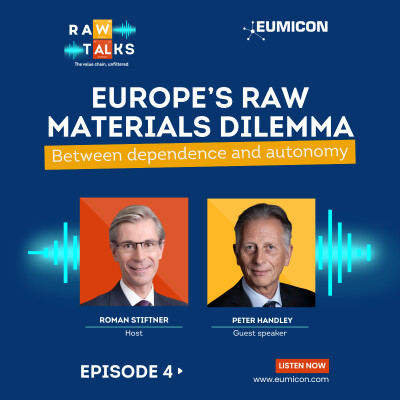
to raw talks today we turn the lens inward to europe because europe stands at the turning point Europe wants climate neutrality, industrial leadership in clean technologies, battery factories, hydrogen infrastructure, semiconductor sovereignty. We speak about resilience, about strategic autonomy. But here is the tension. All of this requires more materials, more industrial minerals, and more metals. And for many of those materials, Europe demands heavily on imports, not only for mining. but for processing, for refining, for intermediate products. At the same time, Europe has high environmental standards, complex permitting systems, fragmented capital markets, high energy costs that matter. So the real question is not simply, is Europe dependent? The deeper question is, can Europe align ambition with material reality? Because ambition is not a supply chain. And if Europe mischarges, disbalances, the consequences will not stay in policy papers. They will be visible in the everyday life of everyone of us. They will appear in energy prices, in industrial jobs, in investment decisions, in inflation. That means higher prices for everyone. And this has an impact on everyday life of all European citizens. That is Europe's dilemma between dependence and autonomy. And I'm very pleased to explore all this with Peter Handley. Peter spent many years at the European Commission working on energy, climate, and industrial strategy, including critical raw materials. Today, he advises institutions and governments at The Hague Center of Strategic Studies, works with the European Initiative of Energy Security, and support strategic transformation at McKinsey. and company. He combines institutional experience with strategic realism. Peter, welcome to Raw Talks.
- Speaker #2
Roman, thank you very much.
- Speaker #1
And I would like to really, without further ado, jump in and speak about Europe's dependence on raw materials. When we speak about Europe's dependence on raw materials, it often sounds abstract. From your perspective, where is Europe structurally most exposed?
- Speaker #2
Europe is very exposed. to a series of dependencies which can be weaponized against us. And it's not just in the field of critical raw materials. It's true for energy, where we've swapped a dependency on Russian hydrocarbons for one from the United States. It's true also for everything to do with tech and IT and AI and social media and working systems for our businesses. It's true for payment systems. It's true for all manner of infrastructure. So let's not... just say that dependency is a critical raw material problem. It's a systemic problem, which Europe needs to address in the round. It needs to reduce its dependencies on others, and it needs to learn how to play a power game with the areas where others are dependent on us, because it's not a one-way street.
- Speaker #1
Yeah, you already explored the complexity on this topic. And if we strip away all the political language, where we are really vulnerable?
- Speaker #2
I think we're particularly vulnerable on... these small niche metals which are not traded transparently, which are produced in relatively small quantities by a very limited number of players around the world and where the supply chain is quite often controlled by China. That's the kind of thing where they can weaponize it through export restrictions on things like gallium, germanium, graphite and a whole bunch of other things. And this is very important because these metals... these niche metals tend to be the things you cannot do without if you want to switch your energy system away from fossil fuels into electricity powered systems or if you want to move your cars away from the petrol or diesel engine into electric vehicles but equally these are things which are showstoppers for
- Speaker #1
europe's ability to defend itself we faced already um some disruptions. When the next major disruption occurs tomorrow? Where does Europe feel it first?
- Speaker #2
It's, um, so far has always felt it first in the, the car making sector. If you look at what's happened since 2022, there was, um, a period when magnesium metal was stopped from coming from China. And I believe that European car manufacturers and aluminium producers were, were living on six to eight weeks inventory before they had to shut down production. We faced a similar problem a year or two later when chips, not the sexiest, most advanced chips, basic chips which go into vehicles were not being supplied because during COVID they were all being used to make gaming machines instead. Again, this caused supply chain disruptions. And last year's ban on exports from China of permanent magnets, again, not the sexiest high-end, the average permanent magnets, this actually caused stoppages in car manufacturing both in Europe and in North America. So it's not an abstract threat. of supply chain disruption.
- Speaker #1
We can distinguish between the mining and then the refining of raw materials. Do you think the concentration of refining is more critical than in mining for Europe?
- Speaker #2
I believe that the key problem area for Europe is the midstream, because it's an area where we have strengths. We have a lot of expertise, we have a lot of facilities in metal making and metallurgy but these are precisely the areas of the economy which are at the greatest risk of leaving Europe for a variety of reasons, high energy costs, high regulatory costs of doing business, and unfair trade from players like China with lots of overcapacity, flooding the market, making it very difficult for our businesses to stay viable. And I believe that's a key area. If we are to look at the refining, it's where we need to keep what we've got and build it up. And we can source the feedstock from a combination of things in Europe and things outside.
- Speaker #1
Interval capacities matters. When we talk about dependency, we often look outside Europe. But are we sometimes our own bottleneck? Do we sometimes limit ourselves, Peter?
- Speaker #2
Yes, I think that we do because we've had like two or three decades of feeling quite comfortable. outsourcing the production of many parts of the products that we're using here in Europe. And that has led to an erosion not only of industrial infrastructure, but also of skills. Just the other day, I was reading, for example, that the number of engineers, metallurgists, material scientists that China is producing from its university systems each year is many multiples times larger than what the United States or the 27 European countries combined are doing. So you cannot just talk about the materials. You also have to talk about who's going to be doing these things. The skills side of it is extremely important. And we have a huge deficit.
- Speaker #1
Is regulatory complexity discouraging investment in Europe?
- Speaker #2
Yes, undoubtedly. It's a bit of a challenge because it does. make you think twice. If you're a multinational company, you have choices where you're going to put your investment into projects, how costly it's going to be, how much time it's going to take, how much predictability you've got when you compare doing a project in, say, India or Turkey or somewhere in the United States or in the European Union. So this is clearly one of those political drivers which has come down the road really fast in the last year or so. which is taking a long hard look at everything that's been regulated up to date and seeing where we may have gone a bit overboard and try and cut back on the amount of administrative complexity and cost that businesses face when they're trying to do business here.
- Speaker #1
Despite the regulation, does Europe sometimes move a bit too slowly compared to global competitors? What we can do against that?
- Speaker #2
Well, we need to really... change our whole toolkit. I think for me, a quite significant moment was last autumn, when a couple of weeks after the Chinese had announced on the 9th of October that they were going to introduce really drastic controls on raw materials going anywhere in the world, even in extremely small quantities. This was a very, very powerful export control measure. And until the kind of... truce that was called a few weeks later between President Trump and President Xi, it was very, very concerning because it could have brought many parts of the world's economies to their knees. And the interesting thing is how President von der Leyen, President of the European Commission, responded. She was giving a speech in Berlin and she said, well, whatever we're doing on critical raw materials, it's not enough. We have to change the whole approach. We have to get to the level of speed and scale and ambition. that the Americans are doing, right? And that's where she announced that within a few weeks, they'd come out with the Resource EU Action Plan, which is a good start. But if you compare what Resource EU has done in terms of making real financial support available, it's minimal compared to how the Americans are approaching this. If you look at the number of investments the Americans have made over the past 12 months, in the hundreds of millions of euros in terms of equity investments, guaranteeing price flaws, guaranteeing offtakes. the deals they've put in place for projects in the US and outside, the number of strategic partnerships they've concluded. And then just in February this year, launching Project Vault, which is a strategic stockpiling scheme, not for defense, because they already have one for that, but for the regular economy with $12 billion worth of investment on the table in the form of loans from their export credit bank and some private money.
- Speaker #1
Europe has recognized these challenges and responded with legislation, as you said. coming to one of the most famous regulations that we are facing. It's the Critical Raw Materials Act. And this sets targets for domestic extraction, processing, recycling at a strategic level. What is trying to correct Europe with such a system and such a framework?
- Speaker #2
The point about the Critical Raw Materials Act is it's trying to reduce the level of dependencies that Europe has, both by boosting what you can do within Europe. and by diversifying the supply outside. Now, these benchmarks that are set for 2030 are adequate as a political signal, but they do not actually have any teeth to them. Many of the strategic projects that have been selected, if you look at the fine print, they're not going to be delivering this side of 2030, right? So it's really important to make sure that the benchmarks that you set, you have the tools to deliver. and you can measure the results in real time. So I think also that what has shown itself in the first set of strategic projects is it's not enough to select a mining project here, a processing project there, and a recycling project somewhere else, because these are standalone projects at an individual point in the value chain. There is absolutely no guarantee that that is going to translate into materials actually flowing into Europe. Where's the feedstock that's going to feed into the processing? Where's the manufacturing that wants to buy from a European refinery? Where's the feedstock going to come that feeds into the recycling facilities? And ultimately, where's the off-taker in all this? I've seen a number of the projects, and what is consistently missing in action is the off-taker. I'm talking about particularly the OEMs, car manufacturers, they have not been there when needed to commit. to buying materials from other than their traditional sources. So there's a real question about where is the value chain approach, which is a selection of strategic projects that is a whole story rather than a point in the value chain, and which factors in the customers, the demand side, in addition to the supply side.
- Speaker #1
When you read the Critical Raw Materials Act, does it feel like a turning point or more like a first step?
- Speaker #2
It's a foundational measure. Congrats. to say that after 15 years of having network building, having analysis, having policy discussions, this was the first time that there was a conscious decision heavily supported by member states, by the European Parliament, by businesses, to actually set some ground rules through a European regulation, which applies consistently across the European Union. So as such, I believe it's a very important measure. but It's only valuable if the provisions that are put on the statute book are implemented.
- Speaker #1
In Europe, we cannot complain about the scarcity on regulation. But on the other hand, what are really the limits for regulators, for Brussels, that can realistically deliver on that topic?
- Speaker #2
I believe that the thing that is important to understand is that you can regulate a whole bunch of things at the European level. But when it comes down to business, Europe Inc. does not have the businesses. Those businesses sit in countries. And it's really individual countries that have more leverage to support their businesses, to de-risk the financing of some of the projects. and to lean on them if the companies are not diversifying their supply chains.
- Speaker #1
So we agree that regulation cannot create mines, but it can create a reliable and maybe also coherent framework. Frameworks are very necessary, but projects require capital. So in the end, let's talk about money, Peter. It's the elephant in the room, because strategy without capital remains paper, and raw materials projects are very capital. intensive. They require long time horizons. We often speak about 10, 15, even 20 years of lead time and developing time. How attractive is Europe today for investors in mining, processing and refining?
- Speaker #2
It is not as attractive as it needs to be. Part of the problem is that we don't have the capital market across the whole of the European Union and we don't have inside EU27 any place that does the job that London or Toronto or Perth do in terms of raising money for projects in the mining, refining space. There's not that expertise in the capital markets. So this is an area that needs to be worked on. Another is we need to learn from how the Americans are moving very robustly with a combination of their development finance corporation and their export credit agency, US Exim. These have hundreds of billions of dollars which are being deployed in a very laser-focused way to support projects where there is a US company offtake, which can be civil or defence related. And they're also very good at putting equity down on the table. Now, to date, we don't have any equity capability at the European Union budgetary level, nor does the European Investment Bank.
- Speaker #1
How much can recycling reduce the pressure in the next decades?
- Speaker #2
It's going to make a very important contribution, provided we get things right today. And the kind of things we need to get right today are getting a much better grip on the metals wastes or the battery wastes, which today are leaking out of the European Union and going into helping other parts of the world make things. So we have to get a much better understanding of the value of the materials that are production waste or end-of-life waste in Europe. I just read today, for example, that there's about 12 million cars in Europe which are decommissioned each year, and 3 million of those are just disappearing. They disappear, they're not registered, they're being broken apart for parts, and there's huge amounts of metals which are just disappearing from the European industrial ecosystem in that way. So recovery, recycling, yes, because if we don't start getting it right better through things like the Circular Economy Act or the Advanced Materials Act, then again, it's going to be the Asian countries that get a lock on the feedstocks and develop all the recycling facilities at our expense.
- Speaker #1
So we have to increase the consciousness about our materials, also on those who are already end of life, meaning going to recycling. The green transition is not immaterial, it's industrial. Beyond the industry and the capital, it's society. Remedios sound often very much as an expert topic, but they shape prices, jobs, energy security, inflation. So my question is, is there a sufficient public understanding for this complex link?
- Speaker #2
No, there is not a sufficient public understanding. And I'm not sure that there ever will truly be one because. You take yourself out of the professional bubble of people who work on this stuff and you just look at your own families. People don't think about this kind of stuff. They think about. jobs, they think about how much money they've got to live off, they think about the safety of their environment, they think about the bad weather. They're not going to think about critical raw materials. And I know that in European policy, you know, lots of money has been spent on public awareness, also at the national levels for the last 15, 20 years. It's not going to really change public awareness of these issues. What will change public awareness is if there are major supply chain disruptions, the kind of thing that can come out of conflicts with China or the United States or Russia. And all of a sudden, large parts of the European economy grind to a halt. That's what brings things home.
- Speaker #1
On a short time, the industry feels like a pressure on these high standards. But my question is, on a long term measure, could we turn it to a strength for Europe?
- Speaker #2
We should be able to. In fact, over the last few years, the whole concept of competitive sustainability has been a driver of many pieces of European regulation because the idea was the way we can move ahead of low cost, low environmental and social respect producing parts of the world is by using the power of our single market and saying we're going to expect high standards for things both produced in our market and things that want to come into the market, but it hasn't necessarily translated into tangible results. And that's partly because other parts of the world can game our regulations. They can work their way around things like the carbon border adjustment mechanism. They can make sure that for the European market, they produce things that respect our requirements. But for the rest of the world, they continue to produce things in a dirtier manner. So it's very difficult to maintain the thesis that European regulation raises the whole global standard of things, which is something that could say. a few years ago.
- Speaker #1
Earlier I said I would come back to one structural change Europe needs. I think now it's the moment to discuss it. If you had to identify just one structural change Europe still needs to make, what it would be to turn ambition to real capacity?
- Speaker #2
I think that the ability to finance strategic priorities is the key. And if you look at the big debates that take place, everyone says we should be investing in competitiveness, in resilience, in security and defense. But when you try to really make that happen, you get pushback saying, no, we have to fund the farmers, we have to fund the regions. So there's a huge amount of inertia.
- Speaker #1
Peter, if you have to summarize Europe's raw materials dilemma in three key insights, what would they be?
- Speaker #2
Well, I would say perhaps three wishes. Firstly, I think that the decision makers at the European and national levels have finally understood just how vital it is to secure the raw materials that the economy needs, just as vital as energy. So that's a good thing. The second is that businesses are starting by experiencing a series of supply chain disruptions to understand that they need to start addressing this not as a procurement issue, but as a to strategic ability to do business issue and making the investments that go with that realization. And thirdly, I think that young people are starting to wonder where they're going to find jobs in the future, because many of the paths that have been attractive in the decades that have gone by are suddenly being destroyed by artificial intelligence. So there are more and more areas that maybe were unsexy in the past, but things which... have real contact either with people or materials, cannot be done by machines, are going to be offering the kind of jobs and satisfying careers that people can enjoy for the decades to come.
- Speaker #1
Peter, Europe has faced so many challenges in the last years. The COVID crisis, now the war, you have two political things. But in the end, Europe is a nice place to live. We managed all these things in a good way. we are maybe completely complaining, but in the end, Europe is doing it better than other regions. Is this not a motivating factor for the future and how we can tackle all these challenges that we are talking about today as well?
- Speaker #2
I think there's really a good reason to be hopeful about Europe because people realize, actually, we have universal health care, we have education, we have social protections we have environmental protections and europe is a good place to live, it's a good place to work, and we're incredibly lucky to be living in this part of the world at this particular time. And I think that's a very positive thing, which comes when you're actually forced to ask yourself, what do we stand for? And so I am very hopeful. I think Europe is starting to realize what it actually stands for in this very sort of turbulent global environment. And I think that can translate also into a newfound pride in making things in Europe, making things to good standards, making things in a way that respects the people that are applying their skills and labor. And I think it also is something that is going to help us to take a bit more responsibility for producing things that we use ourselves.
- Speaker #1
Peter Handley, thank you very much for this thoughtful and open discussion and especially for this positive outlook that you left behind us. You have helped us to understand that Europe's material question is not a technical one. It's economic, it's industrial. it's strategic and it's social. Thank you so much for joining Raw Talks.
- Speaker #2
It's been a real pleasure. Thank you, Roman.
- Speaker #1
Thank you. In the coming episodes, we will continue to explore how minerals and metals shape Europe's future, from global resource geopolitics to project delivery on the ground, from recycling and circularity to the economics of supply chains. Because Europe's raw materials dilemma. It's not temporary, it's structural. And how we respond, we will shape the next decades. Raw materials and metals in Europe and beyond. I'm Roman Stifner.
- Speaker #0
Thank you and goodbye. And follow us on Instagram. Or you can simply download Raw Talks, wherever you find your favorite podcasts, or at eumicon.com.