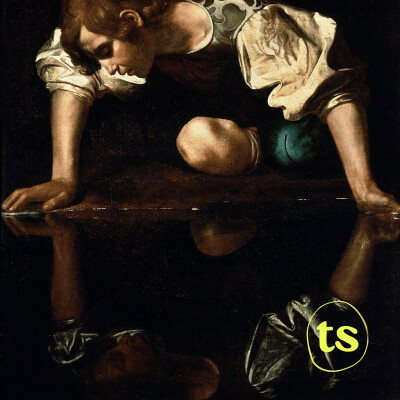
Speaker #0A man looks into the water, and the water looks back at him. The features he slowly recognises all piece together into this gracious face, staring back at him. The man forgets again whose eyes he's lost in. But every time he slowly tries to reach it with his hand, touch the lips, feel the soft skin underneath his fingers, it is the cold water he caresses. His hand disappears underneath the darkness. He thinks that he has been called, so he approaches his face, and as he is about to kiss his lover, he understands by the liquid on his mouth that he is broken. The gods have decided for him, and what just broke him is having thought he ever was. He pulls his head back, his hand out of the water, drops slowly lapping, and he sees in the eyes he's staring into the glint of something waiting to be found. If you look at a landscape, You could say it's broken. Many curves separate higher pieces of land from flat ones to stones, moss, earth and sand, all in one. Rivers can break those pieces of land into more pieces. Trees, aligned together, can break those pieces into more pieces. Everything is broken around. But everything in your eyes makes sense, aligns, curves into something beautiful. No matter when the river cracked into another piece, when the forest grew or when the moss left to let the sand disappear to leave the stones. Today, right now, it is as it is. It is nature, it is whole, and you've never seen something so meaningful. Kintsugi is the Japanese art of repairing broken pottery by mending the pieces back together. Oftentimes, it's glued with golden dust. All the lines fragment a blue, brown or white vase like golden nerves on leaves. It is believed that the brick is part of the history of the object. There is no need to hide it. On the contrary, it is being illuminated. Kintsugi relates to the Japanese philosophy of non-attachment, acceptance of change and fate as aspects of human life. When it's broken, it's an opportunity for light to go inside. There is beauty in the broken. I'd like to read you an extract from a book I'm reading, Watermoon, a Novel by Samantha Sotto Yambao: 'I have found beauty in all manner of broken things. Chairs, buildings, people. (...) Especially people. They shatter in the most fascinating ways. Every dent, scratch and crack tells a story. Invisible scars hide the deepest wounds and are the most interesting.' In a dream, I am a rhinoceros, and my limbs are slowly detaching from my body. I wasn't suffering, I was just thinking: 'What will I do without my lungs, without my legs or my heart?' But I could still breathe, I could still talk, I could still look around, but I could not move. I was just scared, I didn't understand. I was aware that I was a rhinoceros, and I was broken. Dismemberment is the mythic, symbolic act of separation. In some Indigenous communities, young people are guided towards the next step in life, adulthood. To mark this fracture between two moments in one life, they go through being given new names, being given other clothes, having their hair cut, and sometimes being removed from their family homes. Most of the time it is done through the telling of myths and the singing of chants, Chants their ancestors recited when the sky was dark. They may eat different foods, part with childhood tokens, and step into a world that feels at once strange and familiar. Myth in there is a way to travel into one's life, to make sense of who you were, who you are, and who you might become. Within the community, fractured pieces are gathered, held, and we made into something whole. Dismemberment feels bodily, as if you were torn apart. And this is how it must feel, identity, ego is dying. This always feels somewhere in the body. For me, it was the heart. I could hear it pump so strongly, and I imagined it like a drum, a drum held by an ancestor, chanting Earth's song. So I kept listening to this broken sound. It is Osiris Day, the day he becomes king of Egypt. His sister was to become his wife and lover. Her name was Isis. By being kind, Osiris respected the land, life, and the gods. He was loved by his people, acclaimed by his fate, serving humbly. But his brother Set looked at him, shadows tainting his eyes, jealousy growing with every gift the people gave Osiris, with every blessing he received daily from the gods. Thunder rang in his ears. whispering to avenge himself and take what he should have had. So he transformed into a monster, attacked Osiris, killed him, cutting him into pieces, dispersing his body in the Nile and across the lands of Egypt. Like this, he became the new king. Isis, whose love of her lover created a pain she could not face, decided to bring him back to life. She roamed the city with her sister Nephthys and found the scattered pieces of Osiris in the Nile. She assembled them, and by breathing life into his body, chanting prayers even the gods did not know, she resurrected him. Osiris and Isis were together again, and Isis soon bore his child. But Osiris was destined to descend into the underworld, where he became king. From brokenness came life. Each spring, the Nile rises, and with it, Osiris' gifts flow into the land. Crops sprout, flowers bloom, and the world remembers that even in fragments, life returns into something whole. I'm always broken into words. My mind is always travelling into places it has been or places it dreams to be. Conversations I've had, kisses I've given, promises I've made and embraces I've received. I'm in all of those places while I'm here. Does this mean I'm broken? Or isn't being broken the best gift life has ever given? A part of me wants to run into the fields. It feels so free. It can break with joy. Tears can run down my cheeks with a smile on my face. A part of me is scared. It wants to stay inside, to hide, to stop speaking. All of them coexist. They all breathe and move inside of me. Am I undone? Or am I just human, nature, full? full of life and landscapes and rivers going through my veins? Aren't we just hills of a bigger landscape, the leaves or the water drops? If everything is broken outside, if everything is broken inside, is it really broken? Maybe we are not in pieces. Maybe this is not the end. It is remembering we have always been whole. This is an episode in which I wanted to take you not only into the concepts and stories but the feeling, the fragments of emotions of feeling broken when nothing makes sense anymore, inside and out, something I felt deeply after a burnout. There are so many myths that explore this notion of dismemberment and brokenness before going back and growing back into something whole. Osiris, as I've told you, the myth of Dionysus in which he is dismembered by the Titans, the Mesopotamian goddess Inanna, when she meets her sister Ereshkigal in the underworld, and many more. This is a story as old as time, and I think that many young adults like me feel lost because we like ritual and ceremony to go through different stages in life. I'd just also like to say that some shamanic dismemberment rituals felt a bit violent, so I didn't include them in the episodes. I just wanted to show how, as a community, these moments in life can be navigated with light. I don't want to judge other rituals nor to depict for you a tradition of only rainbows and unicorns, but it's comforting to remember that people went through this throughout millennia, across communities across the world. This is what history shows us through myth. I remember that moment when I felt lost. I really needed to talk with an ancestor, someone who had been through it, who would smile at it. As I always say, I needed to talk to this very old, wise woman with long white hair, the one around the fire. So I went to see an old tree, one of the oldest in France. It's an olive tree around 2,500 years old. If I didn't have ancestors nearby, I had this tree, who, maybe, had seen other people's sadness, brokenness, confusion. It had seen life. I didn't know it, but it lives just a two-hour hike from where I live. I went there. I sat underneath the tree with my friend Lizzie, and through the silence, we thought of Pocahontas, wise tree in the Disney movie, who, when asked, 'What is my path?' replies, 'Listen, because the spirits live all around, in earth, water, sky. If you listen, they'll guide you. Listen with your heart, you will understand.' And I know it may sound simple, but we didn't try to judge what came up. It just made me realise that I didn't have to understand everything right now. Our ancestors lingered in this fragmented moment, in stillness, in silence. These transitions were sacred; they were natural. So I went back home that day, content with the moment it had brought, sharing it with my friend, human with human, and tree and brokenness. I hope this episode resonated with you. If it did, please share with those around you and rate the podcast five stars on Spotify or Apple Podcasts. You can also leave a comment on the episode on Spotify. I'd be very happy to hear your reflections. I wish you a beautiful day or evening, and I'll talk to you soon.