- Speaker #0
Are we starting to feel those back-to-school butterflies, whether we are kids, educators, or parents? We have a great episode today with Kara Zelas, who is a primary educator and author. And we talked about the moments that challenge parents and educators most, like kids' big feelings, and how they build connection, behavior, and ways that we can help children. build the emotional skills that they will carry with them, not just for this school year, but for their entire lives. We hope we leave you with some great food for thought. Welcome to the Little Leaders Podcast, where we inspire confidence, connection, and change through conversations with kids just like you and me. Grab your favorite snack, find a comfy spot, and enjoy. Today's guest. Cara, I would like to say thank you so much for joining us today. It's a beautiful summer day and I'm so glad that you could take some time to talk to us. Yeah, thank you so much for having me. I'm so excited for our conversation and we have a very special guest joining us today and that's Little Dude. Oh my God.
- Speaker #1
He's going to be here today with us as well.
- Speaker #0
So yeah, thank you so much for having us. I love that you can put him right in your lap so he can fit right in.
- Speaker #1
It's his happiest little spot right next to me.
- Speaker #0
Well, he leads us right into our first question. Can you tell us a little bit about yourself and the journey that the two of you share together?
- Speaker #1
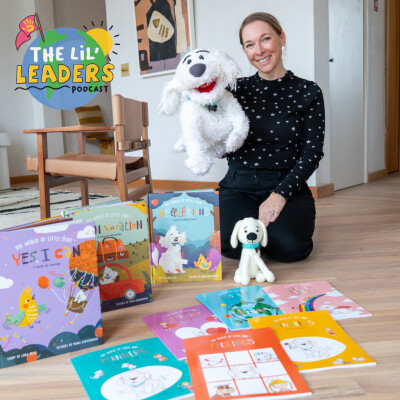
Sure. So I'm an early childhood educator and author, and I founded Big Worlds of Little Dude. It's a, you know, it's a passion. I've been working on this for over 10 years. I've been working with children in the classroom for many years as well. And I kind of kept noticing the same thing. Teachers were spending so much more time helping children navigate friendships and solve conflicts and regulate big emotions on top of all the other pressures teachers were facing. And I also noticed things in the classroom, like basic social skills. And that inspired me to create The Big World of Little Dude, which is a book series based on Little Dude because he's a therapy dog. And I volunteer with the Good Dog Foundation and have been bringing him into schools and classrooms in New York City. And it gave me this realization of the importance of human connection. And I wanted to bring that idea into the classroom that I was teaching in, in the city. That's how this all blossomed. It's amazing how one thing can just open up a huge door, isn't it? Yeah, it's really interesting how a series of events leads you to take a different path. I just think if I never had Little Dude, I would not be sitting here talking with you today. And it was the impact he had on our lives that I wanted to share it with others. I really wanted to volunteer in the community that I was living in. And it really opened my eyes up to a whole new world of children and older folks and really just a lot of people who are suffering and how much dog therapy helped these folks in those moments.
- Speaker #0
Absolutely. I know. our initial conversation, we were talking about social skills and how important they are to all humans, but especially to little ones who are just at the beginning of their social skill journey. As we've seen in the news, many schools and countries have severely cut back on the amount of screen time that they'll be using. And what are some of the changes perhaps since the pandemic? that you've noticed when you go into classrooms that's different than how it has been in recent years?
- Speaker #1
Yeah, I think children have changed a little bit, but really, I think childhood has changed. I think children simply have maybe fewer opportunities to practice social skills in a natural way. There are fewer hours of neighborhood play, families are busier, screens often replace conversations. And what I see in classrooms is that children still want friends, there just needs to be more guidance and learning on how to make them, keep them, and work through the inevitable bumps that happen in everyday friendship. And that's why I believe we need to teach these skills. really intentionally, just as we teach reading and writing.
- Speaker #0
I agree. When you think back to your childhood and even mine, it was just a very different world back then. And even with all of the extras that are impacting kids' childhoods today, there are still ways that we can help them gain the skills and move forward with success.
- Speaker #1
Definitely, yes. I think that there's a lot of opportunity to teach kids all the skills that they need.
- Speaker #0
Which social skills in your experience seem to be the most challenging for young kids right now?
- Speaker #1
I think if we're talking about friendship, three sort of ideas stand out for me. It's about like initiating conversations and starting play, handling disappointment within friendships, and also solving friendship problems and conflicts. vote. children often know something feels wrong, but they don't always have the words or the confidence to work through it. And that's one reason why I created my children's book series, because these stories allow children to explore these situations before they're living them themselves. And then the teachers and parents can simply build routines around these stories. So children actually have to practice these skills. And another thing I noticed is that, you know, as parents, and I'm a parent of a three and seven year old, it's so difficult to see your child in pain caused by someone else. And I think as parents, your first instinct is to rush in and want to solve the problem. And I think we do our kids a disservice by always solving problems. What I try to do is give my kids the tools so when they're... in those situations, they have the words and the understanding to try and manage it on their own. Of course, adults are always going to be there to talk to or intervene if necessary. But for my kids, I want to give them the tools. So the first line is that they're trying to manage it before they go to a grown up. And I think that we need, yes, just through simple, repeatable words and you actions, we can give kids these tools because we want our kids to build resilience and to problem solve on their own,
- Speaker #0
not always having to reach out to an adult. Right. My last few years, probably the last 10, when computers, digitalization became so expansive, I saw all of the same things. And my daughter, now 23, she experienced a lot of these things herself during her middle school years. Right. Um, and, and, and it's not easy, but I totally agree with you that we need to give them the tools, you know, so that they can start to solve things on their own. And it just helps them build their bag of tricks, build their bag of strategies. And knowing that it is going to continue throughout their whole life, you know, even as adults, we go through these same things, but then they will be better equipped.
- Speaker #1
Exactly. That's exactly what I was going to say next is that. As adults, we confront these issues all the time, whether we're managing our own relationships, new friendships, these problems don't just go away when you become an adult. So I think that school is the time for kids to try and navigate and figure it out, even though some moments may be hard and challenging, like life can be hard and challenging. And if we start removing all the... hard and challenging moments to a point, obviously, from kids' lives, then when do they get the chance to practice it? Because in the real world and when they grow up, they're going to face all these things. So we want to give them the tools while they're young.
- Speaker #0
Right, right. As kids at the primary level, middle school level, and high school level, as they return this fall and see that there will be less technology used? What are some adjustments that kids might need to make. I think that this may bring a lot of kids a lot of joy and feeling a lot less pressure,
- Speaker #1
maybe, especially when it comes to phones. It's like if no one is using it, then there isn't that pressure. So I think there's a lot of positives that will come out of it. But just like any change, it takes adjustment. But the wonderful thing about children is that they're incredibly adaptable and resilient. And I think that social skills, they develop through practice. And you can't learn to have a conversation without having a conversation. And you can't learn empathy without seeing another person's experiences. You can't learn cooperation without working alongside other people. So if we don't give our kids these experiences, they won't learn. And I think that the more opportunity kids are given to talk, cooperate, do group projects, to solve problems, to use their creativity and imagination, the stronger those skills will become.
- Speaker #0
I agree. And I would imagine, and this is what I just miss about teaching in general, the lunchroom when I taught, all the years I taught, was always when there were more issues. Obviously, it's a much less structured environment. So hopefully, As kids gain more of these skills under their belts in earlier years, you might even see that time of day run more smoothly than it does sometimes. Yeah, definitely. And also I think it's like,
- Speaker #1
what is the culture and tone of the school? Because I think that has a lot of effect of what happens in the lunchroom as well.
- Speaker #0
What are some examples of just simple ways that kids could engage in perhaps games or activities or just even family routines? Could be morning routines or evening where parents can help kids practice conversation and communication skills.
- Speaker #1
I always like to have conversations when we're active or, for example, going for a walk. I like to have conversations in the car or before we're going to sleep at night. So there's some moments where you can have maybe those more difficult conversations in those moments where you're not requiring eye contact, etc. I think trying to involve your family. So maybe grandparents is a great place where kids can start practicing these social skills. Yeah, I think there's a lot of opportunity where we can have conversations. I also like reading books as a way for conversation because it's kind of like a middle ground between you and your child.
- Speaker #0
And it can bring up different topics in a non-confrontational way. And your series, there being picture books and just picture books in general, just because of their brevity. And they're strong story arcs. There are so many of them that parents can choose to help kids and just open up doors of conversations to talk about ways to communicate. Yeah, I think books are amazing. And also, the more you read to your children, the better vocabulary that they build.
- Speaker #1
And it's also a precursor to reading and writing. And getting kids to enjoy books because as you know there's like very bad reading rates. Kids, I saw something the other day about kids in university not being able to read a book.
- Speaker #0
So I just think that that love of reading starts young and it's a great way to connect with your children. Yes and it's a life skill. Reading is, they all go hand in hand. In the fall, kids always are in a new environment. They have a new teacher, a new adult, new peers, and sometimes they are a little uncomfortable if they don't see familiar faces that they've been used to seeing in the previous year. How can parents help guide their kids into maybe making new friends in their new classroom? I think that, and I fall for this as well,
- Speaker #1
Sometimes we just tell children. Go and make friends without ever having to teach them. Like my son's on a new camp and there's new kids every week. I'm like, oh, you'll make friends. It's fine. You'll have a good time. But then you don't really realize that some kids who aren't as social as others or as extroverted, that sometimes we need to teach kids the lots of tiny steps and skills of how to make a friend. So things like, how do you introduce yourself? How do you ask to join a game? How, what do you do if someone says no to you, you can't join. And I think those are the skills that we can practice at home. And if, especially if you have really young kids, you can practice that at home. Like I have explicit conversations with my kids. Like if a kid says this, you say these three words, you just be direct. You don't have to go on and on. Here's a simple sentence that you stay. Next time this happens, try that and then come back to me. Let me know what happens and then we can think of a new strategy for next time. So it's not about overwhelming them. It's about giving them simple scripts and what to be aware of and just practicing how to make a friend. You can use puppets, which I really love. I do too. Yeah, and I think that's a great, well, just their favorite toy. And even though it feels a little bit silly as an adult, like your kid will love it if you do pretend to play with them. But you could just use their favorite toys. So it's like, oh, look, I'm going to show you how your toys make friends. And then like, hi, how are you? Oh, I'm good. And then, you know, just have a little play around. And it doesn't take a lot of time,
- Speaker #0
but it's something you could do at bedtime. Right. Or in a quiet moment in the day. I used to love to use her stuffed animals. She had a couple that were dogs. Your child just feels like it's more of like an activity without it being like a lesson, quote unquote. So it just relaxes the environment for them too. And at the same time, you're able to help them. And you can also be a little bit silly, you know, like silly questions. I can be like, would you ask that of a friend?
- Speaker #1
Or what if a friend asked you this? So you can make it into a bit of a game and have it be a little bit silly. Right. And our kids need to, all of our kids need to see us be silly.
- Speaker #0
And for parents that are listening today, if they could just focus on one thing to help their child build stronger social skills for the upcoming year, what's one thing that you might suggest? I think that to stop looking for one big lesson that you can teach them,
- Speaker #1
it's more social skills are built in everyday moments. So when you're in the car, when you're having that conversation of bedtime, When you're at the grocery store, when you're having a play date, these are opportunities to help kids notice their feelings, solve problems, and ask good questions, and also try and think about other people's perspectives. And I think that's kind of the philosophy behind everything that I've created. Whether I'm writing a children's book, or working in classrooms, or supporting teachers, my goal is always the same, to help you Adults turn ordinary moments into opportunities to help children build their human skills. So it's not about doing one big lesson or one big activity. It's like, how do we integrate social skills into our day already without using any extra materials or anything complicated?
- Speaker #0
It's just, you're already having all those moments in your day. How can you help your kids with the social skills? in those. Very well said. And that is a beautiful lead in too for parents and teachers and other educational professionals. Where can our listeners find you? Sure. You can find me at worldoflittledude on Instagram, or I'm at Karazilas on LinkedIn.
- Speaker #1
I also have a website and I share a lot of practical tips and ideas for teachers and for parents. And if you are a teacher or school, I have a amazing program called the Humankind Classroom, which really helps teachers build social skills, emotional regulation, and executive functioning through stories and simple classroom routines that really fit into the school day.
- Speaker #0
Yeah. And I think that, you know, children don't learn social skills because we tell them. They learn them because they practice that. And that, there's an old phrase that a good friend of mine always said, practice makes permanent, not perfect. You know, I grew up with that phrase, you know, practice makes perfect. It's really just the more we practice things, the more we can aim toward making those skills permanent. And social skills are just such an important part of who we are currently and who we are evolving into.
- Speaker #1
Definitely. And I think now with change in the world in terms of technology and AI, those human skills are going to be more important than ever. I was just at a conference by Southwest EDU and I went to a panel and it was for the job market. And a lot of the comments were that people coming through don't have social skills. And that's going to be people's edge. If you can have a conversation, if you can talk to others, if you can problem solve, those are going to be a hot commodity to have. So I think the perfect time to teach those skills are earlier because that's when a children is most absorbent with their brain and they're forming all their core foundations. And as you said, practice makes permanence. And I really love that. Because the more we practice and the more opportunities we give our kids to practice social skills,
- Speaker #0
the more ingrained they become. I agree. Well, Cara, thank you so much for joining us today. You are a wealth of inspiration and information for our listeners. I look forward to them listening to you. Thank you so much. I really enjoyed chatting with you, Tina. Before we go, I'd love to recommend two picture books that connect with today's episode. Hello Friend, a guide to making friends from the Big World of Little Dudes series, encourages kids to build friendships through kindness, inclusion, and simple everyday connections. Yes, I Can, a guide to courage, reminds kids that being brave means believing in themselves and trying. Thank you. even when something feels hard. Both books are wonderful conversation starters to help reinforce today's episode at home. Thank you so much for joining us today on the Little Leaders podcast. If you found this conversation helpful, I'd love to invite you to visit the Little Leaders Club using the link in the story notes. You'll find free resources, printable activities, conversation starters, and our picture book recommendations, along with other helpful tools to help support your child's confidence, communication, and leadership skills. And if you enjoyed the podcast, subscribing, leaving a review, or sharing an episode with another parent is a wonderful way to help us reach more families. Thanks for being here, and until next time, keep leading the way.