- Speaker #0
But to see so much enthusiasm, to see the diversity of people, seeing kids interested, it moved teenagers, young people coming, not knowing who he was. I tried to keep the distance when I was making it because I needed to be as objective as possible, treating them as characters with their own objective, their own paradox, their issues. one of my Very powerful scenes that I remember or I consider is the Sanctus in Venice, which is a very important moment in my father's life, and here we're transported in something else, but it is just that the essence of this alignment, a spiritual alignment somehow, and feel that it was conveyed and it's taken and people are there with you. There's been so many misunderstandings, and it's a country that has suffered so much. and has been hard to find their own identity without going in other discussion. It's just so simple to feel that this film can represent a side of a beautiful Romania, and there are of course other subjects, but this is an invitation. And these people have found that. It's so pretty. And in a way, I think it speaks for the people as well. They are very warm and very... pretty. We all have a very strong relationship to our parents, but it just happened that I had a guy next to me who was probably the most generous guy I've ever met, the most sincere guy I've ever met, the most truthful guy I've ever met. He was very intransigent. He was very difficult at the same time, but he was true. And he was loving his activity. He wanted to help you as a person. He wanted to help his students to give this knowledge further, not being able to write it. He would take the time when we were in the house in Loiret, he would sit with the peasant next door and talk about his how was the summer, how was the harvest and the economical conditions. He would just really care about each person around.
- Speaker #1
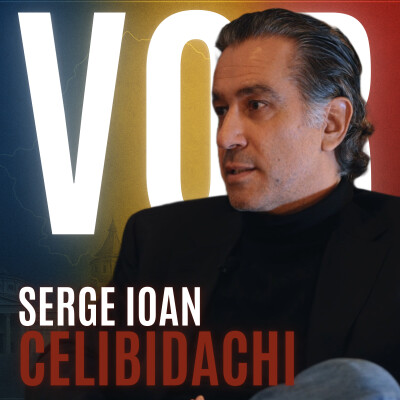
On November 14th, Cravata Galbena, the yellow-tie, hit cinemas in Romania. In dark rooms across the country, people sit down, the lights go out. And for two hours, they step into the life of one of the greatest conductors the world has ever known, Sergio Chelybidaki. Behind the film, there is not just a director, but a son, Serge-Johan Chelybidaki, who grew up in the shadow of a legend, and chose to turn that inheritance into one of the most ambitious Romanian productions ever made. Today, we will talk about what it means to be the child of a genius, to carry the name through your own life, and about the moment When a deeply personal movie stops being your story and becomes your country's film. I'm Dylan Delomoye from Romania Insider and this is Voices of Romania, recorded on the field where the stories that shape Romania's image in the world are written frame by frame. Hi Serge.
- Speaker #0
Hello.
- Speaker #1
Thanks a lot for taking the time to be with us today.
- Speaker #0
Thank you for coming.
- Speaker #1
When you walk since two weeks in a cinema and see people lining up for the yellow What do you feel?
- Speaker #0
It's amazing. It's really... Something we hoped for, but to see so much enthusiasm, to see the diversity of people, seeing kids interested, moved, teenagers, young people coming, not knowing who he was, as much as you have older generations who might have heard of him, know of him, or even have... met him or heard him in an auditorium. So basically you have this very wide spectrum of people and to feel that there's a general emotion that powerful, it's really difficult to put words into it. It's an amazing feeling. It's a first for me, I must say. And it's emotional for me to see that we succeeded to travel with them or to invite them into an experience. They vibrated with the film, which for me is the most amazing gift I could ever wish for.
- Speaker #1
How would you describe yourself today? How would you present yourself?
- Speaker #0
A very happy man.
- Speaker #1
Yeah.
- Speaker #0
Aligned with all the different energies. I'm happy to have arrived at this moment. It was not the easiest path, but it was the one we had to do. The new phase has started. it's the dialogue with the public, which for me is most interesting. And hopefully from Romania, with such enthusiasm, we can see and meet people outside of Romania with a similar enthusiasm and give a chance for this film to travel the world. That's where I feel what I... Hope can happen.
- Speaker #1
The Yellow Tie has been in cinemas for two weeks now. When you see the poster and people buying tickets, what goes through your mind?
- Speaker #0
Not so much that as really to see a full... Because I've been in many of those projections. It is a nice vibe. If I'm coming, people come and stop. And I always ask them, but did you see the film? And some didn't even see the film and they were already happy. And I said, well... be careful maybe you know you need to see the film and after that we talk about it and if you're still so happy then that means a lot but when you feel you're inside a hole and you have all these people watching you know what you worked on for so long and vibrating laughing at the funny parts and then being quite touched with the moving parts and you're thinking well it seems to work it's really sometimes they laugh even more than you expected and you go wow They're really into it and you feel, okay, seems to work. This is the most gratifying moment for any filmmaker.
- Speaker #1
I've had the chance to be at the premiere at Sala Palatului. It was a wonderful moment. I mean, the projection was wonderful, the movie is wonderful, and the atmosphere was really impressive because it was super quiet. I mean, usually it's like that in the theater, but it was pretty quiet and I was feeling the intensity that the people were feeling during the movie. I'm thinking about this scene in Germany with the explosions. I mean, I won't spoil anything about the movie, but there is a scene like that. What was the moment during the premiere at Sala Palaturi that hit you the hardest emotionally?
- Speaker #0
I tried to keep the distance when I was making it, because I needed to be as objective as possible, treating them as characters with their own objective, their own paradox, their issues. So that was the, let's say, the mandatory state I was in while I was making it. At the Sala Palatului, it was the finale, or the beginning of the new phase, presenting it to people. So I was just hoping to feel that emotion. And when you see that, again, the little humorous parts are welcomed, and then the very emotional parts you can feel. feel the emotion you don't have to you just feel that they are there so you know one of my very powerful scenes that i i remember or i i consider is the the sanctus in the in in venice which is a very important moment in my father's life and here we transport in something else but it is just that the essence of this alignment a spiritual alignment somehow and feel that you know it It was conveyed and it's taken and people are there with you. That's just, again, indescribable. It's amazing.
- Speaker #1
What was the most surprising reaction you've had so far from maybe someone who knew your father or someone who watched the movie?
- Speaker #0
The most incredible reaction I've had a few times is when they come, and I think this is only for Romania or for probably expatriates, there's a 60-year-old man... quite well built over 180, 185, 184 maybe, he came like eyes, you know, wet, all very emotional, and he took my hands and he said, it's the first time I feel so proud to be Romanian. And that, it's not a goal, but you arrive at that, it means so much because there's been so many misunderstandings, and it's a country that has suffered so much. and has been hard to find their own identity without going in other discussion. It's just so simple to feel that this film can represent a side of a beautiful Romania and there are of course other subjects, but this is an invitation. And these people have found that. When you arrive at that point, for me, it's not just emotion, it's re-giving to Romania something they've been missing, and not my father, the values of their country. and that's just one but that works to resuscitate in you a certain pride and an identity that you deserve it's a great country with great people And maybe it's an encouragement for other people to do something about other fantastic figures from this country.
- Speaker #1
And you are a good example for that, because you were born in France, you lived in several countries, but you are back at Sarah. Yes,
- Speaker #0
this is also what life has. It was never planned. It's really how life brought me. I did fall in love. It was a very, at the beginning, let's say, dual feeling. I had a lot of... issues with the country. I cannot hide it. But, you know, slowly, slowly, you see the other part and you start to understand a lot of things. And this warmth and the beauty of its landscape, I've been touring a bit and you go to some roads and it's like an impressionistic landscape. It's marvelous. No words, no iPhone can take that. It's just something that, you know, you just feel and And it's... so pretty. And in a way, I think it speaks for the people as well. They are very warm and very pretty. Of course, it's a fool. You have all kinds of people at the end of the day. But this notion of respect and this notion of identity, I think it's the start for to encourage the society to believe in themselves. This film will encourage you to believe in yourself. But at the end of the day, if the people can believe in themselves, they will grow to be better and maybe less envious, less, you know, maybe narrow minded in some cases to give you grandeur and give you a sense of belonging to something that's worth it. It's very simple. For me, I felt at home. And today I do feel at home. even me i feel at home i don't have to explain yeah it's a special country for many reasons yeah yeah and it's easy to fall in love with this country for sure yeah and if your other part is also romanian that also is uh the last uh bit that you need for uh we're having this quote you know in the in the expat community let's say you cry twice when you arrive in romania when you arrive and when you quit it's a good one i like it i will use it i think it's great
- Speaker #1
Before the legend, Sergiu Chelybidaki, how do you remember your father at home as a parent?
- Speaker #0
It was just the most incredible father. You know, we all have a very strong wish to our parents, but it just happened that I had a guy next to me who was probably the most generous guy I've ever met, the most sincere guy I've ever met, the most truthful guy I've ever met. He was very intransigent, he was very... difficult at the same time but it was true and he was loving his activity he wanted to help you as a person he wanted to help his students to give the this knowledge further not being able to write it you know leaving the words to be interpreted he believed that alas or cut that you can you have to give it from a meeting to another meeting from a discussion to another discussion and experience it but The most, the simplest man I've ever met and the most, you know, extraordinarily intelligent and very simple and didn't need a mask on anything and was very open to discuss any subjects, very attentive to the people around him. So much so that, you know, he would take the time when we were in the house in Loiret, he would sit with a... the peasant next next door and talk about his uh how was the summer how's the harvest and the economical conditions he would just really care about each person around him so much so that when he passed away the peasants from landerville where we are we have the the the house they've asked if the if the plus if the roundabout could be named after him wow they came to us and said we would like to name it you know plus which i found absolutely marvelous and the same happened when we had to bury him uh it was just a family and all uh the farmers who carried and you know in munich they were like oh this is a scandal he should have an open thing and with the official thing in munich and no if you know my father you know that he would want just something very simple in his own little house in his little very discreet very uh with much simplicity. So that was him and that's what I probably admire the most. You know, I remember It would rain and we all like with our hands, you know, it's disaster, we can't play outside, we can't go with the bicycles, blah, blah. And he would be so happy because finally the trees and all the flowers would get the water because it would be too hot of a summer and he was very worried. So if we didn't have the rain, I would have to carry the hose and start to water everything with him. But his joy was such a joy. It was just a natural joy of rain. He was just happy that... rain was coming and was giving water to all those alive things around him. Just a true man, just a true, simple man. And that's what people don't understand. If you don't have the luxury to sit next to him or be in his classes that he never actually charged for, evidently, you would understand that immediately. But of course, with the media, you get very strict or, you know, the extremes of the... crazy god or the genius but you don't really have the the man in between and he was just that yeah you can see in the movie i mean from what i can say from the movie you can see that it was the definition of the person working out of patient and as well like to
- Speaker #1
be happy with the small things yeah which bring you back to hers you know like at the end of the day what can make you happy you know it's the patient what you do and the small things that you have in life yeah yeah absolutely And when did you first...
- Speaker #0
realized that for the outside world he wasn't just your father but he was sergiu chelibidake early on thank god i was maybe 11 12 years old and i wanted i was also my first love was music i played the piano i wanted to continue to do something and i realized uh oops there is a guy there that seems to be very near perfection and all i'm going to do is It's the biggest problem for myself. Maybe it was exaggerated, but in a way, I had to choose a second choice, a second direction. But I used, if you will, sound in a dynamic with image, and I found myself through that. But obviously, he was very much out... there with these references and at school you know you would have the music teacher, the German teacher, the history teacher expecting me to be the best of the best and all I had to do was to disappoint them. I had no other choice than just be below their expectations so I had this pressure from the beginning, accepted it in time, took me a long time to actually settle with that.
- Speaker #1
Did it feel more like a shield or a weight? Both.
- Speaker #0
It's a privilege, but you almost see that later. First, it's because everybody expects that, and you go, well, it's not fair. But so I would feel that pressure early on. And then, of course, as time goes by, you realize that it's actually such a privilege. Okay, not because of his fame or his success, but because of the kind of person he was. And the fact that through him, I had maybe 10 persons. you know I had my best was my best friend he was my hero he was my confident he was those people in one person so obviously I felt very privileged because I saw other people having different relations to their fathers and parents so I put that in perspective and I say you know it's a package it comes with this so you'll be probably disappointing most of the people that will meet you at the same time it's real you have him there and you should really treasure every day that uh that you have him next to you.
- Speaker #1
And was there a phase where you were feeling like wanting to run away from this world?
- Speaker #0
Yeah, I was actually quite rebellious when I was growing up. Just to try and, silly perhaps, but to try and define who is Serge, you know. I'm just Serge before. And I tried to look, who is that guy? And it took me a while to really understand that I'm nothing else than my father and everything else than my father. I'm just, you know, linked to him and also I'm my own person. It's kind of a, you have to find the balance in that. So, you know, in my 15s, 20s, probably I would look at that guy and say, that guy is pretty arrogant, he's a pretty shithead. But at the end, I understand where it came from. Probably it's a phase you need to identify and solve, and then you can be yourself. And me, it took a long time because I was also very conscious of how great he was, and I didn't want to dirty the name, I didn't want to not be at the level, so it took me... really a long time to arrive there. I'm probably still searching today, but less so.
- Speaker #1
When you decided to become a director, did you feel that you were continuing his artistic line in some ways?
- Speaker #0
deliberately choosing like a totally different yeah deliberately it's something else it's uh i realized early on that i was not that good at writing novels but i i was very attracted and i wouldn't say gifted but i had the attraction and the fascination of the dynamic between sound and image so when i was writing screenplays and we're talking at 12, 13, I was starting to write screenplays, I knew what I wanted to do. And all I wanted to do is to put into images a compelling story. And that was me. So when I write a scenario or a script, with or without James, it's a visualization of the script. It's like the stages before you can actually make it with all the budget necessary. So it's still a page. So it's still accessible and doable. But I would write in image terms. And of course, dialogue is there too. to be balanced but it's very image oriented and if i'm not mistaken you studied yes yeah you studied i studied theater to begin with because it's the you know that the dramatic point is the base for all and i didn't want to rush into it then i went to uh to a film school in london and uh yeah life brought me back and i was ready to do the documentary and i was lucky that i actually did it because my father's health was deteriorating a bit quickly and i Sort of cancelled the film that I was supposed to do, which was Octave, and I went into the documentary that I always wanted to do, but the doctor said every day that he wakes up, you should consider yourself lucky. So I was okay, I got the point. We cancelled everything and we do what I thought I would do one day. The one day is now or yesterday, so I really need to get going. Which I did, thank God I did it, I filmed it, I took all the facets that I thought were necessary to do this project.
- Speaker #1
the only thing he didn't see the final edit but we had some nice memories talking about it so yeah yeah and I mean for you this documentary is
- Speaker #0
I believe emotionally speaking is something because if it was like every day like a chance you know yeah yeah it's it's special and it has some qualities that you know if you want to know who's the person behind again those cliches that's a it's a good it's a good invitation
- Speaker #1
And do you remember the exact moment when you told yourself, OK, when I do a movie about Sancho Chiribirake?
- Speaker #0
It's in me since I heard his stories when I was a child. He was putting me to bed. I was eight years old, ten years old. And it was like, wow, this is a novel. This is amazing. It's so visual. And he was making it also very visual, describing me all these things. And I started to take notes. And of course, I knew that I had to do it one day. But then what happened is I went to America to try and sell the documentary. We're late 90s, even 2000. And that studio said, we don't buy documentaries, but I'm really interested in the story of this guy. I was like, okay. So I started to develop a bit with them. And then I realized that we were going to lose the essence of that story if I was developing it in the States. So I... took it back and I went back to Europe and I asked my dear friend James if he was feeling capable of doing this with me, which he did, and then we started to write it together. First, second, third script you can imagine we have like 40 plus versions but and it took a while but then I knew that I needed the base for it and then it was a question of opportunities whether We could assemble the budget one day or not. I knew it was not a simple budget and it was not simple to produce, but at least I wrote it and I co-wrote it and it was there.
- Speaker #1
In some ways, you opened the door of your family during this movie. Were you scared about, let's say, putting an intimate story into a public one?
- Speaker #0
Yeah, that's the most unwelcome reality in a way. I knew the story was so important that what I felt or my limitations, let's say, would not count. So it was about making this story because it was too unbelievable not to share. But the reality is that if there's something that I hate the most is to talk about myself, talk about my father. He doesn't need to be talked to. People know about him. And if you don't, maybe you find a way. open up this very intimate situations where they call each other by nicknames with Poufig and and Beatsy these are these are real names and you know it's it feels very intimate and it feels it's a bit disturbing for me But it's the second part of the story. It's not as important. But I hated that process. But I put it aside very quickly because I think what was important was to be able to share the big story in the grand way and my little feelings were not as important.
- Speaker #1
It could have been weird when you were recording, like hearing the nicknames. Yeah,
- Speaker #0
but it didn't because then by that time, I had this distanciation process. I had this distance where I'm treating characters and even to the crew, to James or to... The actors, they were asking, so how is Sergio, or how is your dad? And I said, it's not my dad, it's Sergio, and it's Joanna, and it's Miki. And we keep it there, because otherwise you bring me in, and I won't be able to answer you in the right way.
- Speaker #1
And when you saw John Malkovich, Ben Schneider, playing Sergio Chalibidake for the first time on set, what was your gut reaction?
- Speaker #0
I was happy that Linda, also with the look. And the hair, she could do such a good job. I was very impressed with the quality of the transformation. So I wouldn't say it was emotional, but I would say I was happy to see that it's doable. Because it's always, you have a question. How close will we be? Is it believable? Is it too far? So I was extraordinarily happy to see that the essence of the character was coming out, even visually. And with Ben the same, she did a really wonderful job. At the beginning, it doesn't necessarily look, but then we worked into some directions. Linda did a spectacular job when it came to try and get as near as possible to the characters. And yeah, the credibility, that was like step one of all the different questions we had. So I'm very happy. It was more a satisfaction than a... I try not to be emotional. I don't think I was emotional that much. I was trying to go with the character. So it's not when there is a difficult scene like at the Ateneo and Sonia comes back. For example, I remember being very emotional, but emotional because he was emotional. So I'm trying to join the character and the actor in the space he finds himself. Not because it's my father and not because my story or our story is on the screen. That never happened and until today it doesn't happen. It's a story, if I take a bit of distance today I can say, oh it becomes an homage, it becomes this thing. But it never was the point of that, it was never the objective. And I always wanted to make sure that people can relate to the characters, and if not one, the other, and their contradictions, how they interact with each other. But on a scene I was joining the characters, so I would get emotional. trying to be in the same space as the actor. Yes.
- Speaker #1
And is there like a specific detail, a gesture, a silence that made you think like, oh, this is my father, you know?
- Speaker #0
The theories are close, you know, for example, the importance of silence. And that's, you know, I put that, we put that with James because it goes to his philosophy and it makes sense. If you verbalize it, that's probably how far you're going to go, you know. For example, the conversation in quotes with the Zen Buddhist master is a conversation I had with my father looking at the garden. And we stayed there in silence for 10 minutes with the wind blowing, saying nothing. Just two chairs seated next to each other. And then after 10 minutes my father says, I really enjoyed our conversation. And that tells you the story of... you know the simplicity or sometimes the no need of words to describe something you just live live the moment this is one of the largest uh not to say the largest romanian production ever shot entirely in romania huge stars international
- Speaker #1
orchestras at the ateneo and different locations in romania what was the moment you thought this might be big from day one there was no choices
- Speaker #0
If I was to do this film, I knew a grand subject needed a grand cast and I needed a grand budget. We either do it grand, this is why we called a director of photography, Peter, from Los Angeles. It was obvious that it was going to be like that or not at all. This is why I didn't hurry to do it before because obviously you depend on finances a lot.
- Speaker #1
And was there a day on set when everything went wrong?
- Speaker #0
No, never. This is amazing. There was one occasion and one of the whole platform went down and we had to evacuate and wait for the security to come to put it back up. So we wasted a couple of hours. But this is as bad as it went. We were very lucky and protected somehow. I don't know. We didn't have such securities because every day cost us so much money. The next day, if you actually start to have a delay, for us, it would have been a true disaster. At the same time, it just... just came, just everything fell into, we did not accumulate any delays, we might have had an extra hour here and there, but that's it.
- Speaker #1
And what do you think surprised like Miranda Richardson, Sean Bean, John Malcovich, Ben Schneider in Romania, like were they happily surprised? Yeah,
- Speaker #0
I think so, I think so, they were happy with the way the team was professional, the warmth they received. the interest, the respect, the professionalism of the team. So they were like, I don't know if hugely surprised, but they were happily surprised or positively surprised. And I think they left with a great experience.
- Speaker #1
And John Malcovitch said in an interview that he was having some Romanian DNA.
- Speaker #0
Yes, he does. It's funny. He just found out that after, so it makes it even more interesting. They felt very welcome I think and we made sure that we were filming in a very specific way, respecting all the conditions which are different in America from the SAG point of view than there is in Europe and everything went surprisingly smooth if I can say or happily so yeah, unbelievable.
- Speaker #1
And looking at the finished film now, what makes you like the proudest as a director?
- Speaker #0
No, that we could, you know... that it worked, that we could actually make it. And the happiest moment is to see people in an auditorium, in a cinema, actually joining the Odyssey and traveling with you, and feeling close to Sergio, and talking about an amazing experience, and feeling warmth. It's like a little, you know, a little caress to your heart. Maybe you are crying a bit, but you're crying with a warm... warm tears so there's nothing that can replace that i mean i'm extraordinarily thankful thankful to the team thankful to adela who could raise this budget with the all the people behind it's hard to believe we could make it it is not a simple task but i will be eternally grateful and your father if you would have had the chance to re-watch like let's say his life through this movie would do you think he would have loved it even though he wasn't liking digital no he would not have loved it um don't think so i think he would have accused me to be a bit too romantic maybe too sentimental he was a bit uh stricter let's say even if it was all about emotion you still if you expand the touch too much maybe you you know I think he would have been happy to see that the film connects with people. So for me, happy for me, let's say. From his point of view, he would have said at the beginning, you're losing your time. This is not an interesting subject, what you're doing.
- Speaker #1
Out of modesty?
- Speaker #0
Not even. I think he just believed that there were more interesting subjects than that. And that's just not as interesting as people think it is. It's just not. What is interesting is maybe what Mozart wrote or what Bruckner wrote. And at the end... I start to think he could have said something like, it didn't come out as bad as I expected. That's the best comment I could have gotten. It's a bit better than I expected. And that's it. It would be super positive. Yeah, but for me, it would have meant something. It would have meant something. So I'm just daring to think, yeah, something positive, but very sort of subdued.
- Speaker #1
And for Romanians watching the film today, what part of your father's journey do you think like resonate the most with them today?
- Speaker #0
I think what I've realized when after he passed away, the fact that he kept his identity, his love for his country so much, I didn't understand it myself. When we buried him, my cousin flew from Galats, Radu Makovei, and he said wow you're Country house in Loiret actually looks like a Romanian house and I didn't really understand that. It was obvious it was my weekend house so I never put an accent on it. But he said look the wood the way it's worked and the thatched roof and it's like it's a copy. He was recreating all those universes. I understood that and I wasn't shy to really try to connect with that because the breakup is not necessarily just a breakup with his father, but it's a breakup with his country. So once there's communism and he can't come back, all he has is his memory and so what he does with it. So he recreates a universe that is Romanian, outside of Romania. That is extraordinary. So evidently, for a Romanian to understand that, he could have taken any passport. but he didn't, he remained apatrides, he remained stateless and took only Romanian, declared he's Romanian and would die Romanian. And at the end of the day, coming back, conducting the UNESCO Rhapsody, I mean, you cannot not join the celebration. And I think if we are right, It was the best chosen moment to reunite. Let's say a country that's very divided today. But outside of all those problems, we, for a split of a second or a split of a moment, we can just enjoy being Romanian in the positive sense.
- Speaker #1
And do you think this movie is bringing back your father once again back to Romania?
- Speaker #0
That's what some people have said. I never thought that. In a way, I can see that now suddenly the subject is talked everywhere. It's a new fascination. They forgot he was Romanian or... He was an enigma from the past. So it seems to go in that direction. I never thought it would in that sense. But it seems like not only that, but they are happy to remember that the Romania that had success, had some principles, shows a different kind of Romania. And that, I think, is what they are liking, more than the way he conducts music. But it's more like what he represented. A free Romanian, while you had Ceausescu and all this crazy regime, in itself has a weight. A Romanian in the Romania that we find today, and remember that he stood for some principle, he was not corrupted, he fought for what he believed in, and he followed his heart and his dream. Wow, that must resonate somewhere. So yes, the country is maybe waking up to something that is... they're happy to remember and hopefully for them happy to celebrate.
- Speaker #1
For Romanians from the diaspora that would have the chance to watch the movie in Berlin, in London for example, what do you hope they would feel when the lights goes on?
- Speaker #0
Well for the diaspora maybe they feel sorry they left and they feel the need to come back, that would be actually not because... As you know, many talents, they all go abroad to have a better life. And of course, if you have a better salary, sometimes it's an obvious choice. But if Romania would keep their talents, maybe we'd also have a more vibrating society. That's just a very quiet hope. And I hope it's not only the diaspora who will go see the film. I really hope we have a proper distribution. for Americans and French and German people and English people to discover Romania through this story and realize that you know what those are grand this is a this this country I don't know anything about and makes you curious to really look at Romania through a different angle than what was presented up to that point
- Speaker #1
I truly believe that this movie will put Romania on the map yeah and on opposite because you can be put on the map for the wrong reasons you know Yeah,
- Speaker #0
yeah. So for that reason, yeah. Yes. I secretly hope so. I mean, it's like a side story of why this movie should actually travel, but it would make me the happiest guy in the world if that happened.
- Speaker #1
Yeah. I love the movie, as I told you several times, and I'm sure it will be the case. It's going to be a success for sure. I'm 100% sure of that. Do you think that this film can be a message that Romania can do big?
- Speaker #0
Big? at least can be respected for what it's worth and culturally speaking and with economically it's actually sounder and healthier than people sometimes think we have a lot of incredible rich land for from the minerals point of view from the oil point of view we have a lot of things that we can offer to make to make Europe more powerful and more vibrant and more existing. And there's a real degree of participation from Romania to strengthen our friends and allies. It's very important for me that... Other countries in Europe understand that. Romania can really participate to become its own nation and a real identity within Europe, standing together for a better world.
- Speaker #1
And now that the film is out, what responsibility do you still feel as his son and as the director of his story?
- Speaker #0
The responsibility was there and it is there. I assume the choices I made. You know, this is the time where the film is not ours anymore, it's people's experience and then it's theirs. So all I can say is to have an open dialogue so that I can understand exactly what we did. For now, it's an extraordinary enthusiasm. I'd love to see further, talk to younger generations, see what worked, what didn't work, what appealed to them, what didn't appeal, what part is strongest. So I understand. how they function and how it will function outside as well. So for me, it's an open dialogue. It has to be.
- Speaker #1
And what beliefs guide you the most today?
- Speaker #0
Well, the confirmation that you need to, because basically, ironically, I applied what my father told me. His main motto was any doubt. is the doubt of God, of the existence of God. So he left without a penny, without a plan, following his dream, but knowing that it will be okay because he's not alone. He's surrounded and he just has to be faithful and correct to himself and to society and things will just shape up as long as you remain faithful to what you believe in. And we kind of went this way without realizing that this is kind of... We didn't do compromises. We kept faithful to our vision. And we are now at the end of, we've made the film and now we're starting to see an enthusiasm and a very encouraging result. So I have to go back to the origin and I say, I questioned that many times. You can imagine my life. I was like, no, this is not like that. You were wrong. You know, you want to, sometimes you have problems and you challenge your own beliefs. or your own theories what you heard and I have to give him right to say you know he was actually what he did worked and a couple of years later a couple of decades later I've experienced it through my own eyes and my own you know rock and roll ups and downs because it's what happens in this situation it's not just a straight line that it worked for us too so miracles are possible if if you want to call it a miracle. Or sticking to what you believe in is what I want to remember and try to continue to apply it. Even if you have a thousand obstacles, you still stay faithful to what you believe because it doesn't happen when you want. It happens when it should happen. It's not for you to decide whether it's time now and it's enough. No. If you stick to it and you do what is correct, things will just shape. at the right moment.
- Speaker #1
What scene from the movie you like the most?
- Speaker #0
I have a problem with that, but at the same time, if I have to extract one, it's that main pillar, which actually was one of the main pillars of my father's life, which is the experience he did at the Sanctus moment in the cathedral in San Marco. at the time experienced the famous end in the beginning and the beginning in the end where time does not is not anymore and we took that as a main pillar and something happens in there i don't want to say it directly but it's about uh forgiveness and how you reunite yourself with yourself and with your family somehow in the spirit and allowing uh other members to join the same space somehow. And it's quite spiritual, it's quite powerful, it's simple, at the same time it's extraordinarily humble and telling. So we illustrate it in a different way, but it's about this realignment where in fact maybe all those scars, all these feelings from the past are washed out, are... seen much with more kind eyes and you do arrive to forgive. I found it pointful. It's a very powerful moment.
- Speaker #1
Yeah, I can relate. And if you could put one sentence on a billboard in front of every theater linked to the yellow tie or just a sentence on the billboard, what would it be?
- Speaker #0
Well, as much as it's a cliche, probably listen to your heart or believe in yourself before anybody else.
- Speaker #1
And in 30 seconds, Serge, I mean, or more if you feel like, how would you speech the movie like fast to someone?
- Speaker #0
Yeah, we had that. Something like the odyssey of a man who, you know, had a call to follow his heart and his dream and against all odds. and against even his own family achieved or arrived arrived to to touch it or arrived to the light or arrived to yeah to materialize his dream thank
- Speaker #1
you very much thank you for hosting us thank you the movie is in the theater go watch it it's a wonderful one i can only relate positively i loved it myself thanks a lot for your time thank you very much thank you very much