- Speaker #0
We are a podcast for product marketers and B2B SaaS who feel misunderstood of what they do.
- Speaker #1
From someone who truly gets what you do and basically help you feel less like a misfit being unenormable in your role.
- Speaker #0
Welcome everyone to another ecstatic episode of We're Not Markers. We've got another illustrious guest on deck, but before we bring her out on this stage, let's pass the mic around to our fellow co-host. Let's kick it off with Eric.
- Speaker #2
Oh, I like that new pass the mic around. We got to keep that. I am Eric Holland, the Franken manager of the group. Gab, your turn.
- Speaker #1
Thank you. Gab Bugeaud, Sales Deck Associate. Still doing sales deck and I'll pass it back to Zach.
- Speaker #0
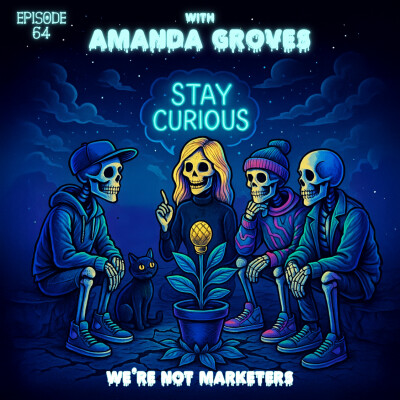
Thanks y'all. Before we hit the record button, we were speaking with this guest and one comment we strung out was that you've really strung the line of weird LinkedIn as of late. And you'd be surprised who this person is because she's killing it in her career. She's painting amazing photos that she hung up in the wharf. She's running ultra marathons. I don't know how she's doing. It reflects her career growth too, from starting as an individual IC PMM two years later in PMM leadership. But I'm going to stop right there because we're going to bring out on the stage Amanda Groves, VP of PMM at Enable. What's cracking, Amanda?
- Speaker #3
Hey, what an introduction. Wow, I am blushing from ear to ear. Well, thank you. Yes, well, happy to be here. And I I have loved the show, long-time listener, first-time caller. So really happy to be with boys.
- Speaker #0
So now you know the next question that's going to be coming your way. I'm going to stop right there and I'm just going to step back into the sidelines.
- Speaker #1
Is that my turn now? I'm forgetting the way things work. Bro,
- Speaker #0
we recorded over 60 episodes. No, it's always your turn.
- Speaker #1
I know, dude. It's a Thursday. That's why. Amanda, I'm product marketers. Actually, marketers. Why or why not?
- Speaker #3
Ooh, this is the age old debate. I think it's one that we have internally as a team, depending on what initiative we're working on, what we're fighting to be a part of, right? If there's something that we may be getting to learn of after the fact, you want to be in the room. Hamilton, what? We want to be in the room where it happens and it depends on The growth stage of the business where marketing and product marketing is seen and heard as a part of the team and some others that are still learning the craft, where it sits and how it's realized. Are we marketers? I would say the people who I bring into my teams are the nonconformists, like the rebels, the people who are willing to go against the grain. I would love to see more marketers have that fabric of zagging when everyone else is zigging. And so I think with all of those attributes, we are more than marketers. So maybe we aren't marketers. Again, that nonconformist through line is what I do. You have that spidey sense with people. Well actually I see it this way or I heard it from over here and maybe we're considering it that way. Marketing's all about trends, but like to really stick out and go against what everyone else is doing, maybe you shouldn't follow that trend. Maybe you shouldn't be a marketer. Maybe you should be someone else. and a product marketer for that matter.
- Speaker #0
- So when you say nonconformist, are you referring to like Comic Sans on a pitch deck? What does nonconformists on Amanda Grove's team look like?
- Speaker #3
- Nonconformist, well one is just something that I've always been as a person. I think you can have people tell you who you are and who they think you are based on the limited information that they know about you To come back to the introduction of how I've grown my career, I have had a lot of people say, "Well, maybe you shouldn't be in marketing. We're not seeing you in this marketing profile in the way that we've always understood it." So coming back to being a nonconformist, it's about, I think, challenging with intention, staying really curious, bringing a lot of information into the conversation and challenging the norm, challenging the status quo That's what product marketers are doing, right? We're disruptors. You have to be a nonconformist to be the biggest disruptor in the room, in the market, in the industry. So that's what I mean by that. Those people who have struck me to have that fabric or in their DNA, whether it's in the interview or I meet them at a conference, they're asking really good questions. They're really inquisitive. They're pulling on a thread that's invisible to me and I haven't noticed, but they're making me notice it. So I think those are the some of the ways I've identified those similar like rebels. And it's when you have that together, product marketers, we do so much a lot of it is a rally cry for a product and who better to shape that than people who can actually rally and hype in a way that no one else can.
- Speaker #2
Yeah, and I'm really just chewing on that piece about being a nonconformist. Not necessarily having to break things but not being afraid to research in the other direction. This might be my opinion, don't want to say it's the other two on the show, but I tend to find that we're asked to conform. Others are wanting us to maybe go in a certain direction, like you said, zig while we maybe want to try zagging for a while. What do you think is like the way to get over that and encourage some of the people who might be a little skittish to go against the zigging grain? And start moving in that zag.
- Speaker #3
Yeah, well it's a good way to preface it where you're not trying to be disruptive to the point of breaking things. And certainly you may have to what the is the saying crack some eggs to make an omelet. Like sometimes you just you do need to break some things. To tap into the weird LinkedIn I was, I shared this with Zach before the call, just thinking about product marketing and all of the ways that we are nonconformists. And I use the analogy like Bogwitch isn't quite correct. Maybe you're a troll under the bridge, but you're stopping people before they pass. And that is in a sense of non-conforming, right? People want to skirt right over maybe the go-to-market process and shout about something before it's ready. We have to stop them, kind of check the scorecard a bit before we're ready to go. And that nonconformity will help us speed up. So it's a slow down to speed up mentality that product marketers can bring to the organization where we're not doing this to be difficult, we're doing this to get to write faster with more predictability so we can make a splash as a team and get more market share from slowing down to speed up and maybe nonconforming to what our competitors are doing to make that us, the business and the product marketing team.
- Speaker #0
How do you socialize that philosophy in an industry that has always believed in moving fast and breaking things?
- Speaker #3
I think you can move fast and break things once you've shown you can and you have to do that in a way where it becomes that slow down to speed up again It doesn't happen overnight. No one walks into an organization with trust built and it's something that has to be earned. And so if a product marketer can say, hey, this is something where I have conviction with a capital C and we need to really think about this and this is why, that's to me the difference between good and great product marketers. It's having that conviction in their point of view. And once they've been able to test that, show the business that there's meat to this conversation, then it will allow them to move fast and break stuff more. And I would want anyone on my team to break the things that need to be broken. Like, I don't want to do the right thing or the wrong thing the right way. I want to do the right thing more. And the best way to do that is to continue to test and experiment and challenge. But in challenge in a way that we've done the work, the voice of the customer, the market intelligence, all the R&D to say why it's a good thread to pull on.
- Speaker #2
How many people do you have on your team right now?
- Speaker #3
Let's see. I think we are about sitting between seven and eight right now.
- Speaker #2
Nice. All right, so shout out to all those awesome seven and eight. What are you shielding them from outside of your little mini product marketing org? So they can go out and do some of those things and bring you some really good information and knowledge that says yeah Go let's move forward with this and I can help you in navigate these tough discussions that are obviously going to come up?
- Speaker #3
Yeah, I think it's not a muscle that, again, is grown overnight. And depending on where you are in your product marketing career and how you got into product marketing, you'll have more comfort level with challenging. I think everyone has a different story for how they got into it. I've seen a lot that are journalists. I was a journalism major, so asking questions is critical to the craft. So those that maybe are comfortable with asking questions and the five whys or whatever framework you're comfortable with can help you break into that. And you start to track like where the questions are leading to better conversations. You're better qualifying your questions. So that's something that I will encourage. And then something that is it's unignorable in the practice is bringing it back to the customer. If you're framing your intent with I think we should. be doing X because it's going to have a better customer outcome and we all benefit from that, it's going to neutralize the conversation and make every party lean into what you're trying to drive forward. So coming at it from that place of this is for the benefit of the customer, we're wrapping our intention around that allows product marketers and not even just product marketers, really anyone that's driving towards that outcome to... again, just neutralize if there's turf wars or if we're challenging something that maybe someone's precious about. Strip that away. It's not about us. We're not bringing ego into the equation. It's about the customer experience.
- Speaker #0
Tell us a bit more about how the customer experience is changing with AI and I'll give you some more context. Everyone's talking about AI but I noticed that Again, I'm not familiar how that is impacting in the manufacturing space that your company works within today.
- Speaker #3
Yeah.
- Speaker #0
But I think one challenge that we've observed is that we talk about AI, but our buyers don't know how to use it within our product. But our leadership wants us to just throw AI on our homepage and into ad nauseum to show that we're innovating. And then it creates this pressure for them, the PMM teams to try to figure out a way of talking about AI while still trying to connect with their buying audience. How does that statement resonate with you? What have you been hearing from your peers? And then follow up maybe is like, how's you and your team approaching this?
- Speaker #3
It's a really good question. And yeah, It's the soup du jour topic amongst everyone, whether you're out in LinkedIn land, you can't scroll without seeing a post about AI impact, AI replacing people. And I wouldn't say if the positioning is AI replacing a role, you are going to have a positive reaction to that. And so you extrapolate that out into the buying world. We don't want to position AI as a threat like AI needs to be. If you're looking at it as an architecture, you have your platform layer. AI embedded layer and then the applications you're building on top of it. So when you think of your homepage, you're not messaging that as a market texture. So it's interesting right now that the technology is taking such a front seat in how we are connecting with other humans. We know that it's a bubble, we know that it's a buzz. So I think it's something that we have to actively navigate and pressure test and show our leadership team. I know you're really eager to talk about AI. It's a very exciting opportunity for all of us to better enrich our technology and help our buyers get to outcomes faster. But that getting to outcomes faster has to be the story. It's not the what or the how, it's the why and why does that matter to the customer cannot get lost in the sauce. So I think Elena Verna, lovable head of growth, does a great job in showing how AI is extremely powerful, but in a way that, and she described it great. I really latched onto it. It's allowing AI to handle the 101, like the very administrative work, not in all cases, but in most, at least where we are, I think in my industry's AI use cases, it's just automating away all the 101 so the user can get to the strategic 201 and 301 and 401 work classes that they want to do, where they get energy from. No one wants to be... in my industry, to answer your question, it's a lot of agreement creation, agreement negotiation, just that agreement creation work and alone between your trading partners. We're essentially a trading platform for suppliers, retailers, manufacturers to come in and exchange data and get the best deal and price and run rebate programs intelligently. So having your best people create agreements not the great the best use of time. So again, going back to that automating away the one-on-one so they can do their best work. I know that's a cliche saying at this point, but that is really the core of what I think product marketers need to hold on to. And if they have leadership that is well, you know, that Portlandia episode, like put a bird on it, put AI on it. We don't need to do that. There's so much fatigue in AI and the test show messaging tests show that buyers aren't interested in having AI everywhere. They want AI to be their partner. But they're the human, they're in the control seat. And that's where it needs to stay and how we message it at least at this point.
- Speaker #0
Because I want to make sure we all hear this. Let's settle this once and for all. So buyers don't want AI to automate everything in their job?
- Speaker #3
Now look to the rest of the crew. I'm curious what you're hearing.
- Speaker #2
I've so I'm still in house until tomorrow. So I get the benefit of talking to our customer base. There's yet to be a single person who's, I want AI. And I've not heard that in a single call. People will ask, what are you doing with AI? But I've never heard anyone say, I need this AI feature. They'll normally say, wouldn't it be cool if I could do this?
- Speaker #1
Yes, same.
- Speaker #2
And that's what I typically hear. And it's again, yes, the conversation is around AI, but the customer doesn't even think of it that way. They're just like, I don't care if you're using sticks and paper or you're using robots in the background. Just let me get to what I'm trying to do.
- Speaker #3
Yeah.
- Speaker #1
What I'm hearing is there's usually a lot of technologists wants to pivot in that sense. They're like our use cases are not big enough for market just doesn't fit. So they're looking at that. But from a customer perspective, it's just creating even more noise. And I'm hearing a lot of people these days that are saying that they're almost sick and tired of just scrolling LinkedIn because it feels very much... Sorry about that. Very much AI-powered, right? There's the dead internet theory that everything that is getting written down is like bland and it's just stuff that has been repeated and repeated over and over. So that's why posts like... being a bug or troll, then people need to pay the toll to interact with product marketing. I feel like it's great because that weird stuff we dig it, we love it. It's so far left or like left field that we're just like, yeah, we need more of that. We need more of that element that makes it relevant and unique technically. Yeah.
- Speaker #0
I'm going to give you guys an analogy that's recently happened to me. Do any of you guys have a robotic vacuum at home?
- Speaker #1
Yep. and she's almost destroyed entirely.
- Speaker #2
Yeah, Roomba
- Speaker #1
Yeah, Roomba.
- Speaker #0
Let me... I'm gonna disclaimer this: I love my robotic vacuum. Like, I love AI. But for the love of God, like every time I turn this thing on, like every five minutes I'll get a little alarm. Why? Because "Oh no, it ran over my shoelace!" "Oh no, it got caught into cable cords!" And so this is why I come back to the point is that, A robotic vacuum cannot do everything in your house. There's still, like you said, Amanda, there still requires that human touch. Even though I have to sometimes crawl underneath my bed and pull it out, today AI can't do everything. And just to assume that it can just wipe us out, I think that's a very simplistic argument for us to be making today. And that falls on deaf ears, like you said here, in terms of when we're talking fires.
- Speaker #3
Totally agree with that. We're still very early days, there's a lot of excitement. And one example, too, I don't know if any of you have tried this where you have two phones and you have your chat GPT voice mode on and you have them talking to each other, you can prompt it to see like how long the conversation will last and test the model in that way. So we did this last night, me and my partner and the first one was just like asking the other one the question. So they just went on a loop like asking a question. Well, I don't know if you've ever done that. I love that question. Would you ask that question? They couldn't get beyond the question. So we had a prompt where we wanted the one to be Socrates and role play with the student, the scholarly student. So that was the furthest we could get it to engage. But even then there was a plateau where they were just in the same loop of not getting to the next best action. So again, very rudimentary experiment, but there's still a lot to be desired from artificial intelligence.
- Speaker #0
Y'all my type of household, I'll be like, "Yo, choose Kato next." All right. I want to be Kato. How about Marcus Aurelius?
- Speaker #1
The stoicism household. Yeah.
- Speaker #0
I'm like, "Y'all my type of house."
- Speaker #1
Exactly. I would like to go back to the move fast and break things discussion we had just from a practical perspective. Okay. Let's say a founding PMM or I'm a junior PMM and I'm working with other folks in your team, hopefully having like seven or six great people I can kind of call on. If I'm trying to break things and make sure that the organization succeed and we're all working together, there's moments when like PMMs, we struggle between, okay, should I do with the consensus and just trust my colleague even if I have some sign or data that might tell me otherwise, or should I prioritize taking initiative on something else? Right. Just from your experience from product marketing leadership and everything you did in your career, I'm just curious, is there low-hanging fruit or specific observation in terms of data or triggers that us product marketing managers should take a look at to make sure that we can decide, is it better to have a consensus? or to take initiative and focus on breaking things without hurting anyone's feet a little bit.
- Speaker #3
If you know me this far in the conversation, I am not one to be a consensus queen. Like a kitchen sink solution is not great. I've seen organizations where they've tried to go that route and you have a messaging doc that has just been red penned with all of these different thoughts, opinions, and it's diluted. It's worse than AI at that point. So it's something where I think you have to learn that where consensus can be good. And maybe that's like an you've deputized a small group and this is why these stakeholders are going to make a choice, whether it's a pricing committee or a product council, like consensus can be good in those environments where you need to hunt and gather your strongest voices to drive an initiative forward. But for product marketing teams where they have an initiative that they are the owner of and like their, the KR is tied to their outcome and their output and, I will always guide them and this is, I have a list of mantras on my team. They probably have a bingo card and roll their eyes with the many times I say them but it's consent over consensus and so we give our team members the knowledge that we are doing this, this is the path forward if you disagree you have your time to share that now but we plan to move forward in this way and this is why And so very much a fan of consent over consensus. I think consensus can be really dangerous in product marketing, especially when we have to have conviction in our point of view for the messaging, for the positioning. It's a surgical practice. And so if it's consensus, you're not going to be precise. That's to me, not what we should be aiming for. Unless like I started, there's a why and it's a product council, a pricing committee. There are certain times where consensus is correct, but it shouldn't be the... default posture of the team by any standard.
- Speaker #1
I love it. And yeah, if everyone agrees, but we are not getting the input of the customers, it's wrong. Marketing and messaging by committee will just please potentially stakeholders, but they won't be happy when they see that no result is getting out of this.
- Speaker #3
Yeah. Yeah. And that echo chamber, we think this is right. We're high on our own supply, so it must be right, but we didn't talk to anyone about it. And then you get it in market and it's Missing the mark and you've lost time and everything's moving so fast. You can't afford to lose time. Like you can't have so many of those versions of what you could have gotten if you were just listening with active listening. So great point.
- Speaker #1
Eric, we should create a hoodie consent over consensus.
- Speaker #2
I like it. So this is my first time meeting you for anyone listening in. And I can quickly tell how awesome it would be to have you as the leader of the PMM team. But I'm curious, what do you miss about being an IC and doing some of that IC work?
- Speaker #3
That's a good question. It's hard. I'm fortunate that the team, they still will... I think they still want me to be involved in more of the IC work because they asked for my opinion on things. They trust their judgment through and through. But I think what I miss most is the hand-to-hand combat with creating messaging documents. I loved doing customer listening tours and just like asking questions and putting together those briefs myself. But now I have a fantastic team, highly competent, wonderful humans who do this day to day. So I trust them fully to take that and have been able to share some of my frameworks, war scars, lessons along the way. But yeah, I still certainly engage with customers, but to the degree where they're in the rooms, having those one-to-one conversations and follow-up conversations. We have a lot of exciting, I know it's very timely, like agentic prototypes going on right now and just testing really quickly, getting those design cycles in place. I know the team is learning a lot. And what a time to be a product marketer. We're able to be at the forefront of groundbreaking technology, having customers use it for the first time. And so it's really cool to see. I do miss being in those conversations. I'm hearing a lot about how it's going, but I do miss that, I would say. But yeah.
- Speaker #0
Going back to 2019, when you made the transition to leadership, what was one growing pain that you just had to go through from IC to leadership?
- Speaker #3
It sounds maybe easier said than done, but delegation is hard. When you care about something so much and you have a point of view on how it should be done, it took me a while to figure out how to share my Legos, if you will, and Yeah, I wasn't good at it in the beginning. Like it was something it would come in my inbox or in a Slack DM and yeah, I'll do it. Hey, I got it. But it wasn't helpful for me. It wasn't helpful for my team. It didn't give them the opportunity to stretch and grow in the same way that like I have to afford as a leader. So delegation was not easy for me in the beginning. And I definitely had to get actively better at it and ask other people in my internal board of advisors. How do they manage delegation and get comfortable with it? I would say I'm much better at it now and knowing when to delegate, when to bring someone in and be their champion for maybe it's something that they've never done before. Like how can I shape that learning growth curve for them? Something that has been a big part of my career is pricing and packaging. It's very difficult to get right. And something that I think is a big differentiator for who I am as my PMM makeup, but- Giving that away in my team recently was a big change. And the person who is now owning it is crushing it. And I'm like, if you do nothing else in product marketing, you are excellent at pricing and packaging. Keep doing that. So it's only by sharing that you are able to grow and help others along the way.
- Speaker #2
How did that feel? What was that like when you realized like, yep, this, I got to give this up.
- Speaker #3
So it's something where at the end of it, You feel proud that you were able to see attributes or skills in someone that, you know, they have the making to be. Like excellent, not only at product marketing, but this very important specialization that not everyone wants to do. There's some people that are like, Oh, like that's it's hard. Or there's a lot of opinions flying around about pricing and packaging, or maybe at a business, it's just an afterthought. But at the businesses I've been at, it's been like core to how we work. But to answer your question, definitely proud at the end of the day that someone was able to own it. They've gotten more recognition and visibility. They're now the go-to and source of truth and expert within the business. And I certainly am still involved and I'm helping to shape how it continues to ebb and flow our business right now. We're going through a lot of M&A. And so the impact on pricing and packaging from an M&A standpoint is massive. We're navigating these things together. It's new for me. It's new for the individual. So being co-pilots and a specialization within the team and knowing she's got it, but I'm here to help. And you're certainly going to skin our knees. But to go back to the analogy, there's no patient on the table. It is just software and we're going to figure it out. But yeah, I was ultimately proud and had all the confidence in the world in this person. And I think if you have that energy, like you're going to be successful. There's no other option.
- Speaker #2
I love it. I love it. And shout out to the young lady who's out there killing it with the pricing on your team. Totally echo what you said. Pricing has always been the big, scary, hairy monster that I've wanted to touch, but it still gives me the diabetes. It is not easy to give that up and trust is going to be one of the biggest things that dictate whether you can pick up a project like that. I think it would be really helpful if we could people in terms of upward management, in terms of building that trust with you? And what are those things that you feel like they can come in and do, whether it's short term, long term, whatever. So it's, hey, you know what, we have I have this thing in my lap, I'm ready to give it up. Because that's, it's not a one way street.
- Speaker #0
With my team members or even aspiring PMMs, I do a lot of mentorship outside of the PMM community. And again, there's different flavors of what product marketing looks like. So raising your hand and putting a stake in the ground, like this is where I want to grow my career. I've had people on my team who had the option to stay in what we define as core product marketing. And so you're map to a product area. And that peak. product manager is your co-pilot and you're running launches like traditional product marketing and then there's solution product marketing which I think some business will have solution and industry marketing and this area of the team is taking the fabric of product and mapping it by segment by persona by industry and so there was a time where someone had the option what do you want to do and I was not precious about which track but they made the choice. They wanted to do solution and it's giving kind of the people the keys to raise their hand, say they want to go down this route. And my job as a leader is to support them, be an advocate, get out of their way. I think a lot of the times it's the business that will be in the way. And I have to be the one to help remove that and shield them so they can focus. So again, like just having the individual raise their hand, have conviction that this is something that they want to try. And maybe it won't work out, but hey, we'll have explored something new. It's very low risk in terms of putting yourself out there to try a new discipline. And there's only upside in my opinion. So again, I think to the ICs listening, it's being very vocal, like you have to advocate for yourself and what you want, you have to keep your hands on your career wheel at all times, let your manager know, and it's their job to make it happen for you. And maybe they can't right away, but making sure that your intentions are known and you're raising hands, your hand for that is going to help them find that opportunity for you. in the short term or help you network with others who may have experience there in the short term.
- Speaker #1
Let's take it back to 2017. Oh, Eric, go ahead. I didn't mean to cut you off.
- Speaker #2
Yeah, no, it's all good. I want to see if maybe a little bit more there, because I'm totally in on that. I'm totally bought in on you got to raise your hand. And if your boss doesn't know what you want to do, how are they going to put you in a position to do that stuff? Do you have any other tips around the actual trust building aspect yourself? Like, of course, let's say I'm in here for 60 days. And I'm just like, Amanda, come on, give me that pricing exercise I asked you about. I don't, maybe it's just me, but I probably need to do a lot of work in that 60 days outside of just raising my hand. Do you have anything particularly that you feel like people should do to really start building that trust with their head of product marketing? So when the time comes, it is, you know what? I remember they told me they want this and I trust them to go get it done.
- Speaker #0
That's such a good call out on just like the trust card and making sure you come in with an idea of what you want to achieve and aligning that to the business goals. Like it should be clear what the business is aiming to work towards in a calendar year, a quarter, you know, in a few weeks. And so if you can identify where you can make some quick wins and impact and stay accountable for what you've signed up for, the more you do that and are showing incremental value, the more your leader will begin to identify not only like those wins as like excellent showcases of the work, but sign you up for more and more of what you want to do. There's certainly a two by two of different areas where we get energy and that's something for the leader. the individual to calibrate on. You're delivering wins. You're delivering impact. Great. Like, where do you want to be doing more? Where do you want to be doing less? Where can we bring your best energy to the business? And so it should be an ongoing conversation, but with focus and incremental impact along the way. And I'll be quick on this, but I shared recently on LinkedIn as well. I run my teams on agile marketing. We do two-week sprints. So we're every two weeks, very tied into our cadence, what we're producing. And it's easy for me to see and easy for everyone on the team to cross-pollinate on where folks are being effective and where there's density on areas of interest. So I think leaders who adopt that sort of framework as well will allow for organically more opportunities to shine through for their team members.
- Speaker #1
And ICPMM, what was a really good piece of career advice? got back then that you might still be seeing happening today but shouldn't be relevant anymore
- Speaker #0
I would say something that I struggled with being an individual contributor, founding PMM, was asking for permission a lot. Like I would wait to get permission to do something. And I think more and more, that advice is not relevant. And it's something that maybe some others have been told, don't ask for permission, just settle for forgiveness after the fact. That was always just really hard. It just didn't feel right, especially founding. It's so precious, the remit and how you want to mold it over time. But now I think it is more of this, let's continue to try, fail fast, learn faster, ship value in increments. And just back to the consent versus consensus, show initiative and just trust yourself. And so it's more trusting your instincts, not waiting to be told things should be done. I think that more of that advice to the product marketing team especially is the sage advice versus permission. I also think that there's just a lot of, in general, like coming into the role as an ICE founding, PMM, you're reading like April Dunford, all of these books, these frameworks, and are they all relevant for you right now? Probably not. There's probably pockets that are, but things are changing so quickly that even some of and Not to April's our girl and she'll always be like the go of product marketing. But I think we can get stuck in this echo chamber of this is the framework that you need to use. And this is the tiering model that you need to use. And if you're setting up the function, this is exactly like the checklist. And that's just not the case. Like it's so fluid anymore. So there's Amanda from 2017 and how I set up my function. And I am contrarian with a lot of her beliefs right now, honestly. And I think... with some of my peers that are consultants right now, I'm having open conversations like with how much is changing and with AI supplementing a lot of the 101 that we built frameworks on in the past. Is it right? Is it correct? I don't know, but I think we should be asking those questions.
- Speaker #1
It's a very valid question to bring up. I think we had this conversation a few months back about AI expertise, and one example sticks out to me really clear as day. Someone posted another day, they were like, hey, I built this PM dashboard using AI, comment AI for access to it. And I see the guys laughing because I think we were all thinking the same line of thought here. But what was really tough about that is like, don't get me wrong, it could be a very incredible tool. But imagine if we were to use that and you take this on a leadership call and they're like, what is the inner workings of this? How did you come up with this output? And you're just like, I learned it on LinkedIn. I don't know what went into it. I don't know the process. I don't know the checks and balances. So I think that's where one example where AI could be hurting us in the foot, going back to what you said.
- Speaker #0
Yeah, we're definitely all very excited to replicate what we're seeing and hearing. But is it right? Is it a good use of time? I'm not sure. I think there's certainly... And just going back to a product roadmap and what customers are asking for, I don't think it's AI. It's like the core product of what the software was built for, for the most part. AI is great if it can help you get to better outcomes. But yeah, it's a good question. I think we're all learning and in some cases leaning in or on the sidelines, just staying curious. So that's all I ask within my team. Let's stay curious. Let's certainly, we're going to be AI illiterate. You have to be. but Let's be smart about our application. It's not a silver bullet. And at the end of the day, it's what's going to serve our customers best. And we're selling to humans. It's human to human. You can have agentic kind of negotiations happening, but it's still at the human level at the end of the day.
- Speaker #3
Yeah. I think it's like you need to master the foundation before you want to make redundant stuff less redundant. Like how can you optimize it within your context in your reality.
- Speaker #0
Absolutely.
- Speaker #1
I think like you guys are saying, it's like that expertise first. I don't know about you all, but I wouldn't hire a contractor and remodel my home. Don't worry about it, guys. I got you. I've never done this before.
- Speaker #3
Yeah, yeah. A hundred percent. I have a question.
- Speaker #2
Chat GPT this. We're good.
- Speaker #0
Oh my God.
- Speaker #2
I got this. Go ahead, Gav.
- Speaker #3
So what we're hearing right now with the market of product marketing managers is there's a lot of people that are taking the route. to go fractional, to go consultant. But something that we also can realize and we heard as emerging chatter is a lot of VP of product marketing, VP PMM, they don't want to become CMO. And we're unsure about it, especially in the product marketing leadership land. Is that something that you heard as well? And can you help us navigate or answer this? Because I'm still, I'm blanking right now, trying to understand. the differences and why would you not take that VP of product marketing position towards the chief marketing officer?
- Speaker #0
I wonder, certainly there's different flavors of leadership and one can argue you can be a VP or a product marketing leader and still have a fantastic career and never want to be in the C-suite. Product marketing, I think you can take it, you could go into product leadership, right you could take it through to marketing leadership, ops leadership. I have heard among some of my peers, a lot of them are going fractional. I think there's, depending on the need of the business, there's certain ways that product marketing can ebb and flow. Your early stage, you're doing product market fit and making sure you're connecting with the market that you've defined. At later stage, it's a lot of M&A. So we're integrating technologies, we're merging markets, we're introducing. products landing and expanding. For me personally, I do want to ride it out to CMO land. And that's always been something I've had conviction in. And I've had the opportunity to try on different marketing specializations throughout my career. I've done content, demand gen, customer, digital, product marketing was always the most fun. And I was like, if I'm gonna, again, ride it to CMO, where am I going to have the most fun for the years that I am in this discipline? product marketing through and through. So I think it just depends certainly on the puzzles you want to solve in your day to day. And for me, being a CMO is definitely the ultimate puzzle, but it has to be within the right company. Certainly, I think a product led growth company is a great layup for obviously a product marketing to leader to grow into doesn't necessarily have to be PLG. But given where we sit and where our thought cycles are most often wired, that's a great. opportunity to leverage and move into. But yeah, I think it's interesting. And I'm observing the same thing where a lot of people moving into fractional and it's a great time to be fractional gig economy is up and on the rise. And if PMMs can be surgical and help companies and certain disciplines, whether they have a big launch and they need to hire some additional PMMs to help get ready for it, or it's a really early company and they need help with positioning and product market fit. That's great. I do. hoped more product marketers maintain their conviction in going into CMO. I'm biased, but I think I love those CMOs that I've met that have product marketing backgrounds as well. So definitely biased and I recognize that, but I would love to see more and more want to take it that far because it is a great, we have so much to flex on in what we've gained from market and ultimately chief market officer like we. own the market point of view, right? And so it's a great foundation for the business to have at the helm.
- Speaker #1
Really, you mentioned about the, that principle of disagree and commit. And I think one challenge for us when we were at IC land is that leaders, like sometimes leadership for us would make decisions and we're like, oh my God, like why, why are we doing this? What's going on? So just for just like a dose of empathy for myself and just anyone that has listened, what is one thing that i see pmms don't know that pmm leaders like yourself are fighting eric said earlier outside of the team meeting that if they did know they'd be like oh my gosh amanda i was an i am so sorry
- Speaker #0
Yeah. Wow. That's very real. There's so much that we have to make peace with and you'll see this is a hill that I will die on. So understanding those hills and what you're willing to really push for and where of all the things that you can try to problem solve, because I think a lot of us in product marketing, you just want to solve all the problems. I have so many people that they see something and I have to put the blinders on and like, is that a controllable? Or is it an uncontrollable? So I try to focus the team on what are our controllables? Because there's only so much, again, that we can impact and technology is changing so fast. Every business is doing their best to high growth, do more with less. And so to answer your question is just making sure that we're focused on what we can control those uncontrollables. I'll try to identify what battles like are really worth our litigation effort, for lack of a better way of saying it and I mean, they're the ones going back to the customer. They're what's best for the customer. If I have conviction that there's an area of product, for example, that has been gapped and we're going to events where it's still gapped, I need to make sure leadership is aware. Right. So it's my due diligence at the end of the day and making sure that what is best for customers are seen and heard. And then also making sure my team understands like what they can control, where they can drive impact. so they stay focused while I'm... making sure our senior leadership team also is keeping the hearts and minds of customers involved in their decision making. So again, pricing and packaging is a big one. Roadmap, obviously, prioritization, and just messaging and positioning. AI, fighting the AI Mad Lib game is something that is a big one for our team and just trying to throttle and be smart to make sure there's resonance. So yeah, it's definitely an ongoing challenge, though.
- Speaker #3
so thank you for that what a fire get what a fire guest guys we're already we're ramping up all of the quotes and the mantras that you've been saying i feel like oh yeah this is the next collection now i've got so many good ones after
- Speaker #1
this session i have to open up my windows just to air up the space from all this even dropping over here man well well done and so
- Speaker #2
Amanda, this is where we like to wrap up the show. But we do give you one more opportunity because a lot of us have some cool stuff that doesn't always make the airwave. So other than just coming and finding you on LinkedIn, is there any other places or activities you got coming up that you want people to know about?
- Speaker #0
Oh, good. So, yeah, LinkedIn land, definitely. I will share my unhinged product marketing takes, some of my paintings I like to share just for funsies because we are whole people. Work is only one part of the many roles that we play. You can definitely connect with me there. I am a big contributor on Sharebird. I will host AMAs there pretty often. So you can check out my Sharebird page for answers to any of my product marketing questions, sign up for an upcoming session. And those are the main ways to connect with me. But yeah. DMs are always open if you have a question. I'm here to support, care deeply about product marketing and where this craft is going, shaped with you all here on the recording and then also listening in. So consider me a friendly. We're in this together for sure.
- Speaker #2
Let's go. Another PMM friendly added. Love it.
- Speaker #3
All right,
- Speaker #2
everybody. Well, this was a dope episode. Hopefully you learned a lot and you had a lot of fun as well. So we're going to wrap this up and call it another episode of We're Not Marketers. We'll catch you next time.
- Speaker #3
See you guys.
- Speaker #0
Thanks.
- Speaker #3
For listening to We're Not Marketers. If you like what you heard, review our podcast, and share this episode with other PMMs. Thanks again and see you soon.