- Dr Caroline Green
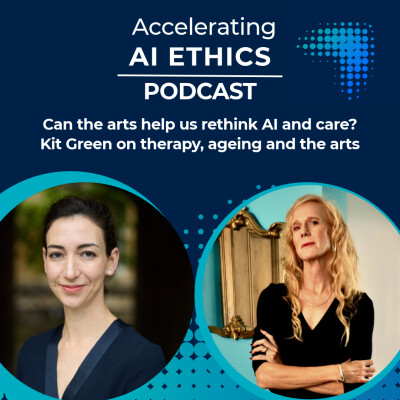
Hello and welcome to Accelerating AI Ethics, the podcast of the Institute for Ethics in AI at the University of Oxford. I'm Dr. Dr Caroline Green, and in each episode we explore bold ideas, innovative research and creative responses to the ethical challenges posed by artificial intelligence. Today's guest is one of our Accelerator Fellowship Programme Fellows, Kit Green. She's an artist working across theatre, music, academia, cabaret, comedy and broadcast. Kit is an Olivier Award winner and was nominated for Best Supporting Actress at the National Film Awards. She will be exploring the ethics of AI in therapy and elder care through innovative digital and performance art. Welcome Kit, it's a great pleasure to have you here.
- Kit Green
It's a delight to be with you to talk about these things.
- Dr Caroline Green
Yes, you are our new type of fellow at the Accelerator Fellowship Programme and creative fellow so we are really really pleased to have you, Kit Green! No relation. No, no relation, probably important to say, there will be people wandering out there even though i would find it great to have an artist in my family.
- Kit Green
That would be great. I would own you too and you know celebrate but no no relation. We choose ourselves as family. Yes, that's what's happening.
- Dr Caroline Green
Exactly, so you're part of the Accelerator Fellowship Programme family now.
- Kit Green
I love that.
- Dr Caroline Green
Kit, it's great to have you here as we're kicking off your fellowship with us. I'd first love to hear more about you. Who are you? What's your background? And then later we'll talk about what brings you here.
- Kit Green
Okay, so I come from a tiny village in Derbyshire in the middle of the country and I had a very evangelical Christian childhood, so I had an extreme childhood and I think I was never really sure what was I going to do, how was I going to break out of that and find myself. And I thought I wanted to be an actor. I studied English and drama. And then I decided I definitely didn't want to do that. And then I almost came to Oxford to do an MPhil when I was 21. And I didn't because I had a fork in my life. And I had to choose between working on a trashy TV show, which was called The Word, which British people of a certain generation will know. And I was a music researcher, so I just hung out with bands. and which was the perfect thing for me. So I think my life split at that point, and I could have come to Oxford at that point. But, you know, I found my own way around, and here we are. So, and then I started making my own work, but not really as an actor, as a creative across lots of different things, as you said. I think, who am I? I really love music. My sort of main form of expression is writing songs, most of which no one will ever hear, probably, thank goodness. I've made a career in which I'm really lucky. All I do is, the things that interest me, like really, really interest me and engage me, I'm lucky enough to go, can I make some work about this? And people go, yeah. And I think that's fantastic. So my work is across many, many different things. And the only thing that unites them is that I'm fascinated by them.
- Dr Caroline Green
So, I would love to hear a little bit more about some of those projects, some of those topics that fascinate you. Tell me how you work. What's your way of operating, so to say?
- Kit Green
So a lot of the things I do are immersive. So it's like, how can I break down the fourth wall is the classic theatrical way of talking about it. But it's like, how can I involve the audience in things? And I think it's because I'm very wary of that old fashioned kind of idea of making work. So we go, here's an issue. Let's put it on a stage and we'll all sit in the dark and go, oh, look at these people with a problem or look at these things. But most of the things that are going on in the world, we're all involved in. And so we can't externalise. And that's, for me, why I make things experiential. Do you know what I mean? We can't afford to sort of other people. So what are good examples of that? But I should also say, crucially, because I started in music and comedy and cabaret, these are really where I got my training, where I trained myself. My thing is always to make difficult, issues, difficult areas of exploration into entertainment and to have this conversation between the two things, between something being super serious and can we be really silly and playful with it. So I always try and call my shows an entertainment about or do you know what I mean to remind us that we don't need to sort of separate these these two parts of our humanity into two separate strands, if that makes sense. A good example that I'm really proud of, and I might remount this show, it was 10 years ago. I'm dangerously close to entering my retrospective period. We might mount a show for its 21st year anniversary next year. That's on the cards. And then this show is 10 years old, so I'm obviously at a stage of life where I'm having retrospective. But this was a show about porn addiction. I was just really interested, I think, and this relates to what I'm sure we'll come on to talk about with digital projects and technology. I wanted to make something about digital addiction. The way that even 10 years ago, we were all starting to be completely obsessed with our phones and the way that the dopamine hit was there to kind of like draw us in. And I was like, well, what's how can I? How can I do that? What's a good way of talking about this? And then I did some research and I read about porn addiction and it wasn't really being talked about at the time. And so I created this piece in which you come along, you know you're coming to a theatre show about porn addiction, but you don't know anything else than that. So people arrive, audience of 200, and they are just held in this kind of waiting area and then they go into an empty meeting room. nothing in there at all i um arrive as the um as a group leader and i'm like if you know where your regulars help the newcomers to set up the room and you're in a 12-step meeting for porn addicts and there are 10 actors but you don't know who the who the actors are and the whole thing unfolds around you and people lost their minds because they're like i know i was coming to see something about people with a problem. I don't want to... be one of them but the point about making experiential and making it funny and a bit silly at times um was to say we all have a problem we all have a problem with these addictions because we're all being exploited by these by these mechanisms so i think that's a that's a good example did it in london at first and then it got taken to new york and it was the first piece theatrical piece that was commissioned by the guggenheim gallery so you know swanky um but the the thing about that was... The differences between America and the UK when it comes to that kind of digital addiction blew my mind as well. So that's a good example of the kind of work I make. Another example was an experiential theatre or immersive theatre piece about a care home called The Home. And that what really struck me there was, again, your approach to. you know not making an audience watch a show as like an entertainment kind of piece but something where you really invited people into the piece and that was really quite something tell me a little bit more about that yeah so it's the biggest scale experiential piece i've made and it was 2019 was the first outing of it and um yeah i wanted to create something where people could really feel that balance which is something we talked a lot about at the time between care and control. Because one of the things in residential care is that the companies, and it often is these big sort of conglomerates that are running all these care home chains, they will say, in order to care for you, we need to control you. We need to limit your human rights. We can't let you go out and do what you want to do because we can't keep you safe. And yeah, so this was really the piece. The point of the piece was this balance between care and control. But the logistics were pretty crazy. So 30 people moved into this fake care home for 48 hours. So it was a theatre show that lasted for 48 hours. They had everything provided for them. There were four points during the weekend in which we sold 200 tickets for other people to come in and they would come to the... the morning activities workshop or the evening bingo session, whatever. So it had elements of a theatrical show. But the core were these 30 people. And we did half journalists or stakeholders in the area and half people were in a ballot to get tickets every time we staged it. So, yeah, it's... And they were coming to a taster session. adjoining a home so they weren't pretending to be old they were just experiencing it and the first time we did it i don't know if i i presumably have told you the story but the first time as a sort of taster version of it of the what became the show i i got lots of stakeholders in the in the industry people from these care home companies academics in in in um Gerontology, medical people, philosophers, you know, who are interested in human rights, all these kind of people. And we had a day-long symposium at the Southbank Centre in London, maybe like 40, 45 people. And, you know, we did the normal kind of coffee thing and then I did the welcome. And then I got an actor as a plant to come. as pretending to be a member of the team from the South Bank and said, oh, there's been an incident outside. We need to lock you in this room for your safety. And everyone's like, what's happened? What's happened? What's happened? And they were like, yeah, so yeah, you can't go to the toilet. You can't do anything. You can't leave this room. And then they were coming to me and going, well, I need to go. And it was a little bit cruel. But then I was like, let me go and have a word with them. And then I came back and went. No, they've told me that in order to keep you safe, you can't do anything. And about 90 minutes in, someone said, is this real? Are you testing us? And I said, yeah. And you've all just completely freaked out and pushed against the thing. But you are, a lot of you are advocating this for vulnerable people. And that's what I mean. I mean, it's social engineering, but it's also, and then they were like, oh my God, you're so annoying. And I was like, well, I got you to experience it. And one woman who was in her early 60s said, I've worked in this area my whole life and I've never felt that kind of sense that like a lack of agency. And I think I've been part of creating that loss of agency for others. So there's a point to it as well as it being an entertainment.
- Dr Caroline Green
Yeah. So I find that really interesting because, you know, what you're essentially doing is you're picking up some really abstract, very emotional topics and you give. people an opportunity to engage with those topics in a way that you know doesn't just sort of involve their brains but also their hearts and you know their bodies and to really feel it which I think then helps people to think about these topics differently.
- Kit Green
that's what I want ultimately I think all you know all artists whatever their practice is is to how can we sort of just disrupt our normal patterns of behavior a little bit and i think yeah deep thought, beauty, you know, all the traditional things are a way of doing it. But also, so is entertainment, so is laughing, so is feeling trapped, you know, all of these kind of very basic human emotions. One of the first big scale shows that I made was called Office Party. And it was a big party show where you go to the annual company office party and it's low level role play and all sorts of stuff happens and it's There's loads of plants and it's all kind of hidden surprises and everything. And then at the end, people realise that it's about what does it mean to be a tiny part of a larger whole. And they realise that the little song they were taught in groups at the beginning fits into a larger piece. And people are like really drunk and then going, I need everyone in this room. And I'm like, wow, this really works. People really get that, but they thought they were coming to a party. So anyway, there's just another example.
- Dr Caroline Green
So super interesting. And this takes us now to AI and your work in AI and how you're going to translate all of your experience and your approach to AI ethics. Because AI ethics, too, that's for sure is an incredibly emotional topic for so many people in so many different ways. And it can be really abstract to many. They can feel quite excluded or powerless, you know, if they feel like they don't know anything about it. So I think this is really interesting, the way that you're working with people. But tell me first, what's your relationship to AI in your work?
- Kit Green
I think it did start with the piece about porn addiction that I was talking about, interested in the way that we... I think that was the first time I really started to explore the way that... Tech developers in Silicon Valley mainly are consciously working out how to hack our brains and working out, not for sinister, maybe for sinister reasons, because it's late stage capitalism after all, but they're like going, what do we need? We need dopamine release. So let's get a little, you know, a little pinging noise every time you put something in your cart or what, you know. all of these things. And I think before that I'd not really thought that we are, they are using all these kind of clever people, you know, neurobiologists to hack our brains and use us. So that, I think it's my interest in AI has developed from that. I was shocked in, because the home piece has continued in many different guises. So I've done it in various context and there's a thing that that tours a version of it that tours real care homes now. So there's often little troops of actors who are going around care homes, which pleases me a lot. And one time an activity coordinator was just showing me through, in a very ordinary care home, was showing me through a care plan. And I was like, wow, there's pages and pages of this. Who wrote this? And they said, oh, we just get AI to do it. And I was like, you get AI to write the care plan? Like, what? When that was the first time, and we've talked to people, to elders, and they had no idea that it's already been used. So that really shocked me. And obviously that kind of dovetails so much with all the different strands of the work I've been doing. And I think, I should say I've had this long-running comedy character who's a very old lady who does hip-hop. in an old-fashioned musical style and it's called her music is artificial hip-hop um this character has been with me for a really long time it's a character i really really love and she's a very opinionated um survivor of a different generation and she's called ida bar ida bar was a real british musical singer and i i was just like i want to make a show called a ida um because that that's enough for me um And then as a way of exploring all these issues. So that's where my interest in AI was like, I want to make a show about this. And so that's going to be one of the things that I'm going to be working on as part of my fellowship, is to go to experts in care for the vulnerable and elder care and talk to them about what are the issues, what do they think I should be talking about in this show. But also as part of the show, I want to use technology. to create, to co-create material with the audience and see whether, can we make beats, can we make raps, can we make rhymes live together using AI, can we make good things or is it going to be, you know, generic slop and what are the ethics involved and talk to them. And then it's almost effortlessly through comedy, like go, every time we generate a couple of rhymes, it costs, you know, it uses 47 litres of water somewhere.
- Dr Caroline Green
we should definitely invite ida bar for podcast recording. we should do a whole thing,that would be amazing but you know also just touching on that i think um you know you were part of some of the workshops we also had on ai and creativity yeah and one of those very big topics in ai ethics you know copyright and you know the the role of ai in essentially the livelihoods of of
- Kit Green
yeah i mean that's something of course i'm really interested in and i think we so many of us just like feel powerless in in that way and this notion that i mean i think so many of the companies are basically saying um even if there's been court cases and of course there have been these big court cases. They're effectively, I don't know, but they're effectively saying, oh, we can't undo it. We can't unlearn. The models can't unlearn things now. And that, I mean, that really sucks, doesn't it? It's like, and I think, just to go back to your point about edging towards this material and talking about it. I mean, I'm always interested in, I mean, another big area of making work for me at the moment is about death. I'm interested in these things that people don't want to talk about and making entertainments about them and just finding a way in for people. And I think AI really is, for so many people, they'll use Claude and they'll use ChatGPT, but apart from that, they'll be like, I just don't want to think about it. I just can't think about any of this ethics. And so if we can do anything to sort of edge people towards it, because everyone needs to have an understanding. It's not enough to say, oh, it's too complicated for me. And the thing, since I've been doing a lot more research in the last six months or so, since coming to some of the conferences you've organised and really educating myself about it, the one fact I say to people is, when they say, oh, I don't really understand it, I go, well, do you know that the people who make these models, these digital interfaces, they don't know how it works either? And they go, what? And I go, so you, they might know more, they might guess more than you, but none of us know how it works. And that's the thing. Then people go, what? And I was like, so not knowing how it works is no reason to not take an interest in it or take an urgent kind of, be a stakeholder in it.
- Dr Caroline Green
I think you're touching on such an important topic, which is, you know, information, education, and that big... issue of digital exclusion and really actually getting an understanding of what how much do people need to understand in order to also feel like you know less powerless in this and able to take part in these conversations and so I think you know I mean that's a big part of what drives me in my work is to build these bridges between People who supposedly know much more, tech develops, and as you say, you know, there's a lot of many, many questions that they don't know, I don't have the answer to. And those people who feel like, well, you know, I'm just having to use it somehow, it's being used on me, but I don't know anything, so I can't talk about it. So I think your work is really important.
- Kit Green
I mean, sorry to interrupt, I mean, it's like, it's maybe a lazy and unhelpful analogy with like the development of nuclear weapons. happens but but you know like once people kind of went oh this thing has happened well then people start to say we don't want this to be used and i'm not saying that that's what we should advocate for with ai but but you people got involved i mean maybe because there was that moment of that first mushroom cloud which was like such a you know terrible sound effect but it was such a focus of the world and people like we need as human beings to start to work together about this and have regulation. And I think AI is just so much more nebulous and hard to get your hands around. If there'd ever been a moment that was as sort of as iconic as that, then we'd all be like going, OK, what is our government doing? What are the international communities doing to regulate this? So that because we can't put the genie back in the bottle. So let's all take be stakeholders in saying, how do we want it to impact our lives? That's that's why we have governments. That's why we have intergovernment organizations. And yeah, I think it is that serious, isn't it? It's not, you know, I'm neither a boomer or a doomer, and I don't know what my P-doom ratio is, but it's, you know, it floats. And I think it's not enough just to say, oh, someone else will sort this out. We can advocate for this.
- Dr Caroline Green
I think, yeah, absolutely. And, you know, we need different people with different experiences in art. And especially your approach is incredibly important in this. I want to talk about another project that you're looking to do as part of your fellowship. So we've spoken about, you know, AI and aging and older people. But you were also thinking of doing a piece which does involve podcast recordings too. But you in character on building an AI chatbot for mental health. tell me more about that.
- Kit Green
yes that's the one so like the ai project is something that i probably might have made um anyway and um but but being here in this environment just will give me access to like such a level of expertise that's exciting but i definitely wouldn't have been able to make this i want to i want my provocation my artistic provocation is it's not a piece of theater it's not an entertainment but it's an AI therapy app and And of course, AI therapy is just is one of the huge areas that people are really interested in because all health systems are groaning. You know, we just can't train enough counsellors, therapists, CBT practitioners, hypnotherapists. We just can't train enough people because because we're in the stage where the world is so is so difficult that mental health is, you know, struggling. So, of course, the companies are like this is this is huge. So and people naturally. I know people, just anecdotally, who are chatting to Claude every morning about their problems. And it always goes, oh, I'm so sorry to hear that. And so I want to make an AI therapy app, which is, you could say it's completely solipsistic and self-obsessed. And I will take that criticism. But my experience of being, of depression, of clinical depression. is that something happens, there's quite a lot of research happening into this, in terms of the neurological pathways, the serotonin, that basically you can't access the good part of yourself. And we know that something shuts down, maybe it's mirror neurons, whatever. So my provocation to all the tech people... and the philosophers as well, so we look at the ethics of it, is can we, with a series of prompts, can somebody upload the best version of themselves, including their voice, maybe even their image, but with memories and, you know, from having chats, so that when you're depressed and you just can't access, go for a walk, do this, talk to a friend. You just constantly go onto your app and then the best version of you goes, now look, I know you won't want to do this, but think of these 17 times when going for a walk made us feel better. And so the depressed version hacks the best version of you when you need it. So that's the idea. It's called Help Yourself Working Title. So it's harnessing all that digital technology, speech synthesis, and all of the interactivity of of these chatbots, these very sophisticated chatbots. So let's see. And I want to document the process of it and what are the pitfalls, what are the unintended consequences? How is it going to destroy the world unintentionally, my tiny little idea? And I like, as an artist, sort of blundering into this world with what I think is a good idea. And I tell people about it since I've been connected to... the centre, I've mentioned it to a few people and they're super excited. That's a really great idea. We should do that. And you can see this kind of and I'm like, OK, great. I can see how things catch fire in this world, in this sort of brave new world that we're in. But also because I'm not from that world, I'm also like going, yeah, but hang on a minute. What are all the downsides? What's. Yeah. And documenting both of those things feels exciting.
- Dr Caroline Green
So why I find this project really exciting is because, I mean, first of all, I can completely see where you're coming from. You know, I mean, how often have I spoken to people who said, oh, I've just been to this retreat and I came out feeling, you know, really well. It was like a well-being and sort of mindfulness retreat. But then it's really difficult to stay. And I was really the best self. that it's really difficult to stay that way in everyday life.
- Kit Green
You feel it leeching away from you.
- Dr Caroline Green
Exactly. And, you know, and I myself, and, you know, I've got days, obviously, like probably most people out there, where I feel really low and where I find it difficult to remind myself of what helps me to get through days where, you know, I'm not as positive as I can be. So I can see how your idea might be, you know, something that suddenly pops up on my phone, like, oh, you should, you know, just a little reminder. Exactly, a little reminder that, you know, don't take... things so seriously. So I can see how that could be a really interesting idea. What I also find interesting, though, is that there are lots of people out there now, which I think is empowering to who, you know, before kind of the new generative AI boom that we are in, they wouldn't have ever really thought about creating a new product, a tech based product. But because that's not their background, you know, they were doing other things. And now they're saying, Oh, wow, I've got this idea for a new product and It must be really easy because it's all out there and I can just ask, you know, whatever perplexity Claude created for me. But then, as you say, there are so many ethical issues that immediately I'm thinking of also with this idea.
- Kit Green
I mean, not least who owns the data, who, you know, this act of co-creation with the app. Let's say it all works like this is a version of yourself, but who owns it?
- Dr Caroline Green
the question of what is the best version of yourself?
- Kit Green
Absolutely. And is it reliable?
- Dr Caroline Green
Is it reliable? Yes.
- Kit Green
What is the best version? Yes, it's true. I mean, I mean, yes, there's a whole argument. I love this. This is why you're a philosopher, ultimately. There's a whole argument that the depressed version of us is a very, very, very logical response to where the world is right now. And if people aren't depressed, what's wrong with them, quite frankly? But yes, it's an abstract thought. so yes trying to sort of use technology to kind of gears up to being acceptable and you know happy yeah it's it might actually be that this you know chatbot has got a very actually what i think is a good version but it's actually like a really narcissistic version absolutely i mean that's clearly the problem with this idea that people are going to be talking to themselves instead of talking to other people yeah no absolutely and i totally i totally get that i love that But it's exactly those problems. why this is such an interesting topic and the way that we had thought about it or you had thought about it and how we could develop it is really to you know have you as this person who says well I've got this great idea now let's go on this journey together to build it and then at the end of the project you'll be able to say yeah well you know I'm going to go ahead with this with A, B, C and D. Wouldn't it be great after 18 months, this is just total fantasy, however long, that I go, hey, this is going to be real and we're going to sell it for $20 million to someone or I'm going to kill it because it's dangerous. You know, that would be such a great kind of sci-fi output, or not even sci-fi. It's just, you know, this real decision-making thing. I mean, both are very possible. Yeah,
- Dr Caroline Green
I love that. So that's maybe a hook for the listeners to this podcast so we'll have a podcast again at the end of your project
- Kit Green
which way do i go exactly yeah how did this turn out what's that sort of thing on um on social media was like you you wouldn't know i've i've got 20 million dollars but there would be signs so i'll come back and i'll be sort of like drenched in fur or i don't know it's a spoon in caviar i wouldn't be drenched in fur but you know i can't think fake fur fake fur Thank you. I discovered from head to toe in gold. And I'd be going, I may have sold the idea, Caroline.
- Dr Caroline Green
Well, stay tuned, everyone. That's fine. Well, Kit, it's really great to have you with us.
- Kit Green
I'm delighted to be here. So it's really, really great. And Schwarzman Center is amazing. And yeah, just to be around all this new innovation. And I love this kind of interface between. in artists and people of all different disciplines and I think that's the that is so hopeful for as we get into this new phase of humanity you know and we all need to be talking to each other and learning from each other absolutely and drawing on each other's expertise and you know
- Dr Caroline Green
backgrounds. I think what you're bringing in that deep experience of involving people with topics that can be so difficult, like death, addiction and so on. loss of control when you age and become frail. I think we're going to be learning a lot from you for AI ethics. So thanks so much for joining us.
- Kit Green
I can't wait to hear what people think is going to happen to that. So yes, please interact, everyone. I'd love to hear from you.
- Dr Caroline Green
Great. Well, thanks so much, Kit.
- Kit Green
Thank you.
- Dr Caroline Green
This has been the Accelerating AI Ethics podcast at the Institute for Ethics and AI at the University of Oxford. If you have enjoyed this episode, please subscribe and share. Until next time, thank you for listening.