- Speaker #0
Hello and welcome to the Accelerating AI Ethics podcast from the University of Oxford. I'm Christina Bratu, I'm the Communications Manager at the Institute for Ethics in AI, and in each episode we explore bold ideas, innovative thinking, and creative responses to the ethical challenges posed by artificial intelligence. Today we're doing things a little differently. I'm delighted to be joined by Dr. Caroline Green, our Director of Research at the Institute for Ethics in AI, Lead of our Accelerator Fellowship Program, and our usual host of our podcast. Dr. Green has recently returned from a fascinating trip to India, where she explored Buddhist approaches to AI as part of her work on the Civic AI Project, co-developed alongside Ambassador Audrey Tang, a Fellow of our program. Caroline, welcome to the podcast.
- Speaker #1
Thank you very much, Christina. It's fun to be on the other side.
- Speaker #0
Tell us about the trip to India. How did that come about?
- Speaker #1
So the trip to India came about, well, so first of all, just to tell you a little bit more where we actually went. We went to a place called Dharamsala. And that's the place in which His Holiness the Dalai Lama and the... Tibetan community is living in exile. So, you know, it's really a place of Tibetan Buddhist ethics. And the trip came about after Ambassador Audrey Tang and our colleague, Tenzin Yangtze, she's got a new name now, it's been given by His Holiness, actually, it was Giselle Chu before. We met in Munich in January and we decided that for... our research for the civic AI approach, it would be good for us to actually go and explore and stay with the community in Dharamsala to learn more from them, how they are working with AI, but also to see what kind of tools they're using, if any. So we thought that would be a good idea. And I didn't really think that, you know, we'd be able to organize it so quickly, but we did. So. That's how it came about.
- Speaker #0
Brilliant. Now, tell us a bit about the trip itself, the places you visited and who you met.
- Speaker #1
OK, so, yes, you know, well, I don't really for me, this trip was one of the I think it was a life changing trip for me, really, because we went to see so many different places, but it wasn't really about the places. It was about the feelings. the experiences, you know, the connections that I made. That's why it was such an important trip to me. So, you know, I want to start, I think, by saying first we flew into Delhi and then from Delhi we flew on to Dharamsala. And it's a very early morning flight. And, you know, it's quite a small kind of like a propeller plane. And I remember sitting on that plane. It was very peaceful. this bright pink. sun was rising and the whole plane was just bathed in this bright pink light and it was so warm and calm and you know then landing into this land with it was covered by sort of like a mist it was really mysterious and I just felt so happy in that moment I felt so grateful being able to to go and explore something so new and I think that was already the moment where I I remembered that you know these little moments. They make life worth living so much. So even, you know, when things are difficult or maybe difficult, having these kind of small moments of joy are just incredible. So our delegation was a very small delegation, but we were really lucky to also have two Tibetan scholars and Tibetan Buddhist monks with us. So Geshe Tapke was one of them and Geshe Lodisankar. as well so these are two people who you know know the the place really well who know the people really well and so we met with them and it was them who really organized all the different places that we went to as well right so we stayed in in a place called Meck-Lautganj which is up a hill just at the top of of Dharamsala and and some of the the places we or many of the places we visited it actually happened. didn't have anything to do with AI at all. And I think that was incredibly refreshing and important to learn more or think about AI differently, because I think about AI and AI ethics every day at the moment. Obviously, that's, you know, my life, my work life. And so one of the very first places we went to was this Tibetan Buddhist nunnery. And so you drive down Meklau Gange, these incredible roads, which are, yeah, I'm still amazed by how people drive them. They're so skilled because, you know, the roads are so small and you drive down that mountain. And then we just arrived in this beautiful place, like a sanctuary of women living together as Tibetan Buddhist nuns and also very young, young girls as well. They call them the little nuns. And we got to explore how they live. We got to see how they learn. I found it incredible because, you know, they have these classes every day from English classes to philosophy. And so we were able to listen into some of the Buddhist philosophy classes, which was beautiful, you know, people sitting down and listening to their teacher. And then what I also found really interesting, I mean, we didn't get to see that, but it's the first time I learned of it, is that they took us to this very big kind of open space. It did have a roof on it, but it's an open space. And they told us that twice a day, all of them, the whole community meets and they have these. philosophical debates and the way that those work is that you have small groups of groups of people who were you know sort of in the same class or lesson um and then they really interact with each other you know they in a way even argue with each other they'll use their hands and they'll clap and they shove each other and then they debate about philosophy and that's how they they do it this is how they learn. Yeah, it's really amazing. So I think why that was important to me, it really just highlighted to me again, just how important it is that we actually debate with each other as humans, that we also allow each other to have, you know, opposing opinions, and that that's okay. And it's maybe a little bit, you know, sad that I need to say that. But I do think we live in times where, you know, people are very polarized, but you have these really opposing opinions, where sometimes, even at universities, you know, this kind of way of working with each other, stretching each other is not there anymore. So that was one of the first trips we did. And I did, of course, ask some of the nuns there on how they're using AI. And one of them said, well, yeah, I use AI to, you know, some of one of the large, big kind of general purpose, large language model based ones to create some of my lessons. And also when I go and I hold speeches or so, I let it help me. But I would never let my students use it unless I know that they have already, you know, got their own kind of like a really good foundation of knowledge. And also like a character that they have built for themselves where they know that knowledge and wisdom is something that they need to practice. They need to acquire. require and that can be quite painful and AI could hear you know take that away from people because it's easy to use but that pain is really necessary for developing um you know that that kind of knowledge and expertise so that was one of the first trips and it was mind-blowing and I really loved it and they're just building actually a retreat for uh foreigners to come and stay with them so it's like okay I'm gonna come at some point and spend some time with them because I really enjoyed. being amongst that group of women.
- Speaker #0
But it sounds from the first meeting and the first trip that it reconnected you back to some of the conversations we usually have at the university. We talk about our human values and we look at the advancements in artificial intelligence, but how do we bring them back together? And you're completely right, bringing the debate and allowing ourselves to agree to disagree more often. That's something that seems to have been brought back into the conversation and it's an experience that has allowed you to think about as well that particular Buddhist approach and how they see it? Is there anything we can learn from that, from what you've engaged with them in terms of their approach to AI? You mentioned a bit earlier a particular person's approach to AI, but what stayed with you from that perspective, from the Buddhist perspectives to AI?
- Speaker #1
Yeah, so what stayed with me was really... first of all also just you know looking at myself as a human and what I can do to to become better because when you are in Dharamsala and you go and you know see these temples they've got there and spaces of prayer There are all these kind of like English, you know, written in English, some lessons, I would say, that are very core to Tibetan Buddhist ethics. And so, you know, if we go to the Tibetan Museum, for example, there are all these cubes that you can turn with questions. So one of them was what is love and compassion, for example, and then you can turn the cube and then it will give you the answer based on what His Holiness the Dalai Lama would say. And reading these kind of, you know, statements, that really helped me, first of all, to understand some of the, I think, the core of Buddhist ethics, which is all about, you know, understanding, and, you know, I may be completely wrong here, I'm not a Buddhist, but from what I learned then, also being with the Geshis, who were just so incredible with giving me their time and teaching me and um you know answering all my questions was that we as humans are dependent not just on each other but also on nature on the resources around us without others and without nature and resources we cannot survive we cannot thrive but that we also as humans as long as we can as we are able to also you know should put effort into develop developing ourselves so that concept of compassion was one that really stayed with me where it's about not wanting others to suffer, you know, understanding that everybody around us suffers as sort of like a human condition that we can overcome. The kindness I received from people there and the grace was something that really touched me a lot. And, you know, I also remember vividly going to another place, which was a school built by a Buddhist scholar as well. And he saw, so that school is for the local children born into some of the poorest families who are living in the slums there. And he told us this whole story on how, you know, 20 years ago, even a bit longer, he stayed in Mecklenburg. And she saw the children on the street were sort of scavenging through, you know, the rubbish and eating rubbish. And he also saw just the poverty and the suffering, people dying. children dying on the street within these slums. And he decided, okay, I really want to do something about this. So it was sort of like compassion manifested. And to cut a very long story short, he just built this incredible school, which now has 700 children in it from local children, helping them to grow into these beautiful human beings, because actually 50% of their curriculum is all about values. um and you know how to be an ethical person all the way from when they start school to when they leave and he had to go through a lot of hardship himself to make this vision happen you know didn't come easy at all and he had to learn and adapt and also being in that school you know I had all these children come and and greet me and you know I think what taught me here so often we hear the question what does it mean to be human in the age of AI and You know, I felt there was always something that doesn't, I find a bit difficult about this, it is a difficult question, but it doesn't really make sense to me so much because, you know, us as humans, yes, AI changes the way we work, maybe also relate with each other, maybe even how we love or so. But in the end, us humans, our essence stays the same. We are dependent on each other. We have this incredible way of making choices of being compassionate, of, you know, relating with each other, being able to change, to also see that maybe we've made a mistake and then do something about it. You know, just going to these places, it just reminded me of the richness of us as individuals, of our lives, of our situations and of our circumstances. And AI can be helping us here in our lives and is incredible, but us as humans. Our essence is there and I don't think we can ever be replaced or we can ever be recreated through a system alone because of that beauty of being human. So this is something that really stayed with me.
- Speaker #0
Yeah. Beautiful example brings me to the work that you are currently doing with Ambassador Audrey Tang on your project called Civic AI and the Six Pack of Care. Would you like to speak about the project in itself?
- Speaker #1
Yes, sure. So Civic AI rests on, well, first of all, you know, some of the incredible examples and experiences of Ambassador Audrey Tang. in her work as previous digital minister in Taiwan, where she showcased the power of technology to, you know, create, first of all, tap into the collective intelligence of humans, to create new solutions to policy issues. So there were some beautiful examples and how that in Taiwan happened. So building on these examples, our work... really is based on three premises. First of all, that premise that, you know, we as humans are all dependent on each other, and that we thrive the best in caring environments in which we care for each other, but in which we also care for the environment, for nature, for other beings. Then the second premise is that even You know, even if people are completely polarized, even if there are such different opinions and perspectives, that we can find a common ground or what Audrey calls an uncommon ground and that AI can help us with that. And the third premise is that we want to see smaller AI systems that are context specific, that tackle specific problem rather than, you know, the sort of super intelligent. almighty AI system. And that's sort of the current trajectory that we're going down, you know, through the whole like, artificial general intelligence, and you know, we need this almighty system that is better than humans. So we are advocating for smaller context specific systems. And there was some really beautiful examples that we actually saw during our trip in Dharamsala. So we spent some time with a group called Monlam IT. And so that's led by Geshe Lobsang, who was also there now at the Civic AI conference in Oxford that took place on the 25th of March. And so he built again a Buddhist scholar, an incredible person who taught himself computer science by himself, and who built this team which have created these beautiful systems using AI to protect Tibetan language. So. If you go into, I don't know those of you, if you've ever seen Tibetan scriptures, but they're just these really long scriptures, often wrapped in these beautiful pieces of cloth. It's just amazing. We went into a library also in Dharamsala and it was incredible to see. And this library with thousands of texts, very ancient, beautiful texts have been digitized. And then MonLam IT has created. systems first of all that do like text translation so you can scan it and then it translates it into English but also like fonts so Tibetan fonts which is helping to you know ensure that people keep on using the language so those were really nice examples of the smaller you know purposeful AI systems that civic AI is is wanting to see because it's really you know doing a particular project. thing for that group of people. What Civic AI is also about is not just, you know, the kind of relational health, as we call it, that we want to see as like thriving societies and communities, and how AI can help us with that. But also that AI is with each other, are relationally healthy, you know, so that's where the so called six pack of care comes in. So this is a very practical framework based on... some of Joan Tronto's work. So she's a care ethicist. And so she speaks of, you know, caring for, caring about, and so on. And so we've based that six pack on her work, trying to integrate ethics of care into Civic AI. And so people can read about this work as it's developing on Civic.ai, and of course, also on our Accelerator Fellowship. program website because Ambassador Audrey Tang is one of our senior fellows.
- Speaker #0
I also think your experience in care and AI and care brings great value to the Civic AI project. Looking at the work you are currently doing and understanding the care systems, not just in the UK, but also globally in your new work in the US and also in Germany. Marrying this alongside the Civic AI project is something that I think will absolutely benefit us as we look at. artificial intelligence systems and how they impact our communities and how we can become part of that development as a community not just be users but be fully involved in their development and i think your input is really important and really appreciate the work that comes together to to bring the focus back to the fact that ai is meant to service us and we need to remember that and the values that we have as humans. look again at our values. And I think this brings me really nicely to a very important moment that you've had during the trip in India, when you met with His Holiness Dalai Lama, and you've spent a bit of time having a conversation with him.
- Speaker #1
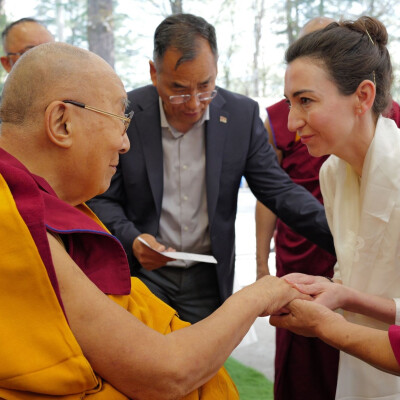
Yeah, so I was lucky enough to meet His Holiness the Dalai Lama, that's right. And it's still moving to think back to that moment. And you know, um Not just because it's such an incredible moment to meet this person who I've known of all my life and whose books have also influenced and supported me in many times of my life. It was also incredibly moving because I now know, having spent some time with the Tibetan community in Dharamsala, just how much he means to people. And so... having that opportunity to meet with him was just, I'm very grateful and, you know, it was really exceptional. So I just want to say that. Yes. So how did this come about? You know, one of our colleagues in the delegation, Tenzin Yangtso, has this incredible ability for diplomacy and she's such a kind and open-hearted person. And she... was in touch with His Holiness the Dalai Lama's office and she made sure that we had this possibility to meet with him and it was a very short meeting but as a group we thought about a question that we could put to him on AI ethics in the language that would also work for him and so Tenzin is very good at that. And so when it came to her to meet with him, she was able to ask that question of him. And he responded back. And this was really special because it was actually the first statement that His Holiness made on AI ethics. And you can read that statement, which was then actually public on YouTube in Tibetan. But we translated it then and got it signed off by his office. essentially says that, you know, AI can support us in the world, but that us as humans, our creativity and who we are, you know, our ability to develop even in the moment and how we think about things, that's irreplaceable, you know, that's just us humans. And so that was, that was really beautiful. And it meant a lot to us. And, you know, it's very much aligned with how we're thinking about our work. Yeah.
- Speaker #0
And so fascinating that artificial intelligence as a technology is now touching the worlds that we would think would not necessarily combine. We're looking at Buddhism. We're looking at religion. We're looking at how religion in itself marries up with artificial intelligence now. And I know you are. working on a project as well around this. And we will be able to read about an expert comment piece on this topic soon.
- Speaker #1
Yes, yeah, we're just working on that. I've also recorded a podcast with Geshe Lodosangpo. And part of that on where we spoke about compassion and whether AI could be compassionate or not. We've already written that up as a little blog piece, but that podcast should be out quite soon as well. and in the work on Civic AI. I'm also going to go much more into these kind of, you know, ideas around compassion, about kindness and so on. And just one thing I also want to say, because you earlier mentioned my work on and with the care community here, you know, people using and offering and providing long term care services. I think what's so great to be working on this topic and with these people is that we can learn so much from them also for responsible AI and for civic AI. So for example, co-production, you know, how to make sure that people who we're building AI systems for are actually part of developing and, you know, throughout the AI life cycle. So co-production is one of the kind of concepts that comes up quite often. But the long-term care community here, they have really worked with that idea of co-production of research and policymaking and so for a really long time. And they're very wise in that. And I think we can learn Thank you. from that community a lot for AI more generally. So that's why I'm really excited to be working on that topic with people.
- Speaker #0
If listeners were to take one thing from your experience and your trip to India, what would it be?
- Speaker #1
So I'm hoping that people are taking away, first of all, again, you know, that beautiful experience that I shared in the beginning. sitting on that plane with the pink light and just how happy that one moment made me. That's something maybe that people take into their day, even the smallest moments can give so much joy and happiness. But that also, AI really can serve us in so many different and beautiful and just incredible ways, but that it's still us humans who are just so... amazing and that looking around us of what happens every day even if if it's terrible if there are a lot of really terrible things happening you know just seeing how people can choose how they can change how we interrelate with each other how we are creative that we remind ourselves about that this is something I'm taking away for myself when we ask that question what does it mean to be human in the age of AI. And then also I'm hoping that people will want to... connect with us on Civic AI, because this is very much, you know, a developing piece of work. It's an idea and a seed of an idea that needs to develop. And it's about the collective intelligence that's us as humans, right? So we're doing this together with others. So we are hoping that people will also work with us in that in one way or another.
- Speaker #0
Conversation. It's been really fascinating. And the trip to India sounds fantastic and a once in a lifetime opportunity so thank you for sharing the experience with us and for sharing your great work alongside audrey on civic ai if you have enjoyed this episode please subscribe and share it forward and until next time thank you for listening