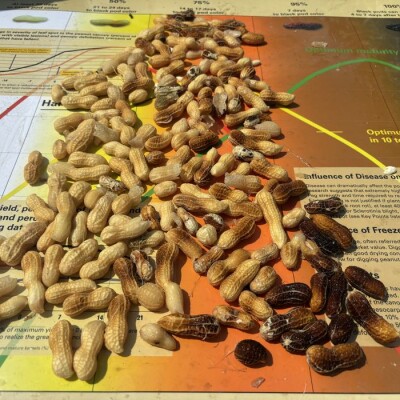
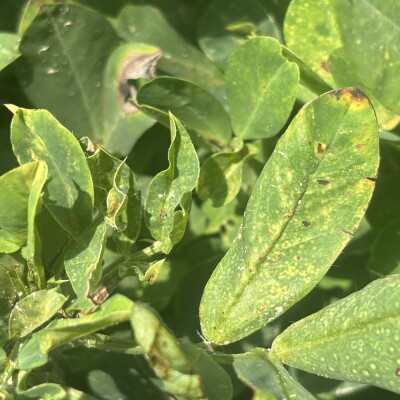
DavidYeah, Gary, that's a good question. And it's an important topic and we discuss it and we deal with it every fall. So a couple of quick things. We know that if we wait till peanuts reach optimum maturity, we gain substantial amounts of yield and also market grade quality. So that's a true statement, but it's a very anxious time of the year. We can often have tropical events or tropical storms that develop hurricanes, and that can lead to some stress in terms of digging and getting the crop out. So this year, we seem to be in pretty good shape. On that front, people have done well protecting peanuts from disease. So we, in many ways, we feel like we can wait and let peanuts mature just because of the fall that we're beginning to have. But we do have some situations where farmers want to dig early because of disease. And so we do have some rules of thumb for that. And one reason that I want to bring this up is. Last week I had a question from someone who sees a lot of peanuts and works with a lot of growers and they had some growers or this person had some growers that had some drought stress peanuts. It had been really dry. The peanuts had that wilted look. Some were brown and beginning to die. Others just had a standard wilted look that wasn't recovering overnight into the next day. And that certainly is a true sign of drought. The farmers, or maybe at least one farmer, was interested in knowing whether they needed to dig last week. And this was before we got the rain over the weekend. And fortunately, the farmer held off from digging because if you have drought-stressed peanuts that aren't brown and the pods aren't rattling in the whole. Those peanuts still have a chance to gain maturity, to gain mass or weight, and also to have an improvement in market grades. I've seen fields on research stations, but also where farmers are producing peanuts, and those peanuts have that drought look well into the fall, but there's still some positive things going on below ground in terms of maturity. And in my experience, if I were to look at those fields and say, gosh, this, these. these peanuts aren't going to yield well or grade well. Most of the time I've been surprised in a positive way about how good the yields were and how good the market grades were, even though those peanuts look stressed for a long period of time. The key is to give those peanuts as much time as you can and let them reach optimum maturity, if at all possible. I understand the stress that goes into that and worrying about what's going to happen to that peanut crop. But as long as there's green material, above ground, even if they look stressed. If you get moisture after that, they may not recover completely, but it's going to really make a big difference in terms of yields and grades. Now, if you have peanuts that are brown and they're already beginning to die, that's another topic. But you have to keep in mind that if I go out into, say, a 40-acre peanut field, It could be that only... 20 or 30 percent of that field has that brown dead look. And I'd say until there's a lot of pods or seed or kernels that are rattling in the hull, those plants are still holding on, even though they're brown. And you don't want to sacrifice the other 60 or 70 percent of the field that continues to mature to try to capture the ones that are brown and beginning to die. It's a very hard decision. And in some ways, there's no right or wrong answer because there's so much going on in the fall and people have different levels of risk and stress management. But the more patient we can be making those decisions on digging, the better off we can. Now, that was a discussion about drought stress. And let me just give you some rules of thumb on diseases. So, and these are debated by lots of people. And I think sometimes folks are looking for a reason to dig. completely understand that I'm ready to dig. I'm ready to get some things over with from the season. But, you know, that extra week can make a big difference. So here's the numbers we often use. And these are historical numbers, some that we've come up with in more recent years. But some of this goes back to previous people that were in the roles that I'm in that knew a lot about peanuts and had a lot of experience. So when you get to about 40% canopy defoliation, From leaf spot disease, we would say that you need to dig those as soon as you can because you're just going to have more defoliation that occurs and you're going to have more pod shed. So regardless of maturity, if you have 40% of the canopy defoliated, you need to dig those as quickly as you can. If you have southern stem rot or sclerotinia blight, you need to have 50% of that field with that disease. Okay. If you had... CBR black root rot, we would say that you need to be at 40% before you dig prior to maturity for that, for those peanuts. A couple of things, the reasons we say that. We know that disease is causing an impact, those diseases do. But if you're at 50%, that means that 50% of the plants are healthy and you're probably not going to gain a whole lot. by digging or even lose much by leaving them out in the field for those disease plants. But you're going to really sacrifice yield and grade if you dig the field early and you have a relatively small amount of disease. You just don't allow the healthy plants to reach maturity. So southern stem rot, sclerotinia blight, you need to have 50% of the plants in that field with that disease. Leaf spot. you want to dig when you, you know, once you get to 40% defoliation, you need to dig as soon as you can. All right, so those are several of the big diseases that we think about. Now, some other stresses to think about would be drought, which I've already mentioned, but then spider mites, sometimes they can really bang up a field, but oftentimes with spider mites, those tend to be localized, spotty in nature in the field. And so we would encourage people not to dig early based on spider mites. And the reason is we don't tend to have pod shed due to spider mite damage. We might have lower yields in those areas, but we're not going to have the pod shed off in most cases. And also because spider mites are more spotty in that field, we don't want to dig early and sacrifice the healthy plants that are going to continue. to increase in terms of yield and market grades. One other disease that we had a podcast on a couple of weeks ago was tomato spotted wilt. And based on what we know in North Carolina from historical work, is we would encourage people not to dig early if they have tomato spotted wilt, even if you have a substantial amount in a field. And part of the reason for that is certainly those stunted plants are going to have smaller pods. They're not going to yield as much. but we tend to not have the pod shedding off from tomato spotted wilt like we do with, say, leaf spot. So the challenge is you don't want to dig early because you have a significant amount of tomato spotted wilt because you're going to sacrifice plants that have very little of the wilt, tend to be growing fairly well, and then there's usually a lot of healthy plants in the field that go along with that. So we just, we don't need to push the trigger too fast based on disease. One last thing, Gary, to kind of wrap this little session up is our eyes are drawn to either something that's really good that stands out or something really bad that stands out. And this time of year, we might look at a peanut field and we might see disease in a field and all of a sudden our eyes are drawn to that disease and it becomes bigger and bigger and bigger, not necessarily in the field, but in our minds. We remember the bad things in that field. And so if I looked in a field and I said, okay, I've got a lot of Southern Stem rot, for example, I might think that I've got 40 or 50% of my field. eat up with that particular disease. If I methodically went out in that field and did some measurements that represented that field, it's probably that instead of it being 40%, it may be more like 10 to 15%. And so when we do the pod blasting and farmers come in with samples, Wee. We're looking at maturity, but we'll often say, well, do you have any disease? And it's not uncommon for somebody to say, yeah, I got a lot of disease in this field. And then, you know, they describe what the disease is, make sure that that is ID'd correctly. But then when you start asking in more detail, well, what percent of the field do you think you have it? That becomes a real guess. And I think usually we're going to guess on the high side. because our minds just go to the bad part or the bad thing in the field, which in this time of year would be disease. So we can convince ourselves that we need to dig early when in most cases we're creating an economic loss when we dig early because it's probably not as bad as it seems if you actually went out and did some counts. And we know that... We don't want to sacrifice the healthy plants that are gaining in maturity and yield. Very, very hard to do in September when we're trying to get a crop out, but very true statements when it comes to the reality of what's going on in those fields. The last one, Gary, is aflatoxin or aspergillus flavus in fields. We had a hot, dry summer at some points. I don't know that we're going to have off-the-chart levels of... of aflatoxin in our samples, but sometimes people want to dig either early or segment peanuts that are drought stressed here, and you've got healthy ones maybe under an irrigation system, and that can be good to do if you can. The challenge is it's hard to, if you've got pockets in a field that were drought stressed and potentially could have something like aflatoxin contamination, that's hard to keep those separated. Hopefully with the rainfall we had over the weekend, that will help reduce some of that. Our temperatures have moderated a little bit, and that helps us with not having as much aflatoxin to worry about. So I did mention that towards the end. That's usually not a major, major issue for us in North Carolina, but sometimes when we have hot, dry conditions, it can be.
DavidThat is a great question. We've done surveys with growers historically to get a sense of what they would do. I certainly have my answer. But and my answer is kind of that standard answer we often give as an extension person is you ask me a question and I want to ask you like three questions after that. So if you were to ask me if a storm is coming, whether you should dig or not, my first step would say, well, how much disease do you have? And in particular, leaf spot disease. And are peanuts fairly well protected? Because that can give you some buffer if they remain in the field, in the ground. The other thing I'm going to ask you is how mature are the peanuts? Because at what point do you think you'll start having a lot of pod shed? And that intersection between leaf spot and maturity becomes really important if there's delays in digging. But the big questions I'm going to ask you on that is, can you tell me if you're going to have another storm after this storm? And we, of course, we know no one can really answer that. But it's one of those things where if I knew you were just going to have one storm, I would probably tell you they're better off in the ground. than on top of the ground because we have sandy soils where peanuts are grown. We can usually get back in those fields fairly quickly after one storm. Now, if you were to tell me that we were going to have two storms, and I know in the fall when we get wet, and especially if we get really wet, it can be really challenging to get the soil back dry enough to where we can dig without a a lot of pod loss, but we may be able to go in a field and combine or harvest those peanuts. But digging becomes a challenge when it gets really wet. But no one can answer the second storm question. But I would say that in my experience, I like to see the peanuts out of the ground if they're close to maturity and I know a storm's coming. But I have seen peanuts blow around some. And I've seen peanuts get mashed down and then you have to lift peanuts to air them out some. And then all of a sudden, the more you move them, the more you lose. That becomes a challenge. So it's hard to come up with a clear answer for that. And everybody has their perceptions of it. And it's one of those deals where this year digging before a storm might be the perfect thing to do. And if I did it this year, I feel really good about that decision. and that might... be what I do for the next 10 years. But over the next 10 years, there could be a couple of years that I would have been better off waiting to dig after the storm. And we just don't know. That's a really hard, it's a genuine question. It's hard to come up with a good answer. I just wish I knew whether we were going to have two or three storms after the first one, and then I could probably give a more concrete answer.