- Gary
Welcome to Searching for the Brighter Pod, a podcast about peanuts. I'm your host, Gary Little, and with me is North Carolina Peanut Extension Specialist, Dr. David Jordan. How are you doing this week, David?
- David
I'm doing well, Gary. It's good to see you this morning. I've been out with field days and also doing a lot of field sampling and things like that, getting some peanuts dug. So it's been busy, but every September is busy, but it's been going pretty well.
- Gary
Yes. So how were things last week in the state?
- David
Yeah, Gary. So last week, We had a field day. We had a number of things going on. We had picked up some rains before last week, the weekend of Labor Day, and that was a fairly general rain in some areas of the state. But as I was out this past week, and especially early this week, I saw a lot of fields that were drought-stressed across a lot of the area. Not brown and not dead, but certainly with the heat. and limited water, those peanuts are not looking great. But we're certainly at a point where we're beginning to dig some peanuts in the state, a very low percentage that are dug now, and even some that are threshed or combined. But again, very low numbers. But again, a lot of folks are going to jump in this week, and certainly next week we'll be going full steam. I think the drought and the heat... has been certainly an issue and will affect our yields, but it's in some ways has come a little bit later, which should help us in terms of not having as big a negative impact as we might have thought at one point in time.
- Gary
You've, last week we've had a couple of field days. Were there any issues that growers brought up or were concerned about?
- David
Yeah, that's a great question. Question, Gary. So we had our annual peanut field day at Lewiston on September the 10th. So that was last week. We had a good attendance there. And we did have a lot of questions from growers that were in attendance. One of the big questions this time of year is how do we make that complete transition from protecting the crop from diseases with fungicide sprays? And then we move into the middle and latter part of September and start. digging a lot of fields and harvesting. And how does that transition fall out? So that was one of the questions. I know LeAnn Lux, our pathologist, has been getting a lot of questions about that transition. And should you spray one more time to protect from leaf spot or can you go ahead and step away? If you've got some dry conditions, what's some of the risk of over spraying a fungicide towards the end if we have a... potential for spider mite. So those are some of the questions we were getting. And of course, at a field day, you're going to get some questions that are more broad, that aren't really focused on the final steps of a particular season. Like what are some of the new varieties that might be coming out? How are they going to be able to handle tomato spotted wilt, for example, because that has shown up as a bigger issue for us this year. Some of the other questions were... related to insect management. So Dominic Reisig had a stop on the field day and talked about thrips management, tomato spotted wilt, and some of the products that are available now for southern corn rootworm and gave a good overview on that. One thing that I talked about off the field day was trying to use spray nozzles that deliver large droplets so that we maybe could get away from issues that... could be a problem for the Endangered Species Act. So that was a more detailed discussion. And Mallory Woodard, one of our graduate students, talked about that at the field day. But again, a lot of questions. But the main thing was that transition from protecting the crop from disease and then moving into harvest.
- Gary
Okay. So where do we stand right now? We're in the middle of September. What do we need to be thinking about?
- David
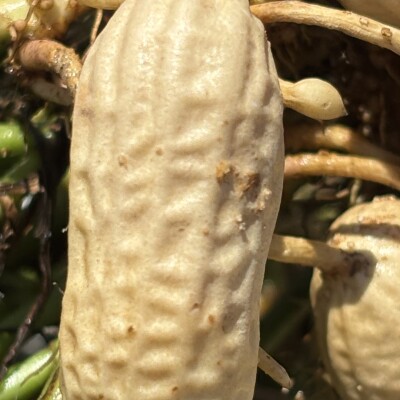
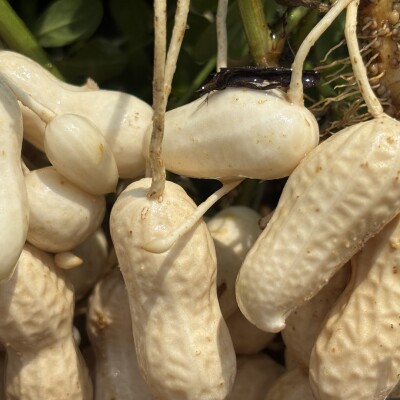
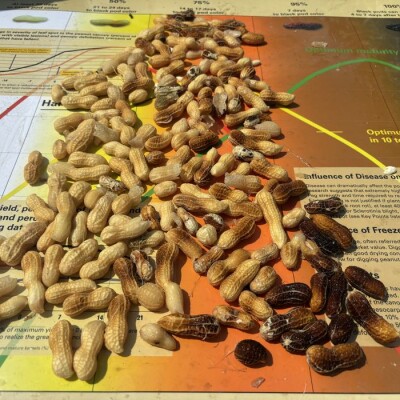
So right now, farmers are doing a lot of pod blasting, either with their consultants or with the county extension agents in the peanut belt. Um, so we're sort of right in the middle of that. And so there's a couple of ways to, to look at that process. One is the pod blasting exposes the mesocarp color, and you can use that to determine how mature the peanuts are and get a prediction on when you might want to dig those fields. Uh, the other thing is, is so it, it gives you that prediction. The other thing it does, especially when you get to this point and certainly over the next couple of weeks. Because once... farmers start, they usually keep going. And so what's really important at this point is to get the order of fields correct if you can. So I might need to go and get started because I've got a lot of acres, but I do want to dig the most mature one first. And that process of digging can take quite a bit of time. And as you move across your entire production, you allow the ones that weren't quite mature or have a long ways to go. to continue maturing. And by the time you get through the ones that are mature, hopefully the other ones have gotten mature themselves if they're not there yet. So that's one of the big things that are going on. We also have folks that are actually digging and it's important for growers to make sure their equipment is working properly, making sure that we're not causing some additional pod loss just because of the techniques we're using. in the field.
- Gary
Okay. Well, as we said, September is moving fast. What is there to watch out for, say, in the coming weeks? It'll be October soon.
- David
It will be October soon, but we still have two weeks. And we're going to need all those two weeks in September before we even think about October. But a couple of things for growers to think about is... And, you know, I'm reluctant to say anything, but at least right now, I don't see any major tropical weather systems that could affect us, at least in the near term. Again, that could change very quickly with our, you know, what's going on in the Atlantic. But so right now, growers are at a pretty steady pace of looking at maturity and harvesting. But we'll need to keep our eyes on storms if they were to develop. With the temperatures we're having right now, I don't see a situation where we're going to have that dip in temperature where we go below 50 degrees for a couple of days in a row. When that happens, maturity pretty much stops and it's hard for it to retool and get back going again. So we want a cool fall. That's really nice. But from a peanut standpoint, it would be good for us to get all the way through September before we get those cool snaps so that the crop continued. can continue to mature. I think those are some of the big things that are, that growers are going to be facing there. They, at this point, especially after this week, we move into that third and fourth week of September and then on into October, folks are going to be full steam digging, but also harvesting or combining after, after digging. One thing that I often encourage people to do is, is If at all possible, slow down a little bit. And the reason is, well, we know that if your digging speed is too fast, your ground speed is too fast. As your ground speed goes faster, the inverter has to go faster to keep up with that to be in a good rhythm. And the faster that is, the more pod loss you get. So the answer is not to increase your ground speed with a digger. it's to get another digger going. And so that can be a challenge. That's a more expensive way to approach it. But we know that, and some work has been done in South Carolina with Kendall Kirk, if for every mile in and out, mile per hour over about two miles per hour, you lose about 200 or so pods per acre. So if you feel like you need to get across a bunch of fields in a hurry and you say, well, I think I'm okay. I can, I can up my speed some. you're going to be sacrificing some yield. So peanuts, when you plant them, you need to go fairly slow compared to other crops. And when you dig them, you need to go fairly slow. But that's hard to do during the fall.
- Gary
So patience, as always, is the key with everything, correct?
- David
That is correct. And one of the big things is making sure your digging and harvesting equipment aligns well with your acres. And, you know, some farmers have... have that figured out really well. They've got all that lined up so that they can anticipate how many days it takes to dig and how many days it takes to harvest, and they can do that in a reasonable window. I think there's other farmers that might be spread out a little bit and that can and that and, you know, the total farm profit might be the best for that operation. But we know on a per acre basis, if you if you can't get there on time or if you have to push a little bit from a speed standpoint, we're going to sacrifice some yield and probably some market grades as well.
- Gary
OK, well, thank you. And thank you for listening. This has been Searching for the Brighter Pod. You can contact us at brighterpod at gmail.com. We're on the web at go.ncsu.edu slash brighterpod. And we thank you.