- Gary
Welcome to Searching for the Brighter Pod, a podcast about peanuts. I'm Gary Little, and with me is David Jordan, North Carolina Peanut Extension Specialist. This is podcast number three. I, when we were doing number one, I wasn't sure we would get that one finished. But now we're already on three.
- David
I would say that's great news for us, Gary. I'm glad we got past number one. We had a couple of, I don't know how many retakes we had on that. And then number two got a little long winded on that. So hopefully number three will, will hit things just right. And usually good things come in threes, hopefully.
- Gary
I hope so. So let's. Talk about the past week and what issues have affected growers.
- David
Thanks, Gary. Yeah, this past week, so growers in August, they tend to get sort of in a kind of in a holding pattern. You know, the crop continues to grow and develop. We're increasing our maturity as time goes by. Most folks are certainly well into their fungicide programs for sclerotinia blight in some places, but mostly leaf spot. and southern stem rot. So that's been the primary thing through the month of August. Last week, folks were maybe on their fourth spray, fifth spray, maybe sixth spray. It depends on when they started in the area. They're also going to probably continue some sprays into early September to make sure we're protected from leaf spot disease. Stem rot's going to play out some. Sclerotinib blight now, it could increase. But growers have been, to answer your question, and I've gotten long-winded again, Growers have been making sure they have vines as healthy as they can be moving into the harvest season.
- Gary
Okay, thank you. What is the big issue this week that we need to talk about?
- David
So I think that, again, you know, we're in early September now. Today's September 1st. I'm getting a number of images of samples sent in from county agents, some consultants. And occasionally a farmer. And what we're looking at now is trying to look at maturity of the crop so we can begin to determine when to dig peanuts and move that crop along. I did some pod blasting last week. So on August 27th, I had a number of samples from up in the northeast, the Rocky Mount area where our station is, and then also over at Lewiston-Woodville. And what I saw there, whether it was April 15th planting or... The first of May planting, those peanuts were about two weeks away. In those images, maybe a touch longer, but certainly if peanuts have the moisture, they certainly are going to have the heat this week to move them further along. So that's what we expect to have. So we might have some peanuts that are dug by the 15th of September if we continue at the pace that we're at.
- Gary
September 15th. That seems early.
- David
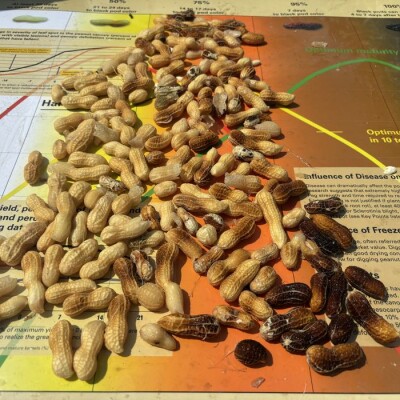
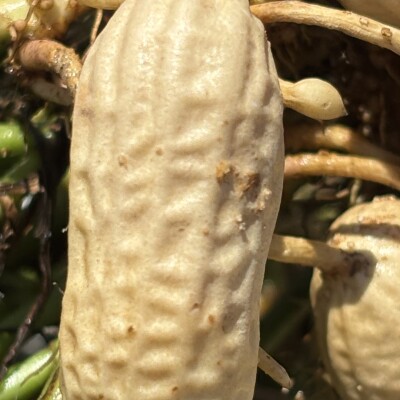
Yeah, I would say that's, to me, that would be on the early side. What I always encourage people to do is certainly look at heat units days after planting also to get just a ballpark of when things might be mature, but remembering that there's no replacement for, or no substitute for, looking at the pod mesocarp color and then moving into harvest. So, Let me explain that real quick. So if you were to take a peanut out of the field, you could take a pocket knife, you could scrape the exocarp, and that gets you down to the mesocarp. And it turns out with peanuts, as the pod grows and develops over time and matures, the mesocarp color gets darker. So we can use that as a proxy, essentially, for knowing how... well-developed the kernels are. The kernels are really important. That's where our mass or weight is from. That's where our quality attributes are derived. So we use the pod mesocarp color to determine, really to get a sense of how far along the kernels are within those pods. So you could take a pocket knife, scrape, get down to the colors, and the colors are going to be kind of a brown or a black. I can't distinguish between the two very well, but brown and black. You might have a rust color. on there or an orange color, some people call that. That's pods that are really about maybe two weeks or so out from maturity. The brown or blacks are pretty close to being ready. The yellow pods, if you get those, those still have a long way to go. And white pods there, if you harvested them, those wouldn't even go in the basket. They would drop and blow away. They're mostly water at that point. So you could scrape. Pods, you could also shell out a pod. And what happens is that kernel rubs up against the endocarp. And if it rubs enough, as it gets mature, it'll expose the mesocarp. And so those are ways to look at maturity. Those are ways that have been in place for a long, long time since peanuts were grown to do that maturity. What I think works better, if you have the time to do it, is to use a pressure washer and one of our baskets. We have some images of those posted. And then a pressure washer, inexpensive pressure washer that has a turbo nozzle or rotating nozzle. And then in about two or three minutes, you can expose the mesocarp across pretty much the full pod if you work with it enough. And then you can lay those out on our laminated sheets that we have. And we have three different curves on there. We have a green curve. If your pods match the... the color of the pod up on the top of the chart under the green curve, I would say that you're at optimum maturity now, which means you could dig those peanuts and you would experience the highest yield and grades at any point in time that you would have had otherwise. So that's ready, green for go. We have a yellow curve. If you laid your peanuts under that curve and matched the colors above, you might be... roughly 10 days or two weeks out from maturity. If you fell under the red card color, that's kind of like the stoplight. You really need to stop. Don't get in a rush because you're better off to let them sit in the field. Just kind of, Gary, one other quick point on that. What we experience is an increase in yield of about 1% per day on the front end of optimum maturity. And just to give you a sense, so if I waited... If I dug my peanuts seven days before optimum maturity, there's a pretty good chance I might not realize, you know, roughly five to seven percent of my yield potential. If I do the math on that, the value of that five to seven percent could be enough to pay for my fungicide bill for the year. If I dug 10 days early, that could be, you know, 10 percent. So it's really important to be as patient. as you can on the front end. Another thing that might help you with that patience, which is really hard to do, and I experienced it myself, I want to go and get going, get things done, get things out of the field before bad weather comes in, whatever the stress might be, is that once you hit optimum maturity, the way that plant works is you're going to have some peanuts that'll shed off, but the yields tend to maintain themselves for two to three weeks. after you hit optimum maturity. So we do worry about weather conditions and so forth after peanuts get mature. And I think sometimes we can convince ourselves that we need to dig our peanuts on the early side because we're worried about what happens after they get mature. But if you've got vines that are healthy and have very little disease in them, that yield potential is going to stay pretty good. or be maintained for a solid two to three weeks. And I've had some examples of where it almost went to four weeks before you saw very much of a loss in yield. So I'd encourage you to do the pod mesocarp color, do that a couple of times. And the reason I do that is because we're taking about 150 pods from a field to represent some astronomical number. I don't know, a billion, a trillion, whatever that number is in a field, depending on how big the field is. That's a fairly small sample to decide when to dig that whole field. You know, you can sample more if you want to, but there's some time required in doing that. I encourage people to start pod blasting on the early side, take a look, then maybe a week to 10 days later, come back and do another sample. And then if you're still a ways out from maturity, do another sample. That takes time, but if you think about those percentages, it could make a big difference if you just look at the time it took to take the sample and do it. The other thing is, I've done this before where I take a sample and then when I pod blast that one compared to maybe my next sample or one after that, my sample seems odd. And it's not out of the norm to occasionally pull up some plants that aren't totally representative of that field or what the maturity is. So when we rely on one sample to decide when to dig. We've got to make sure that sample is a really good one. We're already starting with a really small subsample. I mean, really, really small. And a couple of looks at that, I think, can be of value. I know some folks, they've got a lot of fields to do, and they may decide just to scrape with a pocket knife and just do a handful of pods. All of a sudden, I've gone down to maybe 20 pods that represent all of those peanuts in a field compared to 150. So you got to be careful on the front end rushing some of that. And again, if from a whole scrape standpoint, you know, the pod blaster and using the turbo nozzle and pressure washer, it really does allow you to see the nuance of the colors. And we've taken pods with different colors, dried them all the way down and weighed them. And there's some very big differences between, for example, that black pod and that brown pod. But when I do it with a pocket knife I can't tell the difference between them, but when I do it with a pod blaster, I definitely can. So that's a tool. Hopefully, you know, y'all will use those as you need to. But there's a lot of precision that goes into the harvest. And we want you to do the best you can from a maturity standpoint.
- Gary
It really pays to be patient. It was a key message.
- David
It really does. And as I say that it pays to be patient, I completely understand where the impatience comes from. I do think, and I don't, I mean, I haven't gone back and looked through data. I think one thing that we often do is we worry about that one year out of maybe 10 where we have really tough conditions in late September and in October. And if we wait till the crop matures and then get that weather. and can't get in for multiple weeks, we worry about losing much of the crop that way, and it can happen. But if we dug early, nine out of the 10 years, you know, a week or so early, that loss adds up too. I think that the challenge that none of us know in terms of helping people determine maturity is what somebody's financial conditions are and whether they can withstand that one really tough year. So I completely, completely understand that. One thing you can do that gives you some buffer is have really good leaf spot control going into the fall. And then you have a lot of flexibility in terms of when you dig. You've got a lot of buffer. If you've got a lot of leaf spot going into optimum maturity, those yields are going to drop off really fast. And what might dictate your digging date is your disease and not your maturity. And that's when we begin to lose yield and market grades in a major way.
- Gary
Okay. Thank you for that. It's September 1st. What do we have to look forward to?
- David
Well, you know, September, I really enjoy September. It gets really busy, but it's the fall. I mean, this year we're going to be, you know, September 3rd, we're going to be at 99 degrees. So it does feel very fall-like, but we're going to cool down and that feels really good. We're going to, you know, see that shift. And like what we're doing, harvest around the state. There's just, peanuts are a bit of a magical crop in some ways because the pods are below ground. It's just really a cool thing to pull those up. Look at that pod mesocarp color. I mean, you're looking at the pod mesocarp colors that are really beautiful. And then you start looking around you and you see leaves that are shifting. And it's just a sign of the time. And then once we get harvesting, you know, it's not uncommon. drive around the state a lot in the fall and I'll see this, you know, big storm of dust over here and go a little further up and there'll be another one. And that's usually a group of combines that are trying to get the peanuts harvested. It's really, having grown up around peanuts, it just, it's just a really fun time of the year.
- Gary
Yes. Okay. Thank you. Field day is coming up. Next week is the field day at Lewiston.
- David
That's right. Our field day is on September 10th at Lewiston. We've got a good set of speakers there that we traditionally have. Ashley's come up with a really good program for the grower meeting side of things. We'll have in the field, hopefully you can get there if you're going to come by 8, 8.15 so you can get on one of the trams so you can get out to the field. But LeAnn, our new plant pathologist in peanuts is doing a great job. She's got a lot of good information. Dominic Reisig, who's been... in North Carolina for a long time, working on a range of crops. He's been working on peanuts for a couple of years. He's got some really good comments as well. Jeff Dunne, our peanut breeder, will give some updates on where that program is going. And then I've got some information on trying to minimize the adverse effects, not adverse effects, but our concerns about the Endangered Species Act and how we need to protect that resource and those sensitive areas and how you we might use some different spray nozzles to do that. But hopefully a really good program. The growers have their annual meeting for the membership that day as well, and then we'll finish that out with a meal.
- Gary
Okay. Thank you. And thank you for listening to Searching for the Brighter Pod. If you'd like to reach us, you can email us at BrighterPod@gmail.com. You can find the podcast on the internet at go.ncsu.edu/brighterpod. And thank you for listening.