Description
Stories about money and markets : Monthly talks from the Economic Research department of BNP Paribas.
Hosted on Ausha. See ausha.co/privacy-policy for more information.

Description
Stories about money and markets : Monthly talks from the Economic Research department of BNP Paribas.
Hosted on Ausha. See ausha.co/privacy-policy for more information.
68 episodes
Season 2

Since the outbreak of the conflict in the Middle East on 28 February, energy markets have experienced increased volatility, with a marked rise in oil and gas prices. However, our analysis indicates that the impact on advanced economies is likely to be moderate, provided that the blockade of the Strait of Hormuz does not drag on. What mechanisms are at work and what risks have been identified? In this new episode, Lucie Barette and Marianne Mueller analyse the consequences of the current energy shock triggered by the conflict in the Middle East on advanced economies BNP Paribas Economic Research website (https://economic-research.bnpparibas.com/Home/en-US) Hosted on Ausha. See ausha.co/privacy-policy for more information.
11min | Published on June 11, 2026

Is stagflation back? In this series of podcasts, William De Vijlder, Group Chief Economist of BNP Paribas, discusses the issue of stagflation, a term that has been increasingly used in the media in recent months. Stagflation, a multi-year phenomenon combining rising unemployment and high inflation, brings us back to the dark days of the 1970s and 1980s, when inflation levels were unprecedented and mass unemployment began. Hosted on Ausha. See ausha.co/privacy-policy for more information.
14min | Published on June 16, 2022

The convergence of several factors of tension – the health crisis, the war in Ukraine, the tensions in supply chains – is leading us to speak more and more of stagflation. The term is a contraction of "stag" for stagnation in economic activity and "flation" for inflation. William De Vijlder, Chief economist of BNP Paribas, offers a two-part podcasts series on this worrying phenomenon. Hosted on Ausha. See ausha.co/privacy-policy for more information.
6min | Published on June 10, 2022
Season 1

In this third and final episode of the series dedicated to labour productivity in Spain, signs of encouragement for a recovery in Spanish productivity are presented, in particular thanks to a national recovery plan (2021-2026) that is in line with the España 2050 strategy, which consists of raising R&D investment. Economic Research Website (https://economic-research.bnpparibas.com/Home/en-US) Hosted on Ausha. See ausha.co/privacy-policy for more information.
8min | Published on May 31, 2023

In this second episode of the series on labour productivity in Spain, Hélène Baudchon and Guillaume Derrien discuss the three main factors that explain Spain's low productivity. Economic Research Website (https://economic-research.bnpparibas.com/Home/en-US) Hosted on Ausha. See ausha.co/privacy-policy for more information.
7min | Published on May 24, 2023

In this series of three podcasts "Focus on Labour Productivity in Spain" Hélène Baudchon, Deputy Chief Economist and Head of the OECD team, BNP Paribas Economics Department and Guillaume Derrien, Senior Economist in the same team, discuss productivity as an endemic weakness of the Spanish model. This first episode reviews the main trends in the evolution of productivity in Spain compared to its European neighbours over the last 25 years. Economic Research Website (https://economic-research.bnpparibas.com/Home/en-US) Hosted on Ausha. See ausha.co/privacy-policy for more information.
7min | Published on May 17, 2023
Other episodes
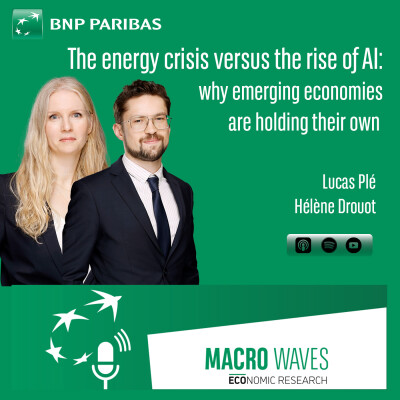
This latest issue of MacroWaves is devoted to the repercussions of the energy shock and the rise of AI in emerging economies. The spring of 2026 saw by mounting risks: war in Iran, the closure of the Strait of Hormuz and soaring energy prices. Yet, against all expectations, emerging economies withstood the shock remarkably well. Lucas Plé and Hélène Drouot, both economists in the Emerging Economies team, help us understand this resilience. Why did the energy crisis not cause the economy to derail? Can the rise of artificial intelligence offset the negative impact of rising energy prices? What are the identified risks of this increased dependence on technology? https://economic-research.bnpparibas.com/Home/en-US EcoPerspectives - Emerging Economies | 3rd quarter of 2026, as of July 13, 2026– Economic Research – BNP Paribas (https://economic-research.bnpparibas.com/Publication/24814/en-US) Hosted on Ausha. See ausha.co/privacy-policy for more information.
12min | Published on September 10, 2026
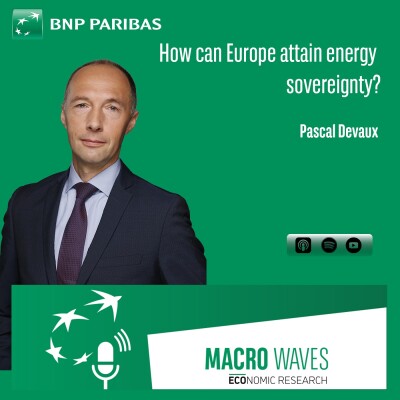
Welcome to this new episode of MacroWaves, the podcast from BNP Paribas’s Economic Research department. In this episode, we’re joined by Pascal Devaux to discuss a crucial issue for Europe: its energy dependence. Reliance on imports highlights the European Union’s lack of energy sovereignty. This applies to both the primary energy mix and the infrastructure needed for its low-carbon transition. The EU is making progress, however, albeit very slowly. To what extent is the European Union dependent? What approaches could enable it to reverse the trend, or at least make progress? That is what we will explore in this episode. https://economic-research.bnpparibas.com/Home/en-US Hosted on Ausha. See ausha.co/privacy-policy for more information.
13min | Published on April 30, 2026
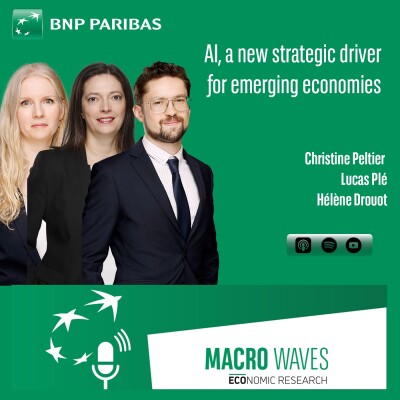
In this new episode of MacroWaves, we examine how artificial intelligence is reshaping growth in emerging economies. We hear from three economists at BNP Paribas Economic Research: Lucas Plé, Christine Peltier, and Hélène Drouot. While Asia dominates semiconductor production, other countries, such as those in Latin America and Africa, are either exploiting their mineral resources or falling behind. What challenges will they face? The answers lie in moving upmarket, securing energy supplies and avoiding increased geopolitical dependence in order to transform this opportunity into sustainable productivity gains. https://economic-research.bnpparibas.com/Home/en-US Hosted on Ausha. See ausha.co/privacy-policy for more information.
12min | Published on April 3, 2026

Between rising interest rates, an ageing population and massive rearmament needs, the budgetary equation for advanced economies is becoming increasingly complex. Why is debt continuing to grow in the United States and France, while it is falling in Spain and Italy? How does Germany intend to finance its infrastructure and defence without jeopardising its budgetary stability? In this new episode of En Eco dans le texte, Stéphane Colliac, Marianne Mueller and Benjamin Puiseux explain the inner workings of public debt. They also explore reasons for optimism: from the impact of artificial intelligence on productivity to reforms in the employment rate of senior citizens. These are certainly significant constraints, but are they really insurmountable? Delve into the issues that will shape global economies between now and the end of the decade. https://economic-research.bnpparibas.com/Home/en-US Hosted on Ausha. See ausha.co/privacy-policy for more information.
10min | Published on February 23, 2026
Description
Stories about money and markets : Monthly talks from the Economic Research department of BNP Paribas.
Hosted on Ausha. See ausha.co/privacy-policy for more information.
68 episodes
Season 2
Since the outbreak of the conflict in the Middle East on 28 February, energy markets have experienced increased volatility, with a marked rise in oil and gas prices. However, our analysis indicates that the impact on advanced economies is likely to be moderate, provided that the blockade of the Strait of Hormuz does not drag on. What mechanisms are at work and what risks have been identified? In this new episode, Lucie Barette and Marianne Mueller analyse the consequences of the current energy shock triggered by the conflict in the Middle East on advanced economies BNP Paribas Economic Research website (https://economic-research.bnpparibas.com/Home/en-US) Hosted on Ausha. See ausha.co/privacy-policy for more information.
11min | Published on June 11, 2026
Is stagflation back? In this series of podcasts, William De Vijlder, Group Chief Economist of BNP Paribas, discusses the issue of stagflation, a term that has been increasingly used in the media in recent months. Stagflation, a multi-year phenomenon combining rising unemployment and high inflation, brings us back to the dark days of the 1970s and 1980s, when inflation levels were unprecedented and mass unemployment began. Hosted on Ausha. See ausha.co/privacy-policy for more information.
14min | Published on June 16, 2022
The convergence of several factors of tension – the health crisis, the war in Ukraine, the tensions in supply chains – is leading us to speak more and more of stagflation. The term is a contraction of "stag" for stagnation in economic activity and "flation" for inflation. William De Vijlder, Chief economist of BNP Paribas, offers a two-part podcasts series on this worrying phenomenon. Hosted on Ausha. See ausha.co/privacy-policy for more information.
6min | Published on June 10, 2022
Season 1
In this third and final episode of the series dedicated to labour productivity in Spain, signs of encouragement for a recovery in Spanish productivity are presented, in particular thanks to a national recovery plan (2021-2026) that is in line with the España 2050 strategy, which consists of raising R&D investment. Economic Research Website (https://economic-research.bnpparibas.com/Home/en-US) Hosted on Ausha. See ausha.co/privacy-policy for more information.
8min | Published on May 31, 2023
In this second episode of the series on labour productivity in Spain, Hélène Baudchon and Guillaume Derrien discuss the three main factors that explain Spain's low productivity. Economic Research Website (https://economic-research.bnpparibas.com/Home/en-US) Hosted on Ausha. See ausha.co/privacy-policy for more information.
7min | Published on May 24, 2023
In this series of three podcasts "Focus on Labour Productivity in Spain" Hélène Baudchon, Deputy Chief Economist and Head of the OECD team, BNP Paribas Economics Department and Guillaume Derrien, Senior Economist in the same team, discuss productivity as an endemic weakness of the Spanish model. This first episode reviews the main trends in the evolution of productivity in Spain compared to its European neighbours over the last 25 years. Economic Research Website (https://economic-research.bnpparibas.com/Home/en-US) Hosted on Ausha. See ausha.co/privacy-policy for more information.
7min | Published on May 17, 2023
Other episodes
This latest issue of MacroWaves is devoted to the repercussions of the energy shock and the rise of AI in emerging economies. The spring of 2026 saw by mounting risks: war in Iran, the closure of the Strait of Hormuz and soaring energy prices. Yet, against all expectations, emerging economies withstood the shock remarkably well. Lucas Plé and Hélène Drouot, both economists in the Emerging Economies team, help us understand this resilience. Why did the energy crisis not cause the economy to derail? Can the rise of artificial intelligence offset the negative impact of rising energy prices? What are the identified risks of this increased dependence on technology? https://economic-research.bnpparibas.com/Home/en-US EcoPerspectives - Emerging Economies | 3rd quarter of 2026, as of July 13, 2026– Economic Research – BNP Paribas (https://economic-research.bnpparibas.com/Publication/24814/en-US) Hosted on Ausha. See ausha.co/privacy-policy for more information.
12min | Published on September 10, 2026
Welcome to this new episode of MacroWaves, the podcast from BNP Paribas’s Economic Research department. In this episode, we’re joined by Pascal Devaux to discuss a crucial issue for Europe: its energy dependence. Reliance on imports highlights the European Union’s lack of energy sovereignty. This applies to both the primary energy mix and the infrastructure needed for its low-carbon transition. The EU is making progress, however, albeit very slowly. To what extent is the European Union dependent? What approaches could enable it to reverse the trend, or at least make progress? That is what we will explore in this episode. https://economic-research.bnpparibas.com/Home/en-US Hosted on Ausha. See ausha.co/privacy-policy for more information.
13min | Published on April 30, 2026
In this new episode of MacroWaves, we examine how artificial intelligence is reshaping growth in emerging economies. We hear from three economists at BNP Paribas Economic Research: Lucas Plé, Christine Peltier, and Hélène Drouot. While Asia dominates semiconductor production, other countries, such as those in Latin America and Africa, are either exploiting their mineral resources or falling behind. What challenges will they face? The answers lie in moving upmarket, securing energy supplies and avoiding increased geopolitical dependence in order to transform this opportunity into sustainable productivity gains. https://economic-research.bnpparibas.com/Home/en-US Hosted on Ausha. See ausha.co/privacy-policy for more information.
12min | Published on April 3, 2026
Between rising interest rates, an ageing population and massive rearmament needs, the budgetary equation for advanced economies is becoming increasingly complex. Why is debt continuing to grow in the United States and France, while it is falling in Spain and Italy? How does Germany intend to finance its infrastructure and defence without jeopardising its budgetary stability? In this new episode of En Eco dans le texte, Stéphane Colliac, Marianne Mueller and Benjamin Puiseux explain the inner workings of public debt. They also explore reasons for optimism: from the impact of artificial intelligence on productivity to reforms in the employment rate of senior citizens. These are certainly significant constraints, but are they really insurmountable? Delve into the issues that will shape global economies between now and the end of the decade. https://economic-research.bnpparibas.com/Home/en-US Hosted on Ausha. See ausha.co/privacy-policy for more information.
10min | Published on February 23, 2026