- Talaya_Host
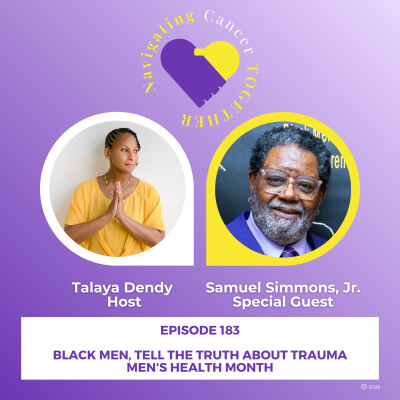
Hello, welcome to another episode of Navigating Cancer Together. I am your host, Talaya Dindi. Today we have a very special guest with us, but before I tell you who he is, I would like to remind you that Navigating Cancer Together is the show that has something for everyone facing cancer. Why? Because everyone is different with different needs, beliefs, and perspectives. Thank you for joining us for another episode. I encourage you to open your minds and your hearts. Navigating Cancer Together is everywhere. Make sure to subscribe and follow the show to stay updated on our latest episodes. Listen on Spotify, Apple Podcasts, YouTube, or your preferred podcast app or platform. Today we have the amazing Mr. Samuel Sam Simmons. June is Men's Health Month, and today we are honoring it with a conversation that is long overdue. My guest is a man whose life work has been dedicated to healing, not just individuals, but entire communities. With over 36 years of experience, Sam Simmons specializes in practical, culturally sensitive, trauma-informed strategies to support men and their families. He is the visionary behind the Community Empowerment through Black Men Healing Conference, a powerful gathering that is transforming how we talk about Black male mental health. He is also the author of Just Sam, A Black Man's Journey to Healing, a deeply personal and important book that explores the profound impact of trauma on Black men. He's done a lot of work. Beyond that, Sam co-hosts The Voices Radio Show on 89.9 KMOJ, where he continues to address the issues that matter most to his community. And most recently, he was honored as the NAMI, N-A-M-I, NAMI 2024 Minnesota Professional of the Year. Sam lives by these words, a community is as strong as the information it's given. Today, I'm so proud to get some very powerful information from Sam. Please help me welcome Sam Simmons. Thanks for joining us, Sam.
- Sam Simmons_Guest
Well, thank you for having me. It's always a pleasure. So, you know, this is what I do.
- Talaya_Host
Wonderful. It's such an honor to have you join me today, Sam. Before we dive into this very powerful conversation and your work, I'd love for the listeners to get to know more about the man behind the titles and the decades of honorable work. Sam, please tell us what is something unique about yourself that might surprise the listeners and what brings you joy and happiness these days?
- Sam Simmons_Guest
People who know me probably won't be surprised. I'm kind of a grouch, you know. I do what I say, you know. I'm a firm believer in one of the quotes I have, a role model is somebody who knows the babies are watching and acts accordingly, you know. So it's not always when the babies are around because they're always watching, you know. And the story behind that is a young man Came up to me out of nowhere and says, you know, Mr. Simmons, I heard of you. I said, OK, so what have you heard? I heard you out here doing the work. I said, OK. He said, but I've been watching you, too. I said, so, OK. And, you know, I'm a little worried now you're watching me. And I said, OK. And what did you conclude? You do what you say you're going to do and you're not going to do what you ain't going to do. and your grouchy butt. up under that you're a nice guy and he walked off i i never i never got his name or nothing i mean it was a young man you know so that inspired that quote because the thing is i'm not knowing this you know and this is true for kids and young people they're watching all the time you know they might be respectful from the standpoint they ain't telling you or they telling you're upset but they be watching you know and and you know and if they have the opportunity they will respond if you ask them You know, so, but I really don't. like talking about myself too much, you know, never have, which is interesting being in a work that I do out in the public. And you say, what makes me happy? My basement by myself.
- Talaya_Host
I understand that. I understand. So are you more on the introverted side then or?
- Sam Simmons_Guest
Yes. Yes. I'm more the introverted. But people like me for some reason, you know, young, you know, young people, you know, they like me, you know, as grouchy as I am. But but young people are not as jaded as adults. Right. So they kind of have enough that they can see through the bull, you know, real quickly. But people who don't know me, you know, they are. What was the question? How do you deal with Mr. Simmons? Could they ask that? Oh, yeah. A couple of my friends said, yeah, man, somebody come. Are you friends with Sam? Yeah. How do you deal with him? I just let Sam be Sam. You know, because the thing is, I'm kind of unconventional, you know, but I'm honest. Because I believe in terms of trauma, you have to first be able to tell the whole truth. And when I say the whole truth, this is where we come up short. We want to tell the truth about everybody else. We don't want to tell the truth about how that trauma, that's not our fault a lot of times. Okay? No trauma, I believe, is our fault. It's just a result of what happened. But again, after we're traumatized, there are certain behaviors that are destructive that we might develop. And we got to be honest about those too. Right? And that kind of honesty is real difficult. And it takes time. But you got to be willing to be fully honest. That starts the healing, but that's a difficult one. And it's really difficult when you start talking about healing of more than just an individual in a community, right? So even with a community, community healing, there's some truths that you got to deal with that that might be very sad, you know? So if we can work through telling the truth, that's a good road to start.
- Talaya_Host
I agree. And I appreciate your honesty. And I don't find you to be someone that's hard to talk to. This is, I think, our second conversation. We've been communicating via email, but our first conversation was really wonderful and it doesn't bother me. It makes me kind of want to talk to you more because I get it. As a fellow introvert, I understand. But thank you for taking some time to talk with me today. We have a lot of great information to cover. I want to transition now, Sam, and talk about your upbringing. You dedicated your life to helping others heal, but your journey started in a very personal place. In your book, you share that you grew up being a very vicious and angry child. Please tell us about the trauma you experienced and when you realized you were traumatized.
- Sam Simmons_Guest
Wow. So when I talk about angry and vicious, the ironic part about it is nobody knew it. Unless, you know, you had these minor explosions, right? Because my anger was always internal, right? A lot of times. And then I was one of them kids who, you know, I'm growing up in the projects. I don't like to fight, which is not a good thing in the projects I grew up in. I don't like to fight. So, you know, we talk all this noise about bullying. Right. In our community, we don't have a lot of times we don't have a healthy conversation about what bullying is because we have made it part of our culture as a rite of passage. When you bring up bullying in the community, sometimes they say, well, you know, that's just the way you just got to beat up the bully. But what if I can't beat up the bully or what if I'm the bully? And one of the things I realize is the bullies, when I started examining my life and that's what, you know, start looking back, the bullies were traumatized. That's why they were bullies. Matter of fact, one of the biggest bullies in my neighborhood, his mama was a bully. Okay? You had parents who were raising their kids. And again, when I say these things, because, you know, people like to run, but people do what they know how to do. People do what they've been taught to do. And so when we're talking about, so some of us been raised around, in terms of discipline, has been around shame. which is a type of bullying, right? And so now, of course, you get the bully. And again, you dig into Billy's background, that cat is probably more traumatized than you. And one of the other things I've learned over the years in terms of being bullied and being angry, that internal anger, and I'll come back to that, is what I call reflective trauma. I didn't understand it when I was a kid. Why are you beating me up and wanting to take my stuff when I was the kind of kid that would give it to you if you asked for it? I had an idea you might need it, but maybe that was my arrogance. But the thing is that reflective trauma is really about, I see you doing well, makes me feel bad. So it makes it okay for me to take something from you. And we see it every day, but we don't have words. I think one of the biggest things is, I think in terms of my work, in terms of this trauma, once I was able to understand it, I started realizing all the words to talk about it were words that were unnecessary. And see, I'm a simple guy. Now I am an introvert. I'm simple. I'm smart, but I'm simple. And I like simple. So when I was able to simplify for myself, I realized that both professionals and non-professionals understood what I was saying. You know, because I was using real language. And real words, some of them were uncomfortable words, but I don't like wasting a lot of air. So I use the word to get the point across the quickest. But if we go back to what you mentioned about being vicious, if I would have went to a therapist when I was a kid and had the therapist talk to me, I used to have nightmares cutting off other kids' heads. That's how angry I was in that kind of stuff. Because when you would mess with me, because again, I wasn't into fighting. And so I would say, leave me alone, leave me alone. I ain't bothering you. And if the person kept bothering me, I would kind of snap. I call them anger blackouts because I don't remember what actually happened in the moment. And in third grade, I almost killed the kid because he kept picking on me, kept picking on me. And then when I would start crying and every hit, I told you to leave me alone. They had to drag me off of that child. But again, we had adults who worked at the school. Oh, you know, they overlook. Oh, that's just kids being kids. But I got this stuff going on. I can't talk to nobody at home because I've got a bully at the house. Okay. It was bad. And then when I realized what I did to the child, you know, but I would go through that. I've had incidents like that when I was an adult. So I grew up scared of my anger. So that don't help. when you talk about standing up for yourself, when you talk about the viciousness, that was, again, people didn't realize what was going on internally. And every time when I would like snap off, it's like, ooh, I didn't, ooh, I never seen him act like this before. Why do I have to act a fool for you to pay attention? And I realized it don't stick. It don't stick. So you'll be acting a fool all the time if you hang out with those people, because they're doing stuff they're not even conscious of. you know, and responding to you. So one of the greatest things about doing this trauma work, it has allowed me to give other people grace. Okay. And the ironic part about understanding the trauma, I started understanding trauma through chronic pain.
- Talaya_Host
Okay.
- Sam Simmons_Guest
Yeah. And start connecting some dots. I used to be a truck driver back in the day for the University of Minnesota, and I injured my back, and I ended up in the pain clinic. And I was an awful patient. I was not a good patient. They wanted to throw me out so bad, it was ridiculous. The good people, the good people. Yeah, they wanted to throw me out so bad. The funny thing about the pain clinic, there was this retired nurse, because at the pain clinic back in the day, you actually lived on the hospital campus for three weeks. And if you didn't live nearby, you stayed over the weekend at the hospital. Otherwise, you went home on the weekend, right? And they had this retired nurse who worked there, who stayed over the weekend with the people and that kind of stuff. And the only reason I didn't kick out, she liked me. You know, ironically, I had that old, how do I put this and be nice? Old white people racism.
- Talaya_Host
Oh, yeah.
- Sam Simmons_Guest
You know, don't mean no harm, but they've been that way forever.
- Talaya_Host
Yes. Yes.
- Sam Simmons_Guest
You know, yeah. Yeah, it would come out every now and then. I would say, Eunice, you know, you can't say that to me. You know? And Eunice told them, give him a chance. And so I got through the program later on, because I started volunteering later on in the program, because I started noticing that it wasn't just me who was angry, but all, because back then it was all blue-collar workers. And so we're talking about they can't do their job. Their job is their personality. The job is who they are. And now you want to tell them that we want to wean you off your medication and we're trying to keep you from having too many surgeries because, you know, when you are running, trying to run away from your pain, man, you'll take surgery in a minute without thinking through the outcomes and stuff like that. So I wasn't the only angry one. And I realized that. Right. Later on, when I was volunteering, because I would volunteer, come in and meet the clients and explain to them to the program because they made it easy for them. This is the program. This is what's going to happen. And I was here. And the patients appreciated that, even though they thought I was their porter. When they showed up, they would hand me their luggage. One lady handed me the luggage at the elevator and I took it and took it to her room. And then later on, she wanted to be embarrassed when she found out I was one of the staff, the regular staff. But it was all good. Carry on. But we started noticing that black men weren't coming in the program, but they were being evaluated. Right. And I went to the head doctor. I had a fairly decent relationship with him. I said, dude, I see these men come through here for evaluation to come program, but they're not coming to program. What's up? Well, Sam, you know, you know, you know as well as I do, my staff can't handle black men, but that's not their fault. Oh, so what are you going to do about that? What do you mean? Oh, if you ain't doing nothing, more than me going to know this. Okay, so what are we going to do about it? What do you suggest? I suggest that I will go to each one of those clients' houses, and I will do the final evaluation and sit down and explain to the young man, look, it's going to be hard, but if you come in here cussing out the staff, threatening their lives, they're going to kick you out. And I'm going to help them. Okay? Okay? Now. This is how we're going to do this. They will, because you're in pain and because of how we do that, you will get upset. All I ask is when you feel like you're getting upset, tell them you want to talk to me now and they will call me. And from that point on, later on, I went back to school. Later on, I got on staff. But what I learned in that pain clinic is that 70% of our clients, because not everybody ends up with chronic pain. A lot of it is physical and our bodies not being able to recover, but 70% of our clients had family trauma, okay? I called it pain, dealing with the pain. I didn't even use the word trauma, right? And 70% and they all either had an alcoholic parent or a chemical use parent, domestic violence, sexual abuse, or all three, okay? And one of the things I learned about that in that experience is that how does that affect us as a person? And our program was a holistic program. So we dealt with the mind, body and soul. And so if I'm suffering, how does that affect me physically? Well, if I'm trying to not deal with my memories, I stay busy. So there's workaholics, perfectionists, caretakers, you know, workaholic. You know, I don't have time to deal with how I feel about myself, you know, but in Sbelly, as a man, at least I know how to work. I believe when I was married the first time, I wasn't a good husband. I was a great provider, but I wasn't a good husband, you know, and I was more comfortable being at work than being at the house, okay? And I was raised by a man who was like that, right? One thing he did teach me is work ethic, how to deal with family. That's a whole different deal, okay? Because his thing was, he was old school. I'm providing. You want anything more out of me, you might get it. I don't know, because I don't understand it for myself. You know? And so we see that. So think about it. If I found my worth in my job, like for my example, I was never good. To me, I was never good to my father. So I spent all my life trying to, well, portions of my life, trying to prove to him I was okay. Okay? And so we got that. Then you end up with a perfectionism. And hardcore perfectionism is hard to be happy because you're so critical of yourself. Then you turn around and be critical of your family. And what you really want your family is to love you because you don't know how to get it no other way. Right. And then the caretaker, I'd rather be in your business than deal with mine. And we see a lot of therapists in that position. And one of the biggest issues around doing this work that we're not doing a lot of work with. is the trauma of the folks doing the work when they walk in the door. Because our clients are a lot more traumatized now, at least to me, than they have been in the past. And that wears on people. We need to acknowledge, remember back to the truth, we need to acknowledge that, right? We need to acknowledge that. But when you're in that cycle of trying to prove the world that you're okay, what gets lost is self-care. And all three of those, it gets lost. I hope I ain't going all over the place too much.
- Talaya_Host
You did a great job, Sam. And you touched on so much. Like, I'm just sitting here nodding my head because I'm like, yeah, yeah. And I love how you talked about perfectionism and learning from what your father showed you and being a provider in all of these things. And that really does take away from the person. Who is the person at the core? And... We put these labels on ourselves and each other, and that prevents us from getting the care and the support and the love that we need. And another thing you touched on, which it kind of made my antennas go up because you said holistic. And during that time, it's amazing that you were having those conversations. So when you started talking about the holistic mind, body, spirit, all of that. How was that received at that time?
- Sam Simmons_Guest
In the program, it was good. When I started bringing it out into the community, you know, I know that's kind of what you like. What's that all about? Yes. Well, how I did that, I used to have a public access show called It's Time. Based on that idea that was on once a week, I did it for a year. I think I did it for once a month. I had a new show. I did it for a year. Then I stopped. Bye. camera person got sick and whatever, but it's time to deal with the pain. So again, I wasn't using the word trauma, but it's interesting how when you start using that word trauma, you know, and so it's time to deal with the pain. And so I talk about starting with the mind, depression. Then if I'm not feeling good, if I'm not dealing with my emotional state, how does that wear on my body? You know, it might affect how I take care of my body? Am I affected with what I eat? It might affect how I sleep, right? And then how does that affect me spiritually, right? Well, if you're suffering, especially if you're suffering in both of those areas, after a while, that's when we start talking about suicidal ideations and stuff like that. And I call it the pot of light. You know, the mind, body, and soul. The soul is the spirit, the pot of light, that flicker that makes life worth waking up for. Right. I tell the story about my grandmother. She wasn't a nice person to us. And what was interesting now that I was able to look back on, she wasn't that nice to us because of the conflict she was having with my mama. You know, and I noticed that she treated my aunt's kids different than us. Right. She was real bitter. She had one arm. The word might have been because we didn't talk about stuff. So I had to put pieces together. And there's two different stories. One is diabetes is probably right. Well, the other one is she was in a car accident, lost her arm with my grandfather, who was this pretty boy who just, you know, he liked spreading the goodness,
- Talaya_Host
you know,
- Sam Simmons_Guest
good looking man. But it was like this ongoing bitterness, didn't know how to be happy. Right. And she got sick. My mama wasted a lot of her time trying to get this old lady to be nice to her. I mean, I watched my mama just bend over, backward, do stuff for this woman. She wouldn't even say thank you or whatever. And then she would just, you know, it was... We found out she was sick. We go down. She's getting better. The doctor was talking about she could get out of the hospital in a couple of days. And she died. Okay? Pilot light out. Because the doctor said, I don't know what happened. Basically, I think she just gave up. She was tired. Because she was suffering in all three of those areas, right? And then I could tell, now that I think about it, the look at my mama, she didn't know how to deal with whatever was going on with her and mama or whatever. And it really was more tied to my grandfather, I think, because my mama and my grandfather look alike. Some of that noise, that stuff in the community. So, again, I started dealing with the pain and explaining it. in those ways so people can understand how to connect the dots. Over time, I realized my speaking style is connecting dots, not telling you what to do, but helping you connect the dot. And system-wise, they always want to tell you what to do. That's why I don't work, you know, because they could be right, but you're dealing with the people. who's always been told what to do and been told that what they feel ain't right. You know, gaslighting us. That felt a little racist. Oh, you're making a mountain out of Moheel. Oh, you know, oh, okay. So you're gonna gaslight me. That's what I feel and what I've seen didn't happen. Right?
- Talaya_Host
Thank you for sharing that, because, again, those are not things that we talk about openly in the black community is that dynamic, that friction between parents and child, mother, daughter, father, son. And I think a lot of times the child, we don't know why this is happening, but it's some things that have happened to our parents and their parents and on and on until somebody. says, hey, I want to stop this. I'm going to get healing.
- Sam Simmons_Guest
But then that person who decides- Gets ostracized sometimes.
- Talaya_Host
They are. Outcast in the black sheep. And yes, please talk about that because that is huge.
- Sam Simmons_Guest
That's me. That was me. Yeah. That's part of the process. That's why change is so difficult because there's a price to pay for changing. And in the short term, it feels awfully painful. If you stick with it in the long term, you'll get mad in the long term about why I didn't do it sooner. Then you can laugh. Then you laugh that one off and be appreciated where you're at right now. The price I had to pay when I started my process is that I realized that there were certain people I couldn't be around. Right. And being the black sheep, when you all of a sudden start thinking about taking care of yourself. Because one of the fears in our community is about being selfish, you know, and so and it's beating our heads. Right. Don't be selfish. Don't be selfish because we're long suffering people. That's part of our history, too. We know how to long suffer. So in the process of that, the reason I ended up being a black sheep and a lot of other folks is when you start saying no to people, then you think you're better than them.
- Talaya_Host
Yeah.
- Sam Simmons_Guest
Right. Then you've got to deal with that in the short term. One of the things you got to do is be willing to be alone with your stuff. That's the first process. That's hard. No matter how dysfunctional the environment we're in, it's our environment. And we done learned how to live in it. And we don't even realize we done learned dysfunctional kind of stuff, right? Even our caretakers that we deal with done learned some dysfunctional stuff, right? So making that choice of... you know i'm gonna do this for me you got to get over the guilt okay you'll feel bad because you've always been made to feel bad you're just being selfish when you would say no and that kind of stuff and so that was the hardest part i had to disconnect because when i started doing my process see i like uh cocaine i like getting high you know my cd counselors friends they used to get mad at me because i used to tell the clients yeah i like getting high the problem is i didn't like consequences. Yeah. Okay. So I can separate the two. They used to, you talk about your sobriety. I still drink every now and then, but my drug problem was with cocaine. I liked getting high with cocaine. And I didn't have to go to a drug dealer because it was in the family. So I had to just clean myself up. I remember my brother said, man, I said, I can't be coming by. I got to go through. Oh man, oh, we brothers, man. I'll put the stuff up. No, I know it's here.
- Talaya_Host
Yeah.
- Sam Simmons_Guest
And it was tough. I mean, it's like, you think you... And for a year, I had to go through that. I mean, it was so bad. I had to get past all the senses around, you know, use of cocaine, you know, because I couldn't even burn incense because it would trigger up my craving because it was all connected. Right? Yeah. I had a lot of chemical use in our family. So there was brothers I had to set aside, you know, it's like, look, you can't come to the house because you'd like to steal. Family got mad. I remember we had a gathering at the house with both families. And my mama was alive then and she was here. And my brother at the time was having a difficult time with crack. And I didn't invite him. Right. I wasn't going to invite him because it was my house. Right. My mama called. Well, you know, he's having problems and all like that. And he needs to be with family and blah, Beating me down and all like this. Okay, mama, I'll think about it. So then I said, okay, he can come. But his girlfriend can't.
- Talaya_Host
Okay.
- Sam Simmons_Guest
He called mama again. I ain't coming without my girlfriend. Why can't she come? Because I said, I can only watch one at a time. Well, I ain't coming if he ain't coming. Have a good holiday, mama. Oh man, I caught hell for that from all the family. How you do mama? This is my house and my house is my sanctuary. And if I can't be happy in my house, you ain't going to be happy in it either. Okay, and so folks don't grow about that some of them came back because they started understanding Right and the ones who didn't
- Talaya_Host
You know, because, you know, our family was outcast on both sides of the family. So it was just me and my brothers and I'm the oldest. So I've been caretaking. So I've been an adult since I've been five. Oh,
- Sam Simmons_Guest
yes. We don't talk about that either.
- Talaya_Host
No, I've been adultified at five due to the environment and due to the trauma of my parents.
- Sam Simmons_Guest
Yes.
- Talaya_Host
Okay. We scream and holler about the system adultifying our kids. We adultify them first. True.
- Sam Simmons_Guest
giving them adult responsibility. The issue is I have to make clear, I understand why when you're trying to survive. See, that's the other piece, how you got to talk about this. What you were doing within that trauma state makes sense. But if you want to get better, we have to make some adjustments. We don't have to get rid of everything, but you got to be willing to make adjustments and you got to be willing to get, it's like cleaning out your closet. You know, you got them clothes that you ain't wearing, but you got memories with them and all like that. No, you got to clean the closet. And sometimes you got to get rid of some of the stuff and the memories with it. You know, but it's a process. And the process never ends. We want it. Oh, I'm healed. No, I'm not healed. I'm just aware. And I still get triggered. I just don't get triggered as much because the longer you do something, the better your skills are. You know, I'm still triggered. And when I'm triggered, I got a plan. Well, I take a time out or I just shut down for a minute, especially if I can't leave and then figure my exit and go and buy my business. Right. You know, or if I'm with an organization and it ain't working for me, I don't have no problem walking away from some money if I have to, but my health is first. I've had... Health insurance. And, you know, we scream and holler about, well, we don't have no health. That's true. But I got a lot of folks who got access to health insurance, man, who don't use it.
- Talaya_Host
Yes.
- Sam Simmons_Guest
OK, so when we're talking about getting healthy and being the outcast, I'm in with this story that you'll probably relate to really well because most folks do. So we got this young girl named Sally. Nice girl. Family ain't seen her. In 15 years, her uncle George, who's a deacon of the church, 80 years old, he died. She shows up and nobody ain't seen her, right? And then the circumstances why she left was always up in the air, right? She comes in, sits in the corner. You know how when everybody's whispering, it gets a loud noise. They're like, what's she doing here?
- Talaya_Host
Yep.
- Sam Simmons_Guest
The only response, she's in their corner. The service go on, you know, because he was a deacon, all the county. Preachers, they all coming in because they all want to be seen. They do the little home going. We're there for an hour and a half, almost two hours, and all this kind of stuff. And then the women go into one room, right? And the men go in another. Or the men are just hanging out. The women in the room. She goes in the room where the women at, walks out 15 minutes later with a smile on her face. And all you hear behind her is screams. Because, look. She left because Uncle George abused her. And they were more worried about his reputation than that girl. And they found out that Uncle George not only violated her, but violated a couple, two or three generations of the kids. And then we go and think about it. We always got this story about telling somebody, yeah, don't be sitting on so-and-so's lap. So you got to do more than that if you want to protect our kids. Because we are so stuck in the idea that the collective is more important than the individual. I understand where that comes from out of our survival as a people, because it had to be that way. But even in the slave quarters, they had to, you know, if there was a pedophile in the slave quarters, they had to work around that because of the environment, right? An example of being that outcast and that kind of stuff. And she lived to it and knew she did the right thing, but she had to come back and let them know. Y'all didn't want to hear me. Y'all too busy worrying about y'all position or the secrets in the family. And that was just one of many, right? And it's hard because again, we're a collective people. So we're very codependent as a people. We don't know how to disconnect even for our best interests. Okay. And we don't trust each other.
- Talaya_Host
Yeah.
- Sam Simmons_Guest
Okay. Some people get mad about that. But one of the things I think I mentioned this to you, I expect to be mistreated unless somebody prove me different.
- Talaya_Host
Yeah.
- Sam Simmons_Guest
When I'm dealing with my people.
- Talaya_Host
You shared that.
- Sam Simmons_Guest
And it ain't that I don't love my people. It helps me not get mad at my people. Right? It's like when we deal with somebody in our community or deal with somebody in our life and we deal with them over and over and they keep being the same person and then you don't want to get mad at them. Why? They ain't changing. They're good. And if they ain't good, they're good and they're suffering. And so they want you to join them, you know? But unfortunately, like I said, unfortunately, when I say that, it's happened more often than not. That's the sad part to me, right? So I don't hold it against folks because we're easily triggered. Our trauma is deep, you know? Our trauma is deep. And that's the piece that I'm most concerned is with the trauma that we do to each other due to the historical trauma. You know, trying to get through that historical trauma has not been easy. Think about it. Somebody told you you were free, but treated you everything but free? How do you deal with that?
- Talaya_Host
Exactly.
- Sam Simmons_Guest
You spend all your time trying to prove to somebody who don't care about you or don't even know that you exist that I'm human. And the bad part, when we don't deal with our trauma, we ain't dealing with our own humanity. And then we want to be mad at everybody else, which brings us to the idea of male trauma. We don't deal with male trauma at all. And they want to be surprised when males act out. They're human beings. If I can't address my trauma, I'm going to act it out. And then when I bring my trauma up, you tell me to suck it up or, you know, quit being a girl or quit being soft or quit being a child. Oh, oh, I don't hurt. You know, think about a little boy. When did we stop cuddling the little boy who's been hurt? That could be early as four or five years old. And so we don't deal with male trauma across the board, no matter what culture it is. And that's what we're seeing, you know, this male trauma. And not know how to deal with that. But the humanity, when you ignore that trauma or you know your own trauma, you ignore your own humanity because we all hurt sometimes. So.
- Talaya_Host
Thank you so much for sharing that because it's so important. And I want to get back to that a little bit later in the conversation, that male trauma, because we are doing this episode in honor of Men's Health Month. And I just want to get some tips from you around that, but we'll come back to that in a minute. One thing I really want to talk about is your book called Just Sam. And Sam, what inspired you to write this book? And what do you want readers to take away from reading your book?
- Sam Simmons_Guest
Oh, wow. The story behind the book. Well, the book, the book effort started over 25 years ago. 20 years ago? The current book is nothing like the original book. The original book was based on my show, you know, so we transcribed my show and started using that to make a book. And the editors I was trying to deal with didn't know how to write the book in my voice. Because you can give people information, but you got to have them understand the voice, right? So it's been shelved for a long time. And I showed it to one of my new young colleagues. Mr. Simmons, we're going to make sure you publish this book on your 70th birthday. So what they did is they took the first manuscript, went through it. They brought some researchers in and find out where all the quotes and stuff came from. And after that, they filled in the spots with interviews. And then we found a ghostwriter in Jamaica. who took it on and she did a wonderful job because if you know me and you read the book it's like yeah he said that you know that kind of thing and so the youngsters the young people if it wasn't for young people i don't know what i do because they get it that trauma stuff they get it because they live it they can see it and when you break it down it's like oh that's why they did that connecting the dots Right. So my staff are all Jamaicans in terms of the book. They put it together. And then how did we come up with the title? We didn't have no title. Right. At first it was it's time to deal with the pain. Same as it was, you know. We don't want that. And then they got on my nerves. I said, let's call it Just Sam. And then everybody got quiet like, yeah, that'll work. And that's how that happened. You know, like, get on my nerves. Just call it Just Sam and leave me alone. That's how the title happened. And then that picture I have on my website, that's when the last time when I was a kid, I was happy. That was before my brothers were born. That was when I was the only child. in Springfield. See how good I look? A pretty little only child.
- Talaya_Host
Exactly. You were a handsome fella.
- Sam Simmons_Guest
The picture on the back, if you look, it's not as clear as it should be, but if you look at it, you'll see the sadness in the little kid's eyes in the front. That's me. And then my three brothers behind me. We got the book done on my birthday a couple of years ago. And we've been kind of bouncing through. Hopefully, finally, we'll get the audio part done. That'll go further because, you know, a lot of us don't like to read. And I'm probably in that piece, too, to some degree. But the response from young people has been really good because of the way it's written. Some of the older folks like it, but they get nitpicky. You know, why didn't you put the pictures in the front? Because we was in a hurry. They're in the back. you know all that kind of stuff they're not saying much about you know there are no problems with with the words but the layout yeah yeah but you know some of us feel like we need to do that even when folks don't ask us that's their opinion you know so you know it's like you know and then they want to get their feelings hurt when people tell them i didn't ask your opinion yes and they're doing it for themselves to feed their own stuff to feel important and we see a lot of that in the community. And like I said, we're a very codependent kind of people. We use people to feel good and don't know how to feel good on our own to a certain degree.
- Talaya_Host
So true. What do you want readers to take away from Just Sam?
- Sam Simmons_Guest
Oh, my goodness. Hopefully they could connect some of the dots to themselves and start their own journey. Right. A lot of times when the people who read it and mention about it, they give it to other family members. Because the community, especially the women in the community, even though some men think they're hard on us, really are worried about Black men.
- Talaya_Host
Yeah.
- Sam Simmons_Guest
You know, and somewhere along the line, we have to find a way. And there's going around the country, we got to have safe spaces for men to have a place to talk. And see, when we talk about safe spaces, usually we're not talking about men. You know, men need safe spaces too. And when we brought that up with a group of men recently, where do you feel safe? They were hard pressed to figure that out. And a lot of them said, yeah, I hear it. Yeah, we're too busy finding safety in the drugs and other stuff. Drugs, sex, even violence. Yeah.
- Talaya_Host
To that point, Sam, many Black men struggle in silence rather than reaching out for help. What is it that myself, family members, friends, and community, what is it that we fully don't understand about that silence? And what can we do to really help Black men?
- Sam Simmons_Guest
Wow. Well, the thing is, is the silence is built into being a man in America, or actually is tied into that, you know, that word that we get upset about, masculinity or toxic masculinity, whatever it means. But again, think about it. If you look at all the male stereotypes from male patriarchy, white male patriarchy, head of the house, strong all the time, you know, all these kind of things, right? If that's your foundation, how do you make it when you don't feel like you're part of the system? So what we've done because of our trauma, we've tripled down on a lot of that toxic stuff. And so we have to understand part of that toxic stuff is not. talking about my stuff because nobody wanted to want to hear it. When I talk about it and I hear this a lot, you know, when they do get comfortable and share with their significant other, their fear is that she's going to use it on me later on in the argument. And we do that to each other, right? And we're real fragile. We're emotionally fragile. We won't admit it, but we're really emotionally fragile. Our feelings get hurt very easily. And if our feelings have been hurt for a long time, we get to a point where we just shut our emotions off altogether so our feelings don't get hurt. The difficult thing is when our partners approach us, we call it nagging. But that's our defenses to get you to leave us alone. Right. And so you got to do it back door. You make suggestions. You put books in front of them. You find YouTube stuff that's done by men. I do a lot of that in my group because I get tired of talking in the group. So I find YouTube videos that will make the point that's done by preferably a man or at least a person of color, because for a lot of us, that's the entry point. Because some of us have learned to shut down when we hear, when we see white faces, which can be a problem too, because there's some folks out there we could learn something from, and you got to understand that. But it's a hard one to approach us. I remember when I did the conference the first year. And one of my female colleagues came up to me and she says, I hear you having a conference for black men, a trauma conference. You know, why are you just talking about black men? You know, they cause so much trauma. And what about the trauma they do? And I'm like, oh, slow down. Now, the ironic part is this particular person had one son in the NBA, another son in college doing well, you know, and single parent. I said, think about it. You got two boys and you've done a good job with them. And I know it because we've talked about it. You love them, right? I said, think about this. Don't you think if I help men take care of themselves, then that gives you time to take care of you? And she paused and she said, have a good conference and walked off.
- Talaya_Host
Nothing left to say.
- Sam Simmons_Guest
Right. Because the thing is, if anything else for Black women, you got to give that up. You treat us like babies. and then get mad when we act like it. Okay? I know you mean well, but you got to let men be men. Then you want to tell us how to heal or how to be in circles, you know? So this kind of guide us somewhere, you know, because, again, we don't trust each other. And it gets even worse between black men and black women. So that's already there. So, you know, you guide them. And it's hard because there's not a lot of examples. That's why I stay in the house because when I go out, I got women coming up to me talking about, Mr. Simmons, can you talk to my husband? And I don't do a lot of one-on-one. That's emotionally tasking for me at this point in my life, right? But I'm willing to train folks. And that's the big piece that I'm having, you know, train folks and that kind of thing. But again, it's a difficult piece being that female who really cares or that family member who really cares. Because we will shut you down if you come in there directly. And then we'll get mad. Part of the domestics I deal with is about that. You know, you think you my mama. Why are you always in my face?
- Talaya_Host
Yeah.
- Sam Simmons_Guest
And again, it's coming from a good place. A lot of our destructive traumatic behavior comes from a good place. That don't mean it's still not good. Okay. And this because you think it's good. Don't mean it's good for me. Okay. I talked to the guys and to get them to really connect with their partners stuff. Right. You know, being able to listen, we don't listen. Well, we too busy listening for a break. I even catch myself waiting for a break to jump in. Right. So when I'm talking with my partners, we always cutting each other off all the time. I'm sorry. You know, but we, we learn how to listen, learn how to listen. Learn how to be patient. We're not patient with ourselves. How are we going to be patient with somebody else? Learn forgiveness. For people to be so Christian, we have some real problems with forgiveness. I've dealt with my highly Christian friends. I listen to them sometimes, and it's like, where is the forgiveness? Well, you know, it's like, oh. But see, again, I'm raised in a real religious kind of home with all the toxicity, right? My grandmother used to talk to us about forgive and forget. And it's like, I can't forget. So am I able to forgive? And I thought I wasn't able to forgive because I never forgot. And then the other thing is, oh, you know, they didn't mean it. Go back. So you repeat, go back and repeat the crap over and over again. Now I'm bitter.
- Talaya_Host
Yeah.
- Sam Simmons_Guest
Right? And I'm not figuring out what the deal is, right? But that whole forgiveness, there's a real issue. How do I learn to forgive myself? Especially black men. Black men are full of regrets. A lot of the ones I deal with. And then the older we get, the more regrets we have, you know. And then we want to find God when we didn't know where he was before, you know, because we're getting close to meeting him if we do right. You know, so, you know, I got a lot of my older friends coming up to me trying to get me to come to church. It's like, dude, please leave me alone. You just found it two weeks ago. You and I, you and I, you know, you want me to, man, we want to, we want you to, you know, we want you to save your soul. My soul good because it's mine. Me and my soul got to understand it. I take care of me and it helps me take care of me. So we good. But it's all that reactionary behavior that. Survival stress management stuff. You know, doing whatever feels good in the moment without thinking about consequences. Then want somebody to give a darn when you come back with the consequences. I mean, the consequences were obvious, but you keep doing it. That's because if you, like, for example, use sex for stress management, you'll have more kids than you can afford. Or you'll have more problems with more people. then you can afford. And that includes people who know all about sex education. But if you're using sex for stress management, it all clicks. As soon as it clicks, you know, and you'll see the behavior. It's like food. I've seen dieticians, you know, probably helping folks, and then when they get stressed by themselves, they eat like a whole piece of chocolate cake and sit in their bed and watch some god-awful reality shows. So they're trying to disappear from their situation. but not in a healthy way, right? And these are the professionals.
- Talaya_Host
That goes back to your earlier point. The healers need healing and support and care, self-care too.
- Sam Simmons_Guest
Right. Exactly. Exactly. Again, back to that long suffering. One of the things in our community is that we have been taught there's more kudos for being long suffering than taking care of yourself.
- Talaya_Host
That's true.
- Sam Simmons_Guest
It's like being an activist. you know, community activists, right? A lot of times, the saddest people in that is the kids, because you're gone all the time. I tell the story about the activist who dies, you go to the funeral, and everybody coming up to the kids, sitting in the front row, talking about, oh, I loved your mama. She was like a mama to me. And I remember one of the kids under the breath said, yeah, I wish she was a mama to us, you know? Because he was out there doing the work because you get credit. You get kudos. It feeds your soul.
- Talaya_Host
It was good.
- Sam Simmons_Guest
Yeah. Yeah, but do it for yourself. We have to learn to appreciate that. It's like one of my clients in my group, he was saying, Mr. Simmons, I've noticed you do a lot of stuff in the community, man, and I want to be more community involved. What should I do to be more involved in the community? I said, take care of your four kids. And he was hot. But we like doing that external stuff, that internal stuff. Then what is the kudos? You know, for him, it might be a good pair, but you got to start at home. If you want to go out here and help people in the community, you need to get your stuff right at home. Yeah, he was mad. Why do you say that, man? Well, you know, if you will help our community, if you take care of your kids.
- Talaya_Host
And that's generational.
- Sam Simmons_Guest
Right.
- Talaya_Host
Setting them up now to be, you know, good in the community. Yeah.
- Sam Simmons_Guest
Right. Exactly. Again, I go all over the place. That's who I am.
- Talaya_Host
That's all right. I accept you as who you are. I want to talk about your upcoming conference that's happening on June 25th. I want to make sure the listeners are aware that this conference is taking place in St. Paul, correct?
- Sam Simmons_Guest
Right. At St. Paul College.
- Talaya_Host
Okay. All right. So please tell us more about the Men Healing Conference.
- Sam Simmons_Guest
Yep. The 18th annual. Community Empowerment Through Black Men Healing Conference, which is an interesting title because it's more than just for black men at this point. The focus this year, we always try to have a focus is the mind, body, and soul of community healing. We're going to have a special session around trauma in the church as well. We're hoping to do a panel of faith leaders and have a conversation about that. There's a lecture. Have you been to church lately? or something like that on Friday, because it's Thursday and Friday, full day Thursday, half a day on Friday. Then we have a lot of therapists and stuff that will be talking about the emotional piece. We got a specialty chef coming in from out of town who works with black athletes in terms of how to keep them healthy. We're trying to have massage therapists there. It's open to anybody who's interested in the topic, you know, because when you put man on stuff, oh, can... Women come, yeah. Don't you work with men? Do you have men in your life? And the thing is, even though we're talking about black men, a lot of the folks who are not black, when they come, they say they learn a lot about their men as well. Yeah, we got a little extra flavor. But why it's always been interesting to me when you say black men, folks get freaky and, you know, get weird. But if you say men, it might be different, right? So. I don't know. What else do you want to know? What do you like to know?
- Talaya_Host
Where can people register?
- Sam Simmons_Guest
Oh, they can go to healingbrothers.com and get all the information they need. And it should be a good time this year.
- Talaya_Host
Congratulations on 18 years. That's amazing. Great work. It's not easy.
- Sam Simmons_Guest
No, I'm working with my youngsters to take it over in two years.
- Talaya_Host
Okay.
- Sam Simmons_Guest
I'm having that conversation with some of my young colleagues so they could take it over. I'm not going to go away. I'm just going to sit in the background and criticize. I'm going to do the old man thing.
- Talaya_Host
Wonderful. Where can people get your book, Just Sam?
- Sam Simmons_Guest
On Amazon. If you put in Just Sam, it'll pop up.
- Talaya_Host
Okay. Wonderful. Thank you, Sam. And before we end, I want to quickly touch on it. If you have a few more minutes. Okay. I want to touch on cancer and trauma. And you shared with me in the previous conversation that you were a caregiver, I think for your sister-in-law. And you witnessed highs and the lows firsthand. When you hear the phrase navigating cancer together, what does that mean to you?
- Sam Simmons_Guest
Oh, well, what that means to me is that when we have cancer in the house, everybody's affected. And it also means that we all need to figure out a way to navigate it for each of us in our own way. You know, that would be. the person with the cancer, the caretakers, how do we support them? It is bigger than just an individual. And unfortunately, sometimes, like we've said for men, you've got this strong person who don't want to ask for help, don't know how to ask for help. It helped them realize, you know, this is a group effort if you're going to get through this. Because everybody's affected because life is turned upside down, you know. And it gets even more if the person with the cancer is one of the main. caretakers of the family making that adjustment.
- Talaya_Host
Thank you. Sam, there is a Black man listening right now and he has just received a life altering call informing him that he has cancer. What words of encouragement would you offer to him in such a traumatizing moment?
- Sam Simmons_Guest
Wow. Feel the feelings that you feel at the time. you know, and then take a deep breath and decide cancer is not going to be your full life, okay? And I'm going to live the life that's left and keep my hope. And then try to find ways to bring support around. That's difficult, especially for men. If we didn't already have the support, because we, you know, I can do it myself and all this other kind of stuff, right? Unfortunately, with medical stuff for men, they get sick and then they start feeling like they're weak because they got sick. No, again, we don't make so conditioned to ignore our own humanity. That's an example of that. You're human, you know, you're human. So again, slow down, take a deep breath and feel the feelings because initially they're hard and start building a support system if you don't already have it. We're not doing enough because I've been running into a lot more female cancer survivors. You're like the fifth one that I ran into and they're asking the same question. And one of the things we had talked about when we do one of the shows again, because I had a bunch of survivors on a couple of times and we wanted to get some men in, you know, and it's hard. But it's hard because of the same problems because we've been conditioned. to take a backseat to our care, to prove our manhood.
- Talaya_Host
Yeah. Thank you for those wise words, Sam. And if you know of any men, particularly Black men, who would be open to talking with me and being on the show, I would love to have them on. We need to keep having these conversations. It's so important. It shouldn't just stop here. It shouldn't just happen in Men's Health Month. We have to keep having these conversations.
- Sam Simmons_Guest
Absolutely.
- Talaya_Host
Sam, I want to thank you so much for joining me for this special episode for Men's Health Month. Is there anything else that you want to share that you haven't had an opportunity to share?
- Sam Simmons_Guest
Oh, my God. If you never heal from what hurts you, you'll bleed on people who didn't cut you.
- Talaya_Host
That's true. That's kind of what we've been experiencing, been sharing our trauma. We got to say it and quit sharing it.
- Sam Simmons_Guest
Thank you for sharing that. What is the first step? I thought we were done.
- Talaya_Host
I thought we were too. We are. Okay, I promise after this. The first step was- That was such a profound-
- Sam Simmons_Guest
The first step is the truth. Being willing to have an honest conversation with yourself. You got to start with the full truth, not just parts, not just, you know, the story about the trauma, but how does it affect you? How does it affect your behavior? How does it affect your relationships? So we're talking about admitting that I don't know what to do. I'm dealing with this pain. The trauma word don't work for you. And so now I will try to gather information to figure out how to move forward. But one of the things you'll find out is if you really want to No. things, interview people close to you and give them the permission to be honest. But the truth is the big one, the full truth, not just the truth about what happened, also the repercussions and how does it change your behavior and how is it feeding back on yourself? We'll leave with that.
- Talaya_Host
Okay. Thank you so much, Sam, for being so gracious with your time. I'm really going to let you go this time because I don't want you to get too grouchy on me.
- Sam Simmons_Guest
Yeah, I was getting ready. My sugar's acting up. My sugar's acting up.
- Talaya_Host
Okay. Okay. Before we end, I would like to give a shout out to the Navigating Cancer community and the valued listeners. Thank you so much for joining us. That is it for this Wednesday. And until next time. Let's keep navigating cancer together. Take care.