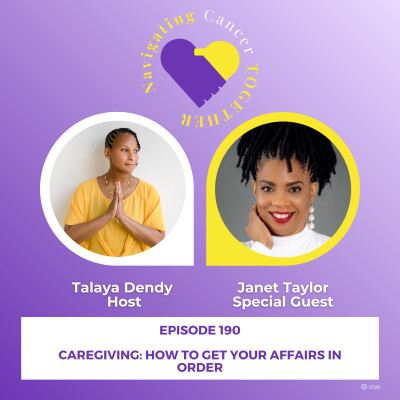
- Talaya Dendy_Host
Hello, everyone. Welcome to another episode of Navigating Cancer TOGETHER. I am your host, Talaya Dendy. Navigating Cancer TOGETHER is the show for everyone facing cancer. Well, why is that? Because everyone is different with different needs, beliefs, and perspectives. Thank you so much for joining us for this episode. I encourage you to open your minds and your hearts. I'd like to remind you that Navigating Cancer TOGETHER is everywhere. Make sure to subscribe and follow the show to stay updated on our latest episodes. Please listen on Spotify, Apple Podcasts, YouTube, or your preferred podcast app or platform. I have an amazing guest with us today, and I am so excited to welcome Ms. Janet M. Taylor to the show. Now listen to this. Janet is a professional life organizer, author, and the founder of Totally Organized LLC, where she has spent over three, three decades helping women navigate life's biggest transitions with clarity, calm, and a solid plan. But Janet's expertise isn't just professional, it is deeply personal. She has served as the primary caregiver to her mother during an intense. 18-month battle with leukemia. That intense experience infused her work with an incredible amount of heart and hard-on wisdom. Jenna is also the author of the e-book, Get Your Affairs in Order. Yes, we need to. And she is the host of the wonderful podcast, Got Clutter? Get Organized. Jenna's mission is simple. She doesn't just help her clients clear away physical clutter. She helps them win their peace of mind back. We need that. Janet, thank you so much for joining me today, and welcome to the show.
- Janet Taylor_Guest
Thank you, Talaya. I'm excited to be here.
- Talaya Dendy_Host
Thank you, Janet. I am excited to have you. I cannot wait for everyone to learn more about your important work. I'm so intrigued by your work as an organizer and how you actually help people do that. But before Janet... I'd like to help the audience get to know you a little bit better. Before we dive into your incredible work, I'd love for the listeners to know the woman behind the business. So Janet, what is something unique or interesting about you that most people might not know?
- Janet Taylor_Guest
I think I love plants. So that's kind of like the space where I go just to kind of be at peace and relax. So right now I think I have like about 17. But I'm continuing to add to the family.
- Talaya Dendy_Host
Wonderful. I know what you mean about plants. I don't have 17, but I have quite a few. And they bring such peace and calm. And also, they are very good to help clear the air, clear different things out of the air in our homes. So yes, I understand that.
- Janet Taylor_Guest
And also I'm surrounded by a lot of plant lovers as well. And I joke with people, I say my best friend and I, I think we've been like, you know, going back and forth for decades. Like she'll get a plant, I'll go over her house. I'm like, okay, can I have a cutting of that? And then she'll come here. So it's nice to be also surrounded by plant lovers as well.
- Talaya Dendy_Host
Yes, I agree. They're the best people. And it's just fun, like you said, to compare and be like, oh, what kind of plant did you get? And how is that going for you? Yes. So Janet, as I read in your intro, unfortunately, your mother was diagnosed with cancer and you were her caregiver during her 18 month battle with leukemia. What was something that caught you by surprise about the reality of being a caregiver?
- Janet Taylor_Guest
I think the first reality was the fact that I didn't really know as much I felt about her medical life that I thought I should have. I think I let go of that guilt, but also just all the different aspects of it, because it's not just going to the doctor's appointments. It's sometimes being that liaison between my mother and the doctors and also just kind of also looking after her life because it got to a point where I had to really help her manage her finances and and also just seeing her, my mother, somewhat come dependent on me. I didn't expect it as well because there was a point where I remember I was in the hospital and I guess they called. Well, the people who would come around and see what she wanted to eat. And she said and the guy told me he was like, well, your mother already said that you will take care of it. And she would. And one time I heard it's like, oh, my daughter will take care of it. She'll just select everything I need. So you just leave it right here. So I was like, OK, all right. So it's those little dynamics as well. And when you become the... the parent of your parent. That was the biggest one. It was like, you know, because you do sometimes have to step in and say, look, this is how I think we should handle this.
- Talaya Dendy_Host
I can understand that. And I've heard that from several people that the shift of roles can be very challenging. But what I heard you say, Janet, is that your mother actually welcomed that shift in a way. Whereas people that I've talked with in the past, it was challenging. The parent didn't want that shift to happen, although it needed to happen.
- Janet Taylor_Guest
And I think it was, I think because we already had a close relationship. And also, I felt that she kind of saw how I almost like really kind of took control of some of the conversations between the doctors, you know, so that. Her wishes were being taken care of. It wasn't necessarily about what you thought was good. It was like, well, what does she want? And of course, it did help because my cousin was actually a cancer specialist. So therefore, I brought her in in those conversations. When they started talking the medical jargon, I was just like, you need to talk to her. And then there were times when I'm glad she was there because she would give them, you know, it was basically they couldn't believe it. because... she would talk the language. So, but yeah, there were times when I had to truly, truly like, okay, I got to stand up to the doctors again, but I was looking out for her best interests.
- Talaya Dendy_Host
And I just want to commend you on being an amazing advocate and caregiver for your mother. I have not been a caregiver, but I understand that it's not easy. You typically give up so much of yourselves and your time. So I do want to thank you for that important work that you did for your mother.
- Janet Taylor_Guest
And I'm glad I was there. I'm glad I was able to do it. I'm glad that not only did she welcome it, but I'm also happy that I had support. Because I told a group this morning, I said one of the things I truly love about her siblings was I only because she was one of 10 and I only had to call one. I just called my Aunt Ruth and then she just let everybody else know what was going on. So I didn't have to kind of keep everybody in the loop. And also I had a really strong church support as well. They would help with transportation. There were times when I wanted to do some things. And so therefore they would kind of just come over and visit her. And I was very careful about the language because I wouldn't say sit. Because that was a trigger word. Because one time, one of her friends was just visiting, and I heard my mother, I'm in the kitchen, you know, it's the kitchen living room, so I can hear everything. She was like, you know, she thinks I need a babysitter. I'm the parent. So sometimes you have to deal with, you know, just making sure you say the right terms so it doesn't trigger them. It's like, hey, I just want them to come spend some time with you. And I'm just going to go out for an hour or two. But I just feel comfortable having somebody here with you.
- Talaya Dendy_Host
Thank you for sharing that, Janet. And you're right. The language can be so important and it can really make things go in one direction or the other. So that is an excellent point to be mindful of the language that you use.
- Janet Taylor_Guest
Yeah, because there was a time when I realized her bank account was dwindling and I couldn't understand why, because basically it was just the expenses of where we lived because I moved in with her. And, you know, just utilities and things like that. But I noticed and I realized because of her mindset, when something would come in, maybe it was from a medical insurance company, even though it didn't wasn't a bill, it looked like a bill. So therefore she would pay it. So therefore, I was added to her checking account. But I also told her that I would be a resistant. So once a month, I would sit. by her. We would go through the bills. I would write everything out. I did not take her check signing privileges away from her. I said once I didn't use completely and she was fine with it. So sometimes it's also just being creative, like, OK, I need to kind of oversee things, but also I need to still allow you to have your independence. So
- Talaya Dendy_Host
I think that's another important point is making sure they have autonomy, the person you're caring for and not feeling like you're taking. something away from them, particularly their rights and, you know, their right to function on a daily basis independently as much as possible. So thank you for sharing those stories. I think it really sheds a light on the amount of patience and reflection that's required for caregiving.
- Janet Taylor_Guest
It is. It's a lot of, it's a lot of patience. There's a lot of reflection. It's also looking at what will work best for The relationship. So like you said, they could still feel like, you know what, even though maybe physically and maybe sometimes mentally, I'm just not there, but I'm still the parent and they're still treating me as such. And that's what I wanted her to feel like. You know, yes, when it came to sometimes conversations with doctors, I had to step in. And I think that's when the dynamics shifted because I still remember she had been. She wasn't able to eat. But then all of a sudden I came in because they had the fluids. And she was sitting up and she was eating a sandwich. And I was happy. But then there was somebody that came in and they wanted to take her for a test. And I says, well, wait a minute. Can she at least finish her sandwich? She hasn't eaten solid food in days. So I heard them on the phone saying, well, the daughter said I can't take her anywhere. And then he came back to me. He says, they told me I have to come back. I said, yes, because you're not. She is going to sit there and enjoy some solid food for the first time in days. So whatever this test is, it can wait. And so and I think that's when she was like, oh, Janice, just going to go toe to toe with these people. And I and I was I really, truly was. And there were several times I had to. But I mean, that was my mom and I was going to make sure that she was treated like with dignity.
- Talaya Dendy_Host
I love that. We're going to pivot now, Janet, and we're going to talk a little bit about you as a professional organizer. So you already understood the system when it was time for you to support your mom as an organizer. But what did that specific 18-month experience teach you about the absolute necessity of being organized during a health crisis? And what happened when things weren't in place?
- Janet Taylor_Guest
So I guess the biggest thing is making sure all your paperwork is in order. Because the fact that she had her medical directives, it made it easier for me during some situations, specifically near the end, where I was like, look, this is what she wants. I'm not going to go against it. So that was important for me. But also, it got to a place where I felt I wasn't being recognized as the caregiver. Because, you know, every appointment, every emergency room visit, I was right there. But they would kind of kind of overlook me. So therefore, what I did was I started organizing everything. I had a list of all the medications, a list of all the doctors, a list of every discharge, whether it was just an office visit or an emergency visit. And I put it in a binder because I saw they had a binder every time they had these thick binders. And so when I went to one emergency visit. The doctor started asking me questions and I'm like, well, according to this, and he was like, well, what is that you have? He was like, can I look at it? He's like, I promise I'll give it back. He's like, this is amazing. So I just started taking that with me. So that helped me. So I did that. I also, because it got to the place where I just never knew what the day was going to be like. I made sure our medication was organized so that if we did have to go to emergency, I could grab it. I put it in a tray, but I could always grab it and go. I did that. And then also just for her, I actually bought her a calendar with a marker so that every day she could kind of in her mind know what day it was. And then, you know, it got to the place where she wasn't as mobile. So what I would do is each night I would kind of lay out. I would ask her what she wanted to wear the next day and I would just kind of place it close to her so that way she could just kind of grab it. In the morning, once we, you know, I got her dressed and everything and she could just grab her clothes and things like that. So those are some like the organizing things that I would do.
- Talaya Dendy_Host
I love that you bought her a calendar. I can really see where that will be helpful. And it kind of gives her some things to look forward to. So I can see where that made things easier. That's a great idea.
- Janet Taylor_Guest
Yeah. And it just gave her that little sense like, okay, this day is done. So the next day.
- Talaya Dendy_Host
And I made it through another day.
- Janet Taylor_Guest
Yes.
- Talaya Dendy_Host
You wrote a fantastic book called Getting Your Affairs in Order. It's an e-book. What does that phrase actually mean from a family currently navigating cancer diagnosis? And where do you see most families drop the ball?
- Janet Taylor_Guest
Well, I always tell people specifically sometimes if you're just because they always say you're either caring for somebody, you are going to care for somebody or either sometimes you're be cared for. And I think just having those conversations in the beginning of finances, legal, medical, I think that's important because a lot of times you don't know what's going on and then you don't even know where things are located. And just having that information organized is wonderful. Also, I think because, you know, a lot of our elders are taking medication. So what do they take and how often do they need to take it? Where did they get it? And also about their insurance, because that was a whole nother thing, like just trying to understand what the insurance was and understanding all of that paperwork that came in. And even after she had passed and I was just kind of going through things, they were telling me I had to keep that stuff for at least 10 years. I'm thinking 10 years, you know, I didn't know that. So what I did was I put it in a big envelope, sealed it, dated it. and just put it somewhere. That way I didn't have to see it anymore and things like that. But just staying on top. And even the financial piece. Yes, my mother was paying her bills, but she was paying bills she should not have been paying. So just kind of keeping track of things like that. I know people who all of a sudden they find out parents own things like boats and things like that. And they're trying to figure out, well, where are the keys? To say, you know, so just kind of having those conversations up front. and knowing, okay, this is how I would like things done. This is all the medications. These are all my legal documents. These are my financial documents. So at least you know where things, and also sometimes even having conversations of who's gonna do what, you know, because not everybody is gonna be that person to maybe go to all the doctor's appointment, but maybe they're gonna be the person that kind of makes sure all the bills are paid and something like that. or just knowing what you feel comfortable in your role. Or maybe you are just going to be the person, hey, every Saturday, because of my schedule, I'm going to come over here so you can do this. Or maybe I'll come over and clean. Or either what I'll do is I'll cook at least three times a week. Those kind of things.
- Talaya Dendy_Host
Thank you for sharing. All very important. Janet, as you were laying things out, I was thinking about How do you recommend starting those conversations? Because that in itself can be tough. And with your organizing background, do you have some ideas of things people can put in place to lead up to those conversations, to get them started?
- Janet Taylor_Guest
I think it gets to the place where you realize their mobility. So I really started laying things out. when it was like my mother wasn't as mobile as she was. And she wasn't, you know, she wasn't really walking around the house like she usually does. She kind of stayed because, you know, most a lot of times in the homes, you kind of create that space and that space is a living room where, you know, it's near the kitchen, there's a bathroom or either portable, you know, toilet close by. So, but I realized she wasn't as mobile. So that's when I just started. you know, laying things out. And I've realized also there were certain things she couldn't wear anymore because I was at that place where when I was laying her clothes, I was helping her get dressed. I was, you know, bathing her in the morning. So I knew what was easy. And I think also she really worked with me because she was like, look, I'm in the house. So what if I'm wearing the same thing? It doesn't matter. But I can tell you, Talaya, whenever I had to take emergency, she had to match because it was a point. Where, you know, with the chemo, her hair came out. So she had to have the turban matched. And it was summertime with the shorts and the slippers and the top. That had to be. So I don't even know. And time wise how I did it. But for the time the emergency got there, she was coordinated. So, yeah, just kind of looking at clothes and what was easy to get on and off. And because I knew how my mother was, I had to make sure she was bathed every day. She had clean clothes and things like that. So, and just also, I think in that time, not making them feel. I don't know the right word, but just making them still have dignity and feel like they're an adult because there's certain things they just sometimes they just can't do. And we're, you know, cleaning and bathing and doing all these things and still making them feel like, you know, OK, I'm clean. I'm feeling fresh. I got my favorite color on. I'm sitting here watching my favorite show. I'm drinking my Ensure, which she liked to chill. I had because it was she loved them. So I'd always put them in the in the. refrigerators to be nice and chill, like almost like ice cream. So
- Talaya Dendy_Host
I love how you made sure that she had a lot of things in place that brought her joy. So making sure she matched when she went into to get her chemotherapy, you have no idea how much that did for her. And I'm saying this because I can relate. There were times when I... felt so bad. But when I had the opportunity to go outside or go to a doctor's appointment, that act of getting prepared and putting on my best and showing up as my best, as best as I could, that made a world of difference. And that actually just makes you feel better all over, you know, especially when you're going through something like cancer. So Thank you. That is beautiful. Thank you for doing that for her. I can tell you she's she appreciated it. I'm sure she told you herself, but just the little things, you know, that people don't think about.
- Janet Taylor_Guest
And you're right. And I think as someone because I had to have surgery as someone who received care, you really don't you just appreciate those little things. You know, you appreciate the meals and somebody willing to take their time. and just take care of you. Because my best friend took off a week to take care of me after my surgery, which was really, you know, because at first I was like, I can't get this surgery. I don't have a husband. I don't have children. She was like, oh, no, I'm going to take care of you. And that was just really nice. And also it gave me a different perspective because it was like, she's like, I don't want you doing laundry. I don't want you cleaning. And she said, if I come back, and even after she left, The week she's like, I'm coming back next week to do your laundry. And if I find out it's been done, then we're going to have to have a conversation. And I knew not to touch it because she didn't want me to do any lifting or anything. So, yeah.
- Talaya Dendy_Host
You know, it's interesting when you go through things like that, it really shows you who shows up for you. And did you witness. particular people that you thought maybe would show up for your mother that didn't?
- Janet Taylor_Guest
I think there was one person in particular who my mother specifically did not want this person to visit during when a chemo when she lost her hair and I had to respect it. Now there were other people it was interesting that this is a person she knew I mean she had to know at least 30 years. But what's interesting is one of my friends who was more into natural living and recipes and things, she wanted to have a conversation with her and she didn't care if she saw her bald. So it was just interesting seeing that because I guess she figured, you know, she'll accept me, but she did not want this other person. So, but, you know, that was the one thing where my mother did not want. But most people, it was amazing. I realize that my mother, because she was 10, so she was child number six, I think. And I just saw how her younger, the ones that were younger than her, how they were like, I'm like, my goodness, what did you do? Because my Aunt Ruth, as I said, she was the only one. She said, you call me, I'll let everybody else know. Whenever I needed anything, I mean, they were. all just kind of there for me. Even her friends, it was just amazing. I had such a wonderful community. And I tell people when you're in that position, don't be afraid to ask people for help. Because some people are like, you know, I know I should, but I don't. I'm like, people were so willing. And also, it was advice one person gave me. She told me, she said, your mother has to see you eat, which it didn't make any sense to me. I'm like, why does she need to see me eat? But she said, your mother needs to see that you're taking care of you. So she said, just start picking at her food, which is not something we did. We don't pick at each other's plates. But I started doing that. And my mother said, oh, yeah, test and taste this. And it was like it brightened up her face. So then what I started doing is when I would go visit her in the hospital, because it was a full time thing, I would try to eat at least two meals a day with her. So it was either... breakfast lunch lunch dinner you know it was and then at that time things were completely different than they are now um they actually whenever they knew after doctor's visit they were going to have to hospitalize her they would always look for a bed for me a cot and allow me to stay in the room so yeah but yeah so it's just like sometimes those little things and just seeing the care that people gave me. I mean, I remember when she was first admitted and that I needed to clean, take her bedpan because that's when we were like really trying to figure out what was going on with her. And one of the women from my church is like, oh, I'll take it and empty it. I was like in awe that somebody would want to do that. I mean, that's like personal, but she's like, no, no, I'll do it. And to be surrounded by so many women who had taken care of their mothers, I think that just kind of gave me that support that I had never expected and was definitely much needed because I did not know what I was doing. It just it just happened. And I think sometimes it's good for us to even though we don't want to think about it, but just have some things in place because it was like it just it was instant for me. I had no clue. I thought she had hurt her side when she fell on the sofa. Because she had one of those old sofas. And then this one, they said that she had leukemia. And at that time, they gave her six weeks. But she lasted 18 months.
- Talaya Dendy_Host
Thank you for sharing that. Because someone out there is listening and you've given them hope. They've been given a diagnosis like that. And the doctors don't know. there. They're kind of guessing, you know, and I'm glad that you were able to spend that time with your mom and she knew that she was loved by you and so many others.
- Janet Taylor_Guest
She definitely was. She definitely was. I saw I just I saw the relationship between her and her siblings. I was like, wow, it was just it was amazing. I'm like, boy, you really, truly treated them and spoiled them because they are just here for me.
- Talaya Dendy_Host
Blessing. blessing. You touched on this a little bit in terms of, you know, eating, slowing down to eat. What are some other ways that caregivers can manage the overwhelming daily chaos of caring for someone else while still taking care of themselves?
- Janet Taylor_Guest
I think one of the things I learned, and it's, you know, new parents learn this all the time. It's like when the baby is asleep, you rest. And sometimes when the person you're caring for is sleeping, napping, take that time and just slow down. And also sometimes just get rid of the perfectionism. Now, yes, there's certain spaces in the house that need to be clean. You want them up kept. But then that room that nobody is going into. Do you really need to care about it? No. As long as the person is comfortable, you're comfortable. That's important. take help, you know, and don't be afraid. You know, if somebody says, hey, I'm going to be in the neighborhood. Do you need anything? You know, when they say that, you may all, I mean, I remember a time it was like, I need eggs. I need a bacon. I need orange juice. And a friend was like, okay, all right, I'll drop it off. I'll let you know when I'm outside. And then to me, that was like, okay, I don't have to go out now. I don't have to try to figure all of that out. And also sometimes I think, We try to, and it's important for us to do things and have, you know, whether we ask a friend to say, hey, can you just kind of hang out and have a conversation with my mother for an hour or two while I go out? Or if it's just you realize you can't do everything. For some reason, Talaya, I thought I could take care of my mother full time and go back to school. And I remember the first night I was in and I was going in in the evening. And the whole time I was there, I was thinking about my mother because I had at that time she was still mobile. So, you know, she could get around. So I figured, OK, I'm just going to be gone for an hour. I left her home. I'm like, you know, I can't do this anymore. I couldn't. So. And, you know, it was like, I'm okay with this, but I just couldn't because just me sitting in class, I couldn't concentrate on the class, you know, and that whole time I'm coming home and I'm thinking, okay, she's going to be. And of course she was sleeping, which is fine because I tried to set everything around her that she would need.
- Talaya Dendy_Host
At least you tried and at least you were honest with yourself and said, this is not a good time because maybe had you tried to push through it, it would have. put so much pressure and stress on you that you did not need. And ultimately that may have impacted your mother. So I truly, I understand from an outside looking in perspective.
- Janet Taylor_Guest
And I think also for me, because I'm organized, I think, and I told someone who is currently like kind of caregiver for her father, no, for mother is that control what you can control. And for me, the organization was I can control like, okay, I'm going to put a clothes out. I can organize a medication. Okay. I can do the schedule. I can do these things. And that felt made me feel like, okay, all right. I don't feel stressed. I don't feel overwhelmed. I got my list. I got this. I got that. So I'm fine with it. I'm okay.
- Talaya Dendy_Host
Janet, how do you guide your clients through the process of decluttering a loved one's life with compassion?
- Janet Taylor_Guest
So basically we talk about what they're ready to let go of. Like one client was ready to let go of the mother's like kind of active wear and everyday wear and some other things. So we got through that. But she was not ready and she still was not ready to let go of her church clothes. So it's like, OK, so when you are ready. Just come to me, let me know, and we'll think of places where we can actually donate these items. But I don't force people, but I try to let them kind of work their way through it. I'm going to be working on a project where a client was a caregiver for a father. He passed away. So she was actually thinking about moving out of the space because it was three bedrooms because it's her and her teenage son. But she decided, she's like, you know, I'm not going to move out. And the son actually is ready to move into where his grandfather, because that room is bigger. So we're going to be in the process of getting rid of whatever they want to get rid of in regards to her father's things. Moving this, you know, setting the son up and then his bedroom is actually going to become her office. So it's just kind of having a plan of what it will look like. And you know, you know, adding color and texture or even sometimes keeping some things. I tell everybody, you know, I couldn't keep everything in my mother's because she had three bedrooms. I kept her traveling trunk because that's my storage. I decided to keep her dresser because it was small. So now that's in my dining room and I'm actually kind of stained it and going to give it a new look and all that kind of stuff. So sometimes it is OK to keep, you know, some things because you just want to keep things. it. You know, you don't have to keep everything. And a lot of times it's giving things a new home and a new life.
- Talaya Dendy_Host
How does one get to that point where they have detached and they're saying, hey, I want to give this a new home and a new life? What have you seen?
- Janet Taylor_Guest
So some people actually find an organization where, you know, there's lots of different for regarding the clothes. There's lots of different organizations for women who are trans. transitioning because some of those maybe work close. So they're transitioning from into the workplace. So they do that. I know of an organization where they're helping children who have been aged out of the foster care system who find an apartment, but you know, they find an apartment, but they need to furnish it. So sometimes those things become, you know, given a new home and a new life. I tell people sometimes depending on the community. You know, especially in my community, sometimes you could just put stuff outside and people will come and they can take it because to them it's something new. People are creative. It'll help them within their budget. You know, they can add something new to their home and to their life. So there's so many different ways that you can just kind of, you know, give things away. And again, it's about giving it a new home and a new life. And it's also about opening up your space. for maybe whatever may be coming into your home, into your life as well.
- Talaya Dendy_Host
I like that perspective. And I think that is a perspective that many people miss sometimes is opening up space for something new.
- Janet Taylor_Guest
And it's important because our life is, you know, is ever changing. So therefore, that was a great, you know, my mother's clothes, I couldn't wear them. So there were people I knew who could wear them and who would love them. So I gave them those. She had a lot of time. clip earrings, which I have pierced ears. So therefore I found somebody who actually loved them and wanted them and, you know, and enjoys wearing them. So sometimes it's just doing that. And then of course, a lot of times it's taking something that may, you may cherish from your childhood and giving it a new purpose. For example, she had a glass sandwich tray and I decided to take, there were four I gave three away, kept one, and now I have perfume bottles on one on my dresser. So sometimes you can repurpose things as well.
- Talaya Dendy_Host
Thank you for sharing that. All great tips. Janet, we talk a lot about moving away from what we should do and focusing on what we actually need. How do you help a grieving client release the guilt of letting go of items that they feel they should keep?
- Janet Taylor_Guest
I usually, sometimes it's in stages because there are some things that they may be ready to just kind of let go. Also, you know, I kind of sometimes have conversations with them because a lot of times when they're looking at things, it brings back memories. You know, some good, some not so good, and just kind of allowing them to feel that. But then also giving them some ideas and suggestions on how they can take this that they may not be using. Because sometimes there are other members of the family that may want these. And so sometimes you can open your home to that. There's a new thing out called, because we have housewarming parties, well, it's a cooling down party. And this is where people, where they're still living, invite relatives in, specifically when they're downsizing. Like, hey, what do you want? And it's amazing because sometimes the younger generation is like, yeah, I want that pan. I want this. I want that. So sometimes it's doing that, but it's really just showing people. This had a great life. Now, if you can find, if you want a space in your home for it, let's figure this out. But if not, then let's figure out how we can allow it to have a new life. Somebody else. Do you know somebody young who's just starting out who may want some of these pieces and may want a part of whether it's grandma, auntie, uncle, you know, think about it like that. If not, then allow it to kind of go to a new home.
- Talaya Dendy_Host
I love that. Thank you. Janet, looking back at your journey with your mother and the work you do now, when you hear the phrase navigating cancer together, what does that mean to you?
- Janet Taylor_Guest
It really means not only thinking about the person you're caring for, but also thinking about yourself as well, because you are going to navigate it together. You're going to have to exert some energy mentally, physically, emotionally. And making sure you take care of yourself and you have your support, but also making sure the support that you're giving, you know, that other person that they have it as well. So it's almost like you are navigating it together. You each have your support systems so you can you can be there for that person. And that person also sometimes doesn't feel like they're burdened because they know, hey, they're taking care of themselves. They've got their support. But, you know, and they also have somebody else that they can lean on as well.
- Talaya Dendy_Host
Beautiful. And as we wind down, Janet, I just want to tell you that, you know, your work is a beautiful lifeline for families. It is so important. For our listeners who want to keep learning from you, what are some of the main takeaways they can expect when they tune into your podcast, Got Clutter? Get Organized.
- Janet Taylor_Guest
That it is more than just physical. It could be mental clutter. We do have discussions about caregiving and how to navigate that. Also, you know, just about how important it is sometimes for us to repurpose things and also begin to look at, again, clutter beyond our closets, because it could be digital. It could be, you know, sometimes our calendars can get as cluttered as our closet. And just knowing when to say no or when to say, you know what, not now.
- Talaya Dendy_Host
Perfect. Janet, how can people, well, where can people listen to your podcast? And if someone is interested in working with you, how can they get started? What does that look like?
- Janet Taylor_Guest
So, of course, you can listen to my podcast on Apple as well as Spotify. You can connect with me at JanetMTaylor.com. And usually it just starts with a free 15 minute consultation, just discussing your project, seeing what you would like done and some of the challenges that you may be having. And then from there, we can go creating a strategy. A lot of times I work with clients virtually or, you know, for clients locally. I come on site and work. with them side by side.
- Talaya Dendy_Host
Wonderful. Be sure to check out Janet. She is extremely organized and very professional and you will not be disappointed. So please check out Janet for your organizing needs. Janet, is there anything else that you'd like to share with the listeners out there before we wrap up?
- Janet Taylor_Guest
I think I would just like to share with them that wherever you are, I just make sure that... You do have your affairs in order. You do have all your legal documents in order, the financial as well as your medical for you, because then that makes the conversation so much easier for the person you're taking care of and making sure like, hey, I have my things in order, so let's work on yours. And then also sometimes just make it a family affair. Everybody gather around maybe once a month and say, okay, let's go down a checklist and see what needs to be done. And just really having those conversations now, because that reduces the stress, the overwhelm and the anxiety, you know, in the future.
- Talaya Dendy_Host
That is a great way to end. Janet, thank you so much for being here, for sharing your wisdom and expertise. And I so enjoyed our conversation.
- Janet Taylor_Guest
Thank you, Talaya. And thank you so much for the opportunity. It's greatly appreciated.
- Talaya Dendy_Host
My pleasure. Before we end, I'd like to give a shout out to the Navigating Cancer TOGETHER community and valued listeners. Thank you so much for joining us. And I hope that you got a lot of valuable information and insights from my conversation with Janet. And actually, if you found value in this episode, please share and tell other people about it. You can listen on Apple Podcasts, Spotify, all the podcast apps and platforms. And then also, if you'd like to stay in touch with the latest episodes, get updates, resources, information, sign up for the Navigating Cancer TOGETHER newsletter at bit.ly forward slash NCT newsletter, and you can tap in and stay in touch there. That is it for this Wednesday. And until next time, let's keep navigating cancer together. Take care.