- Talaya Dendy_Host
Welcome to the Navigating Cancer TOGETHER podcast. My name is Talaya Dendy. I'm an 11-year cancer thriver, cancer doula, and owner of On the Other Side. I use my experience to help others get on the other side of cancer. Gaps between the guidance, emotional support, and education that are needed and what one receives can be huge. This podcast fills those gaps by sharing stories, resources, and information about all things. related to cancer and wellness. I interview guests from all walks of life who are living with cancer, caregivers, and those who are thriving on the other side. Also, I talk with organizations, healthcare professionals, and experts in the health and wellness spaces who offer complementary and integrative care. Join me. We are in this together. Disclaimer. The purpose of this podcast is to educate and to inform. The podcast is provided on the understanding that it does not constitute medical or other professional advice or services. It is not a substitute for professional care by a doctor or other qualified medical professionals and is not intended for the use in the diagnosis or treatment of individual conditions. Guests who speak in a podcast express their own opinions, experience, and conclusions. Neither Talaya Dindi, Navigating Cancer Together, on the other side, LLC, nor any of its affiliates endorses, supports,
- Crystal Sanford_Guest
or opposes any treatment option or other matter discussed in a podcast. The mention of any product, service, organization, activity, or therapy on a podcast should not be construed as an endorsement.
- Talaya Dendy_Host
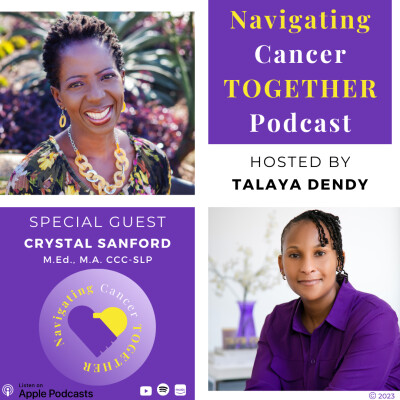
Hello, everyone. This is Talaya Dendy. from ontheotherside.life, and you're listening to the Navigating Cancer Together podcast, the show that has something for everyone facing cancer. Why? Because everyone is different. We're different needs, beliefs, and perspectives. Thank you for joining us for this episode. I encourage you to open your minds and your hearts. Today, our very special guest is Crystal Sanford. Crystal wears many hats, including special education advocate, speech pathologist, entrepreneur, author, and cancer survivor. In 2014, Crystal was diagnosed with multiple myeloma. It is a rare blood cancer impacting the bone marrow. Now, Crystal is a two-time cancer survivor with a passion for empowering everyone to thrive in the midst of life's challenges. Crystal, thank you so much for joining us today and welcome.
- Crystal Sanford_Guest
Thank you so much for having me. It really is an honor and I appreciate this opportunity.
- Talaya Dendy_Host
Thank you, Crystal. You have been diagnosed with multiple myeloma twice. Please tell us how you learned that you had multiple myeloma.
- Crystal Sanford_Guest
It was a very interesting circumstance and a course of events. I was newly married and my husband had a financial planner. And she was very on top of things. And she wanted us to update some things in one of our policies. And it required lab tests just to make sure that both my husband and I were healthy. And surprisingly, my tests came back abnormal, which was a real shock because I felt like a very healthy person. And I was only 39 years old at the time. So I had to then contact my doctor who said, oh, it's probably nothing. Probably was poor lab testing and such things. So. She retested me and this was around the Christmas holiday. So it was a little more challenging, but we did that. In January, 2014, the results came back that truly it was abnormal and truly there was something going on. And by the end of the month, the diagnosis was multiple myeloma. So really a surprise. Again, a fairly healthy person, fairly healthy weight and never had any such thing, nor was at least this kind of cancer in my family. It was a bit of a surprise.
- Talaya Dendy_Host
I can only imagine. It sounds like you didn't have any symptoms at all. You just went in for this test and that's when you learn that, hey, there's something going on.
- Crystal Sanford_Guest
I was fairly young and our kids were infants and I was tired. They asked, are you tired? I'm like, yeah, I'm tired because I've got an 18 month old, of course. But that was it. I would have never had any suspicion of anything else going on. So thankfully when they caught it, it was stage zero. They said that it was just ruminating in there. And that was in January. By October, it did become active.
- Talaya Dendy_Host
That's a blessing that they were able to catch it so early. Crystal, what was your treatment regimen?
- Crystal Sanford_Guest
Initially, because it was stage zero, they wanted me to start treatments. I chose not to initially because, again, I had no symptoms. It was really hard to wrap my brain around starting treatments at that time. So we did other things such as I went to a completely organic diet and tried more and just did as many things as I could, changed my eating habits and such. But then in October, because in addition to the myeloma, kind of a side effect was this like hemophilia situation. I had a tooth extraction that would not stop bleeding. So they said, Crystal, you've got it. take something here because it's all related to that cancer. So I did and began to take injections weekly and some other pills and such. Things began to turn around. And they told me that because of my age, because of my not having any other health issues, that having a stem cell transplant was the way to go. I began to get prepped for that and taking medications and shots and stuff to prepare my body for this stem cell transplant, which I had in 2015.
- Talaya Dendy_Host
Thank you for sharing that, Crystal. Multiple myeloma impacts Black and African-American communities more than others. Do you believe that there is enough education and awareness around this form of cancer? And if you could please share with us where people could go to learn more information about it?
- Crystal Sanford_Guest
Yes, great question. And you're right. And I found that out myself and doing the research once I was diagnosed is that myeloma Yeah. It's typically a disease of those who are older, usually people in their 50s, 60s, 70s, and it does more often impact the African-American community. I do not believe there is enough awareness out there around that. And I think that more could be done to help identify potential signs and markers and such things so that people aren't getting diagnosed later on once the cancer has started doing some damage. There is, I believe it's multiplemyeloma.org or myeloma.org. It's an organization that does do some training and they actually do some targeted support groups to support two African-Americans who have multiple myeloma. So that is one entity that is trying to make some change there.
- Talaya Dendy_Host
Wonderful. Crystal, did you happen to go to a support group at all?
- Crystal Sanford_Guest
I did. I was hesitant because I don't know, I think in my head when I thought support group, I thought, oh, it's going to be a bunch of people sitting around feeling sad and sorry. I was trying so much not to feel that way and to believe the best and be hopeful throughout my journey. But I did end up going, ended up a local multiple myeloma group in my county I found, and they were great. And it was a space at least where I could meet people who understood the journey, the treatment. I could ask them about the transplant. Many of them had one as well. So it was helpful. I would say to anybody, a cancer group of some sort, especially one that focuses on trying to be positive and supportive. supportive can really be helpful in this journey.
- Talaya Dendy_Host
Crystal, how did you learn about the group? Did your healthcare team tell you or just did the research yourself?
- Crystal Sanford_Guest
They actually did tell me, which was great. Once I started going to hematologist, oncologist, they didn't tell me per se, but they had flyers up. They had flyers up all around in the clinic there. And one of them was about a group just for myeloma. So I thought, wow. And I teetered about the idea in my mind for some months, but I didn't end up going. So I was glad that I saw that flyer.
- Talaya Dendy_Host
I'm so glad that they had that information readily available and you were able to get some value out of the group. That's very good to hear. Crystal, you mentioned that when you were diagnosed, you had young children. You had been married a few years. How did your diagnosis impact your family and your career?
- Crystal Sanford_Guest
Yeah, that is a great question. So many things. I had to kind of stop. I had to stop work. I was working in a public school system at that time, and I had to be able to take treatments that caused me to be immune compromised and not be able to work. So I had to stop working. I had to share with my colleagues at work and family and such. It was just amazing, the outpouring of support that I received. Both times when I had the transplant. It was just amazing to see people wanting to help. And I tell people. People did my laundry, people that I barely even knew that were like a part of our church or people from work and such. And people took my kids to places because that was so important for me to be able to have my kids feel like life could still go on. Things were fairly normal as much as possible. So people took my kids to Halloween and places and that was really important. And so it was. amazing to see that outpouring. It was hard to share and to reach out. I remember the day when I had to tell my principal at the school and he was crying. I was crying. It was hard to reach out, but I'm glad I did because you need that. You need people. You really cannot go through this journey successfully by yourself. I'd encourage anybody that if you're concerned about being a burden or something, people want to help. If you just let them know what to do, they really do want to help.
- Talaya Dendy_Host
That's a blessing, Crystal, because a lot of times or sometimes I should say people are not so lucky and they have challenges at work and things like that. But when you get that support right away and often, it just makes the cancer journey so much easier because it's one less thing for you to worry about.
- Crystal Sanford_Guest
Yeah, I totally agree. You're right. There's so much on your plate. You're trying to think about medications and appointments and how your body's feeling. and trying to get up every morning. So yeah, any of those things can be taken off your plate, even a few. It's just super helpful. I used these online platforms when I went through both times and a platform where you can put in there the tasks that you need done and people can sign up for a task. And so it's super convenient because people say, oh, I want to help. But this way, they can see specifically what they can do. Bring a meal. walk the dog, whatever, and then sign up and help. So that was really helpful.
- Talaya Dendy_Host
That's wonderful. And that makes the communication piece so much easier because you're not having to tell four or five or six different people the same thing over and over. So they can just go to the app and say, hey, this is what Crystal needs help with. I'll sign up for that. And you can go on and focus on something else.
- Crystal Sanford_Guest
That's exactly what I found to be true is that It was like trying to tell one person the same, like you said, telling that story over and over again. Man, that just made it so much easier to have that app. And I could also tell them about my journey because then people want to know, how are you doing? So that's another, having to have conversations and telling the same story over and over. So I could post on there. I would remember sitting in the chemo room and I would post about this. Is that what's happening today? Is sound feeling? And so people felt connected. with you along the journey too, because everybody can't be in there, especially the second time around. It was in the middle of COVID 2020 when cancer came back, nobody could go with me to treatments. Nobody could even go with me to the transplant. So that was a way where I could stay connected.
- Talaya Dendy_Host
Crystal, speaking of having cancer the second time around, what has changed regarding your mindset since your first cancer diagnosis?
- Crystal Sanford_Guest
It's interesting because living with multiple myeloma, it is... What doctors will say, it is becoming a kind of cancer that is like hypertension, like diabetes, or like high cholesterol or high blood pressure, where it's just something you're going to live with and manage. So it's not like cancers where there is a tumor and they resect the tumor and you move on the rest of your life and you live 20 years without it. Myeloma, it's looming all the time. And so we're either We're always on some kind of medication for the rest of our lives. And often it comes back. It'd be a year. It came back in 18 months. Some people, it hasn't come back in 18 years, but the potential is there. So I had to wrestle with that. I had to wrestle with the idea of how do I live my life every day and put one foot in front of the other and focus on my kids and all the things that I was doing and not let cancer be looming to the point that I couldn't function. And I feel like I finally got to that place before the cancer returned. Fortunately, I don't know. It just seemed like it was serendipitous. But I finally said, you know what? It is what it is. I can get hit by a car, anything. I can't just be sitting around waiting for cancer to come back or worry about it. And I tell you, when I got to that place, it was six months almost exactly to the point where the doctor said, hey, your results came back abnormal. We think cancer might be back again.
- Talaya Dendy_Host
Wow. Wow.
- Crystal Sanford_Guest
And it was the same thing. It was crazy because it was around December again, and it was January 2020, where I came back with after another biopsy and everything just to confirm that it was myeloma again. But at that point, this time I was like, then it is what it is. I can get another transplant. I've come through it once. I can come through it again. My kids were older relatively. So I felt at least they weren't infants. I felt a little bit better at that. And I had hope. I had hope. I think coming through it the first time gave me hope to know, you know what, if it comes back two, three, four times, I'm going to be okay. I'm going to beat this thing and it's going to be all right.
- Talaya Dendy_Host
I love that mindset. And it's so important because a lot of times we hear the word cancer and we think, oh, wow, I'm going to die. But we have more survivors now than ever. It's very important, like you said, to learn how to live with it. Try not to take that on right away. Oh, I'm going to die because that just makes it so much harder. I think just focusing on living and how to live your best will make things a lot easier.
- Crystal Sanford_Guest
Definitely. And that is really what I have tried to do in the face of cancer, living the life and thriving as much as I can. I think that is my goal.
- Talaya Dendy_Host
Yes, absolutely. Christo, I do have a question. So when the cancer came back the second time, did they use the same treatment regimen as before, or do they have to keep changing the treatment when it comes back?
- Crystal Sanford_Guest
With myeloma, you have the option of having a stem cell transplant twice, which has shown that twice is as many times as that can work and be successful. So I did know that they had harvested enough stales, we could do another transplant. And that is what they did. But so far as the medication for maintenance, I'm on a different medication this time for the maintenance.
- Talaya Dendy_Host
Okay. Thank you for sharing that. That was just something that I thought about knowing that it's something that returns. I would think each time the treatment would have to change or get more aggressive.
- Crystal Sanford_Guest
Yeah, definitely. The doctors have said, now, if it comes back again, I wouldn't have another option for a transplant, but there are so many new medications that are coming on the market and are out now that I've never had. There's many other options out there.
- Talaya Dendy_Host
Crystal, what have you learned from cancer? I know you touched on like mindset, learning to live despite having cancer. Is there anything else that you want to share about what you've learned?
- Crystal Sanford_Guest
I think I've learned to take one day at a time. And I have been a person that loves to plan. And I love to think about five years now, 10 years now, next week, next month. And so I have learned to dial that back and try to really be present. each moment. And I still do make long-term choices and such things, but trying to really enjoy and celebrate the now has been another thing that I've learned.
- Talaya Dendy_Host
Absolutely. It just makes life, I think, more enjoyable because like you, I'm a planner too, but boy, when cancer showed up, it definitely has a plan of its own. And during that time, especially during treatment, you can only plan out so far, a couple of days.
- Crystal Sanford_Guest
because you just don't know how you're going to be feeling from one day to the next or appointments and all the things.
- Talaya Dendy_Host
Crystal, what advice would you give to those at the beginning of their cancer journey?
- Crystal Sanford_Guest
I would say, look, do not go Googling multiple myeloma and going down the rabbit hole of life expectancy. Yes, make yourself aware, be a student, learn about your own body and health and such things, but don't give in to fear. Do not. One of the things I learned early on was in reading books and stuff was People who lived and thrived and who had cancer had a mindset of, I'm going to live. And so you've got to keep that mindset. I'm going to live. I'm going to beat this. This is not going to take me down. So as much as you can keep that mindset, and even if that means keeping a small circle of people around you who believe the same thing, especially in the early times, that might be necessary because people hear cancer and they think the same thing. Oh, she's going to die. So you've got to do as much as you can. To keep that mindset, stay strong and be, like I said, a student of your body and yourself. Take notes, take a notebook with you to these appointments. Write down the questions that you have so that you can ask them to the doctor. Really stay aware and be actively engaged instead of people just doing treatment to you. You really being a part of that team.
- Talaya Dendy_Host
I agree, Crystal. Thank you so much. Great advice. All the things that you've just mentioned are so critical. And I just want to kind of piggyback on what you said about, even if it has to be a small circle, that is okay, because you want those positive people around you that believe in you, the choices you're making, and they're in alignment with your beliefs. It makes a huge difference.
- Crystal Sanford_Guest
Yeah, definitely does. We are the company that we keep, right? In so many ways. And this is also one of those times where, you know, having people that. are believing and supportive. And like you said, we'll honor your choices because everybody won't honor your choice. Some people will say, you should do this. You should, everybody's going to have an opinion for you. Everybody's going to want to tell you X, Y, Z to do, but you've got to do what you know is best for you and keep that circle of people who honor, honor you as you make your choices.
- Talaya Dendy_Host
Crystal, what helped you the most during your cancer treatment?
- Crystal Sanford_Guest
Wow. Eating when I felt good was helpful. because you don't always feel good. So finding things and ways to eat, moving when you feel good enough to move and walking and getting out in the fresh air. It was nice when I had the treatment of the stem cell transplant is that you have to go and live at the hospital basically for two to three weeks, four weeks, depending on how long. My husband, the first time was able to go with me and I had this little cottages. You could stay there and recover. So we would go out and walk. and just go walk around as much as I could and get the fresh air. That really was just rejuvenating.
- Talaya Dendy_Host
I love walking too. It just does something. It clears your mind. And especially if you're able to go and hear nature, the birds, all of those things, just the sun itself, it can make a huge difference. Crystal, you believe thriving is possible in the face of a cancer diagnosis.
- Crystal Sanford_Guest
Please share more of your thoughts with us about thriving during a cancer diagnosis. As much as it may sound hard to believe, I do believe thriving is possible. I think thriving in the midst of any kind of challenge is possible. If you think about people who have gone, there are so many different kinds of challenges, being homeless and losing parents at a young age, all these things. I feel like just like. those challenges thriving in the midst of cancer is possible. If you believe it is, if you believe it is, if you have a network of people that help support and believe that, then yes, it is possible. I would say I am a walking evidence of that.
- Talaya Dendy_Host
Amen to that. Yes, you are. Crystal, one thing I wanted to touch on was faith and spirituality. Did those things play a part in your cancer journey? And if so, how did they help you?
- Crystal Sanford_Guest
Yes. Faith has always been a big part of my life as an adult. Like the support from our church that we were at both times was super helpful. People who were connected to us, it just, it was very helpful. And people would pray for us. That is our faith. Just believing, believing that there is a purpose. And I'm a big proponent of this. So I say I'm always about everybody thriving. That there is a purpose for me while I was born. And that just wasn't finished yet. I believe there was just more work for me to do. I believe that everybody is uniquely designed to do some things on this planet. And I just believed that my work wasn't done. And so my faith just kept me strong enough to come through it because I knew that there was just more people for me to influence and help and support and more work for me to do. Yeah, my faith in God was paramount during this time.
- Talaya Dendy_Host
I agree with that, Crystal, that we're all here for a purpose and we each have our own assignments and work to do. On that note, please tell us about your organization, Sanford Autism Advocacy Group, LLC. You also have a podcast called Thriving Special Families. Please tell us more about that.
- Crystal Sanford_Guest
Thank you for asking. During the time of the first diagnosis, within six months of that time, My father passed away unexpectedly, and my oldest daughter was identified as autistic. I had been a speech pathologist. I was very familiar with kids on the spectrum. I actually suspected it before anybody else did. But to have the diagnosis come was a relief. But then I also started seeing how there just were not enough supports out there for families. A couple of years later, I started my business. So now it's been six years, and we offer support to families, primarily with kids like mine. on the autism spectrum and knowledge and empowerment to families and knowing about special education and how to navigate that. Nobody tells parents what to do when they get a diagnosis. What happens at school? What supports can they get? Nobody does that. So we do that in our company. And it's just been an honor to support fellow families along the way, which was something that I've realized, hey, this is one of the things I've been called to do. So it's really been an honor to support families in that way.
- Talaya Dendy_Host
That's wonderful. When families come to your organization, what... are you seeing that changes right away for them when you're offering your support and your guidance?
- Crystal Sanford_Guest
We've had so many parents just in tears. Honestly, we had this last week was in tears because we really are huge on parent empowerment, parent education, and honoring what parents are doing. It's tough out there being a parent anyway, these days, much less a parent of a child with needs whose brain operates differently. And so And we celebrate parents and say, hey, we always, we never leave a parent without saying, and I've trained all my staff to say this, you're doing an amazing job. Kudos to you. You're an amazing parent. You're doing all the right things, the best you can with what you have. And I mean, I just tell you, people who just cry, who just feel so, finally, thank you. Nobody tells me that. I feel so inadequate. And so to help them feel like they can do this and it's going to be okay, boy, that means so much.
- Talaya Dendy_Host
Yes. Have you come across parents who feel like shame or guilt and how do you support them and help them work through that?
- Crystal Sanford_Guest
I do. I have this conversation with my husband a lot because it hurts my heart to hear sometimes the things that parents say just out of ignorance or like you said, out of shame or guilt. And so again, we always want to educate parents that autism is not your fault or your spouse's fault or whatever. It is just a different way that your brain works for whatever reason. I'm not going to try to get into where it came from, but what we can do is support you and show you that your child can thrive. Your child, autism or not, can do great things and be an amazing human. That is sometimes a mind shift that we're helping parents to make.
- Talaya Dendy_Host
That's a very important mind shift, because if you can just let go of what happened, why, and just focus on how to really support your child and help them develop into the best person and adult that they can be, that's all you can really do is just be there and show up for your child, but take the blame out.
- Crystal Sanford_Guest
Yeah, and that is exactly where we try to focus on, focusing our energy on the things that we can control. Autism is here. We can't control that, but we can control how we respond, how we parent our kid, what resources they get, and just doing the part that we can do.
- Talaya Dendy_Host
Thank you for telling us more about Sanford Autism Advocacy Group. Please tell the audience where they can find you.
- Crystal Sanford_Guest
Definitely. So if there's parents who are like myself, parenting a child on the autism spectrum, if you have any questions or need any help, especially if you're located in the California area, you can reach out at our website, which is... SD like San Diego autism help.com. So SD autism help.com. You can find us on YouTube. Our previous podcast had a visual podcast, so you can check out our videos on YouTube and you can find that at thriving special families. You can also check out the podcast version. of that and thriving autism families, wherever you find podcasts. And then you can always email us at info, I N F O at SD autism help.com.
- Talaya Dendy_Host
Thank you for sharing that crystal. I will include that in the lesson notes as well so that the audience can easily find you.
- Crystal Sanford_Guest
Awesome.
- Talaya Dendy_Host
Before we end today, I like to ask my guests two questions. The first one is. what is something that people often misunderstand about you?
- Crystal Sanford_Guest
Understand about me? Wow, what an interesting question. I often say that as much as I love working with kids on the spectrum and autism is my jam, I think a piece of it is because I relate and that sometimes socially I am direct. And so maybe people might take it the wrong way, but it's just that I want to learn more about people sometimes in the context, or I want to share some ideas that I have that might be helpful for them. So yeah, maybe that's misunderstood.
- Talaya Dendy_Host
Okay, wonderful. Thank you so much for sharing that. The second question is, if you could live anywhere in the world, where would it be and why?
- Crystal Sanford_Guest
I tell you what, it is hard to beat Southern California. I don't know. If I could live in Southern California and not pay what I pay.
- Talaya Dendy_Host
Yes, yes.
- Crystal Sanford_Guest
The ideal. I like the weather here and the for good or for worse, people are very inclusive. Everybody is welcome. And I like that no matter race or whatever. So yeah, I like it here. I like Mexican food too. So I like living near Southern California for the tacos. I don't know. I've been Southern California born and raised and I've been many places, but I guess I'm just spoiled.
- Talaya Dendy_Host
Yes, I hear. California is beautiful, especially San Diego. I've only been to San Francisco and I thought that was beautiful. So yes, I can understand why. Thank you, Crystal, so much for sharing a little bit more about yourself. Before we end, is there anything else, Crystal, that you would like to share with the audience?
- Crystal Sanford_Guest
I would just say if there's any... One who's listening, who is new to cancer, I just hope that they would leave this interview being encouraged. I hope that they would know that there is hope and that they don't have to have everything figured out immediately, but that there is hope and that no matter how bleak their situation might look or they might feel that they're not alone.
- Talaya Dendy_Host
Thank you so much for joining us today. It was such a pleasure talking with you, learning more about the Sanford Group and all the work that you're doing, as well as supporting families with autism. It has been such a pleasure and an honor, Crystal.
- Crystal Sanford_Guest
Oh, same here. Thanks so much for having me on the show.
- Talaya Dendy_Host
My pleasure. Before we end today, I would like to give a shout out to the listeners. Thank you so much for joining us today. If you enjoyed this episode, please share, follow, or subscribe so that you can easily find my podcast and listen again. That is it for this Wednesday. And until next time, let's keep navigating cancer together. Take care.
- Crystal Sanford_Guest
Thanks for listening to this episode of Navigating Cancer TOGETHER. I hope you enjoyed it. Please be sure to subscribe. And if you enjoyed the show, please share or tell your friends and family about it.
- Talaya Dendy_Host
For notes from the show and previous episodes, visit ontheotherside.life and check out the podcast section. I would love it if you joined us for the next episode. Talk to you soon.