Description
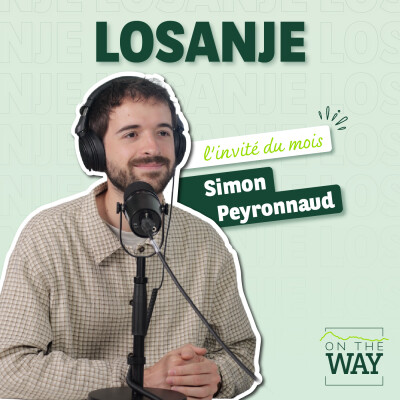
In this new episode of the On The Way podcast, Simon Pernot, co-founder of Losanje, looks back on his journey and shares his vision of a more circular fashion.
What if the solution was to no longer produce material at all? This is the challenge that Simon and his partner Mathieu took up by launching Losanje, an industrial startup that industrializes upcycling. The principle: recover existing clothes, cut the pieces and reassemble them to create a new, higher-value product. As a result, an upcycled garment saves up to 95% of CO₂ emissions compared to a new product, which is ten times less for a simple T-shirt.
In this episode, Simon tells us how this idea came about. Friends since middle school, he and Mathieu set out at the end of their studies, in the middle of lockdown, after a thesis that revealed to Simon the real extent of the environmental impact of fashion.
Their conviction: to offer the ecological impact of second-hand with the experience of buying new in several sizes, several colors.
He also explains why the real challenge was not to seduce, but to industrialize. The entire textile industry is designed to cut from rolls of new fabric, not from existing clothing. After two rounds of fundraising and the development of an automated cutting line, Losanje now manufactures more than 150,000 pieces per year and works with fashion brands (Faguo, Cézanne) as well as with large companies (SNCF, La Poste, or the Olympic Games).
Proof that the model works? The upcycled T-shirt made for Faguo is sold at the same price as a classic T-shirt.
An inspiring conversation about industrial innovation, circular fashion and more sober consumption without sacrificing style or price.
👉 Learn more about Losange: https://www.losanje.com
The previous episode of On The Way with Jessica Mercuriali, co-founder of Pawa Energy, as well as all the other episodes, are available on your usual listening platforms.
Happy listening!
Hébergé par Ausha. Visitez ausha.co/politique-de-confidentialite pour plus d'informations.