- Speaker #0
Artificial intelligence in oncology is booming. We have public programs, private partnerships, and massive volumes of data. China is closely observing European research. Natalie Lasso tells us more about it. She says she is particularly impressed by the commitment of the Gustav Rusi Institute, but cutting-edge research does not necessarily guarantee patient access. The patient caught between academic excellence and industrial deployment. remains in a fragile position. The situation is still precarious. This is the gap I invite you to look at today. If these topics interest you, feel free to subscribe to follow the entire series.
- Speaker #1
So we no longer work in silos when it comes to imaging. We do liquid biopsies and imaging. It's also useful for all pharmaceutical companies. Now everyone is joining in.
- Speaker #0
How did you first get started in the fields of liquid biopsy and AI? Is there a formula?
- Speaker #1
It's true that at this year's Chicago conference, we proved we're actually the first in the world to do this. We're real pioneers. We presented a study of 1,000 patients and 55,000 metastases. A Chinese man in the room said, that's impossible. You didn't do that. It's impossible to do that. How did you manage to get French people to work together? It was an artificial intelligence lab at Central Suppilic, the CVN, and also Okin, with whom I worked. Then I told them, we're going to do a study, and I would like to use each of your technologies, which were different. One of them was working on machine. learning. So in deep learning, I told them it's a bet. May the best one win. We'll take the best technology and use it.
- Speaker #0
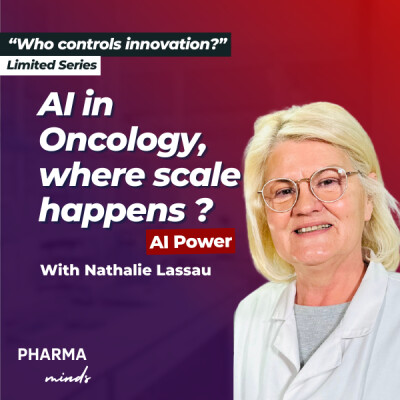
Hello, everyone. Today, I am joined here by Professor Nathalie Lassau. She is a highly distinguished expert in the specialized care of cancer patients and a radiologist currently practicing at the Institute. Gustave Roussy, a professor, PUPH at the University of Saclay and also a researcher. So I am delighted to be with you today Nathalie Hello. Hello. It is nice to meet you. Thank you for the warm welcome. The reason I came to the Gustave Roussy Institute today to have this conversation is because you have a fascinating background, an incredible career, but also a truly unique personality. And we're really going to try to understand that. Maybe we can start by introducing this place, the Gustave Roussy Institute. So the Gustave Roussy Institute is a truly incredible place. And in the end, it draws people in. That's how I found myself. incredibly attracted to it.
- Speaker #1
Once I fell into the pot, I just never managed to get back out. That's the story of Gustave Roussy. It's a place of genuine passion, of vocation, of wonderful exchanges with patients that makes you never want to leave. Especially in oncology, you form a very strong bond. And that's why I love it. Ultrasound, I'm not from the CT or MRI side. That's how I was also hired at Gustave as an ultrasound specialist. I was really immersed in it. And for me, it was through research that I managed. I knew it. So I had to innovate. As a result, I invented some patents. These were bought by Toshiba, for example, which made me known worldwide and established my reputation. I love being a pioneer in what I do. We've just filed another patent with Gerbit. I really like being a pioneer, being the first demonstrating things and then passing them on, spreading them so that they benefit patients. And it is definitely true that I have this drive to discover new things, to prove things that we might have suspected. but that hadn't yet been demonstrated and I absolutely love that.
- Speaker #0
If I look back at the stories about Doppler ultrasound, there's still this fundamental aspect taking on topics no matter what they are. It's about cancer, ultimately looking for things and staying curious, but as a result not necessarily doing what everyone else does or what's most trendy right now.
- Speaker #1
Yes, it's about moving into innovation, that's for sure. It's true that I'm I'm vice president for innovation and all that. It's really about innovating. innovating in imaging or innovating for the patient, innovating with oncologists, with new drugs. I had worked a lot with pharmaceutical companies. So it's about seeking different topics and combining them because medicine is very compartmentalized and siloed. You have radiologists on one side, oncologists on the other. Early on, I worked closely with oncologists, sometimes even more than with radiologists, because you had to understand their issues. Obviously, what did they need for their patients? A tool that would allow in early stage trials. to know whether a drug was working or not. So I thought, okay, I'm going to develop my technique that will help the oncologist determine when a pharmaceutical company proposes a new drug, whether we can quickly know if it works or not. That was it. It's a very maybe practical approach as well. Pragmatic, you've got it exactly right.
- Speaker #0
It is not something that is driven by the expectations of other people. It is really just more about being basic. That's exactly it. Every time I talk to my young colleagues, I always tell them, okay, what is the question being asked? We do a study at the end, we publish and we deliver a result that allows us to better monitor patients,
- Speaker #1
better select patients or better assist them. We need something concrete for the patients. That is to say, there are so many beautiful publications with little significant p-values, but the oncologist can't do anything with them. What I want every time is to say, okay, we're doing research, but afterwards, It has to be usable in routine practice for patients. That's it. And that the end of the road is always complicated. We realized that in research, a lot of things are developed, but they remain pending and are never applied. And the end, which is always hard, ultimately to, can we use it? Can we implement it routinely for patients? It's always hard at the end. It's complicated. And that's the hardest part. And that's the strength and value of what you do and what is recognized.
- Speaker #0
Why does it come to an end too soon?
- Speaker #1
Because it's hard to implement at the end. People stop right after they finish. No, you must see things through to the end. You have to go all the way for the patient. You have to put yourself in the clinician's or the patient's shoes and say, okay, what I'm developing could change the doctor's life or the patient's life, and how can I change it? It's in their hands or all the doctors now. Exactly, exactly, exactly. And we realize that there are a lot of things that have been published that never made it to the end. So maybe it's because people don't have that tenacity to see things through to the end in some way. Do you have concrete examples? I don't know. A publication where you say, actually, I could have stopped there, but no, I kept going. Yes, for example, the technique I invented. You could say, okay, great, I filed a patent, it got bought. No, the idea was to say it has to be used, it has to be included in the guidelines. The next step, after I had done, I don't know, four or five studies, go right to the guideline. Yes, that's it, the recognition. You say, okay, this is the global reference used in various contexts. I had done several single center studies and could have said that's enough. They're in my publications. But no, I told myself, for it to be truly recognized, it's essential to have a multi-center study. I went to see INCA when there were major calls for proposals. I responded to a major call for 1.5 million euros. I brought together 19 teams in France from cancer centers, university hospitals, and so on. I told them I'd invented a technique, but we had to prove it works beyond Gustave Roussy, across France with residents, professors, and department heads. We conducted a large study on 500 patients, followed for six years, and we demonstrated the relevance of the tool that it helped to predict the effectiveness of drugs that destroy blood vessels. We validated a biomarker because we correlated it with survival. And afterwards it was referenced in a nature review clinical oncology, and it's included in the international ultrasound guidelines. So it was really, this is truly, I search, I find, and I apply. So it took quite a long time to develop. because the original patent dates all the way back to 2005 and the multicenter publications, all of that came out in 2015. So it took 10 years. That's when it gets tough. So at that point, you can't give up. First, you have to demonstrate proof of concept on a phantom, then do small studies on mice, monocentric studies on patients, the multicenter study, and then convince Toshiba. And now on ultrasound machines all over the world, my technique is implemented on the devices.
- Speaker #0
All right.
- Speaker #1
There you go. You can use it. All right.
- Speaker #0
And the manufacturer, when did they come into the picture? At what point, right from the very beginning, Canon?
- Speaker #1
Canon got involved pretty quickly. Well, it was Toshiba and now it's Canon. But back then it was Toshiba. So I was with Pierre Perronneau, the inventor of Doppler, and I had told him my idea and everything. And I had gone to present my first work. And at the time, actually, we were doing quantification with Photoshop. I don't know if you ever experienced that. I think you're not too young, but it was, you know, quantifying images with Photoshop. I presented it in the United States. It was a great study I had done on sarcomas, evaluating glyphosate, which had just come out from Superdrug Revolutionary and all that. And so I was quantifying my contrast echoes with Photoshop. I presented this at RSNA and there I got myself into a mess. It was a radiologist from MD Anderson back in Houston, someone who really tore me apart. He said to me, how can you propose quantification with Photoshop? I was completely, I wanted to cry, basically. It was done on 50 patients with sarcomas. I thought, I might as well just go home. I went to see Pierre Perronon, and he said, OK, Nathalie, we need the raw linear data from the manufacturers. So then we went to see every ultrasound manufacturer like GE and Shimatsu. And there we said, look, we want the raw linear data because we need to do real quantification. We can't just use Photoshop. So then... Most of the manufacturers said, no, no, that's classified. We don't give out the raw data. It's secret, except for the Japanese Toshiba, who agreed. It was a gamble, so they brought me to Japan. I explained everything and they said, OK, let's sign the contracts. All right, we'll give you the raw data. And from that, we were able to create the patent. So they followed us. They followed me all around the world. They gave me access. And to tell you, it took a long time. For example, just five years ago, all of a sudden, they announced at the big Congress in Chicago, that's it, we are giving access to the raw linear data. That was 15 years after what we had requested. But so we had managed to convince the Japanese. And for me, the Japanese, everyone says it's hard to work with them. It's hard to convince them. But the day it's okay. When you sign the deal, they're really funny and they stick with you. Their loyalty is absolutely unwavering. So it was hard to convince them. But after that, they've always been there. And they're still with us today. I've always, right now, I'm still a reference in ultrasound. And so is Gustav. I have machines on loan. I have a full-time engineer who's been paid for 10 years. And I keep publishing a lot. I work a lot. So there you have it. It's a partnership that's lasted. It's incredible. It's a really beautiful story of a partnership with industrialists who are straightforward, reliable, and loyal. The Japanese, it's true that they don't play tricks. That's...
- Speaker #0
That's not the case with everyone.
- Speaker #1
I now work with other industrial partners and it's true that at first I was criticized in radiology because they didn't understand. They said you have to work with everyone. I said no, if you're doing research very early stage and pioneering and if you really want to do R&D, you can't work with all the industrial partners. You have to make a choice. Afterwards you can't pick the wrong horse. You have to tell yourself it's the right industrial partner and all that. But in this case you can't do... Now I do more things with other industrial partners but on different topics. I always make sure to have a well-defined scope so there's no overlap because otherwise you ruin everything. And that's also the advantage of working at Gustav, having the possibility to work with all the industrial partners because it's also a research accelerator.
- Speaker #0
Yes, it took 10 years but without them you would have done nothing. Well you...
- Speaker #1
Yes, I wouldn't have filed my model after that and so what, nothing really. I'd just be planting cabbages.
- Speaker #0
So indeed it's... No, but that's it. So in the end in PharmaMind... it's essentially personalities who make up the pharma world. So it's inevitably people who actually see the final stages of innovations when they arrive, either on the market or when they're about to arrive. But as a result, it's interesting to have something that's really upstream and to say to yourself, sometimes, yes, it's a gamble. It's a gamble. Afterwards, I've had one or two things that didn't work out or that I stopped. Yes, there's that, which I just picked up again. For example, there's molecular imaging with ultrasound.
- Speaker #1
I filed a patent with some Americans. That was in 2003. I realized I wouldn't be able to do it. It cost too much money. My boss told me, we won't be able to make it. Yet I had raised the money and everything from the region, but I just couldn't do it. I stopped for a moment and put it aside, but it was still on my mind. It's molecular imaging. And then all of a sudden we managed to convince an industry partner because I'm more visible now. And so now we're going to do a phase one trial with patients. There you go. It's incredible. with a molecular ultrasound contrast agent that targets receptors. But you have to know when to stop. My boss always told me, Natalie, because he saw that I was still pretty stubborn. He said to me, OK, that's good. But sometimes you have to tell yourself, OK, now you need to stop. You have to cut the branch. Stop. You're wearing yourself out. And then you move on to other things. And maybe you'll come back to it later. And that project, yeah,
- Speaker #0
it was picked up again.
- Speaker #1
It started up again because there were problems. With gadolinium contrast, scanners used radiation. Now we have ultrasound. It's radiation free, infinitely repeatable and cheaper than a PET scan. We finally have the technology, so suddenly it's the right time. It's always like that, the stars must align. And now everything is lining up perfectly. So we're just starting again to see what happens. It's a massive gamble. It has to work. I would be truly happy to have conducted this molecular imaging study using ultrasound because it was something I really cared about at the time, but it was far too innovative, too early, I didn't have enough money. It just wasn't possible. And when the industry did not follow along, you still need the industry. We can do academic research, but in this day and age, you still need the powerful drive from industry and funding from industry. We need all three of these elements. You need power behind it. Something must be pushing from behind or we'll be stranded in the middle of nowhere.
- Speaker #0
That is actually interesting. It's about knowing how to wait.
- Speaker #1
That's something my bosses taught me. Bide your time, know how to wait. Since you have young people doing research with you. You shouldn't set them up for failure on those topics in the end.
- Speaker #0
You think about that?
- Speaker #1
Well, I'm still responsible for my little ones. We do great research, but then they need to find jobs and have a life of passion. And so at that point, I thought I couldn't take them down that path. It was kind of a dead end. So yeah, well, yeah, we're still responsible for the young people. You can't control everything.
- Speaker #0
You can't do it all either. Even if with experience, you can know what's going to happen.
- Speaker #1
It has to be at the right time. It has to be the right people. You have to analyze the ecosystem. You need to have a kind of vision. We can't control everything, never in life. But still.
- Speaker #0
What does that really mean? Mentoring, guiding and leading a research group or students?
- Speaker #1
Well, for me, guiding always means leading a research group. OK, we have our topics. And right now we're working on biomarkers in oncology, predictive prognosis. So I know what could be promising for patients, for oncology, for pharmaceutical companies and for imaging in general. Five or even 10 years gets more complicated. People who project 10 years ahead, I think that's, I like to have something concrete and pragmatic. So 10 years is too far for me. While research or ministers might plan that far ahead, that's not how I operate. Since I like to achieve concrete results beyond five years, it's hard to see anything tangible. I always tell young people I prefer to build my castle with small bricks first. Then I expand and make my first room rather than trying to build the big castle first. You have to be realistic. Even if you're visionary and a pioneer, you have to be realistic. And you always have to in the end, because for young people, we're here to help them fill out their CVs. That's how they're going to find a job. What remains in the end are the publications, patents or publications that catch someone's eye. Basically, that's it. Okay, you have the degrees. But when I look, I pay attention to which internships they've done, where they've been and which team they've worked with. Was the person able to publish? Is their name listed first? Did they keep a good pace in a fairly short time? That's what I focus on. Then after that, the desire to go further, the passion and all that. So as a result of this, the projects I start are things that span over five years. I need to achieve a solid result within five years, or in one year, or in two years, or in three years, but you have to achieve concrete results. So tell me what are the topics? So the topics right now, the themes I've chosen include molecular imaging and molecular ultrasound. That's really the ultrasound part, which is my little baby until the end, and I'll see it through. And then it's everything related to biomarkers, it's tumor burden. So now we're getting into a topic. For more than 20 years we've been explaining to radiologists, so internationally, we have a single rule all together to make sure we're talking about the same thing. That is to say, when we evaluate a patient who has several metastases, we say here is the rule, you will only measure five lesions and that way from one scan to another, no matter where the scan is done, we will measure in the same way. Except that you say, well, it's extremely restrictive. For example, the patient had multiple metastases but you only measure five of them. Up until now, that hasn't been a problem for anyone. Except now, liquid biopsy has arrived. Liquid biopsy, I've been talking about it non-stop, but it's a new tool that's going to revolutionize oncology. Up until now, it's been 10 years, I think even 15 years, that we've been talking about precision medicine. Millions and millions have been invested. Previously, we'd biopsy a patient's lesion, take a sample, examine the cells and say, it's this type of cancer or abnormality. Now we've broken things down quite a bit. For example, lung and breast cancers, all categorized by the genome, except there's a gap in the system. We realize that if you do a biopsy somewhere else on another lesion, you don't necessarily get a good result. You think to yourself, all that for this? So we don't have a comprehensive analysis of the patient. What is a liquid biopsy? You take a blood sample directly from a patient. You detect in the blood the DNA from tumors that are circulating in the bloodstream. So the DNA from all of the patient's metastases, and you collect it, and then you analyze the modifications. So you are much more holistic, much broader. Well, you might say, a CT scan is the same. I'm not going to measure all five of my metastases. Actually, I need to measure everything, what we call the tumor burden. Except here, there's a problem. You've heard about the demographics of radiologists. They say there are fewer and fewer radiologists. A CT scan, when you evaluate a scan, it's one every 10 or 15 minutes at most. Each time that's 2,000 images. That means every 10 or 15 minutes you have 2,000 images and a report to write. By the end of the day your eyes hurt and your head is spinning. And if on top of that you ask radiologists to measure every single lesion, for example, if there are 100 lesions it's impossible to do in 10 minutes. So at that point you realize, okay, if we want to assess this tumor burden, we need to develop AI, artificial intelligence tools. That's just mathematics, so it's being developed. It's a project we've just submitted with Gerbit and we'll get the answer at the end of the week. Probably BPI France, a major source of funding.
- Speaker #0
So what's our vision?
- Speaker #1
So within five years we should be able to produce a platform where you upload a patient scan and automatically an algorithm detects all the patients metastases, segments all of them. and says for example this patient has 200 millimeters of tumor, 200 cubic millimeters or 300 cubic millimeters and we know that this tumor burden before starting treatment is highly prognostic. You can stratify and just now we published an article in the European Journal of Cancer. These are patients with metastatic colon cancer who respond very well to immunotherapy. It's a particular status. These are MSI positive patients so it's a molecular abnormality. Half of patients respond to immunotherapy so double immunotherapy is great. But there's a public health issue. Immunotherapy is expensive, costing 70,000 euros each, so double immunotherapy is 140,000 euros. unlike chemotherapy at 300 euros. Well, now by looking at this significant tumor burden, the number of metastases and everything, we've shown that we are able to stratify to know for whom we should immediately give double immunotherapy. Those with a very poor prognosis versus those for whom a single immunotherapy was enough for them to have a... So that's something concrete. It's for the oncologist. It's a scoring system. They count the number of cubic millimeters, the number of metastases. This small scoring system assesses four parameters for stratification. We did this with an oncologist. a world-leading expert in colon cancer, Professor Thierry André at Saint-Antoine. And we conducted this study together, so it's really concrete. It's tumor research, and I work on this. These are AI tools.
- Speaker #0
Right now,
- Speaker #1
my radiologists are segmenting all the tumors. It takes time for research, but the goal is to have a fully automated platform. Once that's done, and it will be ready before I retire, I am confident it'll work.
- Speaker #0
Okay, good news.
- Speaker #1
And if it happens before, I'll retire. It's exhausting, but truly great research. We are correlating liquid biopsy with imaging, so we're no longer working in silos with imaging alone. We do liquid biopsy and imaging. This will benefit all pharmaceutical companies. Now everyone is joining. So how do you actually bridge the gap between liquid biopsy and AI? How do you integrate these fields together? How do you mix everything? At what point? How do you make it happen? It's true that this year when we presented it at the restaurant in Chicago, actually we are the first in the world to do this. We are real pioneers. Because we presented a study of 1,000 patients, we tagged 55,000 metastases. There was a Chinese man in the room. He stood up and said, that's impossible. You didn't do that. It's impossible to do that. How did you manage to get French people to tag 55,000 metastases? I told them it was extremely important and that I had taken young people for a year of research to do it. At noon after that, it's because for the past 25 to 30 years, I've always had a very close relationship with the oncologists here who are really at the forefront. and they educate me about what's new and everything. They'd alerted me about liquid biopsy. Benjamin Besser said, you'll see it's going to replace the CT scan. I said, what? That's not possible. It will be complimentary, but you're not going to replace the scan. And that's how it started, just by talking. And it's always about having those kinds of exchanges. Actually, that's what's needed, not staying stuck. Maybe it's because very early on, I was involved in research. So as a result from early on, I didn't stay put. I was a radiology intern, so that was my whole thing. And so I had to open up. I think it's because of that research training. So for me, whatever topic I'm given, well, yes, I go for it. I dive in.
- Speaker #0
Okay, so what is it?
- Speaker #1
The topic? What's the problem? Should we involve the stakeholders? Who should we include? It takes mental flexibility and energy to get people working together who have different professions, skills, and objectives. We don't have the same goals, so it requires a certain level of positive energy by saying you have to get people on board, get them on the fast train. But the most beautiful projects right now are those, the ones that break down silos with people who really have different visions, different minds. And it's always people from the hospital, people from research and people from industry. All my projects now always mix these three worlds together.
- Speaker #0
So there's something you truly like, which is bringing together an industry professional, the hospital and research at the same time. Is there a specific project that you are especially proud to have successfully carried out using this exact methodology?
- Speaker #1
Well, I think it will be my best publication and my greatest experience of collective intelligence, even though it was an artificial intelligence project. It was during COVID. You know that at that time all research labs were asked to close except those that were going to work on COVID. I was still a researcher at heart, along with another colleague. Here we were also busy with Gustave because we were receiving all the patients who had COVID. And even afterwards, we were asked to take in patients since the APHP was completely... well, there was a wave, you see, they no longer had enough bids So we were asked to open Gustav as well, to take in non-cancer patients who had COVID. We were overwhelmed, but I still wanted to do research. So a colleague and I decided to study COVID. This allowed us to keep working since it was essential research. Outside regular hours, since we spent our days on Doppler ultrasounds and working in the ICU, then we said to ourselves, OK, what do our patients need? Always the same thing. So we talked with the intensivists and the issue is a patient arrives in the emergency room. In fact, we don't know whether to let them go home or keep them if in 12 hours they'll be in the ICU dead or back at home. So he said, if you can find us a scoring system, something that can tell us whether we should at least keep the patient or send them home. OK, we said to ourselves, OK, since we've started working with artificial intelligence, we said to ourselves, let's use imaging because there was a lot of talk about CT scans. We could see the shading on the scan with the ground glass opacity and all that. We decided to work on AI using the CT scans. We decided not to stay isolated. We reviewed early reports from the Chinese because they published one or two months before us. We decided to collect all clinical, biological and medical history data. We'll collect everything to build a scoring system. At the time, we didn't have a CT scanner running constantly for COVID. But at the APHP Kremlin Bicêtre, my colleagues in the research lab you Franz Belen and the others actually had an entire dedicated CT scanner that was only doing COVID cases. So I told them, well, I would like to do a study with our patients and your patients. That will provide a validation cohort to try to see how we can predict when the patient arrives at the emergency room based on all these parameters, whether they need to be admitted or not. They said to me, OK. Then I said, well, I need to find the best people in AI. So then I went looking of the two teams I worked with. One was from INRIA, an AI lab at Centralis Superlec, the CVN, and then Kin, who I also worked with. And I told them, basically, I told them, well, here's the plan. We'll do a study and I'd like to use both your technologies, which were different. One was in machine learning, so in deep learning. I told them after that, it's a bet. May the best one win. We'll take the best technology and use it. OK, that's a challenge between getting the contract signed with APHP, retrieving the data, which was no small matter, and everything else. Well, let me tell you, in just 10 days, which is unimaginable, we did it. We signed the contracts with APHP, with Aukin, with INRIA, and so on. And I got everyone working. We were 45 people. They put half their lab on it for me. You can check in the publication, which was published in Nature. It's my longest, most major work. Half Aukin on it, 45 total. There are 20 co-authors on my paper. And then everyone got involved. In the end, I told them I need a school for intensive care. So we included 1,000 patients in one month. Every evening at 9 p.m. we went to the Ambicet ward to record all patient data by hand. Honestly, it was true, we did everything ourselves. People were stressed by what was happening in the hospital and the study, but we finished the publication. We sent it to the study, which challenged us to compare our results to 15 others. And there was an amazing methodologist who is the last author. Michael Bloom, you should look him up, he was an incredible guy. And we published a great paper. And in the end, you have a kind of scoring system with a color code. When the patient arrives, you know, with AI, the scan results. And then it was the oxygen saturation level, the platelet count, the duration rate that no one expected, and then age and sex. And with that, you knew, depending on the color and the involvement. So it was a paper with explainability in AI, which is very important. This allowed a doctor to say, OK, this patient is orange-red. I need to keep them, but this one is blue-green. so I don't need to keep them. And that was incredible. And we did that in three months. But it's surreal when you say that. Any industry professional or any laboratory, like if you explain this, they'll say, how did she do that? I told myself, yeah, never again will I do a study with 100 meters between the hospital industry and academia each time. It was possible. It was a bit tough at the beginning, but well, in the end, it produces something magnificent. Magnificent, really. It's the best paper of my entire career. And it was truly an adventure in collective intelligence, more than artificial intelligence. Even though we used AI, it was really collective intelligence. Every time we made a video with everyone, with all the stakeholders, to be sure. All right, so what do you have the data, the stuff? Every evening, we would have a video call with everyone, because I had to keep motivating everyone, the whole team. Those who were locked up at home, but working like crazy, analyzing the scans as well. Those who were collecting the data, those who were on site. It was funny. It was amazing. Very rewarding. a very tough period. For me, I think it was the hardest period of my career as a doctor to lose our patients like that, but at the same time very rewarding. I think it was also a way for us to keep our heads above water and not let ourselves be overwhelmed by what was happening. It was really hard. I was not really afraid to read. Me, I was afraid. I was 55 years old. I was in the age group of people who could die quickly. I could catch it and die. In a week I could be dead. Those are still things that cross your mind. Even if we had the equipment, we were protected, dressed like little astronauts all day. But those are still things that cross your mind. Me, I said it. I was scared.
- Speaker #0
It's true. Thank you. It was very interesting to see the innovations coming out of the research centers. Thank you for this exchange.
- Speaker #1
It was a pleasure meeting you.
- Speaker #0
Goodbye. If Europe excels in AI research, why does access remain unequal? Is it because of regulation, industrial caution, fragmentation of systems? In the next episode, we will address another structural gap. Why are there 100 new drugs already available? In the United States, but not in Europe? And to follow up on this video, I'll be waiting for your comments. In your country, what is the biggest barrier to accessing AI? Is it funding, regulation, or collaboration between industry and academia?
![[EXTRAIT] « On a toujours fait comme ça » : comment faire accepter le changement ? avec Loïc Lagarde cover](https://image.ausha.co/Z4UFs5vNSEorx3y4j2iPdqtldxxZGpWWdDliU0pD_400x400.jpeg)
![[Insights] Produits frontières : transformer la réglementation en avantage stratégique cover](https://image.ausha.co/DxYZ9g83tTEC6Wr39rcUpzpTWcQsUBjd7hU5AZsG_400x400.jpeg)
![[Insights] Groupements de pharmacies : ce qu’il faut retenir du rapport IGF-IGAS, avec Hugues Villey Desmeserets cover](https://image.ausha.co/UgNUSqEle2cZH1rOVklykwyk35Rz2q4seXKVMgWM_400x400.jpeg)